

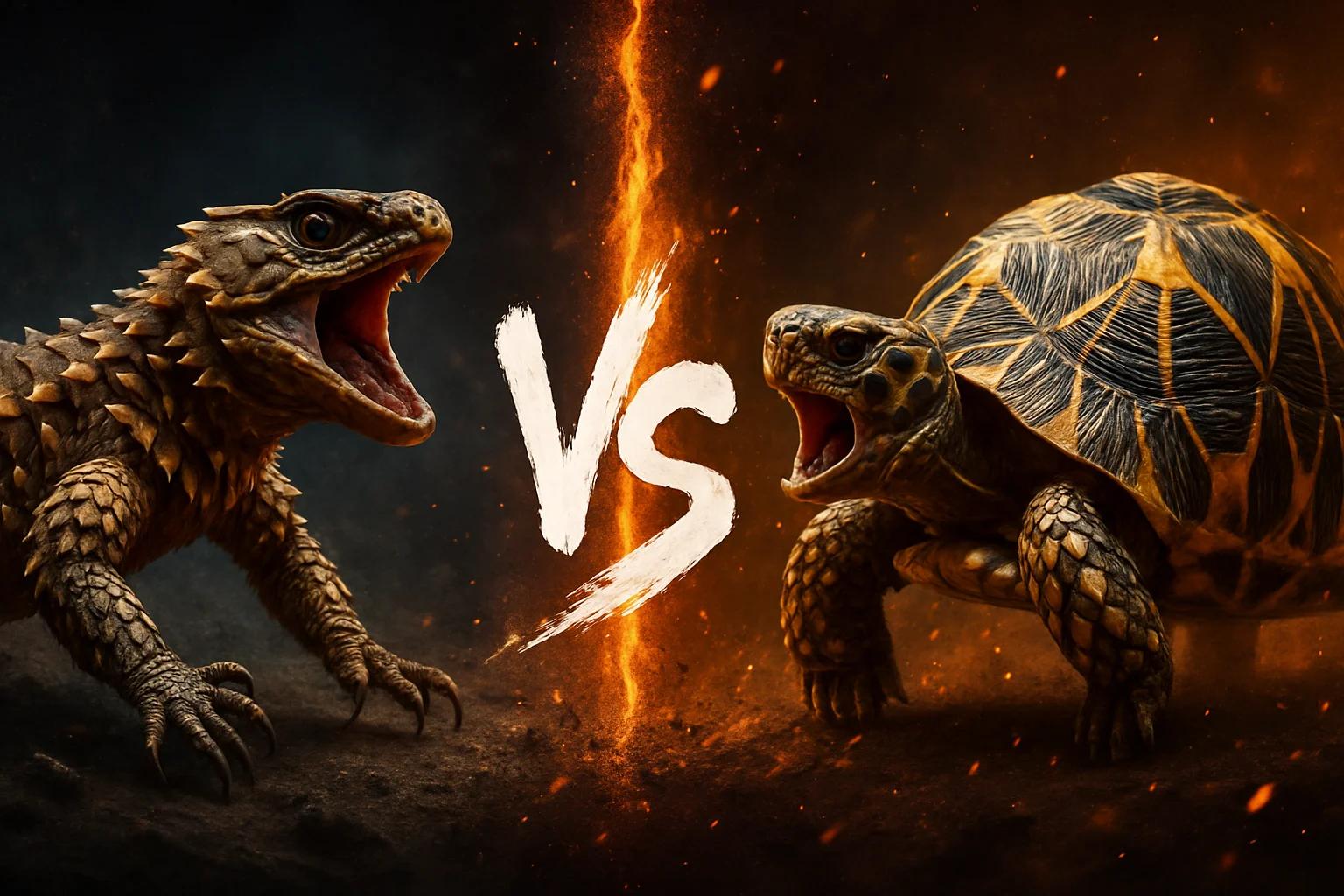
Armadillo Girdled Lizard vs Geometric Tortoise: Who Actually Wins?
Armadillo girdled lizard vs geometric tortoise: two armored South African reptiles compared on defense, mobility, bite, and survival strategy. Here is who wins and why.
Armadillo Girdled Lizard vs Geometric Tortoise
Matchup winner
Armadillo Girdled Lizard
Quick verdict
Start with the direct answer, then use the structured comparison below to see what changes the outcome.
The armadillo girdled lizard wins this matchup, though not by a knockout. Neither reptile can seriously injure the other. The tortoise's domed shell shrugs off a small lizard's bite, and a toothless, plant-eating tortoise has no real weapon against spiny scales. So the contest comes down to who controls the encounter. Here the lizard has the edge. It is faster, more agile, quicker to react, and it has actual jaws and a defensive playbook built for confrontation. That playbook includes gaping, biting, wedging into rock cracks, and its famous tail-in-mouth armored ball. The geometric tortoise is a superb passive fortress. Its strategy is to endure, not to contest, and in a head-to-head that means it holds its ground but never takes it. Edge: Armadillo Girdled Lizard, on initiative and positional control.
Read the full explanation
Armadillo Girdled Lizard wins on mobility, reaction speed, and its ability to bite and reposition.
Neither animal can meaningfully injure the other. Armor beats offense on both sides.
The Geometric Tortoise wins pure endurance standoffs because its shell is the more complete fortress.
In real life they would ignore each other. One eats termites, the other eats plants.
Reader vote
Who do you think wins?
Pick a side — no account needed. Results update live.
No votes yet — be the first to call it.
Editorial note
Why people disagree
Armor fans pick the tortoise. A full bony shell is a more complete defense than a ring of spiny scales, and in a pure 'who can't be hurt' contest the tortoise looks unbeatable.
Armor completeness
The tortoise's shell is a sealed fortress. The lizard's armor depends on a behavior, curling up, that it has to hold.
Mobility and repositioning
Whoever can move decides where and whether the encounter happens.
Bite and offensive threat
Only the lizard can apply any pressure, even if it cannot crack the shell.
Read the full explanation +
Action fans pick the lizard. It is the only one of the two that can chase, bite, threaten, or retreat on its own terms, and battles reward initiative.
Some argue there is no fight at all. A herbivorous tortoise and an insect-eating lizard share no prey and have little reason to clash, so any 'win' is about who controls space.
Comparison FAQ
Short, direct answers to the next questions readers usually ask after the headline verdict.
Would an armadillo girdled lizard beat a geometric tortoise?+
Yes, narrowly. The lizard wins by controlling the encounter with speed, bite, and use of cover. It cannot actually defeat the tortoise's shell.
Which is stronger, the armadillo girdled lizard or the geometric tortoise?+
Neither is strong in a fighting sense. The tortoise has the stronger defense in its shell, while the lizard has more active strength: a bite, quick movement, and bracing power in crevices.
Can the lizard hurt the tortoise?+
Not meaningfully. Its small jaws evolved for termites and insects and cannot get through a tortoise's bony shell.
Why does the geometric tortoise stay dangerous even when it loses?+
Because it never really loses its defense. Once withdrawn into its shell, it is effectively untouchable by a small lizard and can outlast any standoff.
Do these animals meet in the wild?+
Both live in South Africa's western regions, but they use different niches and food sources, so real conflict would be very unlikely.
Why does the armadillo girdled lizard bite its own tail?+
It curls into a ring with its tail in its mouth to shield its soft belly behind spiny armor. This is a defense against predators like birds and mongooses.
Head-to-head species stats
These are the same core AnimalDex stat dimensions used on the dedicated animal pages, pulled side by side so the matchup is faster to scan.
Armadillo Girdled Lizard
Tier BGeometric Tortoise
Tier BTrait-by-trait comparison
Only the categories that matter to this matchup are included. The goal is not filler stats, but the real design differences that change the result.
Spiny, osteoderm-backed scales; ball-roll protects the soft belly
Armor completeness
Geometric Tortoise
Fully enclosed domed bony shell
Armor completeness
Geometric Tortoise
Quick dashes between rock crevices
Mobility and repositioning
Armadillo Girdled Lizard
Slow, deliberate plod
Mobility and repositioning
Armadillo Girdled Lizard
Small but genuine bite; gaping threat display
Bite and offensive threat
Armadillo Girdled Lizard
Beak built for plants, not fighting
Bite and offensive threat
Armadillo Girdled Lizard
Fast visual hunter of moving insects
Reaction speed
Armadillo Girdled Lizard
Slow, low-metabolism responses
Reaction speed
Armadillo Girdled Lizard
Wedges into rock cracks, puffs up, braces with spines
Cover exploitation
Armadillo Girdled Lizard
Shelters under renosterveld shrubs
Cover exploitation
Armadillo Girdled Lizard
Holds the ball posture only temporarily
Passive endurance
Geometric Tortoise
Can withdraw and wait almost indefinitely
Passive endurance
Geometric Tortoise
How the verdict forms
Verdict timeline
01 · Armor completeness
Geometric Tortoise
02 · Mobility and repositioning
Armadillo Girdled Lizard
03 · Bite and offensive threat
Armadillo Girdled Lizard
04 · Reaction speed
Armadillo Girdled Lizard
05 · Cover exploitation
Armadillo Girdled Lizard
06 · Passive endurance
Geometric Tortoise
Change the conditions
Scenario breakdown
This is where shallow battle content usually fails. Terrain, spacing, timing, and engagement style can change the answer.
Scenario lean
Armadillo Girdled Lizard
Verdict confidence
82%
The lizard owns the rocks.
Among cracked sandstone, the girdled lizard can wedge itself in and brace with its spiny tail and scales. The tortoise cannot follow or dislodge it. The lizard controls access and leaves the encounter on its own terms.
AnimalDex field profiles
Explore these animals
Armadillo Girdled Lizard
Ouroborus cataphractus
rocky desert scrub and arid outcrop habitat
Geometric Tortoise
Psammobates geometricus
lowland fynbos and renosterveld shrubland
Systems Intelligence & Hidden Purpose
See the animals behind this comparison as engineered biological systems: what each one is built to do, where it gains leverage, and why the matchup changes by scenario.
Specialized Hardware
armor-like spiny scales, tail-grabbing defensive curl, and rock-crevice desert life give the Armadillo Girdled Lizard a body plan tuned for its niche.
Systems Script
Armadillo Girdled Lizards operate through rocky desert scrub and arid outcrop habitat Their design links movement, shelter, feeding, and survival into one workable system.
Strategic Insight
The smartest defense can come from making the whole system close in on itself.
Specialized Hardware
bold yellow geometric shell lines, high-domed small body, and fynbos browsing give the Geometric Tortoise a body plan tuned for its niche.
Systems Script
Geometric Tortoises operate through lowland fynbos and renosterveld shrubland. Their design links movement, feeding, shelter, and timing into one workable survival system.
Strategic Insight
Good design turns a difficult habitat into usable ground.
Final take
The Armadillo Girdled Lizard takes this armored-reptile matchup by controlling the encounter, not by doing damage. It moves, bites, threatens, and uses terrain. The Geometric Tortoise can only endure.
Read the full explanation
That endurance is real. In any contest judged on who can be hurt, the tortoise's sealed shell is the better armor. Neither animal ever truly beats the other's defenses.
The bigger story is that both are vulnerable treasures of South Africa's western drylands. The geometric tortoise is one of the world's rarest tortoises and survives only in fragments of renosterveld. The real threats to both are habitat loss and illegal collection, not each other.
Collect both animals in AnimalDex
Track the species behind this matchup, compare their real traits, and build the rivalry into your AnimalDex collection.
Related comparisons
Continue with nearby matchups to compare more real-world animal traits without dropping into junky who-wins filler.
Armadillo Girdled Lizard vs Leopard Gecko: Who Actually Wins?
The armadillo girdled lizard wins this matchup overall. Both lizards are similar in body length, but the girdled lizard is built like a mobile fortress. Thick, spiny osteoderm-backed scales cover its back and tail, and its famous tail-in-mouth roll turns it into a spiked ring with almost no soft target exposed. The leopard gecko is quicker and a capable night hunter of insects, but its soft, granular skin and comparatively light bite give it little way to hurt an armored opponent. In any sustained contact the gecko is the one taking damage, and its best outcome is breaking off. Speed lets the gecko avoid a fight, but it does not let the gecko win one.
Read comparison
Discussion
What do you think?
Share your reasoning with other readers. Be civil and stick to the animals.
Sign in to join the discussion.
Sign inNo comments yet. Start the conversation.