

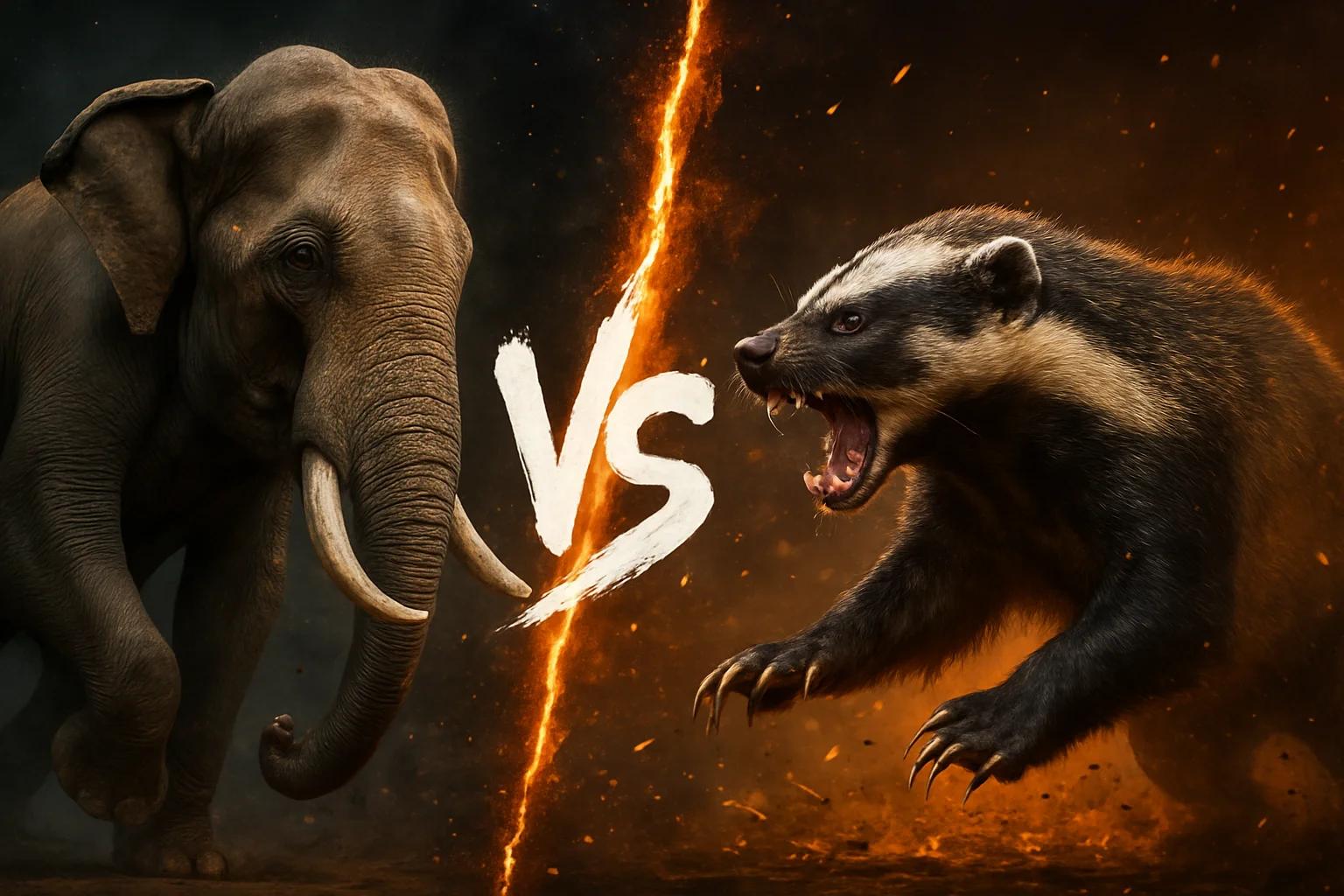
Asian Elephant vs Hog Badger: Who Actually Wins?
Asian elephant vs hog badger: a biology-first breakdown of size, power, armor and behavior to explain who wins and why the hog badger still earns respect.
Asian Elephant vs Hog Badger
Matchup winner
Asian Elephant
Quick verdict
Start with the direct answer, then use the structured comparison below to see what changes the outcome.
The Asian elephant wins decisively. At roughly 2,500–5,000 kg against a hog badger's 7–14 kg, the mass gap is a few hundred to one. The elephant also brings a muscular trunk, pillar legs and, in many bulls, tusks, all guided by excellent spatial memory and threat assessment. The hog badger is a tough, thick-skinned digger with strong claws and a bad temper when cornered, but it has no tool that can seriously injure an animal of that size. Realistically, the badger's best outcome is to make enough noise to be ignored, or to get underground before the elephant decides it is worth stepping on.
Read the full explanation
Asian elephant wins: the size gap is roughly 300:1 or more.
A trunk swipe or foot stomp ends any real contest almost at once.
The hog badger's claws and loose, tough skin are built for digging and for surviving predators its own size, not giants.
The badger's real win condition is escape: burrows, dense undergrowth and the elephant's lack of interest.
Reader vote
Who do you think wins?
Pick a side — no account needed. Results update live.
No votes yet — be the first to call it.
Editorial note
Why people disagree
Mustelid-style 'fearless badger' stories make people overrate small fighters against megafauna.
Explosive power
Raw force decides the first contact, and the elephant's force is in another league.
Close-range durability
The badger's armor works against jaws, not against crushing weight.
Weapon reach
The elephant can strike from well outside the badger's reach.
Read the full explanation +
Elephants often retreat from small, noisy animals, which can look like losing even though it is just risk avoidance.
Hog badgers are genuinely tough for their size, so people mix up 'hard to kill' with 'able to win'.
Comparison FAQ
Short, direct answers to the next questions readers usually ask after the headline verdict.
Would an Asian elephant beat a hog badger?+
Yes, easily. The elephant outweighs it by several hundred times and can kill it with a single step or trunk strike.
Is a hog badger strong for its size?+
Yes. It has powerful digging claws, strong forelimbs and tough skin, which make it formidable against animals of similar size.
Why is a hog badger still dangerous?+
Its bites and claws can injure the sensitive trunk or feet. That is why elephants often just avoid a cornered badger instead of risking a wound.
Could a hog badger scare off an elephant?+
Briefly, maybe. An elephant may step away from a hissing, lunging badger to avoid injury, but that is a choice, not a defeat.
Head-to-head species stats
These are the same core AnimalDex stat dimensions used on the dedicated animal pages, pulled side by side so the matchup is faster to scan.
Asian Elephant
Tier CHog Badger
Tier BTrait-by-trait comparison
Only the categories that matter to this matchup are included. The goal is not filler stats, but the real design differences that change the result.
Multi-ton charge and trunk strikes
Explosive power
Asian Elephant
Short, scrappy lunges and bites
Explosive power
Asian Elephant
Skin 2–3 cm thick over massive bulk
Close-range durability
Asian Elephant
Loose, tough hide that resists bites
Close-range durability
Asian Elephant
Trunk around 2 m, plus tusks in many bulls
Weapon reach
Asian Elephant
Snout-level claws and teeth
Weapon reach
Asian Elephant
Can't follow underground
Evasion and burrowing
Hog Badger
Expert digger with a low profile
Evasion and burrowing
Hog Badger
Strong memory and social learning
Tactical cognition
Asian Elephant
Instinctive, defensive aggression
Tactical cognition
Asian Elephant
How the verdict forms
Verdict timeline
01 · Explosive power
Asian Elephant
02 · Close-range durability
Asian Elephant
03 · Weapon reach
Asian Elephant
04 · Evasion and burrowing
Hog Badger
05 · Tactical cognition
Asian Elephant
Change the conditions
Scenario breakdown
This is where shallow battle content usually fails. Terrain, spacing, timing, and engagement style can change the answer.
Scenario lean
Asian Elephant
Verdict confidence
82%
The elephant wins any contact. The badger can survive by hiding.
Dense undergrowth gives the hog badger places to vanish, but cover doesn't protect it from a single stomp or trunk sweep. If an engagement happens at all, mass settles it.
AnimalDex field profiles
Explore these animals
Asian Elephant
Elephas maximus
forest, grassland edge, floodplain, and scrub woodland
Hog Badger
Arctonyx collaris
forest edge, hill woodland, and agricultural fringe
Systems Intelligence & Hidden Purpose
See the animals behind this comparison as engineered biological systems: what each one is built to do, where it gains leverage, and why the matchup changes by scenario.
Specialized Hardware
piglike digging snout, heavy low-set body, and powerful clawed foraging give the Hog Badger a body plan tuned for its niche.
Systems Script
Hog Badgers operate through forest edge, hill woodland, and agricultural fringe. Their design links movement, feeding, shelter, and timing into one workable survival system.
Strategic Insight
Dense environments reward precision, patience, and the ability to read layered cover.
Final take
This is one of the most lopsided pairings in Asian forests. The Asian elephant combines a massive body with a careful, intelligent mind, and the hog badger has nothing that scales up to that size.
Read the full explanation
The hog badger deserves respect as a tough, foul-tempered digger that predators its own size often avoid. Against an elephant, though, its strategy is survival, and the clear overall winner is the Asian elephant.
Collect both animals in AnimalDex
Track the species behind this matchup, compare their real traits, and build the rivalry into your AnimalDex collection.
Discussion
What do you think?
Share your reasoning with other readers. Be civil and stick to the animals.
Sign in to join the discussion.
Sign inNo comments yet. Start the conversation.