


Atlantic Puffin vs Razorbill: Who Actually Wins?
Atlantic Puffin vs Razorbill: a biology-first look at size, bill weaponry, burrow defense, and colony ledge disputes to settle which North Atlantic auk wins.
Atlantic Puffin vs Razorbill
Matchup winner
Razorbill
Quick verdict
Start with the direct answer, then use the structured comparison below to see what changes the outcome.
The Razorbill wins this auk-on-auk matchup. At roughly 500–890 g against the puffin's 380–550 g, it carries about 50% more mass. Its deep, blade-like bill is built for pinching and jabbing, and ledge life has hardwired it for shoving matches over cliff real estate. The Atlantic Puffin is no pushover. Its colorful bill delivers a surprisingly hard bite, and inside its own burrow it fights with stubborn, territorial ferocity. Its tunnels are also too narrow for a bigger bird to bring its weight to bear. But in most contexts where these two actually meet, the larger, heavier-billed, more physically assertive Razorbill controls the exchange. Those contexts include open rock, crowded ledges, and contested landing spots.
Read the full explanation
Razorbill wins overall: heavier body, deeper bill, more ledge-brawling experience.
Puffin's best shot is inside its own burrow, where tight space cancels the size gap.
On open ledges and landing zones, Razorbill mass and reach decide most disputes.
Neither bird is a true predator of the other. Real clashes are short shoving and bill-locking contests.
Reader vote
Who do you think wins?
Pick a side — no account needed. Results update live.
No votes yet — be the first to call it.
Editorial note
Why people disagree
Puffins are famously feisty burrow defenders, so people overestimate how that grit transfers to open ground.
Body mass & shove power
Auk disputes are pushing contests on narrow rock. Extra weight translates directly into displacement.
Bill weaponry
Both pinch hard, but the Razorbill's longer, heavier bill adds reach and leverage in a bill-lock.
Burrow defense
The puffin owns a fortress that neutralizes size. It is the one terrain where it is favored.
Read the full explanation +
The Razorbill's bill looks dangerous, but auks fight by gripping and pushing more than by stabbing, so the weapon gap is smaller than it appears.
Both birds are small and similar in silhouette, so many readers assume a coin flip. In practice, a 50% mass edge is decisive between close relatives.
Comparison FAQ
Short, direct answers to the next questions readers usually ask after the headline verdict.
Would a Razorbill beat an Atlantic Puffin in a fight?+
Usually yes. The Razorbill's larger body and heavier bill win most open-ground and ledge disputes.
Which is stronger, a puffin or a razorbill?+
The Razorbill. It is noticeably heavier and has more leverage in its bill, giving it greater pushing and gripping power.
Can a puffin ever beat a razorbill?+
Yes, inside or at the mouth of its own burrow. The tight space cancels the size gap, and the puffin's territorial drive keeps it fighting.
Why is the puffin still dangerous even though it loses?+
Its bill clamps with real force and can cause painful wounds. Puffins are also stubborn defenders that rarely give up a burrow without a fight.
Do puffins and razorbills actually fight in the wild?+
They share colonies and sometimes squabble over space, but serious fights are rare. Most disputes are brief posturing, shoving, or bill-locking.
Head-to-head species stats
These are the same core AnimalDex stat dimensions used on the dedicated animal pages, pulled side by side so the matchup is faster to scan.
Atlantic Puffin
Tier DRazorbill
Tier CTrait-by-trait comparison
Only the categories that matter to this matchup are included. The goal is not filler stats, but the real design differences that change the result.
~380–550 g, compact
Body mass & shove power
Razorbill
~500–890 g, heavier frame
Body mass & shove power
Razorbill
Tall, laterally flat bill with strong clamp
Bill weaponry
Razorbill
Deep, blade-edged bill built for grip and jab
Bill weaponry
Razorbill
Digs and holds earthen tunnels aggressively
Burrow defense
Atlantic Puffin
Nests in crevices and ledges, rarely burrows
Burrow defense
Atlantic Puffin
Rapid wingbeats, nimble diver
Flight & underwater agility
Razorbill
Slightly faster, powerful diver
Flight & underwater agility
Razorbill
Bold on home turf, yields in crowds
Ledge assertiveness
Razorbill
Habitual shover on dense ledges
Ledge assertiveness
Razorbill
How the verdict forms
Verdict timeline
01 · Body mass & shove power
Razorbill
02 · Bill weaponry
Razorbill
03 · Burrow defense
Atlantic Puffin
04 · Flight & underwater agility
Razorbill
05 · Ledge assertiveness
Razorbill
Change the conditions
Scenario breakdown
This is where shallow battle content usually fails. Terrain, spacing, timing, and engagement style can change the answer.
Scenario lean
Atlantic Puffin
Verdict confidence
82%
Puffin holds its tunnel.
Inside a narrow earthen burrow, the Razorbill cannot use its mass or reach. The puffin's clamp-and-hold defense, backed by territorial commitment, turns the tunnel into a choke point. Home-field motivation also counts here: a puffin defending its egg or puffling fights longer than an intruder is willing to.
AnimalDex field profiles
Explore these animals
Atlantic Puffin
Fratercula arctica
Cold North Atlantic seas with nesting on offshore cliffs, islands, and burrows.
Razorbill
Alca torda
sea cliff, offshore ledge, and North Atlantic water
Systems Intelligence & Hidden Purpose
See the animals behind this comparison as engineered biological systems: what each one is built to do, where it gains leverage, and why the matchup changes by scenario.
Specialized Hardware
Wing-powered diving, fish-carrying bill design, and colony nesting behavior make puffins two-environment logistics hardware.
Systems Script
Puffins shuttle marine productivity from cold seas into cliff and island colonies. Their success depends on whether ocean food pulses still line up with breeding deadlines.
Strategic Insight
A good system can work across environments, but only if the timing between them still syncs.
Specialized Hardware
black-and-white auk body, deep grooved bill, and wing-propelled diving give the Razorbill a body plan tuned for its niche.
Systems Script
Razorbills operate through sea cliff, offshore ledge, and North Atlantic water. Their design links movement, feeding, shelter, and timing into one workable survival system.
Strategic Insight
In steep terrain, balance and route control matter more than brute force.
Final take
The Razorbill is the overall winner. Among closely related auks, a sizable mass advantage paired with a heavier, longer bill decides most physical disputes, and the Razorbill's ledge lifestyle gives it daily rehearsal.
Read the full explanation
The Atlantic Puffin keeps real dignity in this matchup. Its burrow is a genuine equalizer, and it is a tenacious, hard-biting defender. Anyone who has handled a puffin knows that bill draws blood. In open terrain, though, it is simply outweighed.
Collect both animals in AnimalDex
Track the species behind this matchup, compare their real traits, and build the rivalry into your AnimalDex collection.
Related comparisons
Continue with nearby matchups to compare more real-world animal traits without dropping into junky who-wins filler.

Northern Gannet vs Razorbill: Who Actually Wins?
The Northern Gannet wins. It is the largest seabird in the North Atlantic, roughly 2.5–3.5 kg with a wingspan near 1.7–1.8 m. A Razorbill weighs about 0.5–0.9 kg, so the gannet carries three to five times its mass. Gannets are also hardwired for aggression. They nest in dense colonies where neighbors constantly jab, grip and twist each other's necks with dagger-like serrated bills, so close-quarters fighting is part of daily life. The Razorbill has a deep, blade-shaped bill that can draw blood, and underwater it is the more agile animal. It cannot overcome a body-mass gap this large, and a gannet's skull and neck are built to absorb 20+ m plunge-dive impacts. In nearly any realistic confrontation, the gannet controls the space and the Razorbill's best move is to dive and leave.
Read comparison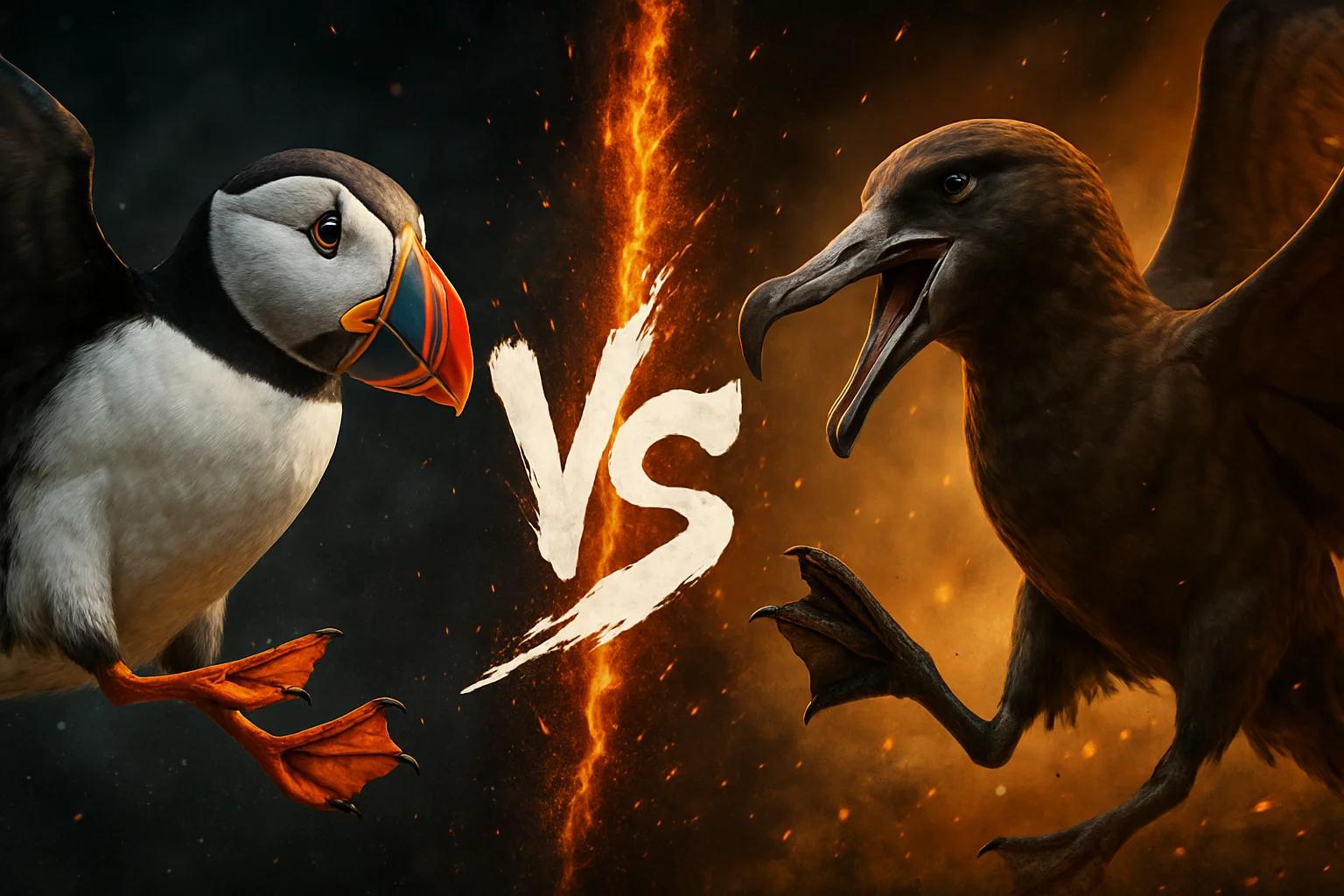
Atlantic Puffin vs Black-footed Albatross: Who Actually Wins?
The Black-footed Albatross wins this matchup. It weighs roughly 2.6–4.3 kg against the puffin's 400–550 g, so it carries six to eight times the mass. It also has a hooked, plated bill built to seize slippery squid and fish, and a wingspan near two meters that lets it loom over and pin a smaller bird. The puffin is no pushover. Its thick, colorful bill is a real crushing and biting tool, its burrow fights with rival puffins can be fierce, and it is far faster and more agile underwater and in quick wingbeats. But in any contact exchange, mass and reach decide who controls the fight, and the albatross has both. The puffin's best realistic result is a sharp bite and a fast escape, not a victory.
Read comparison
Horned Puffin vs Razorbill: Who Actually Wins?
The Razorbill wins this one. Both are compact North Pacific and North Atlantic auks built for wing-propelled diving, but the Razorbill carries more body mass (roughly 500–890 g vs. the puffin's ~500–650 g), a longer reach, and a deep, laterally flattened bill with a sharp hooked tip that works as a pinching, stabbing tool. Razorbills are also notorious for defending crowded ledges with lunges and bill-grappling. The Horned Puffin brings a thick, brightly sheathed bill with real crushing grip and a burrow-holder's stubbornness, so it is far from helpless. In a straight contest of mass, reach and ledge-fighting temperament, though, the Razorbill holds the edge most of the time.
Read comparison
Discussion
What do you think?
Share your reasoning with other readers. Be civil and stick to the animals.
Sign in to join the discussion.
Sign inNo comments yet. Start the conversation.