

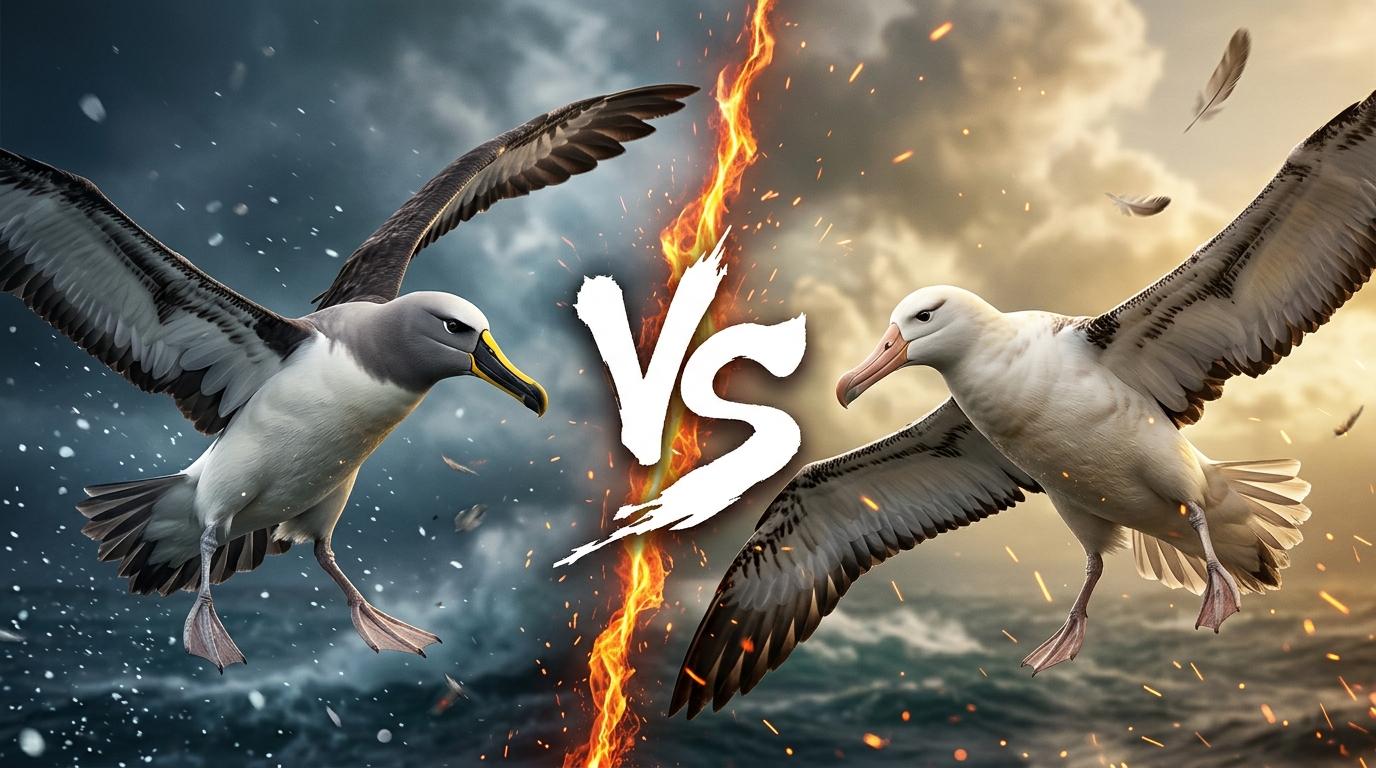
Atlantic Yellow-nosed Albatross vs Wandering Albatross: Who Actually Wins?
Atlantic Yellow-nosed Albatross vs Wandering Albatross: a biology-first look at size, reach, agility, and feeding-scrum dominance to decide which ocean wanderer wins.
Atlantic Yellow-nosed Albatross vs Wandering Albatross
Matchup winner
Wandering Albatross
Quick verdict
Start with the direct answer, then use the structured comparison below to see what changes the outcome.
The Wandering Albatross wins, and it is not especially close. It typically weighs around 6–12 kg against the Atlantic Yellow-nosed Albatross's roughly 2–3 kg. It carries the longest wingspan of any living bird, up to about 3.5 m, and backs that up with a heavy, hooked pink bill. In the real contests these birds have, jostling over squid, offal, and fishing discards at the surface, body mass and reach usually decide who keeps the food. Larger albatrosses generally hold the best spots in a feeding scrum while smaller mollymawks work the edges. The yellow-nose is quicker to take off, tighter in its turns, and sharper at snatching scraps. That keeps it fed and out of trouble, but it does not let it overpower a bird three to four times its weight.
Read the full explanation
Wandering Albatross wins overall on mass, reach, and bill size.
In a surface scramble for food, the larger bird usually displaces the smaller one.
The Atlantic Yellow-nosed Albatross is more nimble and quicker off the water, which helps it steal and escape rather than win a straight contest.
These birds compete, they don't fight to the death. 'Winning' means holding the food and the space.
Reader vote
Who do you think wins?
Pick a side — no account needed. Results update live.
No votes yet — be the first to call it.
Editorial note
Why people disagree
Wingspan photos make the wanderer look unbeatable, but agility matters at the water's surface. A smaller bird that lands, grabs, and lifts off faster can win individual scraps.
Body mass and heft
At a contested carcass, the heavier bird shoulders in, and the lighter one gets pushed aside.
Wingspan and reach
Huge wings help the wanderer intimidate rivals, claim space, and cover enormous foraging ranges.
Bill weaponry
In jabbing and tugging matches over food, a bigger hooked bill grips harder and threatens more.
Read the full explanation +
Both are 'albatrosses,' so people assume they're similar. In reality, a wandering albatross outweighs an Atlantic yellow-nose roughly three to four times over.
Some readers count survival as winning. By that measure, the yellow-nose is a highly successful forager and annual breeder, even though it loses most face-to-face contests.
Comparison FAQ
Short, direct answers to the next questions readers usually ask after the headline verdict.
Would an Atlantic Yellow-nosed Albatross beat a Wandering Albatross?+
Almost never in a direct contest. The wandering albatross is roughly three to four times heavier, with a much larger bill and wingspan, so it usually wins any confrontation over food.
Which albatross is stronger?+
The Wandering Albatross. It is far heavier, has the longest wingspan of any living bird, and carries a massive hooked bill that gives it an advantage in shoving and tugging contests.
Do albatrosses actually fight each other?+
Mostly they compete through displays, bill jabs, and jostling at feeding sites. These contests rarely cause serious injury. The usual outcome is that the larger bird keeps the food.
Why is the Atlantic Yellow-nosed Albatross still a dangerous competitor?+
It is quicker off the water and more agile at low speed. That lets it snatch food in calm conditions and slip away before larger birds can respond. It wins by timing, not force.
Are either of these albatrosses endangered?+
Both are threatened. The Atlantic Yellow-nosed Albatross is listed as Endangered and the Wandering Albatross as Vulnerable, largely because of longline fishing bycatch.
Head-to-head species stats
These are the same core AnimalDex stat dimensions used on the dedicated animal pages, pulled side by side so the matchup is faster to scan.
Atlantic Yellow-nosed Albatross
Tier BWandering Albatross
Tier ATrait-by-trait comparison
Only the categories that matter to this matchup are included. The goal is not filler stats, but the real design differences that change the result.
About 2–3 kg, the smallest mollymawk
Body mass and heft
Wandering Albatross
About 6–12 kg, among the heaviest flying seabirds
Body mass and heft
Wandering Albatross
Roughly 1.8–2.0 m
Wingspan and reach
Wandering Albatross
Roughly 2.5–3.5 m, the longest of any living bird
Wingspan and reach
Wandering Albatross
Slender black bill with a yellow upper ridge
Bill weaponry
Wandering Albatross
Massive, hooked pink bill
Bill weaponry
Wandering Albatross
Quick takeoffs and tight maneuvers
Surface agility
Atlantic Yellow-nosed Albatross
Needs wind and a run-up, and maneuvers slowly at low speed
Surface agility
Atlantic Yellow-nosed Albatross
Efficient dynamic soarer across the South Atlantic
Long-haul soaring
Wandering Albatross
Elite dynamic soarer, with foraging trips spanning thousands of kilometres
Long-haul soaring
Wandering Albatross
Works the edges of mixed seabird flocks
Scrum presence
Wandering Albatross
Tends to anchor the center of feeding flocks
Scrum presence
Wandering Albatross
How the verdict forms
Verdict timeline
01 · Body mass and heft
Wandering Albatross
02 · Wingspan and reach
Wandering Albatross
03 · Bill weaponry
Wandering Albatross
04 · Surface agility
Atlantic Yellow-nosed Albatross
05 · Long-haul soaring
Wandering Albatross
06 · Scrum presence
Wandering Albatross
Change the conditions
Scenario breakdown
This is where shallow battle content usually fails. Terrain, spacing, timing, and engagement style can change the answer.
Scenario lean
Wandering Albatross
Verdict confidence
82%
The wanderer holds the food.
Around fishing vessels and floating carcasses, albatrosses settle on the water and compete by spreading their wings, jabbing with their bills, and shoving with their bodies. Size generally sets the pecking order in these mixed flocks. A bird three to four times heavier, with a far bigger bill, will usually displace the smaller one from the prime spot.
AnimalDex field profiles
Explore these animals
Atlantic Yellow-nosed Albatross
Thalassarche chlororhynchos
open ocean, wind-rich pelagic water, and remote islands
Wandering Albatross
Diomedea exulans
Open Southern Ocean waters with nesting on remote subantarctic islands.
Systems Intelligence & Hidden Purpose
See the animals behind this comparison as engineered biological systems: what each one is built to do, where it gains leverage, and why the matchup changes by scenario.
Specialized Hardware
long gliding ocean wings, yellow stripe along the bill, and remote island breeding life give the Atlantic Yellow-nosed Albatross a body plan tuned for its niche.
Systems Script
Atlantic Yellow-nosed Albatrosss operate through open ocean, wind-rich pelagic water, and remote islands. Their design links movement, feeding, shelter, and timing into one workable survival system.
Strategic Insight
In moving water, the best systems use flow, visibility, and depth instead of fighting every current.
Specialized Hardware
Extreme wingspan and dynamic soaring control make albatrosses atmospheric energy-harvesting hardware for long-range ocean movement.
Systems Script
Albatrosses convert wind structure into global-scale foraging reach, linking isolated marine resources across vast distances. They are proof that motion efficiency can outcompete raw exertion by orders of magnitude.
Strategic Insight
Learn the currents first. Systems that ride existing energy go farther on less.
Final take
The Wandering Albatross is the clear winner. Its advantages in mass, wingspan, and bill size line up with how albatrosses actually compete: posturing and shoving over food at the surface, where bigger usually beats faster.
Read the full explanation
The Atlantic Yellow-nosed Albatross is not outclassed in life, only in a direct contest. It is a nimble, efficient forager that breeds on Tristan da Cunha and Gough Island and thrives by avoiding fights it can't win. Both species face serious threats, especially from fisheries bycatch, so the real battle for both is survival.
Collect both animals in AnimalDex
Track the species behind this matchup, compare their real traits, and build the rivalry into your AnimalDex collection.
Discussion
What do you think?
Share your reasoning with other readers. Be civil and stick to the animals.
Sign in to join the discussion.
Sign inNo comments yet. Start the conversation.