

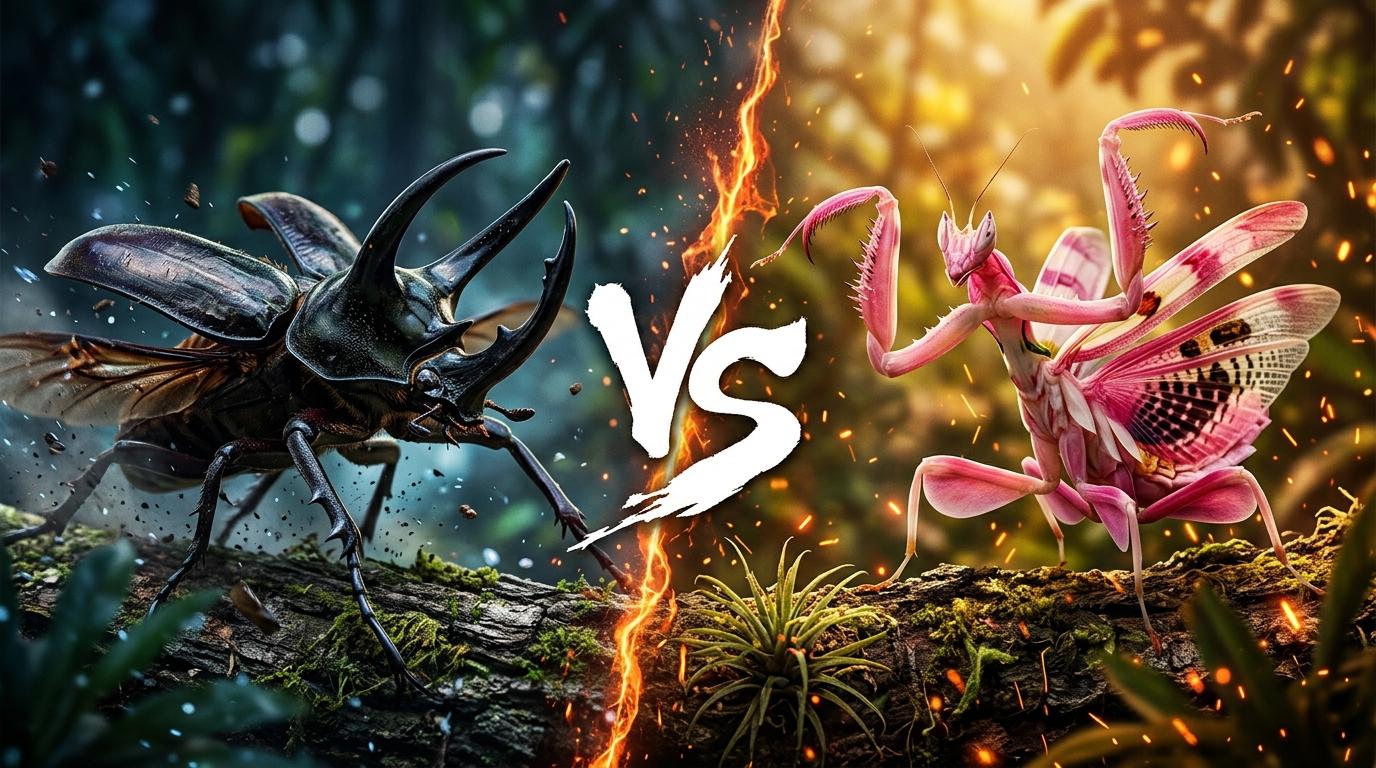
Atlas Beetle vs Orchid Mantis: Who Actually Wins?
Atlas beetle vs orchid mantis: armor and horn leverage against a flower-disguised ambush predator. See who wins, why, and in which scenarios the mantis stays dangerous.
Atlas Beetle vs Orchid Mantis
Matchup winner
Atlas Beetle
Quick verdict
Start with the direct answer, then use the structured comparison below to see what changes the outcome.
The Atlas Beetle wins this matchup clearly. Chalcosoma atlas is a heavily armored rhinoceros beetle. Its three-horned males are built for prying and flipping rivals, its grip is strong, and its body mass dwarfs most orchid mantises. The Orchid Mantis is an elite ambush hunter, but its toolkit is calibrated for soft-bodied pollinators like bees, flies and moths. Its spined raptorial forelegs can't get a meaningful purchase on thick elytra and a chitin-plated thorax. The mantis needs a vulnerable target and a fast kill. The beetle offers neither, and it can shove, pin or simply outlast an attacker that has no way through its shell.
Read the full explanation
Winner: Atlas Beetle. Armor and leverage beat a strike system designed for soft prey.
The orchid mantis is smarter at hunting, but its forelegs can't crack beetle armor.
The mantis's best realistic outcome is avoiding the fight, not winning it.
Size and mass favor the beetle heavily, especially against small male mantises.
Reader vote
Who do you think wins?
Pick a side — no account needed. Results update live.
No votes yet — be the first to call it.
Editorial note
Why people disagree
Mantises have a fearsome reputation as insect killers, so people assume any insect is on the menu. Hard-shelled beetles are the exception.
Close-range durability
The mantis's whole kill method depends on piercing or pinning soft tissue. Armor shuts that down.
Explosive power
The mantis strikes faster, but speed without penetration only buys a grip it can't use.
Ambush control
The mantis decides when contact starts, which is its biggest edge in any encounter.
Read the full explanation +
The Orchid Mantis's camouflage is spectacular. Fans overrate how much disguise matters once contact happens.
The Atlas Beetle is a herbivore that rarely attacks anything except rival males, so its fighting ability looks passive until it's tested.
Comparison FAQ
Short, direct answers to the next questions readers usually ask after the headline verdict.
Would an Atlas Beetle beat an Orchid Mantis?+
Yes. The Atlas Beetle's armor, mass and horn leverage overwhelm a mantis whose forelegs are built for soft-bodied prey.
Which is stronger, the Atlas Beetle or the Orchid Mantis?+
The Atlas Beetle, by a wide margin. Rhinoceros beetles are among the strongest insects for their size, able to lift and shove rivals much heavier than a mantis.
Can an orchid mantis eat a beetle?+
Small, soft beetles occasionally, but a large armored Atlas Beetle is effectively off the menu.
Why is the orchid mantis still dangerous?+
Its flower camouflage gives it total control of when an encounter starts, and its strike is among the fastest in the insect world. Against suitable prey it is lethal, and even against the beetle it can win the opening exchange.
Does the Atlas Beetle attack other insects?+
Rarely. It is a herbivore that fights mainly rival males, but its defensive power is enormous.
Head-to-head species stats
These are the same core AnimalDex stat dimensions used on the dedicated animal pages, pulled side by side so the matchup is faster to scan.
Atlas Beetle
Tier COrchid Mantis
Tier DTrait-by-trait comparison
Only the categories that matter to this matchup are included. The goal is not filler stats, but the real design differences that change the result.
Thick, domed chitin armor and hardened elytra
Close-range durability
Atlas Beetle
Light, thin exoskeleton built for agility
Close-range durability
Atlas Beetle
Horn-driven lifting and shoving, built for flipping rivals
Explosive power
Orchid Mantis
Lightning foreleg strike measured in milliseconds
Explosive power
Orchid Mantis
Minimal; relies on armor rather than surprise
Ambush control
Orchid Mantis
World-class floral mimicry that lures prey in
Ambush control
Orchid Mantis
Large, heavy, low center of gravity
Mass and leverage
Atlas Beetle
Small and light, especially males
Mass and leverage
Atlas Beetle
Powerful tarsal claws that cling to bark
Grip and anchoring
Atlas Beetle
Spined raptorial forelegs for holding prey
Grip and anchoring
Atlas Beetle
Simple, rival-focused behavior
Hunting intelligence
Orchid Mantis
Patient visual predator that selects targets
Hunting intelligence
Orchid Mantis
How the verdict forms
Verdict timeline
01 · Close-range durability
Atlas Beetle
02 · Explosive power
Orchid Mantis
03 · Ambush control
Orchid Mantis
04 · Mass and leverage
Atlas Beetle
05 · Grip and anchoring
Atlas Beetle
06 · Hunting intelligence
Orchid Mantis
Change the conditions
Scenario breakdown
This is where shallow battle content usually fails. Terrain, spacing, timing, and engagement style can change the answer.
Scenario lean
Orchid Mantis
Verdict confidence
82%
The mantis lands the first strike, then the result stalls.
Hidden on blossoms, the orchid mantis gets the initiative and can seize the beetle's legs or head. Its edge comes from position rather than damage. It can harass and briefly control the beetle, but it can't easily finish it. On points of initiative this round is the mantis's best showing, even though a full kill remains unlikely.
AnimalDex field profiles
Explore these animals
Atlas Beetle
Chalcosoma atlas
rainforest canopy and humid woodland edge
Orchid Mantis
Hymenopus coronatus
Humid tropical forest and flowering understory vegetation.
Systems Intelligence & Hidden Purpose
See the animals behind this comparison as engineered biological systems: what each one is built to do, where it gains leverage, and why the matchup changes by scenario.
Specialized Hardware
massive horned male body, heavy armored shell, and forest-sap feeding give the Atlas Beetle a body plan tuned for its niche.
Systems Script
Atlas Beetles operate through rainforest canopy and humid woodland edge. Their design links movement, feeding, shelter, and timing into one workable survival system.
Strategic Insight
Dense environments reward precision, patience, and the ability to read layered cover.
Specialized Hardware
Petal-like limbs, color mimicry, and still hunting posture make orchid mantises deception hardware tuned for pollinator-rich environments.
Systems Script
This mantis exploits the visual trust insects place in flowers, converting attraction into predation. It is an elegant reminder that signal systems can always be gamed by a skilled mimic.
Strategic Insight
If attention flows predictably, someone will learn to intercept it. Design with signal security in mind.
Final take
The Atlas Beetle wins because this matchup comes down to whether the attacker's weapon fits the defender's body. The Orchid Mantis is a precision tool for soft, flying prey, and the Atlas Beetle is a tank.
Read the full explanation
The mantis is still dangerous. Its camouflage and strike speed make it a top predator of pollinators, and in an ambush it can seize the initiative. Initiative only matters when you can convert it, though, and against armor the mantis can't. Expect the beetle to win most realistic encounters, usually because the mantis wisely disengages.
Collect both animals in AnimalDex
Track the species behind this matchup, compare their real traits, and build the rivalry into your AnimalDex collection.
Related comparisons
Continue with nearby matchups to compare more real-world animal traits without dropping into junky who-wins filler.

Orchid Mantis vs Philippine Leaf Insect: Who Actually Wins?
The orchid mantis wins this matchup decisively. It is a true ambush predator with raptorial forelegs lined with spines, binocular vision tuned to detect motion, and strike reflexes measured in tens of milliseconds. The Philippine leaf insect is a slow, plant-eating stick-insect relative. Its whole survival strategy is not being noticed, and it carries no grasping weapons, venom, or real bite to use against an attacker. The leaf insect does have some advantages. It is a bit longer and broader, especially adult females, its armor-like flattened body is awkward to grip, and its camouflage is among the best in the insect world. Once a mantis has detected it, though, the fight is mostly over. In any encounter where the mantis knows the leaf insect is there, the predator's hardware beats the prey's disguise.
Read comparison
Discussion
What do you think?
Share your reasoning with other readers. Be civil and stick to the animals.
Sign in to join the discussion.
Sign inNo comments yet. Start the conversation.