

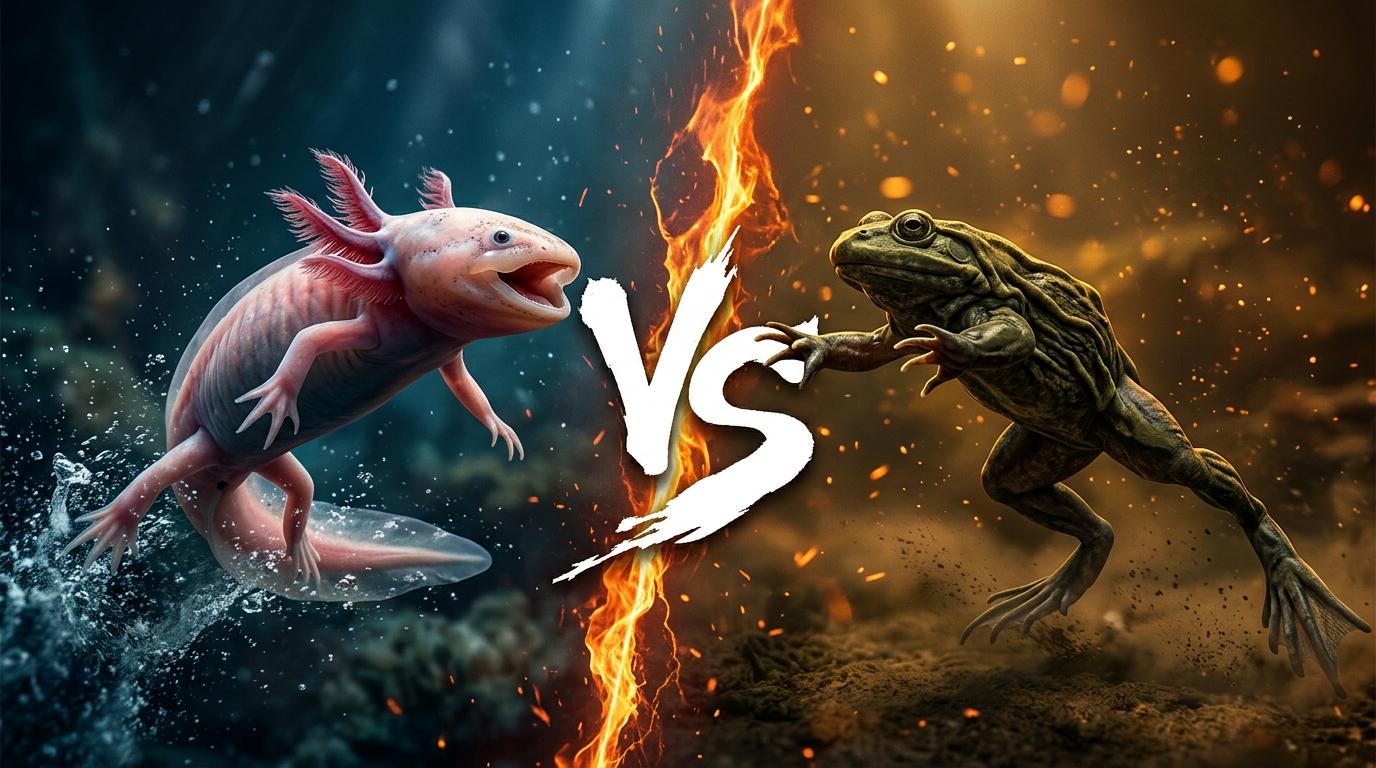
Axolotl vs Titicaca Water Frog: Who Actually Wins?
Axolotl vs Titicaca water frog: who wins a clash between Mexico's regenerating salamander and Lake Titicaca's baggy-skinned giant frog? A biology-first breakdown of size, bite, durability and habitat.
Axolotl vs Titicaca Water Frog
Matchup winner
Axolotl
Quick verdict
Start with the direct answer, then use the structured comparison below to see what changes the outcome.
The axolotl wins, but only narrowly. This is a contest between two critically endangered aquatic oddballs built for still, cold water rather than combat, and neither one would normally pick a fight. The axolotl's edge comes from three things. It has a longer, more muscular body that commonly reaches 23–30 cm, while the frog's typical body runs well under that. It has a wide suction-gape that snaps shut fast on anything mouth-sized. And it can regenerate limbs, gills and even parts of organs, so nips that would cripple most amphibians barely slow it down. The Titicaca water frog is no pushover. Its powerful hind legs deliver real kicks, and heavyweight individuals can outweigh a small axolotl. But it is a slow, low-energy specialist that breathes mostly through its loose skin folds. That skin is a huge, fragile surface that suffers in any prolonged scuffle, especially in warmer or less oxygenated water. Over a sustained encounter, the axolotl's reach, grip and recovery tip the outcome.
Read the full explanation
Winner: the axolotl, by a modest margin.
Its edges are longer body length, a fast suction bite and elite tissue regeneration.
The frog's best weapons are strong kicking hind legs and occasional greater bulk.
Both are gentle, slow, critically endangered species that would never meet in the wild. They live on different continents and at very different altitudes.
Reader vote
Who do you think wins?
Pick a side — no account needed. Results update live.
No votes yet — be the first to call it.
Editorial note
Why people disagree
Size claims vary wildly. Old reports of 'scrotum frogs' approaching a kilogram skew perceptions, while typical wild frogs today are far smaller.
Reach and body length
A longer torso and tail give the axolotl more leverage when twisting and holding onto a rival.
Strike and grip
The axolotl's sudden suction-snap is the most decisive offensive tool in this matchup.
Explosive power
The frog can shove and push off hard, which helps it break contact quickly.
Read the full explanation +
Regeneration sounds like a superpower, but it heals wounds after the fact. It does not stop the frog from winning a short shoving match.
Habitat bias matters. Put them in frigid, oxygen-poor high-altitude water and the frog's skin-breathing system suddenly looks like the better engine.
Comparison FAQ
Short, direct answers to the next questions readers usually ask after the headline verdict.
Would an axolotl beat a Titicaca water frog?+
Usually yes. Its longer body, suction bite and regeneration give it the edge in most realistic encounters, though the frog could win in very cold, low-oxygen water.
Which is stronger, an axolotl or a Titicaca water frog?+
The frog has more explosive leg power, while the axolotl has better overall reach and grip. In a sustained struggle, the axolotl's combination matters more.
Why is the Titicaca water frog still dangerous to an axolotl?+
Its powerful hind-leg kicks can shove off and injure an attacker, and large individuals can outweigh small axolotls. In thin, cold water its endurance can outlast the salamander.
Would they ever meet in the wild?+
No. Axolotls live only in the Xochimilco canals of Mexico City. Titicaca water frogs live in Lake Titicaca high in the Andes, on the Peru–Bolivia border.
Are both species endangered?+
Yes. Both are listed as critically endangered, threatened by pollution, habitat loss and invasive species, and in the frog's case also by overharvesting.
Head-to-head species stats
These are the same core AnimalDex stat dimensions used on the dedicated animal pages, pulled side by side so the matchup is faster to scan.
Axolotl
Tier CTiticaca Water Frog
Tier CTrait-by-trait comparison
Only the categories that matter to this matchup are included. The goal is not filler stats, but the real design differences that change the result.
Typically 23–30 cm including tail
Reach and body length
Axolotl
Body usually under ~15 cm; legs add span
Reach and body length
Axolotl
Wide suction gape with small rasping teeth
Strike and grip
Axolotl
Broad mouth suited to small invertebrates
Strike and grip
Axolotl
Short tail-driven lunges
Explosive power
Titicaca Water Frog
Strong frog hind-leg kicks
Explosive power
Titicaca Water Frog
Regenerates limbs, gills, tissue
Close-range durability
Axolotl
Loose skin folds are vulnerable to injury
Close-range durability
Axolotl
Gills plus some gulping at the surface
Low-oxygen endurance
Titicaca Water Frog
Massive skin surface for cutaneous breathing, rarely surfaces
Low-oxygen endurance
Titicaca Water Frog
Opportunistic, will bite tankmates
Aggression index
Axolotl
Sedentary, bottom-dwelling
Aggression index
Axolotl
How the verdict forms
Verdict timeline
01 · Reach and body length
Axolotl
02 · Strike and grip
Axolotl
03 · Explosive power
Titicaca Water Frog
04 · Close-range durability
Axolotl
05 · Low-oxygen endurance
Titicaca Water Frog
06 · Aggression index
Axolotl
Change the conditions
Scenario breakdown
This is where shallow battle content usually fails. Terrain, spacing, timing, and engagement style can change the answer.
Scenario lean
Axolotl
Verdict confidence
82%
The axolotl's ambush snap lands first.
Both species are sit-and-wait feeders, but the axolotl strikes by suction at anything that moves near its head. Among cover the frog can't use its kicks to open space, and a grabbed limb or skin fold gives the axolotl a lasting advantage.
AnimalDex field profiles
Explore these animals
Axolotl
Ambystoma mexicanum
Cool freshwater canals, remnant lakes, and slow wetland channels with cover.
Titicaca Water Frog
Telmatobius culeus
high-altitude lake and reedbed shallows
Systems Intelligence & Hidden Purpose
See the animals behind this comparison as engineered biological systems: what each one is built to do, where it gains leverage, and why the matchup changes by scenario.
Specialized Hardware
External gills, aquatic neoteny, and unusual regenerative capacity make axolotls living hardware for low-motion survival and tissue rebuilding.
Systems Script
Axolotls occupy cool freshwater systems where regeneration, camouflage, and patience outperform speed. They are less about domination and more about biological repair efficiency under pressure.
Strategic Insight
Some systems win not by avoiding damage entirely, but by rebuilding faster than disruption compounds.
Specialized Hardware
deeply wrinkled water-breathing skin, large lake-dwelling body, and cold high-altitude aquatic life give the Titicaca Water Frog a body plan tuned for its niche.
Systems Script
Titicaca Water Frogs operate through high-altitude lake and reedbed shallows. Their design links movement, feeding, shelter, and timing into one workable survival system.
Strategic Insight
Good design turns a difficult habitat into usable ground.
Final take
The axolotl takes this one. It is longer, more willing to bite, and backed by one of the most remarkable regeneration systems among vertebrates. The Titicaca water frog's kicks and skin-breathing endurance make it competitive, especially on its own frigid home turf.
Read the full explanation
The bigger truth is that both animals are critically endangered survivors shaped by single lake systems: Xochimilco and Titicaca. Their 'battle' is a lens on design trade-offs. One is built to grab and repair. The other is built to breathe where little oxygen remains.
Collect both animals in AnimalDex
Track the species behind this matchup, compare their real traits, and build the rivalry into your AnimalDex collection.
Discussion
What do you think?
Share your reasoning with other readers. Be civil and stick to the animals.
Sign in to join the discussion.
Sign inNo comments yet. Start the conversation.