


Bald Uakari vs Woolly Monkey: Who Actually Wins?
Bald uakari vs woolly monkey: who would win? Compare size, jaws, prehensile tails, canopy control and real Amazon ecology to see why the woolly monkey takes the edge.
Bald Uakari vs Woolly Monkey
Matchup winner
Woolly Monkey
Quick verdict
Start with the direct answer, then use the structured comparison below to see what changes the outcome.
The woolly monkey wins this matchup. Adult woolly monkeys typically weigh 5 to 10 kg, and big males sit near the top of that range. Bald uakaris usually weigh about 2.7 to 3.5 kg. That means the woolly monkey often carries twice the mass or more. It also has a muscular prehensile tail that works like a fifth limb, so it can anchor itself, brace and keep both hands free in a canopy scuffle. The bald uakari is no pushover. It is a specialized seed predator whose jaws and canines crack hard, unripe fruit, which gives it a nasty close-range bite and real nerve. But its short, non-prehensile tail and much smaller frame mean it loses the contest that matters most in the trees: staying anchored while pushing a heavier opponent off position. Expect a bluffing, displacement-style standoff rather than a lethal fight, and expect the woolly monkey to hold the branch.
Read the full explanation
Woolly monkey wins overall, mainly on body mass (often 2–3x heavier).
Its prehensile tail gives it anchoring and leverage the uakari simply lacks.
The uakari's seed-cracking jaws make it the more dangerous biter pound for pound.
Real encounters would be displacement and threat displays, not fights to the death.
Reader vote
Who do you think wins?
Pick a side — no account needed. Results update live.
No votes yet — be the first to call it.
Editorial note
Why people disagree
The uakari's red face and aggressive displays look intimidating, so people overrate how much fighting weight sits behind them.
Body mass & frame
In a grapple on a branch, the heavier primate controls position and is far harder to dislodge.
Canopy anchoring
A fifth limb lets the woolly monkey brace, hang and keep its hands free to shove or strike.
Bite hardware
The uakari's jaws are built to break hard husks, which makes every bite it lands costly.
Read the full explanation +
Seed-predator jaws are genuinely strong, and some argue bite quality should outweigh size in a short, sharp clash.
Both are agile Amazon canopy primates with similar speed and intelligence, so the gap feels smaller than the scale says it is.
Comparison FAQ
Short, direct answers to the next questions readers usually ask after the headline verdict.
Would a woolly monkey beat a bald uakari in a fight?+
Yes, most likely. The woolly monkey is often two to three times heavier and can anchor itself with its prehensile tail, so it would usually win a physical contest or simply displace the uakari.
Which is stronger, the bald uakari or the woolly monkey?+
The woolly monkey is stronger overall because of its greater body mass and muscular prehensile tail. The uakari has the stronger specialized bite for its size.
Why is the bald uakari still dangerous?+
Its jaws and canines are adapted to crack tough, unripe seeds, so a bite can do real damage. It is also fast and agile enough to strike and escape before a heavier rival can pin it.
Do bald uakaris and woolly monkeys meet in the wild?+
Both live in western Amazon forests. Uakaris favor seasonally flooded várzea, while woolly monkeys prefer terra firme and other forest types, so meetings are uncommon. When they happen, they would mostly involve avoidance or displacement at food sources.
Why does the bald uakari have a red face?+
Its bright red face reflects healthy blood circulation and is thought to signal good condition, including freedom from malaria, to potential mates.
Head-to-head species stats
These are the same core AnimalDex stat dimensions used on the dedicated animal pages, pulled side by side so the matchup is faster to scan.
Bald Uakari
Tier BWoolly Monkey
Tier ATrait-by-trait comparison
Only the categories that matter to this matchup are included. The goal is not filler stats, but the real design differences that change the result.
About 2.7–3.5 kg, compact
Body mass & frame
Woolly Monkey
About 5–10 kg, stocky and dense-furred
Body mass & frame
Woolly Monkey
Short, non-prehensile tail
Canopy anchoring
Woolly Monkey
Strong prehensile tail with a gripping pad
Canopy anchoring
Woolly Monkey
Seed-cracking jaws, robust canines
Bite hardware
Bald Uakari
Fruit-processing jaws, solid canines
Bite hardware
Bald Uakari
Quick leaper in flooded forest
Branch agility
Bald Uakari
Deliberate climber, strong suspensory moves
Branch agility
Bald Uakari
Vivid red face, tail-wagging threats
Intimidation & display
Even
Branch-shaking, vocal group displays
Intimidation & display
Even
Large, fission-fusion troops
Social backup
Woolly Monkey
Cohesive multi-male groups
Social backup
Woolly Monkey
How the verdict forms
Verdict timeline
01 · Body mass & frame
Woolly Monkey
02 · Canopy anchoring
Woolly Monkey
03 · Bite hardware
Bald Uakari
04 · Branch agility
Bald Uakari
05 · Intimidation & display
Even
06 · Social backup
Woolly Monkey
Change the conditions
Scenario breakdown
This is where shallow battle content usually fails. Terrain, spacing, timing, and engagement style can change the answer.
Scenario lean
Woolly Monkey
Verdict confidence
82%
Woolly monkey holds the branch.
In dense canopy, the outcome depends on who stays anchored. The woolly monkey can lock its tail around a limb and use its extra weight to push and grapple. The uakari has to rely on its hands and feet alone, so every shove risks a fall. Its bite can force a retreat, but leverage and mass favor the woolly monkey.
AnimalDex field profiles
Explore these animals
Bald Uakari
Cacajao calvus
flooded Amazon forest and river-edge canopy
Woolly Monkey
Lagothrix lagotricha
rainforest canopy and humid tropical forest
Systems Intelligence & Hidden Purpose
See the animals behind this comparison as engineered biological systems: what each one is built to do, where it gains leverage, and why the matchup changes by scenario.
Specialized Hardware
bright red bare face, short tail, and flooded-forest troop life give the Bald Uakari a body plan tuned for its niche.
Systems Script
Bald Uakaris operate through flooded Amazon forest and river-edge canopy Their design links movement, shelter, feeding, and survival into one workable system.
Strategic Insight
Strange-looking features often make sense inside a very specific world.
Specialized Hardware
prehensile tail like an extra hand, soft thick fur, and large social canopy groups give the Woolly Monkey a body plan tuned for its niche.
Systems Script
Woolly Monkeys operate through rainforest canopy and humid tropical forest Their design links movement, shelter, feeding, and survival into one workable system.
Strategic Insight
A good extra tool can change how an entire system moves.
Final take
The woolly monkey is the clear overall pick. It brings more mass, a prehensile tail that serves as a built-in anchor, and cooperative group defense. In the arboreal shoving matches that actually decide primate conflicts, those three advantages compound.
Read the full explanation
The bald uakari is still a serious animal. Its jaws are specialized tools for breaking hardened seeds, and its agility in flooded forest makes it hard to pin down. It loses the strength contest but often wins the survival contest by avoiding fights altogether.
Collect both animals in AnimalDex
Track the species behind this matchup, compare their real traits, and build the rivalry into your AnimalDex collection.
Related comparisons
Continue with nearby matchups to compare more real-world animal traits without dropping into junky who-wins filler.
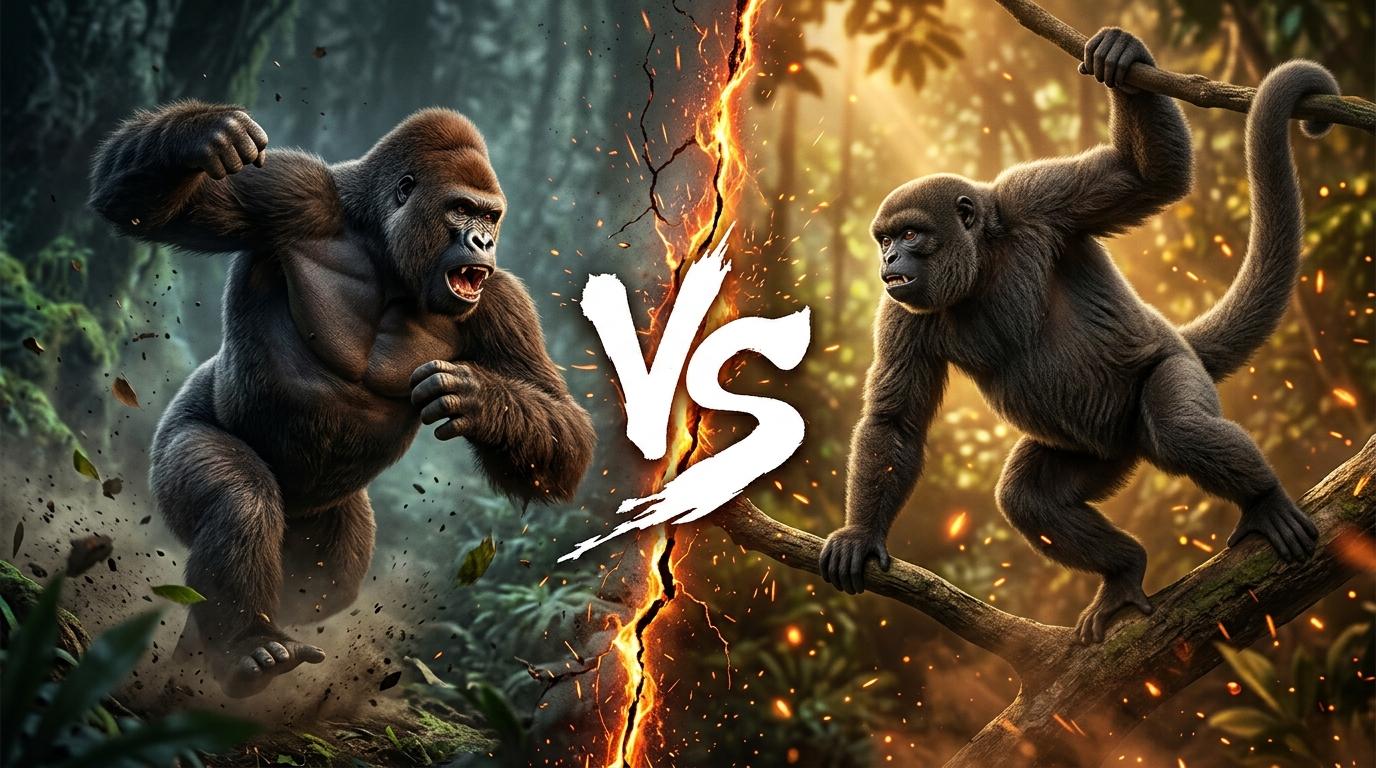
Western Lowland Gorilla vs Woolly Monkey: Who Actually Wins?
The western lowland gorilla wins, and it is not close in any contest that stays within reach. A silverback weighs roughly 140–180 kg. A woolly monkey weighs about 5–10 kg. That gap of more than fifteen times in body mass comes with a crested skull anchoring huge jaw muscles, long canines, and arms built for pulling down saplings and tearing apart termite mounds. The woolly monkey is a graceful, social fruit specialist. Its prehensile tail and canopy agility are designed for travel and escape, not combat. Its only real winning move is to refuse the fight by climbing where a gorilla cannot follow, and that is evasion, not victory.
Read comparison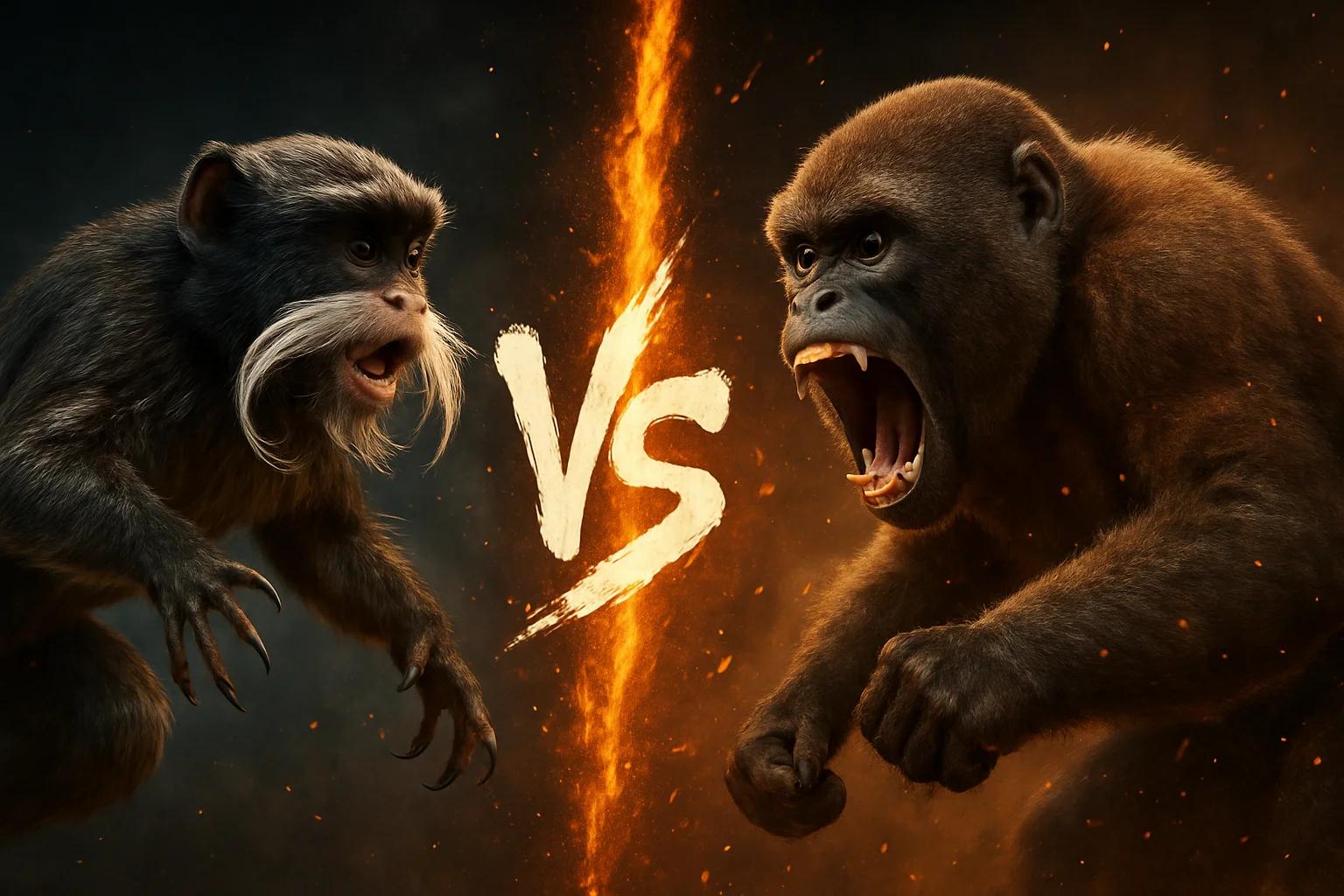
Emperor Tamarin vs Woolly Monkey: Who Actually Wins?
The woolly monkey wins, and it is not especially close. An adult woolly monkey weighs roughly 5–10 kg against the emperor tamarin's 400–500 g, which makes it about fifteen to twenty times heavier. It also has a powerful prehensile tail that works as a fifth limb, a dense muscular build, and the social confidence of a large-bodied primate that displaces smaller species at fruiting trees. The tamarin's speed, clawlike nails and twig-level agility make it nearly impossible to pin down in fine branches, so it rarely loses its life in a standoff. It simply loses the contest. In any real dispute over space or food, the woolly monkey dictates terms.
Read comparison
Bald Uakari vs Bald Uakari: Who Actually Wins When a Species Meets Itself?
This is an unusual matchup: both profiles are the same species, the Bald Uakari (Cacajao calvus), the red-faced, short-tailed seed-cracker of the Amazon's flooded várzea forests. So the real question is which kind of uakari wins a rival contest. The answer is the uakari-1752 profile, which leads in dominance (64 vs 38), size (45 vs 24), and speed by a hair (53 vs 51). Among uakaris, as in most primates, disputes over fruiting trees, mates, and position in a big foraging group are mostly settled by display, mass, and status long before anything turns physical. The heavier, higher-status individual tends to win the stare-down, keep the best branch, and push the other aside. The bald-uakari profile is cleverer (64 vs 38 intelligence) and can win by timing, sneaking, and slipping into gaps in a crowded canopy, but brains rarely beat a confident heavier rival at a contested food source.
Read comparison
Discussion
What do you think?
Share your reasoning with other readers. Be civil and stick to the animals.
Sign in to join the discussion.
Sign inNo comments yet. Start the conversation.