

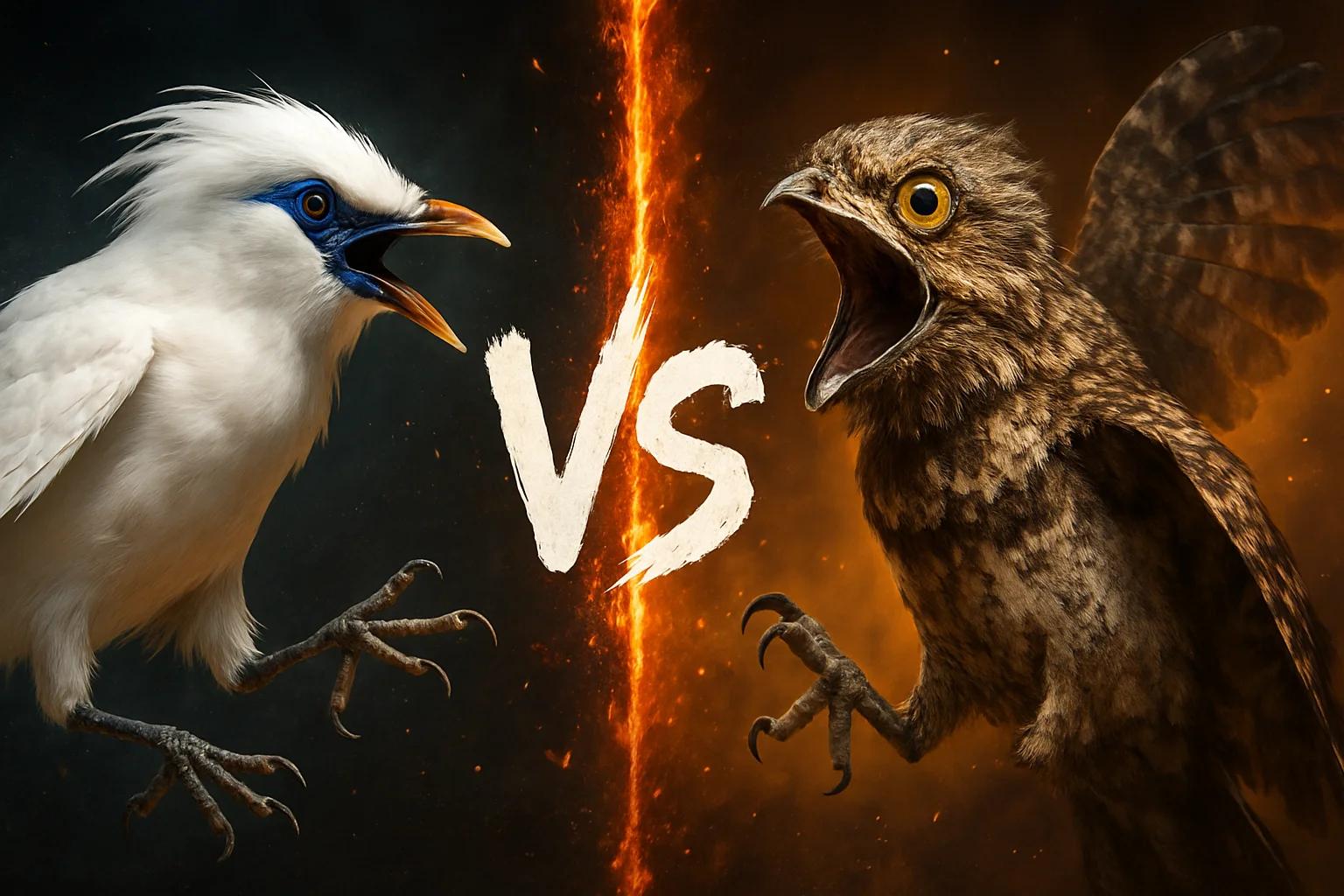
Bali Myna vs Great Potoo: Who Actually Wins?
Bali Myna vs Great Potoo compared on size, speed, defense and behavior. Find out which bird wins a head-to-head showdown and why.
Bali Myna vs Great Potoo
Matchup winner
Great Potoo
Quick verdict
Start with the direct answer, then use the structured comparison below to see what changes the outcome.
The Great Potoo wins this matchup. At roughly 360–650 g and up to about 55 cm long, it outweighs the 90–100 g Bali Myna several times over. It also has a huge gape and a startling threat display that can stop a small bird mid-approach. The Bali Myna is faster, nimbler and far more socially coordinated in daylight, but it is a fruit- and insect-eater built for foraging and flocking, not for pressing a fight against a bird three to six times its mass. If the two actually met, the potoo's sheer size and its gaping defensive display would decide most close-range encounters. The myna's best result is simply leaving, which it does very well.
Read the full explanation
Great Potoo wins: it has several times the body mass and a defensive display built to intimidate.
Bali Myna is quicker, more agile and better at coordinated daytime harassment.
Neither bird is a true fighter. The potoo wins by deterrence, and the myna survives by mobility.
Realistically they rarely, if ever, meet: one lives on Bali, the other in Central and South America.
Reader vote
Who do you think wins?
Pick a side — no account needed. Results update live.
No votes yet — be the first to call it.
Editorial note
Why people disagree
Mobbing is real. Small songbirds routinely harass larger birds, so some readers assume a bold myna could drive off a potoo.
Body mass & frame
In any physical contact between birds, a multi-fold mass gap is the single biggest predictor of who gives ground.
Aerial agility
Agility lets the myna dictate distance, which matters most when it wants to avoid or escape contact.
Intimidation display
The potoo's open-mouth display makes it look far bigger and riskier than it is, which deters approaching birds.
Read the full explanation +
The potoo looks frozen and helpless as a 'broken branch', which hides how dramatic its gaping threat display is.
Speed stats favor the myna, and people often overweight agility in bird-vs-bird matchups where mass usually decides contact.
Comparison FAQ
Short, direct answers to the next questions readers usually ask after the headline verdict.
Would a Great Potoo beat a Bali Myna?+
Yes, in most direct encounters. The potoo is several times heavier and uses a dramatic gaping threat display that would likely deter a lone myna. It wins mainly by intimidation rather than by inflicting injury.
Which bird is stronger?+
The Great Potoo. With roughly 360–650 g of body mass against the myna's ~90–100 g, it has far more physical presence, though neither species is built for fighting.
Why is the Bali Myna still dangerous to the potoo?+
Its speed and agility make it nearly impossible to catch. In a group, mynas can mob and harass a potoo enough to make it abandon a roost, so they can win on persistence even without real force.
Do Bali Mynas and Great Potoos ever meet in the wild?+
Almost certainly not. The Bali Myna is native only to Bali, Indonesia, while the Great Potoo lives in Central and South America.
Is the Great Potoo a predator?+
Yes, but of large flying insects, which it snatches on short sallies from a perch at night. It does not hunt songbirds.
Head-to-head species stats
These are the same core AnimalDex stat dimensions used on the dedicated animal pages, pulled side by side so the matchup is faster to scan.
Bali Myna
Tier BGreat Potoo
Tier BTrait-by-trait comparison
Only the categories that matter to this matchup are included. The goal is not filler stats, but the real design differences that change the result.
~90–100 g, starling-sized
Body mass & frame
Great Potoo
~360–650 g, owl-like bulk
Body mass & frame
Great Potoo
Quick, maneuverable daytime flier
Aerial agility
Bali Myna
Short sallies from a perch, less nimble
Aerial agility
Bali Myna
Crest raising, loud calls
Intimidation display
Great Potoo
Massive gape, wing spread, guttural growl-like calls
Intimidation display
Great Potoo
Brilliant white plumage, highly visible
Cryptic defense
Great Potoo
Bark-mimic plumage, near-invisible on a branch
Cryptic defense
Great Potoo
Pairs and small flocks, cooperative alarm calls
Group coordination
Bali Myna
Largely solitary
Group coordination
Bali Myna
Diurnal
Activity window
Great Potoo
Nocturnal hunter, roosts motionless by day
Activity window
Great Potoo
How the verdict forms
Verdict timeline
01 · Body mass & frame
Great Potoo
02 · Aerial agility
Bali Myna
03 · Intimidation display
Great Potoo
04 · Cryptic defense
Great Potoo
05 · Group coordination
Bali Myna
06 · Activity window
Great Potoo
Change the conditions
Scenario breakdown
This is where shallow battle content usually fails. Terrain, spacing, timing, and engagement style can change the answer.
Scenario lean
Great Potoo
Verdict confidence
82%
Potoo wins by concealment and deterrence.
In wooded cover, the potoo's bark-like camouflage means the myna may not even register it until it is very close. If disturbed at short range, the potoo can flare its enormous gape and spread its wings, and that sudden display, together with its larger size, would likely send a lone myna away. The potoo doesn't need to chase. Holding its perch counts as a win.
AnimalDex field profiles
Explore these animals
Bali Myna
Leucopsar rothschildi
Dry monsoon forest, open woodland, and managed restoration habitat.
Great Potoo
Nyctibius grandis
lowland forest, riverine woodland, and tropical edge habitat
Systems Intelligence & Hidden Purpose
See the animals behind this comparison as engineered biological systems: what each one is built to do, where it gains leverage, and why the matchup changes by scenario.
Specialized Hardware
A cavity-nesting body plan, conspicuous plumage, and flexible insect-fruit feeding make Bali mynas light woodland hardware with unusually high exposure to human pressure.
Systems Script
The species reveals how quickly a tiny island system can lose resilience when trapping and habitat loss converge. It is less a backup component than a warning light about scarcity.
Strategic Insight
Scarcity magnifies every mistake. The smaller the system, the less room there is for casual damage.
Specialized Hardware
huge mouth and tiny bill, bark-mimicking perch posture, and giant night-adapted eyes give the Great Potoo a body plan tuned for its niche.
Systems Script
Great Potoos operate through lowland forest, riverine woodland, and tropical edge habitat. Their design links movement, feeding, shelter, and timing into one workable survival system.
Strategic Insight
Dense environments reward precision, patience, and the ability to read layered cover.
Final take
The Great Potoo is the clear overall winner. Its advantage is not aggression, since potoos are insect-eaters rather than raptors. It comes from size, camouflage and one of the most startling defensive displays in the bird world. In most realistic contacts, the bigger, more intimidating bird holds its ground.
Read the full explanation
The Bali Myna's strengths are real: speed, agility, sharp alarm calls and social coordination. Those tools are built for avoiding conflict and escaping it, and in open air or as a group they make the myna very hard to pin down. Its 'wins' are wins of survival, not of dominance.
Both species also face different pressures in the wild. The Bali Myna is critically endangered, with a small wild population supported by conservation efforts on Bali, a reminder that its rarity, not combat, defines its story.
Collect both animals in AnimalDex
Track the species behind this matchup, compare their real traits, and build the rivalry into your AnimalDex collection.
Discussion
What do you think?
Share your reasoning with other readers. Be civil and stick to the animals.
Sign in to join the discussion.
Sign inNo comments yet. Start the conversation.