


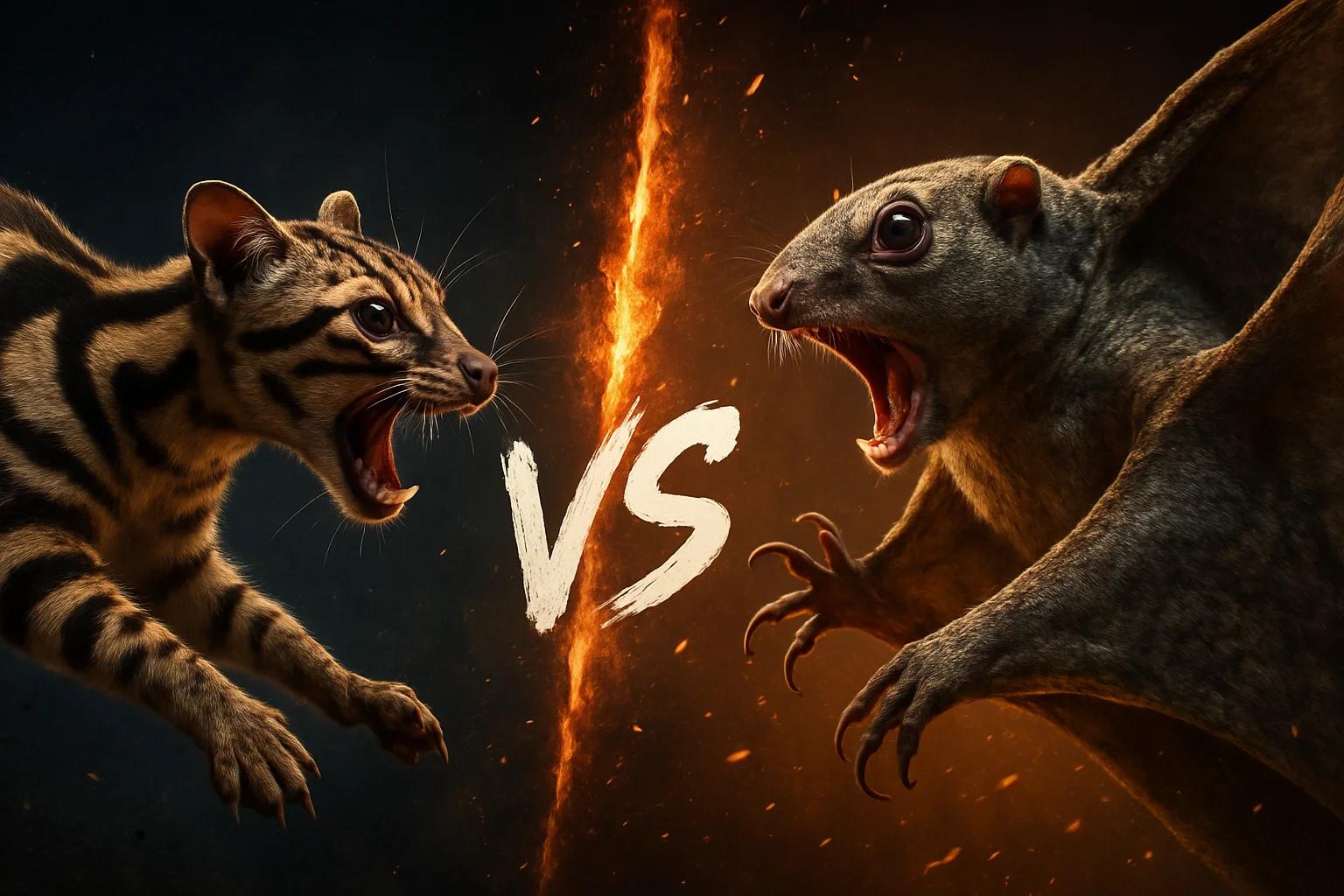
Banded Palm Civet vs Sunda Flying Lemur: Who Actually Wins?
Banded palm civet vs Sunda flying lemur (colugo): who would win a fight? A biology-first look at teeth, claws, gliding escape, and forest-floor control in Southeast Asian rainforests.
Banded Palm Civet vs Sunda Flying Lemur
Matchup winner
Banded Palm Civet
Quick verdict
Start with the direct answer, then use the structured comparison below to see what changes the outcome.
The banded palm civet wins. The two animals are close in weight: the civet runs roughly 1.5 to 3 kg, and the colugo roughly 1 to 2 kg. The difference is in what each body is built to do. The civet is a true carnivoran with shearing carnassial teeth, a predatory bite, and the reflexes of a nocturnal hunter that seizes struggling prey on the ground and in low vegetation. The Sunda flying lemur is a leaf-eating glider. Its comb-like lower incisors are grooming and food-scraping tools, not weapons, and its skin membrane makes it clumsy and slow on any flat surface. The colugo's best move is not to fight at all but to climb high and glide away, and in a sustained close-range contest the civet's bite decides it.
Read the full explanation
Winner: banded palm civet, a small but genuine predator with a real bite.
The colugo may be similar in size or bigger by app stats, but it is a folivore with no fighting dentition.
On the ground, the colugo's gliding membrane becomes a handicap.
High in the canopy, the colugo usually escapes rather than loses, which is why it survives.
Reader vote
Who do you think wins?
Pick a side — no account needed. Results update live.
No votes yet — be the first to call it.
Editorial note
Why people disagree
The name 'flying lemur' makes people picture a primate brawler, but it is neither a lemur nor a true flier. It is a gentle gliding leaf-eater.
Bite weaponry
Fights between small mammals are settled by bites, and only the civet has a killing bite.
Predatory instinct
The civet knows how to grab and hold a struggling animal. The colugo has never needed to.
Ground mobility
Once the colugo is on the forest floor, it can neither flee well nor reposition.
Read the full explanation +
Size stats can favor the colugo, yet body plan matters more than mass. The civet's carnivoran skull outclasses the colugo's leaf-processing jaws.
Some argue the colugo 'wins' by vanishing on a glide. That counts as survival, not victory in a fight.
Comparison FAQ
Short, direct answers to the next questions readers usually ask after the headline verdict.
Would a banded palm civet beat a Sunda flying lemur?+
Yes, in most direct encounters. The civet's carnivoran bite and predatory reflexes outclass the colugo's leaf-eating jaws.
Which animal is stronger?+
Pound for pound, the civet is stronger in a fight because it has a more muscular, compact frame and a skull built for biting. The colugo's strength is in its grip, not in combat.
Is the flying lemur actually a lemur?+
No. Colugos belong to their own order, Dermoptera, and are among the closest living relatives of primates. They glide rather than fly.
Why is the colugo still dangerous to a civet?+
Its sharp clinging claws can rake a predator's face, and its ability to glide away from a trunk means a civet can lose its target in an instant.
Do they meet in the wild?+
Their ranges overlap in Sundaland forests, but they rarely compete. The civet forages low at night, and the colugo feeds on leaves high in the canopy.
Head-to-head species stats
These are the same core AnimalDex stat dimensions used on the dedicated animal pages, pulled side by side so the matchup is faster to scan.
Banded Palm Civet
Tier BSunda Flying Lemur
Tier BTrait-by-trait comparison
Only the categories that matter to this matchup are included. The goal is not filler stats, but the real design differences that change the result.
Carnassial shearing teeth, predatory canines
Bite weaponry
Banded Palm Civet
Comb-like incisors built for scraping leaves and grooming
Bite weaponry
Banded Palm Civet
Active nocturnal hunter of invertebrates and small vertebrates
Predatory instinct
Banded Palm Civet
Folivore with no hunting behavior
Predatory instinct
Banded Palm Civet
Agile, quick, low to the ground
Ground mobility
Banded Palm Civet
Awkward, hampered by its patagium
Ground mobility
Banded Palm Civet
Competent climber, but no gliding
Vertical escape
Sunda Flying Lemur
Elite climber that glides 100+ m between trees
Vertical escape
Sunda Flying Lemur
Sharp, partly retractable claws
Clinging grip
Sunda Flying Lemur
Strong, needle-sharp claws for trunk clinging
Clinging grip
Sunda Flying Lemur
Compact, muscular carnivoran frame
Close-range durability
Banded Palm Civet
Light build spread across a thin membrane
Close-range durability
Banded Palm Civet
How the verdict forms
Verdict timeline
01 · Bite weaponry
Banded Palm Civet
02 · Predatory instinct
Banded Palm Civet
03 · Ground mobility
Banded Palm Civet
04 · Vertical escape
Sunda Flying Lemur
05 · Clinging grip
Sunda Flying Lemur
06 · Close-range durability
Banded Palm Civet
Change the conditions
Scenario breakdown
This is where shallow battle content usually fails. Terrain, spacing, timing, and engagement style can change the answer.
Scenario lean
Banded Palm Civet
Verdict confidence
82%
Civet controls the tangle.
Low vegetation is the civet's hunting ground. Confined space cancels the colugo's glide, and the civet's quick bite-and-hold technique dominates at close quarters.
AnimalDex field profiles
Explore these animals
Banded Palm Civet
Hemigalus derbyanus
rainforest, peat swamp forest, and dense tropical woodland
Sunda Flying Lemur
Galeopterus variegatus
rainforest canopy, plantation edge, and tropical woodland
Systems Intelligence & Hidden Purpose
See the animals behind this comparison as engineered biological systems: what each one is built to do, where it gains leverage, and why the matchup changes by scenario.
Specialized Hardware
dark coat with pale bands, large night-adapted eyes, and tree-and-ground foraging give the Banded Palm Civet a body plan tuned for its niche.
Systems Script
Banded Palm Civets operate through rainforest, peat swamp forest, and dense tropical woodland. Their design links movement, feeding, shelter, and timing into one workable survival system.
Strategic Insight
Dense environments reward precision, patience, and the ability to read layered cover.
Specialized Hardware
full-body gliding membrane, large night-adapted eyes, and tree-trunk clinging feet give the Sunda Flying Lemur a body plan tuned for its niche.
Systems Script
Sunda Flying Lemurs operate through rainforest canopy, plantation edge, and tropical woodland. Their design links movement, feeding, shelter, and timing into one workable survival system.
Strategic Insight
Dense environments reward precision, patience, and the ability to read layered cover.
Final take
The banded palm civet is the clear winner in a fight. It is a predator with the teeth and instincts to finish a confrontation, while the Sunda flying lemur is a gentle leaf-eater whose anatomy is tuned for drifting between trees, not trading bites.
Read the full explanation
The colugo is still not easy prey. With altitude it has one of the best exit strategies in the rainforest, and its claws can punish a careless grab. But the question is who wins, and when the two actually meet in contact, it's the civet.
Collect both animals in AnimalDex
Track the species behind this matchup, compare their real traits, and build the rivalry into your AnimalDex collection.
Related comparisons
Continue with nearby matchups to compare more real-world animal traits without dropping into junky who-wins filler.
Banded Linsang vs Sunda Flying Lemur: Who Actually Wins?
The banded linsang wins. It is the smaller animal, often around 0.6–0.8 kg against a colugo that can weigh twice as much, but it is built to kill. The linsang is a lean, almost entirely carnivorous climber with retractile claws, a fast neck-directed bite, and a hunter's habit of committing to small, struggling prey. The Sunda flying lemur is a nocturnal folivore. Its body is designed around a huge gliding membrane, a leaf-processing gut, and grasping claws that are made for clinging rather than fighting. If the colugo is forced to stand and fight, its extra mass buys it time but no real offense. Its genuine advantage is leaving. A colugo that reaches launch height can glide away and end the encounter. So the colugo wins the escape game, but the linsang wins the fight.
Read comparison
Discussion
What do you think?
Share your reasoning with other readers. Be civil and stick to the animals.
Sign in to join the discussion.
Sign inNo comments yet. Start the conversation.