

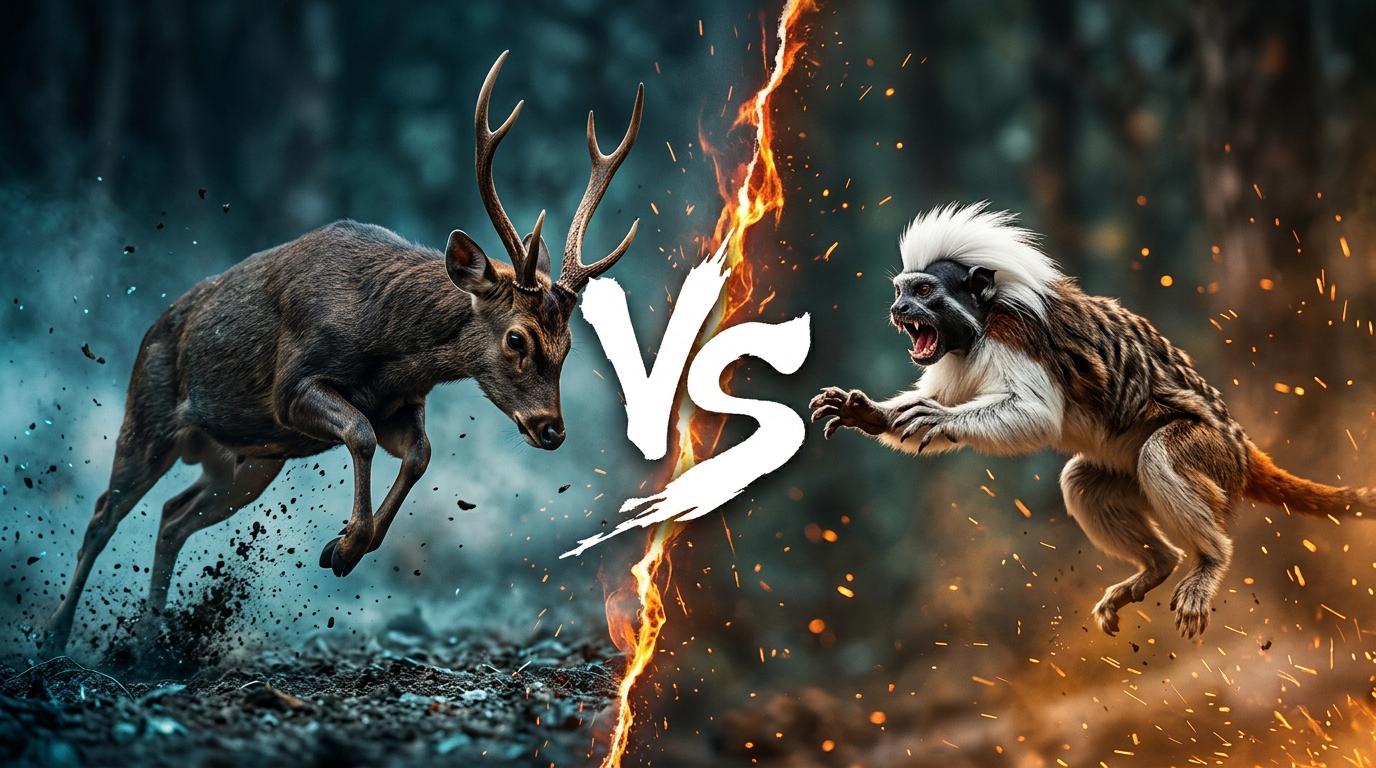
Bawean Deer vs Cotton-top Tamarin: Who Actually Wins?
Bawean deer vs cotton-top tamarin: a biology-first look at size, speed, defenses and habitat to explain why the island deer wins a hypothetical clash.
Bawean Deer vs Cotton-top Tamarin
Matchup winner
Bawean Deer
Quick verdict
Start with the direct answer, then use the structured comparison below to see what changes the outcome.
The Bawean deer wins clearly. A Bawean deer is a small, critically endangered deer from one Indonesian island, but it still weighs roughly 15–25 times more than a cotton-top tamarin (about 15–30 kg versus about 0.4–0.5 kg). It has hard hooves, a sturdy neck, and in males short antlers used in rutting contests. The tamarin is a nimble Colombian forest primate built for gripping branches, catching insects and running from hawks and snakes. It is not built to hurt something the size of a deer. In any meeting on the ground, the deer controls the space. The tamarin's real strength is avoiding the encounter altogether, and that is a survival win, not a fight win.
Read the full explanation
The Bawean deer wins: it outweighs the tamarin by more than an order of magnitude.
Hooves, a sturdy frame and male antlers give the deer real tools; the tamarin has little more than small teeth and claw-like nails.
The tamarin's best move is to climb and stay out of reach, which keeps it safe but cannot beat the deer.
In the canopy there is no contest at all, because the deer can't get there.
Reader vote
Who do you think wins?
Pick a side — no account needed. Results update live.
No votes yet — be the first to call it.
Editorial note
Why people disagree
Some readers think 'deer' means harmless and 'primate' means clever fighter. Body mass decides this one, not reputation.
Body mass advantage
A gap this large makes any physical contact one-sided.
Striking tools
The deer can kick, butt and trample. The tamarin's weapons are sized for insects.
Burst & escape speed
On level ground the deer covers distance faster. The tamarin's speed only shines in the canopy.
Read the full explanation +
The tamarin is far more agile in trees, which some people count as winning. Escaping is not the same as overpowering.
Both animals are rare and gentle, so a 'battle' feels artificial. The comparison really tests body design, not aggression.
Comparison FAQ
Short, direct answers to the next questions readers usually ask after the headline verdict.
Would a Bawean deer beat a cotton-top tamarin?+
Yes. In a ground encounter the deer's large size and weight advantage, hooves and durability make it the clear winner.
Which is stronger, the Bawean deer or the cotton-top tamarin?+
The Bawean deer, by a wide margin. It weighs roughly 15–25 kg or more, while the tamarin weighs about half a kilogram.
Why is the cotton-top tamarin still hard to beat?+
It climbs and leaps very well, and its family group raises alarm calls early. A deer can't follow it into the trees, so it usually avoids the fight entirely.
Do these animals meet in the wild?+
No. The Bawean deer lives only on Bawean Island in Indonesia, and the cotton-top tamarin lives in northwestern Colombia.
Are they endangered?+
Both are listed as Critically Endangered by the IUCN, mainly because of habitat loss.
Head-to-head species stats
These are the same core AnimalDex stat dimensions used on the dedicated animal pages, pulled side by side so the matchup is faster to scan.
Bawean Deer
Tier BCotton-top Tamarin
Tier BTrait-by-trait comparison
Only the categories that matter to this matchup are included. The goal is not filler stats, but the real design differences that change the result.
Compact deer, ~15–25 kg+
Body mass advantage
Bawean Deer
Featherweight, ~0.4–0.5 kg
Body mass advantage
Bawean Deer
Hard hooves, short antlers (males)
Striking tools
Bawean Deer
Small teeth, claw-like nails
Striking tools
Bawean Deer
Quick ducking runner in dense cover
Burst & escape speed
Bawean Deer
Rapid leaper along branches
Burst & escape speed
Bawean Deer
Ground-bound
Vertical control
Cotton-top Tamarin
Expert climber and leaper
Vertical control
Cotton-top Tamarin
Mostly solitary, shy and secretive
Group vigilance
Cotton-top Tamarin
Cooperative family groups with alarm calls
Group vigilance
Cotton-top Tamarin
Thick neck, robust frame
Close-range durability
Bawean Deer
Fragile, lightweight build
Close-range durability
Bawean Deer
How the verdict forms
Verdict timeline
01 · Body mass advantage
Bawean Deer
02 · Striking tools
Bawean Deer
03 · Burst & escape speed
Bawean Deer
04 · Vertical control
Cotton-top Tamarin
05 · Group vigilance
Cotton-top Tamarin
06 · Close-range durability
Bawean Deer
Change the conditions
Scenario breakdown
This is where shallow battle content usually fails. Terrain, spacing, timing, and engagement style can change the answer.
Scenario lean
Bawean Deer
Verdict confidence
82%
The deer controls the low thicket.
Bawean deer are specialists of tangled secondary forest and use their low profile to move through it. Undergrowth slows a tamarin, which travels best in the branches above. At ground level the deer's mass and hooves dominate.
AnimalDex field profiles
Explore these animals
Bawean Deer
Axis kuhlii
island forest, shrubland, and teak woodland edge
Cotton-top Tamarin
Saguinus oedipus
dry forest, secondary woodland, and forest edge
Systems Intelligence & Hidden Purpose
See the animals behind this comparison as engineered biological systems: what each one is built to do, where it gains leverage, and why the matchup changes by scenario.
Specialized Hardware
small island deer frame, short upright antlers, and low-cover forest browsing give the Bawean Deer a body plan tuned for its niche.
Systems Script
Bawean Deers operate through island forest, shrubland, and teak woodland edge. Their design links movement, feeding, shelter, and timing into one workable survival system.
Strategic Insight
Dense environments reward precision, patience, and the ability to read layered cover.
Specialized Hardware
wild white crest hair, tiny agile monkey body, and cooperative troop life give the Cotton-top Tamarin a body plan tuned for its niche.
Systems Script
Cotton-top Tamarins operate through dry forest, secondary woodland, and forest edge. Their design links movement, feeding, shelter, and timing into one workable survival system.
Strategic Insight
Harsh places reward efficiency, timing, and bodies that waste very little.
Final take
The Bawean deer is the clear overall winner. Weight, hooves and a sturdy frame decide every ground-level scenario, and the tamarin has no tools that scale up to an animal its size.
Read the full explanation
The tamarin still deserves respect. It is a tiny, alert, cooperative climber whose whole survival strategy is not being caught. Neither animal is aggressive, and both are threatened in the wild. The real story is how differently each body solves the problem of staying alive.
Collect both animals in AnimalDex
Track the species behind this matchup, compare their real traits, and build the rivalry into your AnimalDex collection.
Related comparisons
Continue with nearby matchups to compare more real-world animal traits without dropping into junky who-wins filler.
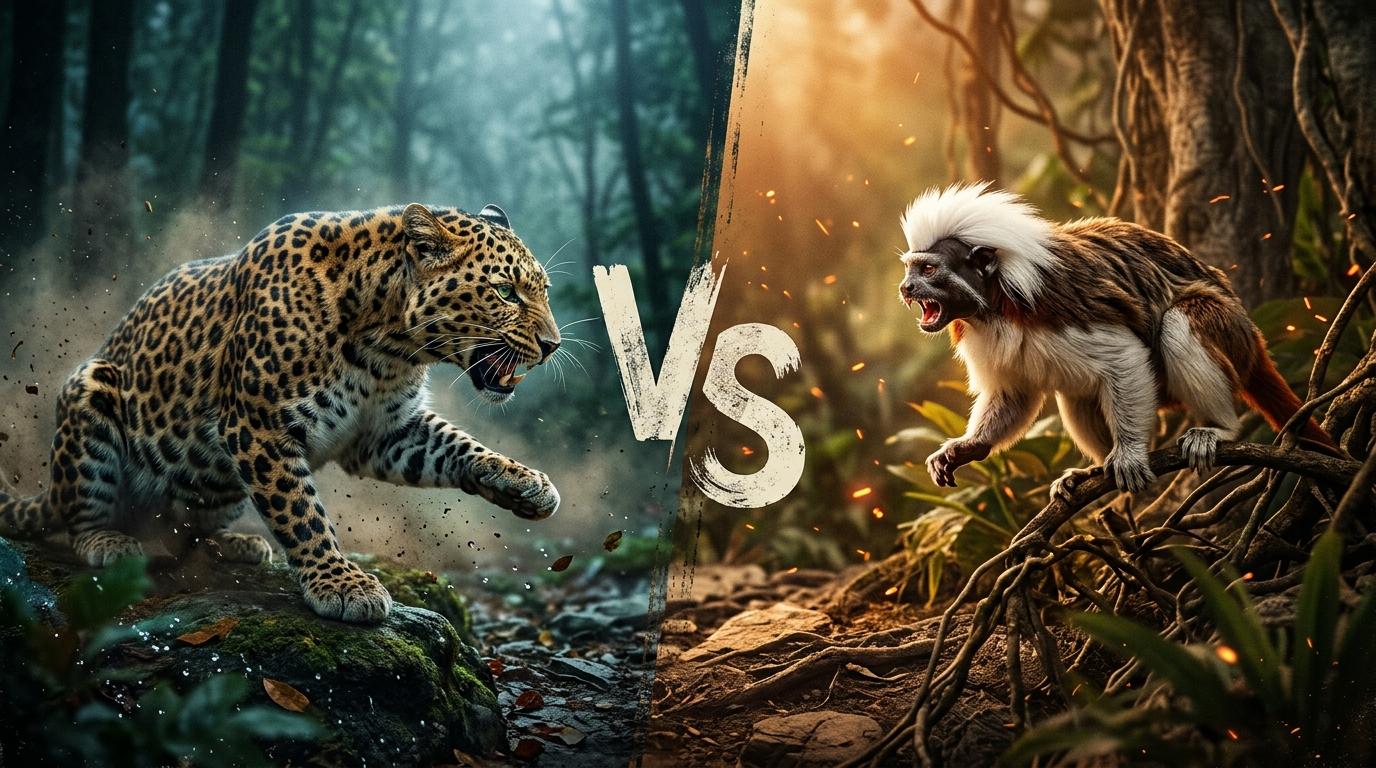
Amur Leopard vs Cotton-top Tamarin: Who Actually Wins?
The Amur leopard wins decisively. It weighs roughly 30–48 kg against the cotton-top tamarin's 400–500 g, about 80 to 100 times heavier, and pairs that mass with retractable claws, a crushing bite and stalk-and-pounce timing refined for deer-sized prey. The tamarin has no weapon that changes a direct contact outcome. Its only winning move is to avoid the encounter entirely by using thin canopy branches, group vigilance and sharp alarm calls to detect a predator early and stay where a heavy cat cannot follow. Once contact happens, the contest is over almost immediately. The real question is whether the leopard can reach it first.
Read comparison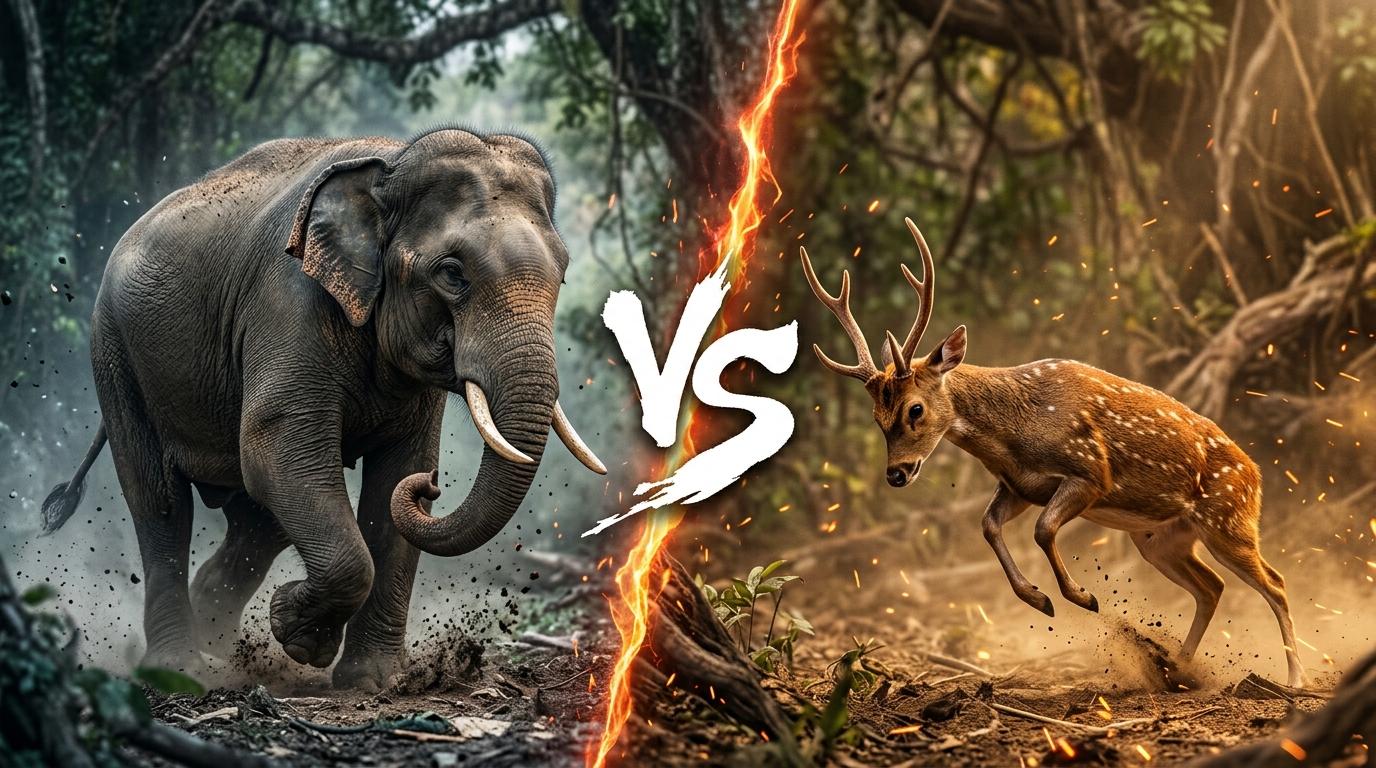
Asian Elephant vs Bawean Deer: Who Actually Wins?
The Asian elephant wins decisively. At roughly 2,500–5,000 kg against a Bawean deer of about 50–60 kg, the elephant holds an advantage of nearly a hundredfold in body mass, plus a trunk capable of lifting and shoving with enormous force, thick skin, and the social intelligence to read and control a confrontation. The Bawean deer, a critically endangered small deer found only on Bawean Island off Java, has no weapon or defense that scales to this matchup. Its antlers are modest, and its real strategy is to vanish into dense secondary forest and teak scrub. In any direct contest the elephant controls space completely. The deer's only win condition is to never engage at all.
Read comparison
Asian Elephant vs Cotton-top Tamarin: Who Actually Wins?
The Asian elephant wins decisively. An adult weighs roughly 3,000–5,000 kg. A cotton-top tamarin weighs about 400–500 g, so the elephant is around ten thousand times heavier. The elephant also has a muscular, prehensile trunk, thick skin, and a strong threat-response instinct, which gives the tamarin no realistic way to hurt it. The tamarin's real strengths are speed through branches, alertness, and group vigilance. Those are survival tools, not fighting tools. If the two ever came into conflict, the elephant would control the space and the tamarin would simply leave. The only 'contest' the tamarin can win is not being caught.
Read comparison
Discussion
What do you think?
Share your reasoning with other readers. Be civil and stick to the animals.
Sign in to join the discussion.
Sign inNo comments yet. Start the conversation.