

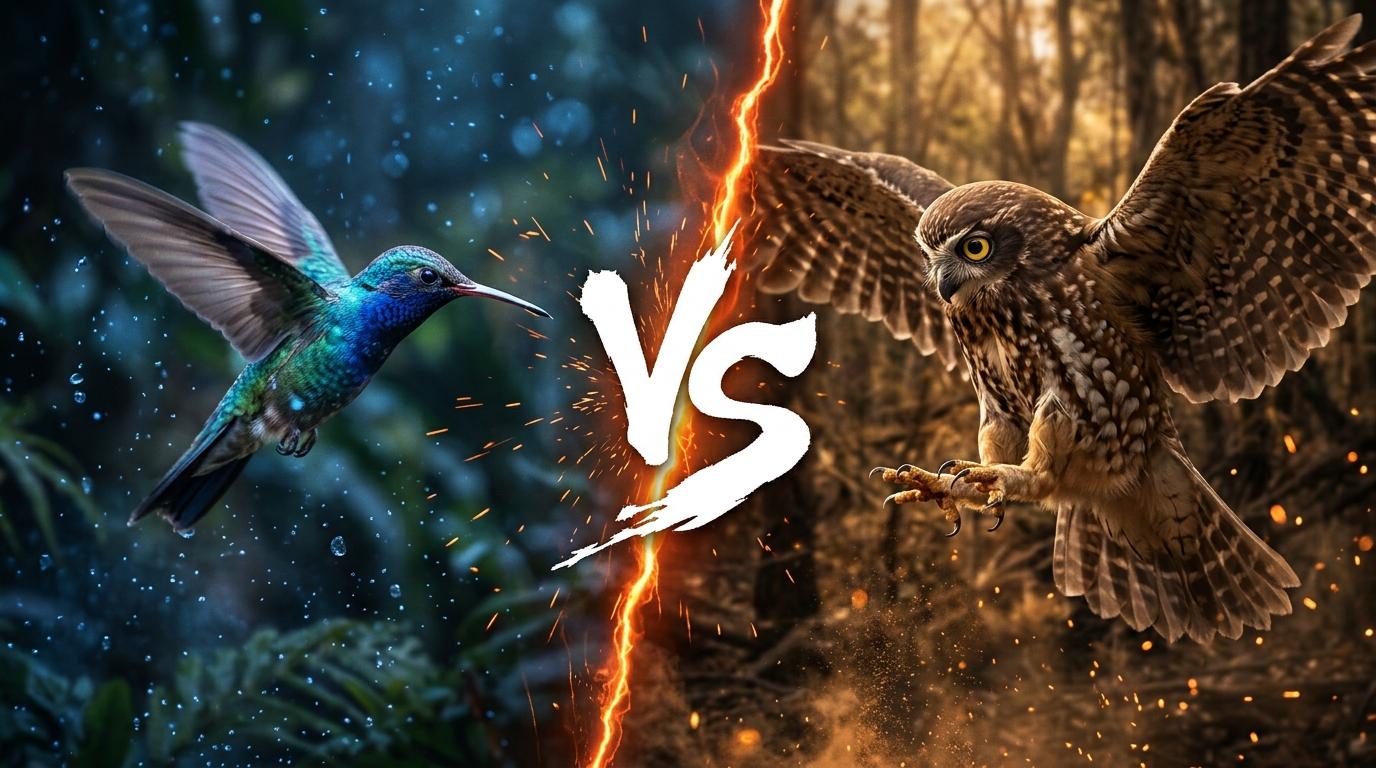
Bee Hummingbird vs Boobook Owl: Who Actually Wins?
Bee hummingbird vs boobook owl: the world's smallest bird against a nocturnal Australasian hunter. See who wins, why, and how each one survives.
Bee Hummingbird vs Boobook Owl
Matchup winner
Boobook Owl
Quick verdict
Start with the direct answer, then use the structured comparison below to see what changes the outcome.
The Boobook Owl wins clearly. This is a predator built to catch small animals against a 2-gram nectar specialist. A southern boobook weighs roughly 150–360 g, more than a hundred times the mass of a bee hummingbird (about 1.6–2 g). It carries curved talons, a hooked bill, near-silent flight feathers, and hearing tuned to locate small prey in darkness. The bee hummingbird has no weapon of any kind. Its needle bill is a feeding tube, and its feet are made for perching, not gripping prey. What it does have is extraordinary flight control: hovering, instant reversals, and a wingbeat of roughly 80 per second. That makes it a frustrating target in daylight and open air. But in any frame where contact happens, the owl's grip ends it immediately. One real-world note: these two never meet in the wild. The hummingbird lives only in Cuba, and the boobook lives in Australia, New Guinea, and nearby islands.
Read the full explanation
Boobook Owl wins. It outweighs the hummingbird by over 100x and is armed with talons and a hooked bill.
The bee hummingbird has no fighting tools. Its only strategy is not being caught.
In daylight open air, the hummingbird's agility and reaction speed make it very hard to catch.
At dusk or night, which is the owl's working hours, the hummingbird is roosting and exposed.
Reader vote
Who do you think wins?
Pick a side — no account needed. Results update live.
No votes yet — be the first to call it.
Editorial note
Why people disagree
Matching speed scores hide a key difference. The owl's speed is a silent glide-and-strike, while the hummingbird's is hover-and-dodge agility. Both are 'fast' in completely different ways.
Mass and reach
At this size gap, any contact is decisive. The hummingbird cannot absorb even a glancing grab.
Killing tools
Only one side carries tools that can injure the other.
Evasive agility
This is the hummingbird's whole survival case. In open air, a missed strike usually means it is gone.
Read the full explanation +
Hummingbirds are famously aggressive and will dive-bomb birds far larger than themselves. People mistake that territorial bluff for fighting power.
Some readers argue that 'escaping is winning.' In a battle frame, escape only denies the owl a kill. It never threatens the owl.
Boobooks mostly eat insects. That leads people to underrate them, even though they regularly take small birds and mice.
Comparison FAQ
Short, direct answers to the next questions readers usually ask after the headline verdict.
Would a boobook owl beat a bee hummingbird?+
Yes. The owl is over 100 times heavier and armed with talons. Any successful grab ends the encounter.
Which is stronger, a bee hummingbird or a boobook owl?+
The boobook owl, by an enormous margin. The hummingbird is the world's smallest bird and has no gripping or tearing strength.
Why is the bee hummingbird still hard to catch?+
It can hover, fly backward, and change direction instantly. In daylight open air, a single missed strike usually lets it escape.
Do boobook owls eat birds?+
Mostly insects, but they also take small birds and mammals when the chance comes up.
Do they live in the same place?+
No. Bee hummingbirds live only in Cuba. Boobooks live in Australia, New Guinea, and nearby islands. This matchup is hypothetical.
Head-to-head species stats
These are the same core AnimalDex stat dimensions used on the dedicated animal pages, pulled side by side so the matchup is faster to scan.
Bee Hummingbird
Tier CBoobook Owl
Tier BTrait-by-trait comparison
Only the categories that matter to this matchup are included. The goal is not filler stats, but the real design differences that change the result.
About 2 g, roughly 5–6 cm long
Mass and reach
Boobook Owl
About 150–360 g, roughly 27–36 cm long
Mass and reach
Boobook Owl
Needle bill made for nectar; weak perching feet
Killing tools
Boobook Owl
Curved talons, hooked tearing bill
Killing tools
Boobook Owl
Hovers, flies backward, makes instant direction changes
Evasive agility
Bee Hummingbird
Steady, silent glide; turns well but cannot hover
Evasive agility
Bee Hummingbird
Daylight vision; enters overnight torpor
Low-light detection
Boobook Owl
Large forward eyes; precise sound-locating hearing
Low-light detection
Boobook Owl
Loud wing buzz announces its presence
Stealth strike
Boobook Owl
Soft-edged feathers allow near-silent approach
Stealth strike
Boobook Owl
Must feed every few minutes; has almost no energy reserves
Metabolic endurance
Boobook Owl
Sit-and-wait hunter with patient energy use
Metabolic endurance
Boobook Owl
How the verdict forms
Verdict timeline
01 · Mass and reach
Boobook Owl
02 · Killing tools
Boobook Owl
03 · Evasive agility
Bee Hummingbird
04 · Low-light detection
Boobook Owl
05 · Stealth strike
Boobook Owl
06 · Metabolic endurance
Boobook Owl
Change the conditions
Scenario breakdown
This is where shallow battle content usually fails. Terrain, spacing, timing, and engagement style can change the answer.
Scenario lean
Boobook Owl
Verdict confidence
82%
Owl, decisively.
Branches cut off the hummingbird's escape lines. Fading light hands the owl its sensory advantage. The owl's silent approach and listening-based targeting let it pin down a perched hummingbird before the bird can react.
AnimalDex field profiles
Explore these animals
Bee Hummingbird
Mellisuga helenae
forest edge, garden, and flowering scrub
Boobook Owl
Ninox boobook
open woodland, eucalyptus forest, and scrub edge
Systems Intelligence & Hidden Purpose
See the animals behind this comparison as engineered biological systems: what each one is built to do, where it gains leverage, and why the matchup changes by scenario.
Specialized Hardware
tiny jewel-like body, hovering flower feeding, and blazing wingbeat speed give the Bee Hummingbird a body plan tuned for its niche.
Systems Script
Bee Hummingbirds operate through forest edge, garden, and flowering scrub Their design links movement, shelter, feeding, and survival into one workable system.
Strategic Insight
Being tiny is powerful when precision is extreme.
Specialized Hardware
rounded head, yellow eyes, and repeated two-note calls give the Boobook Owl a body plan tuned for its niche.
Systems Script
Boobook Owls operate through open woodland, eucalyptus forest, and scrub edge. Their design links movement, feeding, shelter, and timing into one workable survival system.
Strategic Insight
Dense environments reward precision, patience, and the ability to read layered cover.
Final take
The Boobook Owl is the clear winner. It was built to locate, grab, and kill small animals. The bee hummingbird was built to hover at flowers and get away from trouble.
Read the full explanation
The hummingbird's best result is surviving a missed strike in bright, open air. That is real biology, not a consolation prize, but it is evasion, not victory. In three of four realistic scenarios, the owl's mass, talons, stealth, and timing settle the outcome.
Collect both animals in AnimalDex
Track the species behind this matchup, compare their real traits, and build the rivalry into your AnimalDex collection.
Related comparisons
Continue with nearby matchups to compare more real-world animal traits without dropping into junky who-wins filler.
Boobook Owl vs Satin Bowerbird: Who Actually Wins?
The Boobook Owl wins. On paper this looks close. Both birds are roughly 27–36 cm long and weigh a few hundred grams, and the Satin Bowerbird is the more cognitively flexible animal. But this is a battle question, and only one of these birds is built to subdue other animals. The boobook carries curved, gripping talons and a hooked tearing bill. It also has silent-flight feathers, and its eyes and ears are tuned for low light. It regularly takes moths, beetles, small mammals and small birds. The bowerbird is a fruit-and-insect eater whose stout bill is made for stripping fruit and arranging blue treasures, not for disabling a rival. In most realistic encounters, especially at dusk or at night, the owl controls the opening strike and the grip. The bowerbird's best result is to spot the threat, sound the alarm, and leave.
Read comparison
Boobook Owl vs Sacred Kingfisher: Who Actually Wins?
The Boobook Owl wins, and it is not especially close. The Australian boobook (Ninox boobook) is a small hawk-owl but still several times heavier than a Sacred Kingfisher: roughly 150–360 g, with females the larger sex, against about 30–65 g for the kingfisher. It also brings the right weapons for the job. Its grasping talons are built to seize and grip live prey, its night vision and directional hearing let it find targets in darkness, and its soft-edged flight feathers let it approach quietly. Small birds are a normal part of the boobook's diet, so this matchup sits within its predatory routine. The Sacred Kingfisher's best weapon is a dagger-like bill that drives into lizards, insects and crabs from a perch. That bill can hurt, but it is a striking tool built for small ground prey, not for fighting off a heavier raptor that controls the grip. In darkness or cover, the owl dominates. Only in bright daylight, with room to dodge, can the kingfisher reliably avoid a loss.
Read comparison
Discussion
What do you think?
Share your reasoning with other readers. Be civil and stick to the animals.
Sign in to join the discussion.
Sign inNo comments yet. Start the conversation.