


Beluga Sturgeon vs Largetooth Sawfish: Who Actually Wins?
Beluga sturgeon vs largetooth sawfish: a biology-first look at size, armor, weapons and habitat, plus who wins a head-to-head clash between two giant, critically endangered fish.
Beluga Sturgeon vs Largetooth Sawfish
Matchup winner
Largetooth Sawfish
Quick verdict
Start with the direct answer, then use the structured comparison below to see what changes the outcome.
The largetooth sawfish wins. Both are giant, ancient-lineage fish built for river mouths and murky water, but only one carries a weapon. The beluga sturgeon is a huge, armored bottom-cruiser. Its bony scutes and sheer bulk make it hard to hurt, but it has no teeth as an adult and feeds by suction through a toothless, protrusible mouth. The largetooth sawfish is a ray that routinely reaches 6–7 m. It packs a toothed rostrum that sweeps side to side, an electroreceptive sensor array along that saw, and a muscular shark-like tail. In any meaningful confrontation, the sawfish holds the only real offensive tool and the sensory edge in turbid water. The sturgeon's realistic best outcome is to absorb blows and leave.
Read the full explanation
Winner: Largetooth Sawfish. It is larger on average and the only one of the two with a true weapon.
The sawfish's toothed rostrum slashes and pins prey, and it can sense electric fields in muddy water.
The beluga sturgeon relies on armor plates and mass. It can endure damage but cannot dish it out.
In real life the two barely overlap. The sturgeon lives in the Caspian and Black Sea basins, while the sawfish lives in tropical coasts and rivers.
Reader vote
Who do you think wins?
Pick a side — no account needed. Results update live.
No votes yet — be the first to call it.
Editorial note
Why people disagree
Record beluga sturgeon (historical claims over 7 m and 1,500 kg) can rival or outweigh typical sawfish, so size arguments get messy.
Size and mass
Typical sawfish outsize typical sturgeon, and reach matters when the weapon sits on the front of the body.
Offensive hardware
This is the decisive gap. The sturgeon cannot meaningfully injure a large opponent.
Close-range durability
The sturgeon's armor is why it survives an exchange rather than collapsing quickly.
Read the full explanation +
Some readers treat the sturgeon's bony scutes as near-impenetrable armor and underestimate how a sweeping rostrum works against flanks, fins and gills.
Neither animal is aggressive toward large fish, so 'who wins' really means 'who controls the encounter', and that favors the armed, sensor-rich sawfish.
Comparison FAQ
Short, direct answers to the next questions readers usually ask after the headline verdict.
Would a largetooth sawfish beat a beluga sturgeon?+
Yes. The sawfish is usually larger and has a toothed, electroreceptive rostrum it can swing as a slashing weapon. The sturgeon has no comparable offense.
Which is stronger, the beluga sturgeon or the largetooth sawfish?+
Pound for pound they are comparable heavy-bodied fish. The sawfish converts its strength into damaging strikes, while the sturgeon's strength goes into cruising and endurance.
Why is the beluga sturgeon still dangerous if it loses?+
Its bony scutes are sharp-edged and hard, and its huge mass can bruise or batter in a thrashing encounter. Its armor also means a fight would be slow and costly rather than quick.
Is the beluga sturgeon bigger than the sawfish?+
Historic record belugas may have matched or exceeded the largest sawfish. Typical modern adults, however, are smaller than typical adult largetooth sawfish.
Do beluga sturgeon and largetooth sawfish ever meet in the wild?+
Essentially no. Beluga sturgeon live in the Caspian, Black and Adriatic Sea basins, while largetooth sawfish inhabit tropical coasts and rivers in the Atlantic, Indo-Pacific and eastern Pacific.
Is a sawfish a shark?+
No. Sawfish are rays with shark-like bodies. They are distinct from sawsharks, which have gills on the side and barbels on the saw.
Head-to-head species stats
These are the same core AnimalDex stat dimensions used on the dedicated animal pages, pulled side by side so the matchup is faster to scan.
Beluga Sturgeon
Tier BLargetooth Sawfish
Tier BTrait-by-trait comparison
Only the categories that matter to this matchup are included. The goal is not filler stats, but the real design differences that change the result.
Typically 3–5 m, rare giants larger
Size and mass
Largetooth Sawfish
Commonly 5–7 m including rostrum
Size and mass
Largetooth Sawfish
Toothless suction mouth, no weapon
Offensive hardware
Largetooth Sawfish
Toothed rostrum with lateral slashing
Offensive hardware
Largetooth Sawfish
Five rows of bony scutes, thick body
Close-range durability
Beluga Sturgeon
Tough skin with dermal denticles, but unplated
Close-range durability
Beluga Sturgeon
Barbels for touch and taste on the bottom
Murky-water sensing
Largetooth Sawfish
Electroreceptors packed along the rostrum
Murky-water sensing
Largetooth Sawfish
Steady cruiser, modest bursts
Burst and maneuver
Largetooth Sawfish
Shark-like tail, quick head sweeps
Burst and maneuver
Largetooth Sawfish
Long-distance migratory spawning runs
Endurance and range
Beluga Sturgeon
Wide-ranging but more site-attached
Endurance and range
Beluga Sturgeon
How the verdict forms
Verdict timeline
01 · Size and mass
Largetooth Sawfish
02 · Offensive hardware
Largetooth Sawfish
03 · Close-range durability
Beluga Sturgeon
04 · Murky-water sensing
Largetooth Sawfish
05 · Burst and maneuver
Largetooth Sawfish
06 · Endurance and range
Beluga Sturgeon
Change the conditions
Scenario breakdown
This is where shallow battle content usually fails. Terrain, spacing, timing, and engagement style can change the answer.
Scenario lean
Largetooth Sawfish
Verdict confidence
82%
Sawfish dominates in low visibility.
In turbid water, electroreception beats barbel-based touch sensing. The sawfish can locate the sturgeon's body field and deliver repeated lateral rostrum sweeps at fins and gill regions. The sturgeon's armor blunts some hits but gives it no way to answer.
AnimalDex field profiles
Explore these animals
Beluga Sturgeon
Huso huso
large river, estuary, and inland sea
Largetooth Sawfish
Pristis pristis
river mouth, estuary, and large tropical river
Systems Intelligence & Hidden Purpose
See the animals behind this comparison as engineered biological systems: what each one is built to do, where it gains leverage, and why the matchup changes by scenario.
Specialized Hardware
armored scute rows, protrusible bottom-feeding mouth, and immense migratory river size give the Beluga Sturgeon a body plan tuned for its niche.
Systems Script
Beluga Sturgeons operate through large river, estuary, and inland sea. Their design links movement, feeding, shelter, and timing into one workable survival system.
Strategic Insight
Where water controls movement, position and timing often matter more than speed.
Specialized Hardware
long tooth-lined saw rostrum, broad estuary-moving body, and muddy-water bottom cruising give the Largetooth Sawfish a body plan tuned for its niche.
Systems Script
Largetooth Sawfishs operate through river mouth, estuary, and large tropical river. Their design links movement, feeding, shelter, and timing into one workable survival system.
Strategic Insight
Where water controls movement, position and timing often matter more than speed.
Final take
The largetooth sawfish is the clear winner. It matches or exceeds the beluga sturgeon in size, and it adds the one thing the sturgeon completely lacks: a weapon, guided by an electrical sensing system built for murky water.
Read the full explanation
The beluga sturgeon is no pushover. Its armored scutes, enormous mass and long-distance endurance make it a survivor rather than a fighter. That is exactly why its best outcome is escape, not victory.
Both species are critically endangered. Overfishing for caviar has devastated the sturgeon, and net entanglement and habitat loss have devastated the sawfish. The real threat to both is us, not each other.
Collect both animals in AnimalDex
Track the species behind this matchup, compare their real traits, and build the rivalry into your AnimalDex collection.
Related comparisons
Continue with nearby matchups to compare more real-world animal traits without dropping into junky who-wins filler.
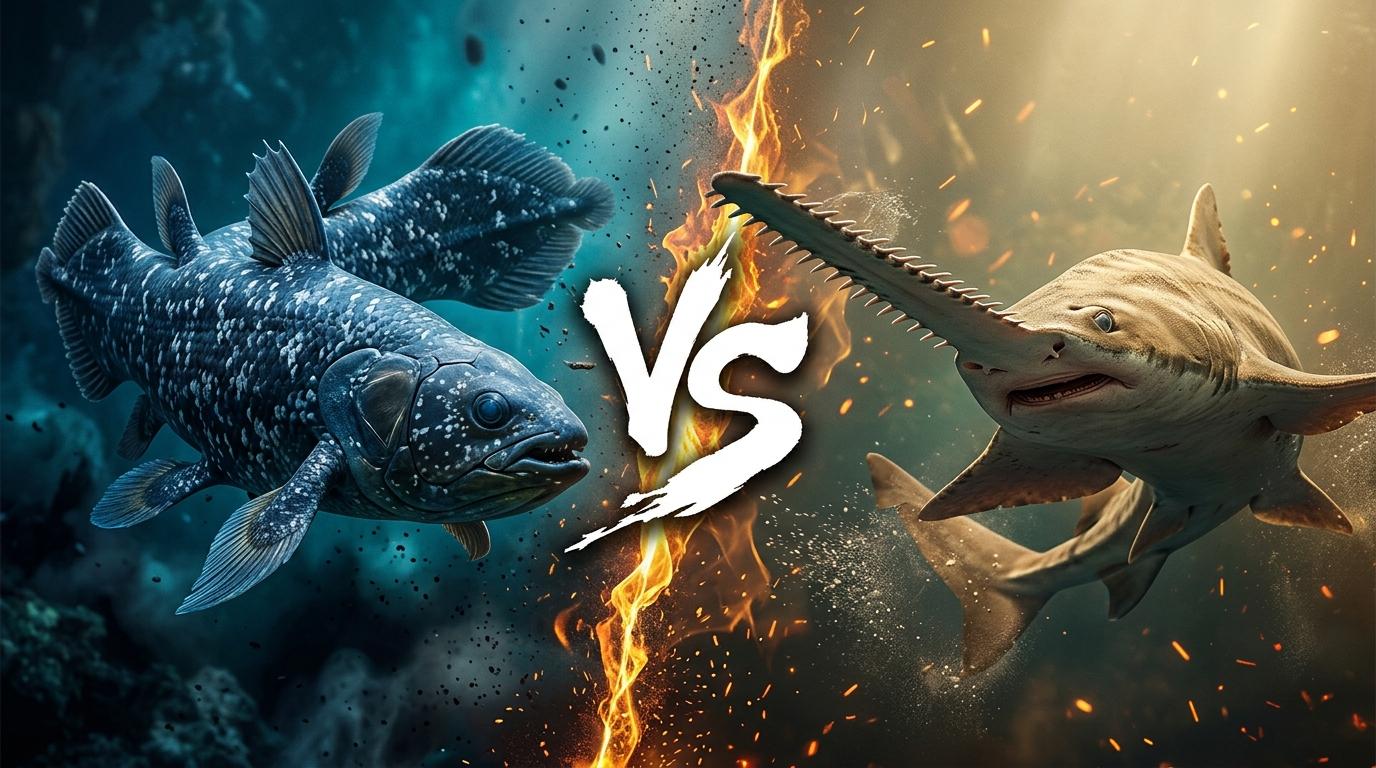
Coelacanth vs Largetooth Sawfish: Who Actually Wins?
The largetooth sawfish wins clearly. It is one of the largest rays on Earth. Big adults commonly pass 5 to 6 meters and several hundred kilograms, and some reach around 7 meters. Its rostrum is a toothed, sensor-packed blade that it whips sideways to stun and slash fish. The coelacanth is a slow, roughly 2-meter, 90-kilogram deep-reef drifter. It is built to save energy, not to fight, and its main defenses are heavy cosmine-coated scales and a habit of hiding in volcanic caves. In any frame where the two actually meet, the sawfish's three-to-one length edge, electroreceptive targeting and lateral slashing weapon outmatch the coelacanth's armor and patience. The coelacanth's real 'win condition' is avoidance: staying deep and in the rocks, where a shallow-water sawfish rarely goes.
Read comparison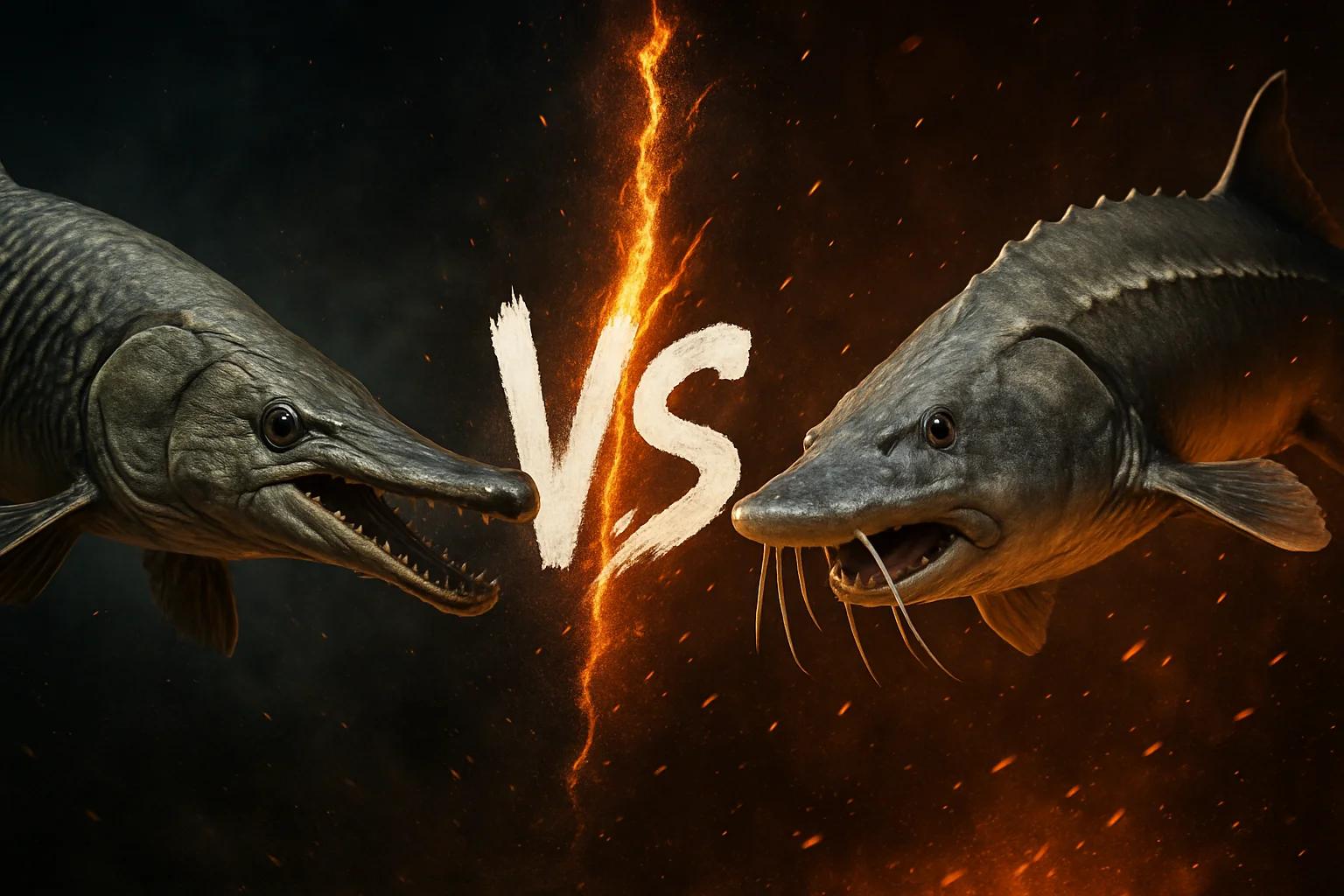
Alligator Gar vs Beluga Sturgeon: Who Actually Wins?
The alligator gar wins this matchup. The beluga sturgeon is the larger animal. Exceptional individuals have been recorded at over 1,000 kg and around 6 m, while a big gar runs about 2–3 m and 100–150 kg. But the sturgeon is built to vacuum fish and invertebrates with a toothless, protrusible mouth, not to bite. The gar is a dedicated predator. It has a long, double-rowed tooth-studded snout, a lunge-and-clamp strike, and interlocking ganoid scales hard enough that people once used them as arrowheads. In any contest where damage has to be dealt, only one fish has a weapon. The sturgeon's mass and bony scutes make it very hard to finish off, and the gar cannot swallow or kill a full-grown beluga. Still, the gar controls the exchange, lands the wounds and walks away the clear winner on points and on punishment.
Read comparison
Discussion
What do you think?
Share your reasoning with other readers. Be civil and stick to the animals.
Sign in to join the discussion.
Sign inNo comments yet. Start the conversation.