

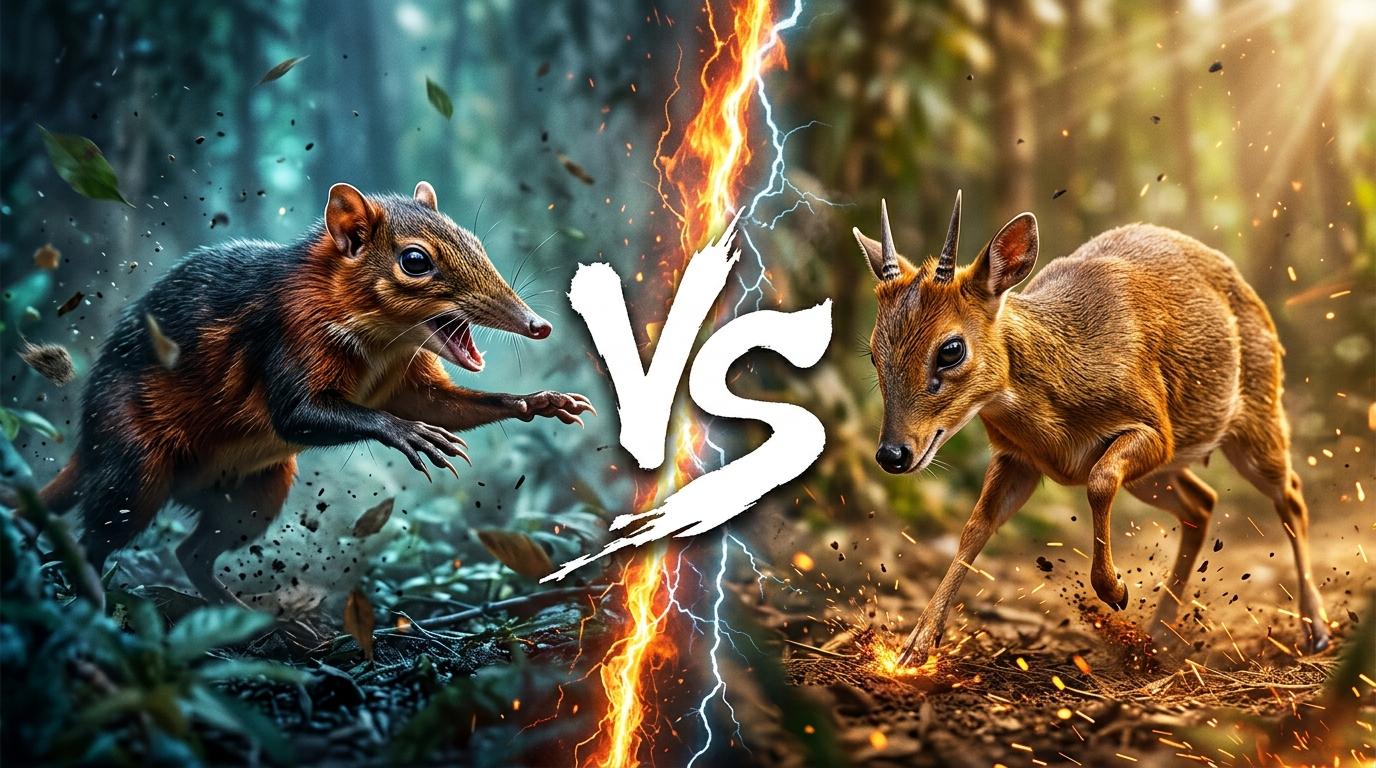
Black-and-rufous Elephant Shrew vs Suni: Who Actually Wins?
Black-and-rufous elephant shrew vs suni: a biology-first breakdown of size, weapons, speed, and forest-floor tactics, with a clear verdict on which East African forest dweller wins.
Black-and-rufous Elephant Shrew vs Suni
Matchup winner
Suni
Quick verdict
Start with the direct answer, then use the structured comparison below to see what changes the outcome.
The suni wins, and it isn't close. Both animals live on the leaf litter of East African coastal forests, but they belong to very different weight classes. A black-and-rufous elephant shrew, a giant sengi, weighs roughly half a kilogram and is built to hunt invertebrates and escape at speed. A suni is a dwarf antelope of about 4–6 kg, roughly ten times heavier. Males carry short, ridged, sharply pointed horns, and every suni has hooves and a body made for bounding through thickets. The sengi is quick, alert, and territorial, but it has no weapon that can seriously threaten an animal that size. In any real confrontation the suni's mass, horns, and kicking hooves decide it. The sengi's best outcome is to get away cleanly, and it is very good at that.
Read the full explanation
The suni wins: it outweighs the sengi about 10 to 1 and males have sharp horns.
The elephant shrew is fast and nimble, but its teeth are built for insects, not fighting large animals.
Neither animal hunts the other. A clash would be a territorial or startle encounter, not predation.
The sengi's real skill is escape. It can avoid losing, but it cannot beat a suni.
Reader vote
Who do you think wins?
Pick a side — no account needed. Results update live.
No votes yet — be the first to call it.
Editorial note
Why people disagree
Both animals are 'tiny' and share the same forest floor, so people assume they are evenly matched. In fact a suni is roughly ten times heavier than a giant sengi.
Body mass advantage
At small scales, a tenfold weight gap decides contact. The suni can shove, pin, and trample. The sengi can only bounce off.
Built-in weaponry
The suni has real stabbing and striking tools. The sengi's bite is made for beetles and centipedes.
Explosive getaway speed
Both are escape specialists. The suni's longer legs cover more ground per bound, while the sengi relies on short bursts along routes it knows.
Read the full explanation +
Elephant shrews are famous for speed and twitchy reflexes, which makes people overrate their chances in a fight. Speed helps them flee, not win.
The suni is shy and freezes when threatened, which reads as weakness. But a cornered male suni with horns and hooves is a real fighter at this scale.
Comparison FAQ
Short, direct answers to the next questions readers usually ask after the headline verdict.
Would a suni beat a black-and-rufous elephant shrew?+
Yes. The suni is roughly ten times heavier, and males have sharp ridged horns. It would win any direct physical confrontation.
Which is stronger, the suni or the elephant shrew?+
The suni, by a wide margin. It is a muscular antelope weighing about 4–6 kg, while the sengi weighs about half a kilogram.
Is the elephant shrew faster than the suni?+
Over short bursts the sengi is impressively quick, especially on its own cleared trails. The suni's longer legs and powerful bounds give it the edge over distance.
Why is the elephant shrew still dangerous, or at least hard to beat?+
It is extremely hard to catch. Constant vigilance, warning drumming, quick reflexes, and a small frame that slips through undergrowth mean a suni would rarely make contact at all.
Do sunis and elephant shrews actually fight in the wild?+
Rarely, if ever. They share coastal forest habitat but eat different foods, so real conflict would be a brief startle or a trail dispute.
Head-to-head species stats
These are the same core AnimalDex stat dimensions used on the dedicated animal pages, pulled side by side so the matchup is faster to scan.
Black-and-rufous Elephant Shrew
Tier BSuni
Tier BTrait-by-trait comparison
Only the categories that matter to this matchup are included. The goal is not filler stats, but the real design differences that change the result.
About 0.4–0.7 kg
Body mass advantage
Suni
About 4–6 kg
Body mass advantage
Suni
Small insect-crushing teeth
Built-in weaponry
Suni
Ridged horns (males) plus sharp hooves
Built-in weaponry
Suni
Fast, springy sprinter on cleared trails
Explosive getaway speed
Suni
Powerful zigzag bounder through thicket
Explosive getaway speed
Suni
Slips through litter and low gaps
Tight-space agility
Black-and-rufous Elephant Shrew
Agile, but needs more room
Tight-space agility
Black-and-rufous Elephant Shrew
Constant alertness, warning foot-drumming
Threat detection
Black-and-rufous Elephant Shrew
Keen senses, freeze-then-bolt response
Threat detection
Black-and-rufous Elephant Shrew
Light, delicate frame
Close-range durability
Suni
Compact, muscular antelope build
Close-range durability
Suni
How the verdict forms
Verdict timeline
01 · Body mass advantage
Suni
02 · Built-in weaponry
Suni
03 · Explosive getaway speed
Suni
04 · Tight-space agility
Black-and-rufous Elephant Shrew
05 · Threat detection
Black-and-rufous Elephant Shrew
06 · Close-range durability
Suni
Change the conditions
Scenario breakdown
This is where shallow battle content usually fails. Terrain, spacing, timing, and engagement style can change the answer.
Scenario lean
Suni
Verdict confidence
82%
The suni wins any contact, though the sengi may slip away first.
Dense cover is the sengi's best setting, because it can duck through gaps the suni can't use. But if the two actually meet head-on, the suni's weight and horns end it quickly. Cover only changes how easily the sengi escapes, not who wins the encounter.
AnimalDex field profiles
Explore these animals
Black-and-rufous Elephant Shrew
Rhynchocyon petersi
coastal forest and dense understory woodland
Suni
Neotragus moschatus
coastal forest, scrub, and thornbush
Systems Intelligence & Hidden Purpose
See the animals behind this comparison as engineered biological systems: what each one is built to do, where it gains leverage, and why the matchup changes by scenario.
Specialized Hardware
long flexible probing snout, bright black-and-rufous coat, and quick leaf-litter running give the Black-and-rufous Elephant Shrew a body plan tuned for its niche.
Systems Script
Black-and-rufous Elephant Shrews operate through coastal forest and dense understory woodland. Their design links movement, feeding, shelter, and timing into one workable survival system.
Strategic Insight
Dense environments reward precision, patience, and the ability to read layered cover.
Specialized Hardware
tiny chestnut antelope body, huge alert ears, and thorn-thicket zigzag hiding give the Suni a body plan tuned for its niche.
Systems Script
Sunis operate through coastal forest, scrub, and thornbush. Their design links movement, feeding, shelter, and timing into one workable survival system.
Strategic Insight
Dense environments reward precision, patience, and the ability to read layered cover.
Final take
The suni is the clear winner. Two animals that both seem small can still be very different in power. A dwarf antelope with horns and hooves sits in a different physical class from a giant sengi, however lively the sengi is.
Read the full explanation
The elephant shrew is not built for defeat, though. It is built to never be in the fight at all: it detects threats early, drums warnings with its feet, and sprints along trails it keeps cleared. On the forest floor, that counts as success. But in a direct contest of strength, the suni decides the outcome.
Collect both animals in AnimalDex
Track the species behind this matchup, compare their real traits, and build the rivalry into your AnimalDex collection.
Related comparisons
Continue with nearby matchups to compare more real-world animal traits without dropping into junky who-wins filler.
Gerenuk vs Suni: Who Actually Wins?
The gerenuk wins clearly. An adult gerenuk stands roughly 80–105 cm at the shoulder and weighs 28–52 kg. A suni is about 30–43 cm tall and weighs only 4–6 kg, so the gerenuk outweighs it by roughly six to ten times. Male gerenuks carry thick, lyre-shaped horns built for shoving matches and use powerful forelegs to stand upright while browsing. The suni's short, sharp horns and its fast dive into thick cover are made for escaping, not for winning a fight. In almost any direct contact, the gerenuk's mass, reach and horn leverage decide it. The suni's real win condition is never letting the meeting become a fight at all.
Read comparison
Discussion
What do you think?
Share your reasoning with other readers. Be civil and stick to the animals.
Sign in to join the discussion.
Sign inNo comments yet. Start the conversation.