

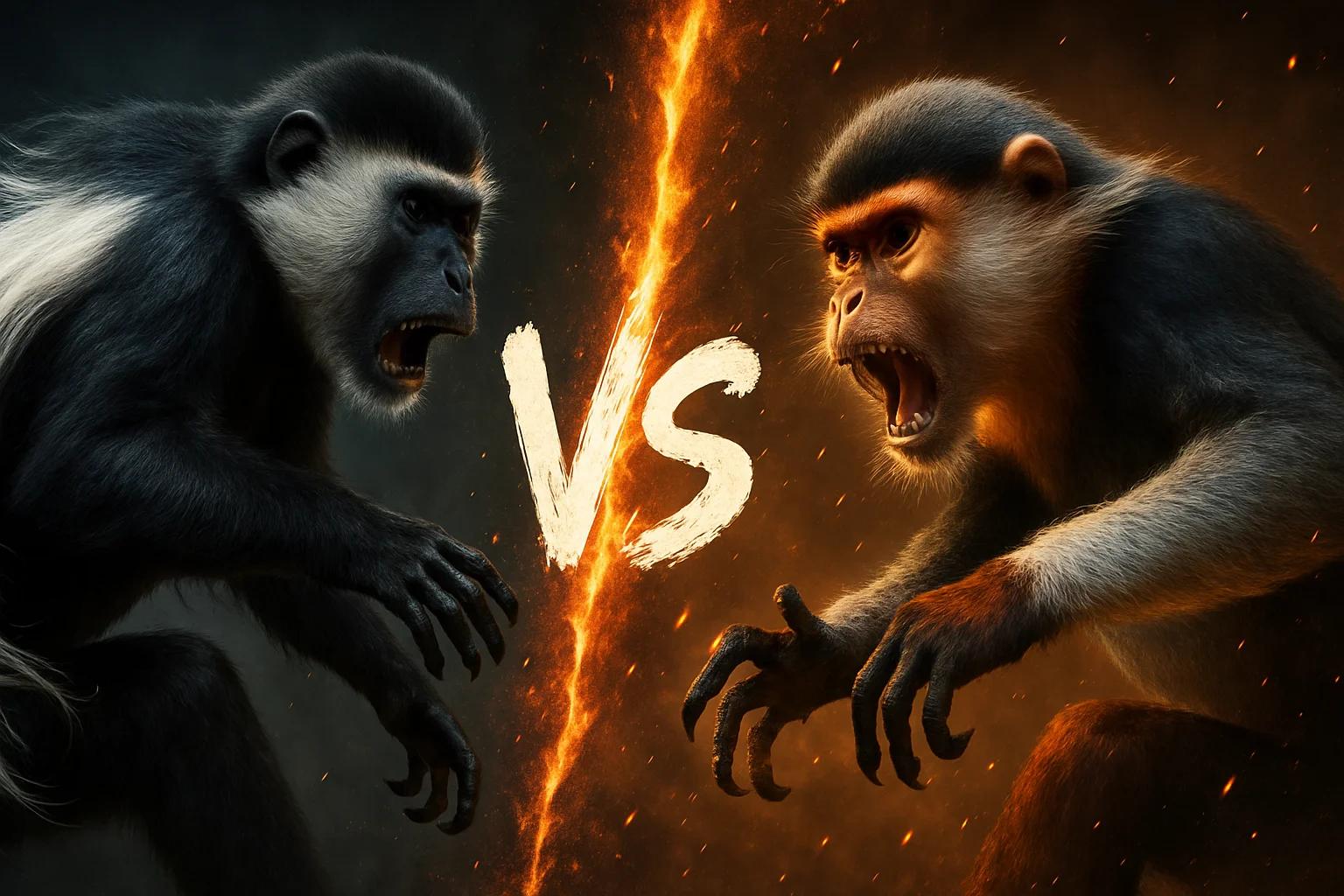
Mantled Guereza vs Red-shanked Douc: Who Actually Wins?
Mantled guereza vs red-shanked douc: two leaf-eating colobine monkeys compared on canopy power, agility, durability and behavior. See who would win and why.
Black-and-white Colobus vs Red-shanked Douc
Matchup winner
Black-and-white Colobus
Quick verdict
Start with the direct answer, then use the structured comparison below to see what changes the outcome.
The mantled guereza wins this colobine clash, though it is a close fight between leaf-eating cousins. Both monkeys are similar in size, with adult males around 9–14 kg for the guereza and roughly 10–11 kg for the douc, and both run on a slow-burning folivore engine built around a multi-chambered stomach. The guereza gets the edge for three reasons. Its males are seasoned territorial defenders whose roaring choruses and branch-shaking displays are built for confronting rivals. It has a slightly heavier, denser frame. And it is famous for bold, controlled leaps through the canopy, using its long cape and tail as stabilizers. The red-shanked douc is a slightly quicker, very agile arm-and-leg climber that lives in cohesive, low-aggression groups. That makes it superb at moving through the forest, but it is less practiced at forcing a confrontation. In a rare real dispute, the guereza's habit of defending space should carry it.
Read the full explanation
Overall winner: mantled guereza, by a narrow margin.
The guereza's territorial displays and slightly sturdier build give it the confrontation edge.
The red-shanked douc is a touch quicker and more fluid at climbing and swinging through branches.
In the wild these two never meet: guerezas live in Africa, doucs in Indochina.
Reader vote
Who do you think wins?
Pick a side — no account needed. Results update live.
No votes yet — be the first to call it.
Editorial note
Why people disagree
They look like weight-class twins, so small differences in temperament end up deciding the matchup.
Confrontation drive
In closely matched primates, the animal more willing to hold its ground usually wins the standoff.
Canopy agility
The douc can reposition faster in tangled branches, which makes it hard to pin down.
Frame and mass
A few extra kilograms matter when grappling on a branch.
Read the full explanation +
The douc's agility and spectacular coloring make it seem more athletic than its low-conflict social style suggests.
Neither species is a fighter by design, so some people argue any outcome is just a bluff contest rather than a real fight.
Comparison FAQ
Short, direct answers to the next questions readers usually ask after the headline verdict.
Would a mantled guereza beat a red-shanked douc in a fight?+
Most likely yes, by a narrow margin. Its territorial temperament, display behavior and slightly heavier build give it the edge in a direct confrontation.
Which monkey is stronger?+
The guereza is slightly stronger in practical terms. Males can be a little heavier and more compact, which helps in grappling and branch-shaking displays.
Why is the red-shanked douc still dangerous?+
Doucs have sharp canines and excellent agility, and they can bite and escape quickly. In dense cover they can avoid a losing fight altogether.
Do guerezas and doucs ever meet in the wild?+
No. Guerezas live in equatorial African forests, while red-shanked doucs live in Vietnam, Laos and Cambodia.
Are these monkeys aggressive?+
Both are mostly peaceful leaf-eaters. The guereza is more openly territorial, while the douc is known for relatively calm, tolerant groups.
Head-to-head species stats
These are the same core AnimalDex stat dimensions used on the dedicated animal pages, pulled side by side so the matchup is faster to scan.
Black-and-white Colobus
Tier BRed-shanked Douc
Tier ATrait-by-trait comparison
Only the categories that matter to this matchup are included. The goal is not filler stats, but the real design differences that change the result.
Territorial males that roar, display and chase rivals
Confrontation drive
Black-and-white Colobus
Tolerant groups that rarely escalate
Confrontation drive
Black-and-white Colobus
Powerful, gliding leaps
Canopy agility
Red-shanked Douc
Fluid arm-swinging, climbing and leaping
Canopy agility
Red-shanked Douc
Dense, heavy-caped body; males up to about 14 kg
Frame and mass
Black-and-white Colobus
Lean and long-limbed; males about 11 kg
Frame and mass
Black-and-white Colobus
Sharp male canines used in disputes
Bite and canines
Black-and-white Colobus
Comparable canines, rarely used
Bite and canines
Black-and-white Colobus
Loud dawn roars that carry across the forest
Signal warfare
Black-and-white Colobus
Subtle facial expressions and quiet calls
Signal warfare
Black-and-white Colobus
Low-energy leaf digestion with long rest periods
Endurance engine
Red-shanked Douc
Similar foregut fermentation on a broad leaf diet
Endurance engine
Red-shanked Douc
How the verdict forms
Verdict timeline
01 · Confrontation drive
Black-and-white Colobus
02 · Canopy agility
Red-shanked Douc
03 · Frame and mass
Black-and-white Colobus
04 · Bite and canines
Black-and-white Colobus
05 · Signal warfare
Black-and-white Colobus
06 · Endurance engine
Red-shanked Douc
Change the conditions
Scenario breakdown
This is where shallow battle content usually fails. Terrain, spacing, timing, and engagement style can change the answer.
Scenario lean
Red-shanked Douc
Verdict confidence
82%
The douc slips away and dictates terms.
In thick, interlaced branches, agility matters more than mass. The douc's fluid climbing lets it avoid commitment and wear down a heavier opponent. The guereza cannot force contact there.
AnimalDex field profiles
Explore these animals
Black-and-white Colobus
Colobus guereza
montane forest, river forest, and tropical woodland
Red-shanked Douc
Pygathrix nemaeus
tropical forest canopy and mountain woodland
Systems Intelligence & Hidden Purpose
See the animals behind this comparison as engineered biological systems: what each one is built to do, where it gains leverage, and why the matchup changes by scenario.
Specialized Hardware
dramatic black-and-white coat, high canopy leaf feeding, and tail used for balance in leaps give the Black-and-white Colobus a body plan tuned for its niche.
Systems Script
Black-and-white Colobuss operate through montane forest, river forest, and tropical woodland Their design links movement, shelter, and feeding into one workable survival system.
Strategic Insight
Grace becomes efficient when balance and diet both fit the same layer of habitat.
Specialized Hardware
bright multi-colored fur, leaf-eating monkey diet, and high-canopy social life give the Red-shanked Douc a body plan tuned for its niche.
Systems Script
Red-shanked Doucs operate through tropical forest canopy and mountain woodland Their design links movement, shelter, feeding, and survival into one workable system.
Strategic Insight
Even dazzling systems can be extremely fragile when the habitat web is broken.
Final take
The mantled guereza takes this matchup. It is not a powerhouse; it is simply the more practiced defender. Its males treat the canopy as space worth holding, and that mindset outweighs the douc's slight edge in agility.
Read the full explanation
The red-shanked douc is still no pushover. It is quick, fully capable of biting, and very hard to corner in dense forest. It is also endangered, with its numbers shrinking mainly due to hunting and habitat loss, which makes its real-world survival far more important than any hypothetical contest.
Collect both animals in AnimalDex
Track the species behind this matchup, compare their real traits, and build the rivalry into your AnimalDex collection.
Related comparisons
Continue with nearby matchups to compare more real-world animal traits without dropping into junky who-wins filler.
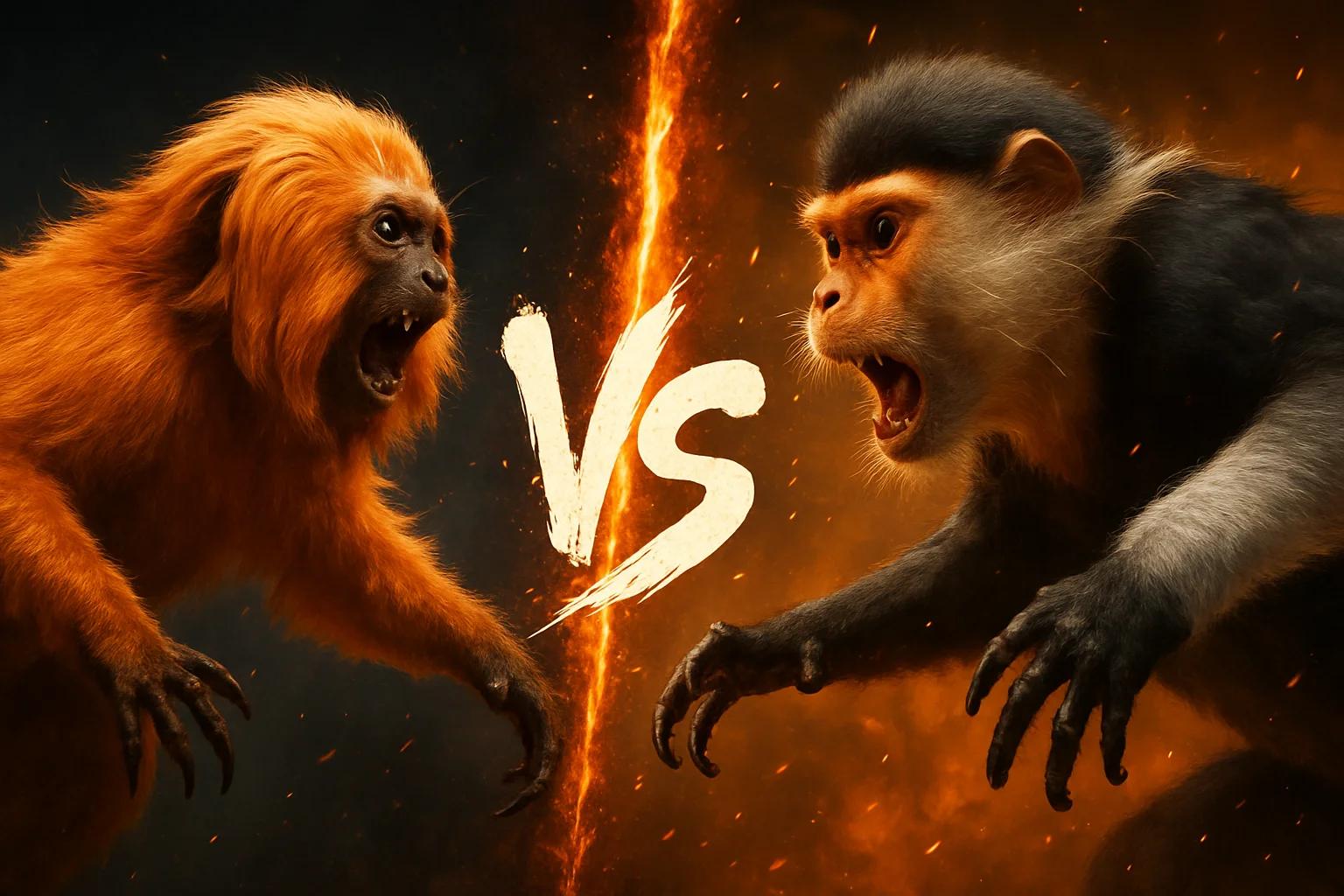
Golden Lion Tamarin vs Red-shanked Douc: Who Actually Wins?
The red-shanked douc wins, and it isn't especially close. An adult douc weighs roughly 8–11 kg against a golden lion tamarin's 500–700 g, a mass gap of more than tenfold. Its long limbs, heavy body, and real canine teeth turn any sustained contact into a mismatch. The tamarin's edge is speed in fine branches, claw-like nails for clinging, and sharp group vigilance, so it can escape almost any time it wants. In a forced confrontation, though, the douc's size and reach decide it. The tamarin's best result is a clean retreat, not a win.
Read comparison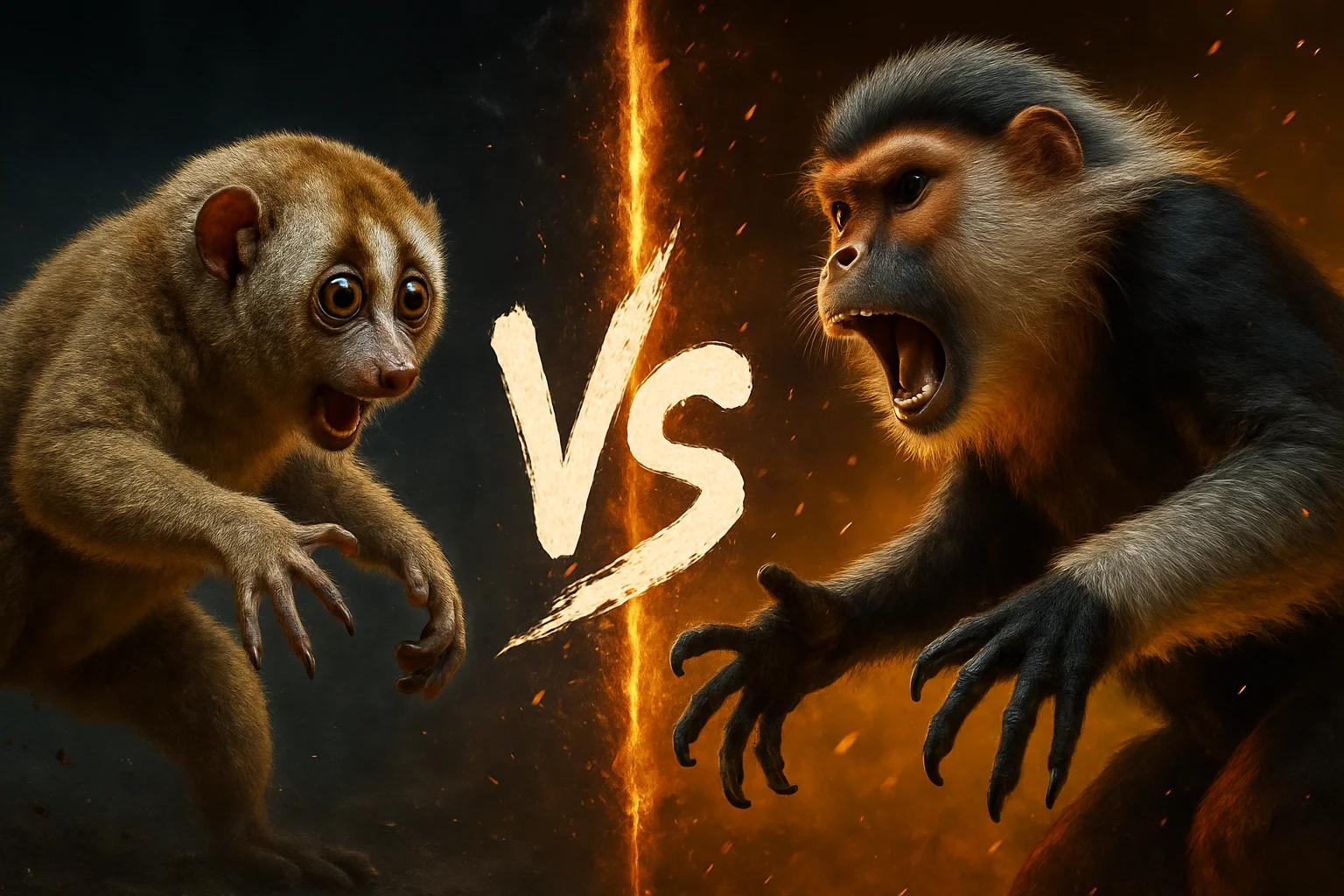
Pygmy Slow Loris vs Red-shanked Douc: Who Actually Wins?
The red-shanked douc wins clearly. An adult douc can weigh roughly 8–11 kg, while a pygmy slow loris usually weighs about 0.3–0.6 kg, often 20 or more times lighter. The douc also has long-limbed reach, leaps of several meters through the canopy, daytime alertness and a social troop around it. The loris's real weapon is a venomous bite. It mixes secretions from glands on its upper arms with saliva to make a toxic, wound-slowing mix that it delivers through comb-like lower teeth. That venom is a serious deterrent and can cause painful, festering wounds, but it works slowly and only after the loris gets a grip. In most realistic encounters the douc simply never lets that happen. It shoves, swats, or leaps away from an animal that cannot chase it.
Read comparison
Discussion
What do you think?
Share your reasoning with other readers. Be civil and stick to the animals.
Sign in to join the discussion.
Sign inNo comments yet. Start the conversation.