


Black-and-white Ruffed Lemur vs Indri: Who Actually Wins?
Black-and-white ruffed lemur vs indri: Madagascar's loudest fruit-raider against its largest living lemur. We compare size, leaping power, agility and canopy tactics to find who wins.
Black-and-white Ruffed Lemur vs Indri
Matchup winner
Indri
Quick verdict
Start with the direct answer, then use the structured comparison below to see what changes the outcome.
The indri wins this matchup. As the largest living lemur, an adult indri weighs roughly 6–9.5 kg, about twice the 3–4.5 kg of a black-and-white ruffed lemur. Its long, heavily muscled hind legs launch vertical leaps of up to about 10 m between trunks. In a canopy standoff, that mass and leg-driven power let the indri displace, shove and outlast the smaller lemur. The ruffed lemur is no pushover. It is the quicker, more flexible four-limbed climber, and it can reverse direction along branches faster than the trunk-bound indri. That agility helps it escape or harass. It does not give it the leverage to dislodge an animal twice its weight. In reality, both are critically endangered plant-eaters that settle conflicts with calls, posturing and brief chases rather than real fights.
Read the full explanation
Winner: Indri, mainly because it weighs about twice as much as the ruffed lemur.
The indri's leg-powered leaping and grip on vertical trunks give it more force in a close contest.
The ruffed lemur is the more agile branch runner and harder to pin down, but it lacks the mass to push the indri off.
Neither species is built to fight. Real encounters are noisy displays, not injuries.
Reader vote
Who do you think wins?
Pick a side — no account needed. Results update live.
No votes yet — be the first to call it.
Editorial note
Why people disagree
Speed vs. size: the ruffed lemur's quickness on branches looks decisive until you remember that weight controls who holds a branch.
Body mass advantage
In tree-top shoving matches, the heavier animal anchors itself better and is much harder to dislodge.
Explosive leg power
The indri's hind legs are its main weapon. They deliver its most forceful contact and its fastest getaway.
Canopy agility
The ruffed lemur can change direction mid-branch, which makes it the better escape artist.
Read the full explanation +
Indris are famously calm, slow-feeding leaf-eaters, so many people assume they are passive. Their legs are among the most powerful of any primate their size.
Both species are extremely loud. Their roaring and singing make them sound fierce, but neither uses volume as a substitute for physical force.
Comparison FAQ
Short, direct answers to the next questions readers usually ask after the headline verdict.
Is an indri stronger than a black-and-white ruffed lemur?+
Yes. The indri is roughly twice as heavy, and its hind legs are among the most powerful of any lemur.
Would an indri beat a black-and-white ruffed lemur in a fight?+
Most likely, yes. Its mass and grip let it displace the smaller lemur, though real encounters rarely go beyond displays.
Why is the ruffed lemur still dangerous to an indri?+
Its agility, sharp alarm calls and tendency to mob as a group can harass a lone indri and drive it out of fine-branched areas where the indri moves poorly.
Do these lemurs fight in the wild?+
Rarely. Both rely on loud vocal displays and spacing between groups, and their diets mostly differ, since the indri eats leaves and the ruffed lemur eats fruit.
Head-to-head species stats
These are the same core AnimalDex stat dimensions used on the dedicated animal pages, pulled side by side so the matchup is faster to scan.
Black-and-white Ruffed Lemur
Tier BIndri
Tier BTrait-by-trait comparison
Only the categories that matter to this matchup are included. The goal is not filler stats, but the real design differences that change the result.
About 3–4.5 kg, compact
Body mass advantage
Indri
About 6–9.5 kg, the largest living lemur
Body mass advantage
Indri
Strong leaps between branches
Explosive leg power
Indri
Vertical leaps of up to about 10 m powered by the hind legs
Explosive leg power
Indri
Four-limbed runner that can hang by its feet
Canopy agility
Black-and-white Ruffed Lemur
Clings to trunks and leaps, but is awkward on thin branches
Canopy agility
Black-and-white Ruffed Lemur
Loud roar-shrieks, with group-wide alarm calls
Alarm and coordination
Black-and-white Ruffed Lemur
Long territorial songs that space out family groups
Alarm and coordination
Black-and-white Ruffed Lemur
Light frame, little cushion against impact
Close-range durability
Indri
Thick-bodied, with a sturdy grip on trunks
Close-range durability
Indri
Excitable and quick to mob
Conflict temperament
Indri
Calm, but stubborn about holding its ground
Conflict temperament
Indri
How the verdict forms
Verdict timeline
01 · Body mass advantage
Indri
02 · Explosive leg power
Indri
03 · Canopy agility
Black-and-white Ruffed Lemur
04 · Alarm and coordination
Black-and-white Ruffed Lemur
05 · Close-range durability
Indri
06 · Conflict temperament
Indri
Change the conditions
Scenario breakdown
This is where shallow battle content usually fails. Terrain, spacing, timing, and engagement style can change the answer.
Scenario lean
Indri
Verdict confidence
82%
The indri holds the trunk.
On vertical supports, the indri's clinging posture and mass are at their best. The ruffed lemur cannot get the leverage to push off an animal twice its weight. Its best option is to leave.
AnimalDex field profiles
Explore these animals
Black-and-white Ruffed Lemur
Varecia variegata
rainforest canopy, river valley forest, and humid hillside woodland
Indri
Indri indri
humid rainforest and montane forest
Systems Intelligence & Hidden Purpose
See the animals behind this comparison as engineered biological systems: what each one is built to do, where it gains leverage, and why the matchup changes by scenario.
Specialized Hardware
black-and-white shaggy coat, loud carrying calls, and fruit-heavy canopy feeding give the Black-and-white Ruffed Lemur a body plan tuned for its niche.
Systems Script
Black-and-white Ruffed Lemurs operate through rainforest canopy, river valley forest, and humid hillside woodland. Their design links movement, feeding, shelter, and timing into one workable survival system.
Strategic Insight
Dense environments reward precision, patience, and the ability to read layered cover.
Specialized Hardware
black-and-white upright body, long carrying forest calls, and vertical trunk-clinging leaps give the Indri a body plan tuned for its niche.
Systems Script
Indris operate through humid rainforest and montane forest. Their design links movement, feeding, shelter, and timing into one workable survival system.
Strategic Insight
Dense environments reward precision, patience, and the ability to read layered cover.
Final take
The indri wins the black-and-white ruffed lemur vs indri matchup because body mass and hind-leg power decide arboreal contests more often than nimbleness does. In three of four scenarios, the bigger, steadier animal keeps its position.
Read the full explanation
The ruffed lemur's real strength is avoidance. It is a fast, loud, agile climber that is almost never trapped on terrain it chooses. Both species are critically endangered, and habitat loss, not each other, is the threat they actually share.
Collect both animals in AnimalDex
Track the species behind this matchup, compare their real traits, and build the rivalry into your AnimalDex collection.
Related comparisons
Continue with nearby matchups to compare more real-world animal traits without dropping into junky who-wins filler.

Black-and-white Ruffed Lemur vs Coquerel's Sifaka: Who Actually Wins?
The black-and-white ruffed lemur takes this one, though not by much. Both are mid-sized Madagascar lemurs weighing roughly 3–4.5 kg, so neither has a big mass edge. The ruffed lemur wins because of how it is built and how it behaves. It is a quadrupedal canopy runner with strong grasping limbs and a loud, assertive temperament: its group 'roar-shrieks' are among the loudest primate calls in Madagascar. Coquerel's sifaka is a specialist vertical clinger and leaper. Its long, powerful hind legs are superb for springing between trunks and for bounding sideways across open ground. They are less suited to the close, grappling, branch-level scuffles where the ruffed lemur's all-four-limbs dexterity matters most. Lemur conflicts are usually short bursts of display, cuffing and chasing rather than prolonged fights. In that kind of contest, the ruffed lemur's bolder posture, slightly higher speed rating and comfort moving horizontally through dense canopy give it the edge more often than not. The sifaka's best answer is evasion, and evasion doesn't win a confrontation.
Read comparison
Bongo vs Indri: Who Actually Wins?
The bongo wins, and it is not close on the ground. It is a heavyset forest antelope weighing roughly 200 to 400 kg, with spiraled horns carried by both sexes and a neck and shoulders built for shoving through dense undergrowth. The indri is the largest living lemur, but it still weighs only about 6 to 9.5 kg. It is a leaf-eating, tree-bound vertical clinger with no weapons designed for combat. In any encounter that forces contact, the bongo's mass and horns end it quickly. The indri's real strength is that it rarely has to fight. Powerful leaps of up to about 10 m carry it between trunks and keep it out of reach. That makes the indri hard to catch, but it cannot beat the bongo, so the overall verdict goes to the bongo.
Read comparison
Black-and-white Ruffed Lemur vs Javan Slow Loris: Who Actually Wins?
The Black-and-white Ruffed Lemur wins this one. At roughly 3.1–4.5 kg, it carries about five to six times the mass of a Javan Slow Loris (around 0.6–0.7 kg). It is also a fast, explosive leaper built for daylight canopy travel, while the loris is a slow, grip-locked climber. The loris is not harmless. It is one of the very few venomous mammals, mixing a secretion from glands on its upper arm with saliva to deliver a toxic bite through its sharp toothcomb. That bite can cause painful, slow-healing wounds. But venom delivered at loris speed has to land first. A heavier, faster animal that controls distance, reach, and the timing of contact holds most of the decisive levers. In nearly every realistic frame, the lemur either overpowers the encounter or simply refuses it, and the loris has no tool to force a fight on its own terms.
Read comparison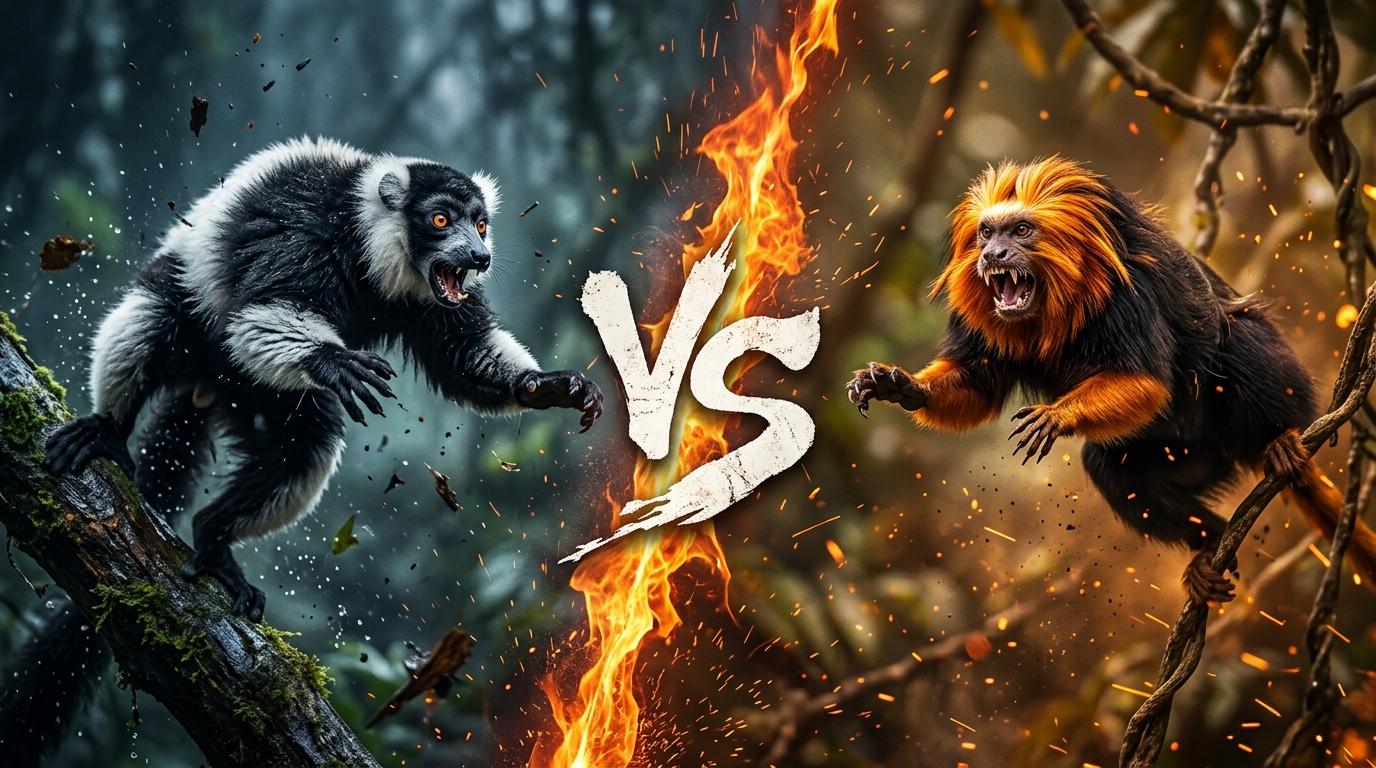
Black-and-white Ruffed Lemur vs Golden-headed Lion Tamarin: Who Actually Wins?
The Black-and-white Ruffed Lemur wins this matchup clearly. At roughly 3.1–4.5 kg it outweighs the Golden-headed Lion Tamarin (about 0.5–0.7 kg) by around six to eight times. In small primates that gap decides almost every physical contest. The lemur's longer limbs, stronger grip, bigger jaws, and loud group defense mean a tamarin cannot overpower it, hold its ground against it, or drive it away from a shared fruit tree. The tamarin's real edges are being quick and agile, slipping through tangles, and staying alert. Those help it avoid a confrontation, but they don't help it win one. In any frame where the two actually have to settle something, the lemur's mass and reach decide it.
Read comparison
Discussion
What do you think?
Share your reasoning with other readers. Be civil and stick to the animals.
Sign in to join the discussion.
Sign inNo comments yet. Start the conversation.