

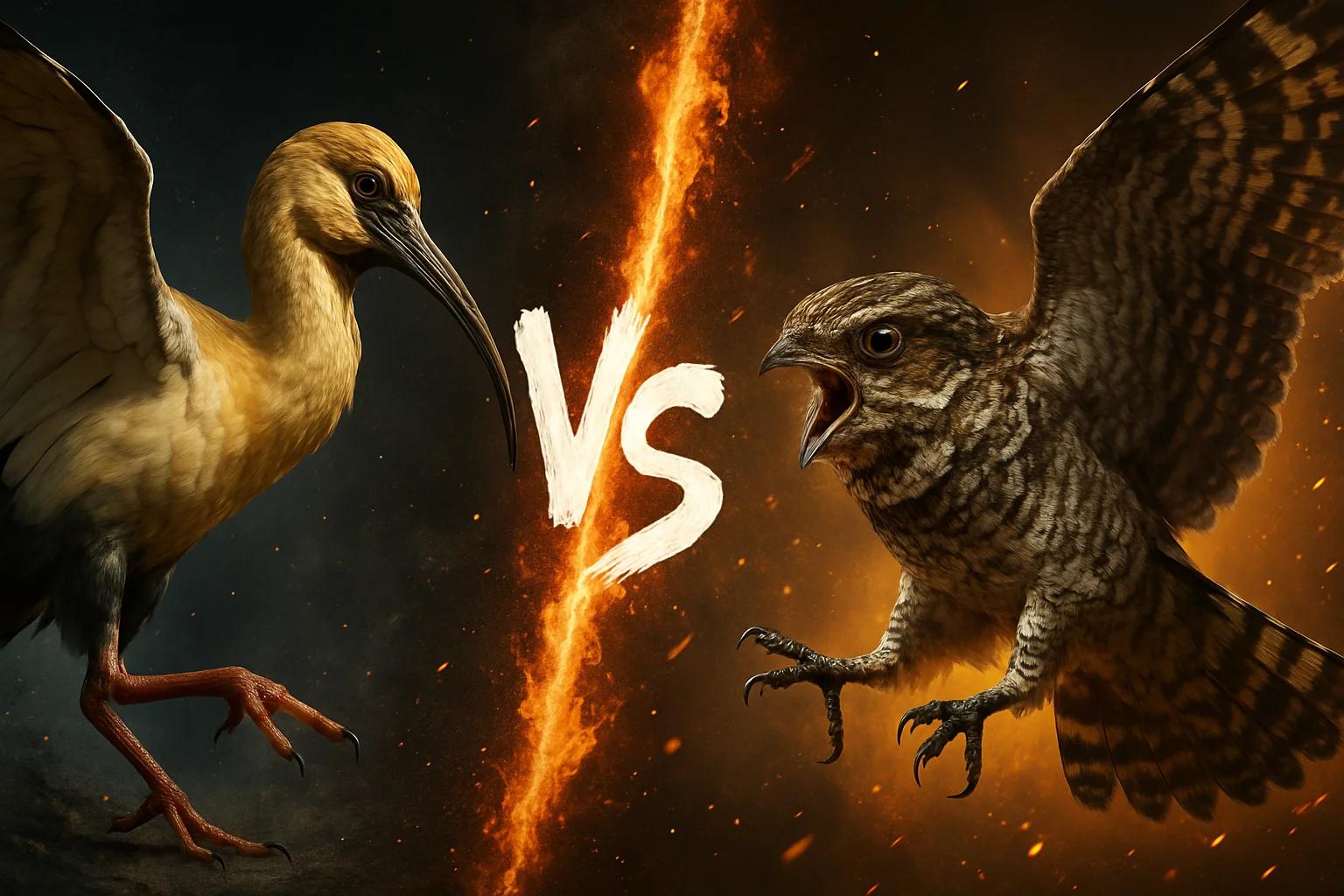
Black-faced Ibis vs Nacunda Nighthawk: Who Actually Wins?
Black-faced Ibis vs Nacunda Nighthawk compared on size, bill power, speed, and survival tactics. See who wins a confrontation between these South American birds and why.
Black-faced Ibis vs Nacunda Nighthawk
Matchup winner
Black-faced Ibis
Quick verdict
Start with the direct answer, then use the structured comparison below to see what changes the outcome.
The Black-faced Ibis wins clearly. At roughly 2 kg and up to about 75 cm long, it outweighs the Nacunda Nighthawk (around 150–200 g) by roughly ten to one. It also carries a long, stout, decurved bill built for prying prey out of hard ground and a sturdy body adapted to open grassland and Patagonian steppe. The nighthawk is a superb aerial insect hunter with a tiny bill, a huge gape, and weak feet that are almost useless for grappling. It has no weapon that can hurt an ibis. Its real strengths are camouflage, evasive flight, and leaving fast. In any frame where the two birds actually have to deal with each other, the ibis controls the space and the nighthawk's best result is a clean exit.
Read the full explanation
Black-faced Ibis wins: about 10x heavier, with a long probing bill that works as a jabbing tool.
Nacunda Nighthawk has no offensive hardware. Its tiny bill and weak feet are built for catching insects, not fighting.
The nighthawk's edge is aerial agility and camouflage. It avoids losing rather than winning.
Real-world contact is rare. These birds use different niches and different hours.
Reader vote
Who do you think wins?
Pick a side — no account needed. Results update live.
No votes yet — be the first to call it.
Editorial note
Why people disagree
Nighthawks look large in flight because their long wings exaggerate their size, but their bodies are light and fragile.
Body mass & frame
A tenfold mass gap means the ibis can shove, pin, and absorb contact the nighthawk cannot.
Strike hardware
Only the ibis has a tool that can deliver force at range.
Aerial evasion
The nighthawk can almost always choose to leave, which is its main survival card.
Read the full explanation +
Some readers treat speed as winning power. The nighthawk's maneuverability lets it escape, but it cannot convert that into damage.
Ibises seem gentle because they spend their days probing for grubs, yet that bill drives hard into compacted soil and can deliver a real jab.
Comparison FAQ
Short, direct answers to the next questions readers usually ask after the headline verdict.
Would a Black-faced Ibis beat a Nacunda Nighthawk in a fight?+
Yes. The ibis is about ten times heavier and has a long, strong bill. The nighthawk has no effective weapon and would flee rather than fight.
Which bird is stronger?+
The Black-faced Ibis, by a wide margin. It has a heavier body, stronger legs, and a bill built to drive into hard soil.
Why does the Nacunda Nighthawk stay dangerous to beat?+
Mostly because it is so hard to catch. Its cryptic plumage, startling gape display, and highly agile flight mean an ibis would rarely land a blow before the nighthawk escaped.
Do these birds actually meet in the wild?+
Their ranges overlap in parts of South America, but they use different niches and are active at different times. Direct conflict is very unlikely.
Is the nighthawk faster?+
In maneuverability, yes. The nighthawk turns and dodges far better. The ibis is a strong flier, but its flight is more direct.
Head-to-head species stats
These are the same core AnimalDex stat dimensions used on the dedicated animal pages, pulled side by side so the matchup is faster to scan.
Black-faced Ibis
Tier CNacunda Nighthawk
Tier CTrait-by-trait comparison
Only the categories that matter to this matchup are included. The goal is not filler stats, but the real design differences that change the result.
~1.5–2 kg, robust grassland wader
Body mass & frame
Black-faced Ibis
~150–200 g, light aerial frame
Body mass & frame
Black-faced Ibis
Long, stout decurved bill
Strike hardware
Black-faced Ibis
Tiny bill, wide insect-net gape
Strike hardware
Black-faced Ibis
Strong but straight-line flier
Aerial evasion
Nacunda Nighthawk
Agile, buoyant, erratic flight
Aerial evasion
Nacunda Nighthawk
Conspicuous, loud, social
Ground concealment
Nacunda Nighthawk
Cryptic plumage, ground roosting
Ground concealment
Nacunda Nighthawk
Sturdy body, strong legs
Close-range durability
Black-faced Ibis
Weak feet, delicate build
Close-range durability
Black-faced Ibis
Vocal flocks that mob intruders
Territorial assertiveness
Black-faced Ibis
Defensive distraction displays
Territorial assertiveness
Black-faced Ibis
How the verdict forms
Verdict timeline
01 · Body mass & frame
Black-faced Ibis
02 · Strike hardware
Black-faced Ibis
03 · Aerial evasion
Nacunda Nighthawk
04 · Ground concealment
Nacunda Nighthawk
05 · Close-range durability
Black-faced Ibis
06 · Territorial assertiveness
Black-faced Ibis
Change the conditions
Scenario breakdown
This is where shallow battle content usually fails. Terrain, spacing, timing, and engagement style can change the answer.
Scenario lean
Black-faced Ibis
Verdict confidence
82%
Ibis dominates the turf.
On open steppe and pasture, the ibis's home terrain, mass and bill reach decide everything. A grounded nighthawk on weak legs cannot hold position, so it would flush and fly. The ibis takes the ground without a real fight.
AnimalDex field profiles
Explore these animals
Black-faced Ibis
Theristicus melanopis
wet pasture, marsh, and open plain
Nacunda Nighthawk
Chordeiles nacunda
open grassland, marsh edge, and sandy plain
Systems Intelligence & Hidden Purpose
See the animals behind this comparison as engineered biological systems: what each one is built to do, where it gains leverage, and why the matchup changes by scenario.
Specialized Hardware
long downcurved probing bill, dark bare facial skin, and meadow and marsh walking give the Black-faced Ibis a body plan tuned for its niche.
Systems Script
Black-faced Ibiss operate through wet pasture, marsh, and open plain. Their design links movement, feeding, shelter, and timing into one workable survival system.
Strategic Insight
Where water controls movement, position and timing often matter more than speed.
Specialized Hardware
very wide gaping mouth, long pointed wings, and crepuscular insect-chasing flight give the Nacunda Nighthawk a body plan tuned for its niche.
Systems Script
Nacunda Nighthawks operate through open grassland, marsh edge, and sandy plain. Their design links movement, feeding, shelter, and timing into one workable survival system.
Strategic Insight
Where water controls movement, position and timing often matter more than speed.
Final take
The Black-faced Ibis is the clear winner. Size, a real striking tool, and a sturdy, grounded body give it total control of any encounter that involves contact.
Read the full explanation
The Nacunda Nighthawk is not weak. It is specialized for a different job. It is a master of disappearing: camouflaged by day, agile at dusk, and built so it never has to fight. Its win condition is never being caught, and it achieves that often. In a head-to-head, though, avoiding the fight is not the same as winning it.
Collect both animals in AnimalDex
Track the species behind this matchup, compare their real traits, and build the rivalry into your AnimalDex collection.
Related comparisons
Continue with nearby matchups to compare more real-world animal traits without dropping into junky who-wins filler.
Black-faced Ibis vs Coscoroba Swan: Who Actually Wins?
The Coscoroba Swan wins this matchup. At roughly 3.5–5 kg against the Black-faced Ibis's 1.5–2 kg or so, the swan brings more mass, a longer and heavier neck, and powerful wing blows. It also has the territorial temperament of a waterfowl that defends nests and cygnets aggressively. The ibis is lighter, quicker to lift off and armed with a long decurved bill. But that bill is a probing tool for grubs and insects in grassland soil, not a stabbing weapon built for combat. In any confrontation over water, nesting ground or shoreline space, the swan's body-mass advantage and committed defensive posture push the ibis into retreat. The likely outcome is a short display and a few wing buffets, then the ibis takes off. It is not a drawn-out fight.
Read comparison
Discussion
What do you think?
Share your reasoning with other readers. Be civil and stick to the animals.
Sign in to join the discussion.
Sign inNo comments yet. Start the conversation.