

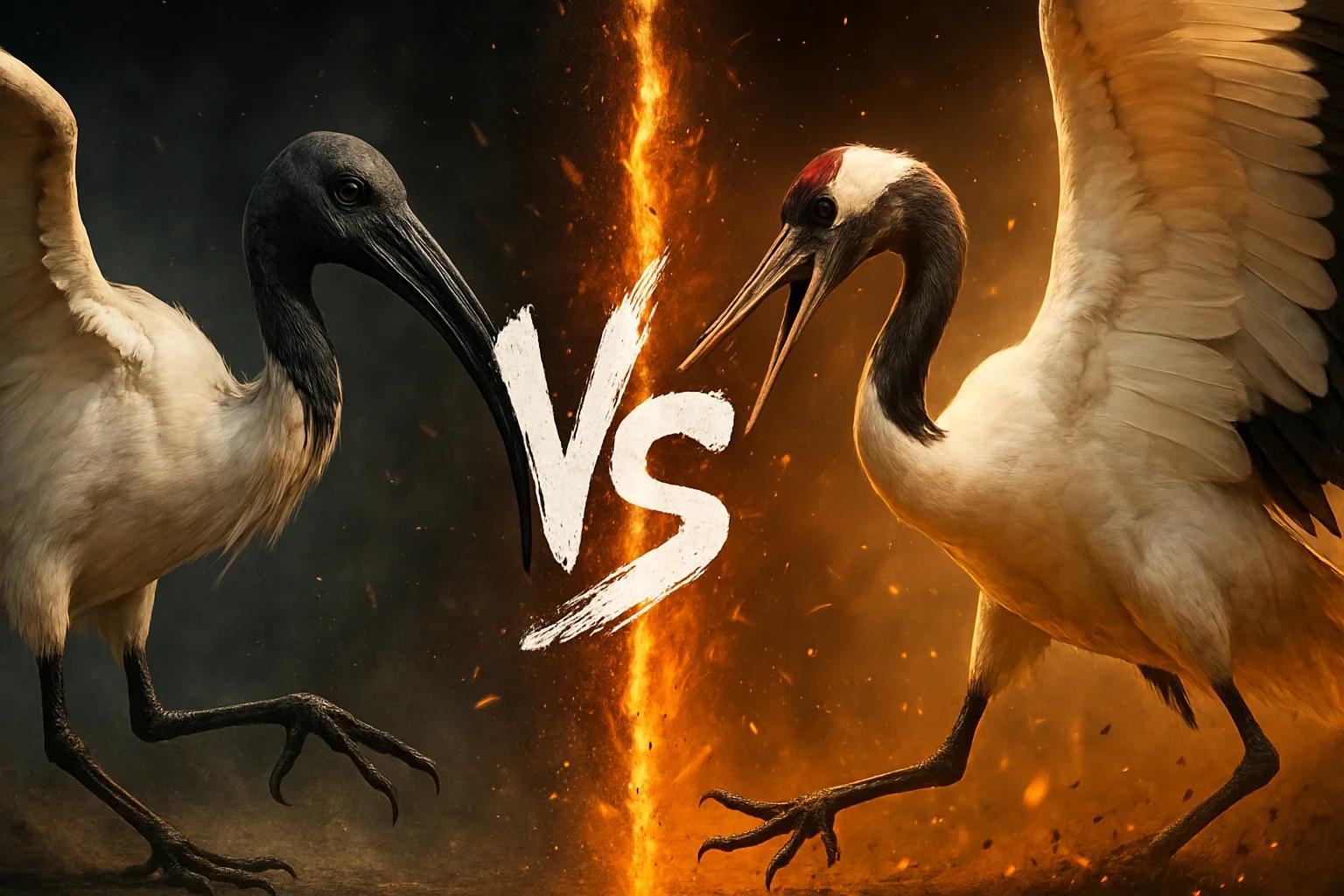
Black-headed Ibis vs Red-crowned Crane: Who Actually Wins?
Black-headed Ibis vs Red-crowned Crane: a biology-first look at size, beak weapons, territorial aggression and wetland tactics to settle who would win.
Black-headed Ibis vs Red-crowned Crane
Matchup winner
Red-crowned Crane
Quick verdict
Start with the direct answer, then use the structured comparison below to see what changes the outcome.
The Red-crowned Crane wins this clearly. At roughly 150 cm tall, with a wingspan near 2.4 m and a body mass of 7–10 kg, it outweighs the Black-headed Ibis (about 65–75 cm long and roughly 1.5–2 kg) by around four to six times. It also carries a straight, dagger-like bill built for jabbing, long legs that can deliver kicks, and a breeding-season temperament forged by defending territories against foxes, raccoon dogs and rival cranes. The ibis is agile, social and armed with a long decurved bill, but that bill is a soft-mud probe, not a weapon. In almost any realistic wetland standoff, the crane's height, reach and willingness to escalate force the ibis to give way.
Read the full explanation
Red-crowned Crane wins: it is about 4–6x heavier and nearly twice as tall.
The crane's straight bill stabs; the ibis's curved bill is built to probe mud.
Cranes defend nesting territories aggressively. Ibises rely on flocks and leaving fast.
The ibis's best result is avoiding the fight altogether, which it does well.
Reader vote
Who do you think wins?
Pick a side — no account needed. Results update live.
No votes yet — be the first to call it.
Editorial note
Why people disagree
Both are tall, long-billed wading birds, so people underestimate how much heavier and stronger the crane really is.
Size and reach
Reach decides bird confrontations. The crane can strike down from a height the ibis cannot match.
Bill as a weapon
A straight bill delivers force along its length. A curved probing bill deflects and risks damage.
Territorial aggression
The crane is used to escalating against predators. The ibis is used to jostling neighbors.
Read the full explanation +
Ibises live in noisy colonies and can look bold in groups, which gets mistaken for one-on-one toughness.
Crane dancing looks graceful, not combative, but the same leaps and wing displays escalate into real kicks and bill strikes.
Comparison FAQ
Short, direct answers to the next questions readers usually ask after the headline verdict.
Would a Black-headed Ibis beat a Red-crowned Crane?+
No. In a one-on-one confrontation, the Red-crowned Crane wins thanks to its much greater size, reach and stabbing bill.
Which bird is stronger?+
The Red-crowned Crane. It is roughly four to six times heavier and powers strong kicks and wingbeats.
Why is the ibis still dangerous?+
Its long bill can still jab at the eyes, and it is agile and fast to escape. In flocks it can also harass and distract larger birds.
Do they actually meet in the wild?+
Their ranges overlap in parts of East Asia, mainly in wintering wetlands. Serious fights are unlikely; displacement over feeding spots is more typical.
Head-to-head species stats
These are the same core AnimalDex stat dimensions used on the dedicated animal pages, pulled side by side so the matchup is faster to scan.
Black-headed Ibis
Tier CRed-crowned Crane
Tier BTrait-by-trait comparison
Only the categories that matter to this matchup are included. The goal is not filler stats, but the real design differences that change the result.
~65–75 cm, ~1.5–2 kg
Size and reach
Red-crowned Crane
~150 cm tall, 7–10 kg, 2.4 m wingspan
Size and reach
Red-crowned Crane
Long, decurved mud probe
Bill as a weapon
Red-crowned Crane
Straight, pointed stabbing bill
Bill as a weapon
Red-crowned Crane
Colony squabbles, mostly bluff
Territorial aggression
Red-crowned Crane
Fierce defense of nest and pair territory
Territorial aggression
Red-crowned Crane
Quick takeoff, nimble flier
Agility and escape
Black-headed Ibis
Powerful but heavier launch
Agility and escape
Black-headed Ibis
Large flocks and colonies
Social backup
Black-headed Ibis
Pairs and family groups
Social backup
Black-headed Ibis
Light frame, little buffer
Close-range durability
Red-crowned Crane
Large body, thick plumage
Close-range durability
Red-crowned Crane
How the verdict forms
Verdict timeline
01 · Size and reach
Red-crowned Crane
02 · Bill as a weapon
Red-crowned Crane
03 · Territorial aggression
Red-crowned Crane
04 · Agility and escape
Black-headed Ibis
05 · Social backup
Black-headed Ibis
06 · Close-range durability
Red-crowned Crane
Change the conditions
Scenario breakdown
This is where shallow battle content usually fails. Terrain, spacing, timing, and engagement style can change the answer.
Scenario lean
Red-crowned Crane
Verdict confidence
82%
Crane dominates in the open.
In clear view, the crane's height and wing-spread display intimidate before contact. If the ibis stays, it meets downward bill strikes and kicks from beyond its own reach.
AnimalDex field profiles
Explore these animals
Black-headed Ibis
Threskiornis melanocephalus
marsh, rice plain, and shallow wetland
Red-crowned Crane
Grus japonensis
marsh, wet meadow, river plain, and shallow wetland
Systems Intelligence & Hidden Purpose
See the animals behind this comparison as engineered biological systems: what each one is built to do, where it gains leverage, and why the matchup changes by scenario.
Specialized Hardware
bare black head, clean white body, and wetland probing feeding give the Black-headed Ibis a body plan tuned for its niche.
Systems Script
Black-headed Ibiss operate through marsh, rice plain, and shallow wetland. Their design links movement, feeding, shelter, and timing into one workable survival system.
Strategic Insight
Where water controls movement, position and timing often matter more than speed.
Specialized Hardware
tall white body with black wings, red crown patch, and courtship dancing in wetlands give the Red-crowned Crane a body plan tuned for its niche.
Systems Script
Red-crowned Cranes operate through marsh, wet meadow, river plain, and shallow wetland Their design links movement, shelter, and feeding into one workable survival system.
Strategic Insight
Ritual can stabilize a system by making signals clear, repeatable, and shared.
Final take
Red-crowned Crane is the overall winner. Size, reach, a stabbing bill and a defender's temperament stack decisively in its favor.
Read the full explanation
The Black-headed Ibis is not a pushover. It is a fast, social survivor, and its real skill is recognizing a losing fight and leaving before it starts.
Collect both animals in AnimalDex
Track the species behind this matchup, compare their real traits, and build the rivalry into your AnimalDex collection.
Related comparisons
Continue with nearby matchups to compare more real-world animal traits without dropping into junky who-wins filler.

Red-crowned Crane vs Wood Stork: Who Actually Wins?
The red-crowned crane wins. It is one of the heaviest cranes on Earth, roughly 7–10.5 kg and about 150 cm tall, against a wood stork of roughly 2–3.3 kg. It also carries a real fighting toolkit: a dagger-straight bill built for stabbing, powerful legs that deliver leaping kicks, and a territorial temperament sharpened by fierce defense of breeding grounds. The wood stork is a heavy-billed, colonial tactile feeder. Its thick, decurved bill is made for snapping shut on fish by touch, not for dueling. It also tends to avoid conflict rather than escalate. In nearly every realistic frame, the crane's mass, reach, and willingness to fight decide it.
Read comparison
Discussion
What do you think?
Share your reasoning with other readers. Be civil and stick to the animals.
Sign in to join the discussion.
Sign inNo comments yet. Start the conversation.