

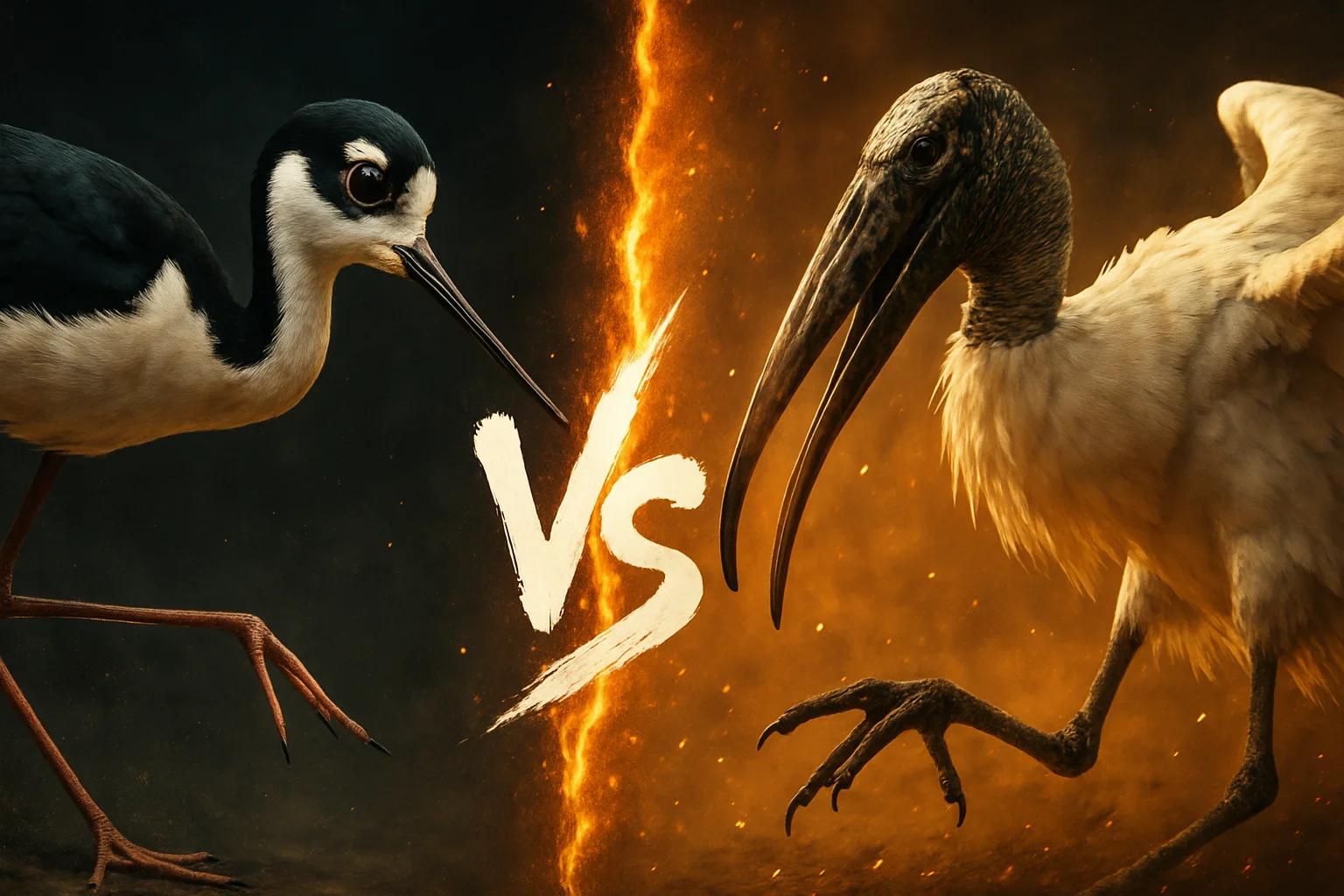
Black-necked Stilt vs Wood Stork: Who Actually Wins?
Black-necked Stilt vs Wood Stork compared on size, beak power, speed, and wetland tactics. Find out who wins a confrontation and why the smaller bird is still a nuisance.
Black-necked Stilt vs Wood Stork
Matchup winner
Wood Stork
Quick verdict
Start with the direct answer, then use the structured comparison below to see what changes the outcome.
The Wood Stork wins, and it isn't especially close. A Wood Stork stands about 85–115 cm tall, spans roughly 150 cm, and weighs around 2–3 kg. That is about ten times the mass of a 150–200 g Black-necked Stilt. The stork also carries a thick, downcurved bill built to clamp onto struggling fish, while the stilt's needle-thin bill is made for picking up insects and tiny crustaceans. The stilt's real strengths are agility, fast takeoff, and loud, relentless mobbing, which defend nests well. None of that can hurt a bird this large. In any contest decided by contact, mass, or holding ground, the stork controls the outcome. The stilt's best result is to harass it and leave unharmed.
Read the full explanation
Wood Stork wins overall: roughly 10x heavier, with a far stronger bill.
The stilt is quicker, more agile, and a fearless nest defender.
Stilts can drive a stork off with mobbing, but they cannot overpower it.
In a contest over shallow-water space, the stork holds its ground.
Reader vote
Who do you think wins?
Pick a side — no account needed. Results update live.
No votes yet — be the first to call it.
Editorial note
Why people disagree
Stilts aggressively mob much larger birds near their nests, so observers sometimes mistake noisy harassment for dominance.
Size and mass
Mass decides who gets displaced. The stork can simply stand its ground or walk through the stilt's space.
Bill weaponry
The stork's bill can snap shut on a slippery fish, so it can grip and jab with real force. The stilt's bill is a precision tweezer, not a weapon.
Agility and takeoff
Agility lets the stilt dive-bomb and dodge. It controls whether contact happens at all.
Read the full explanation +
Both are long-legged wetland waders, which makes them look like similar-class rivals until you compare body mass.
Wood Storks feed calmly and slowly by touch, so their real physical power is easy to underestimate.
Comparison FAQ
Short, direct answers to the next questions readers usually ask after the headline verdict.
Would a Wood Stork beat a Black-necked Stilt?+
Yes. A Wood Stork is roughly ten times heavier and has a much stronger bill and longer reach, so it would win any real physical confrontation.
Which bird is stronger?+
The Wood Stork, by a wide margin. Its bill is built to clamp onto live fish, while the stilt's bill is a thin probe for small prey.
Why is the Black-necked Stilt still dangerous to a stork?+
Its agility and aggressive mobbing make it a costly opponent near its nest. Dive-bombing and constant alarm calls can push intruders out of its territory without any real fight.
Do storks and stilts actually fight in the wild?+
Serious fights are rare. Most interactions are stilts mobbing larger birds near their nests, or the two species feeding side by side in different ways.
Head-to-head species stats
These are the same core AnimalDex stat dimensions used on the dedicated animal pages, pulled side by side so the matchup is faster to scan.
Black-necked Stilt
Tier CWood Stork
Tier CTrait-by-trait comparison
Only the categories that matter to this matchup are included. The goal is not filler stats, but the real design differences that change the result.
~35–39 cm tall, ~150–200 g
Size and mass
Wood Stork
~85–115 cm tall, ~2–3 kg
Size and mass
Wood Stork
Needle-thin probing bill
Bill weaponry
Wood Stork
Heavy, downcurved grasping bill
Bill weaponry
Wood Stork
Fast, erratic, quick to launch
Agility and takeoff
Black-necked Stilt
Heavy flapper that soars on thermals
Agility and takeoff
Black-necked Stilt
Loud, persistent nest mobbing
Territorial aggression
Black-necked Stilt
Mostly tolerant, colonial forager
Territorial aggression
Black-necked Stilt
Fragile frame on very thin legs
Close-range durability
Wood Stork
Robust body with a thick neck and bill
Close-range durability
Wood Stork
Long legs, short striking reach
Reach control
Wood Stork
Long neck plus a long bill
Reach control
Wood Stork
How the verdict forms
Verdict timeline
01 · Size and mass
Wood Stork
02 · Bill weaponry
Wood Stork
03 · Agility and takeoff
Black-necked Stilt
04 · Territorial aggression
Black-necked Stilt
05 · Close-range durability
Wood Stork
06 · Reach control
Wood Stork
Change the conditions
Scenario breakdown
This is where shallow battle content usually fails. Terrain, spacing, timing, and engagement style can change the answer.
Scenario lean
Wood Stork
Verdict confidence
82%
The stork keeps the pool.
Wood Storks feed by touch, sweeping their open bills through murky water. A small, darting stilt barely registers to them. The stilt can work the edges, but it cannot push a bird this heavy off a productive patch.
AnimalDex field profiles
Explore these animals
Black-necked Stilt
Himantopus mexicanus
marsh, salt flat, lagoon edge, and shallow wetland
Wood Stork
Mycteria americana
marsh, swamp, floodplain, and shallow wetland feeding ground
Systems Intelligence & Hidden Purpose
See the animals behind this comparison as engineered biological systems: what each one is built to do, where it gains leverage, and why the matchup changes by scenario.
Specialized Hardware
extremely long pink legs, needle-thin bill, and shallow-water wading give the Black-necked Stilt a body plan tuned for its niche.
Systems Script
Black-necked Stilts operate through marsh, salt flat, lagoon edge, and shallow wetland Their design links movement, shelter, and feeding into one workable survival system.
Strategic Insight
A small change in body geometry can open a whole new feeding zone.
Specialized Hardware
large bare-headed wader, touch-based fish feeding, and colony nesting in wetlands give the Wood Stork a body plan tuned for its niche.
Systems Script
Wood Storks operate through marsh, swamp, floodplain, and shallow wetland feeding ground Their design links movement, shelter, and feeding into one workable survival system.
Strategic Insight
A different sensing method can open the same environment in a new way.
Final take
The Wood Stork is the clear overall winner. Its size, reach, and grasping bill put it in a different physical class from the stilt.
Read the full explanation
The stilt's success comes from tactics rather than strength. Speed, noise, and persistence let it protect its nest from much bigger birds. Those tactics end disputes, but they would not win a fight.
Collect both animals in AnimalDex
Track the species behind this matchup, compare their real traits, and build the rivalry into your AnimalDex collection.
Discussion
What do you think?
Share your reasoning with other readers. Be civil and stick to the animals.
Sign in to join the discussion.
Sign inNo comments yet. Start the conversation.