

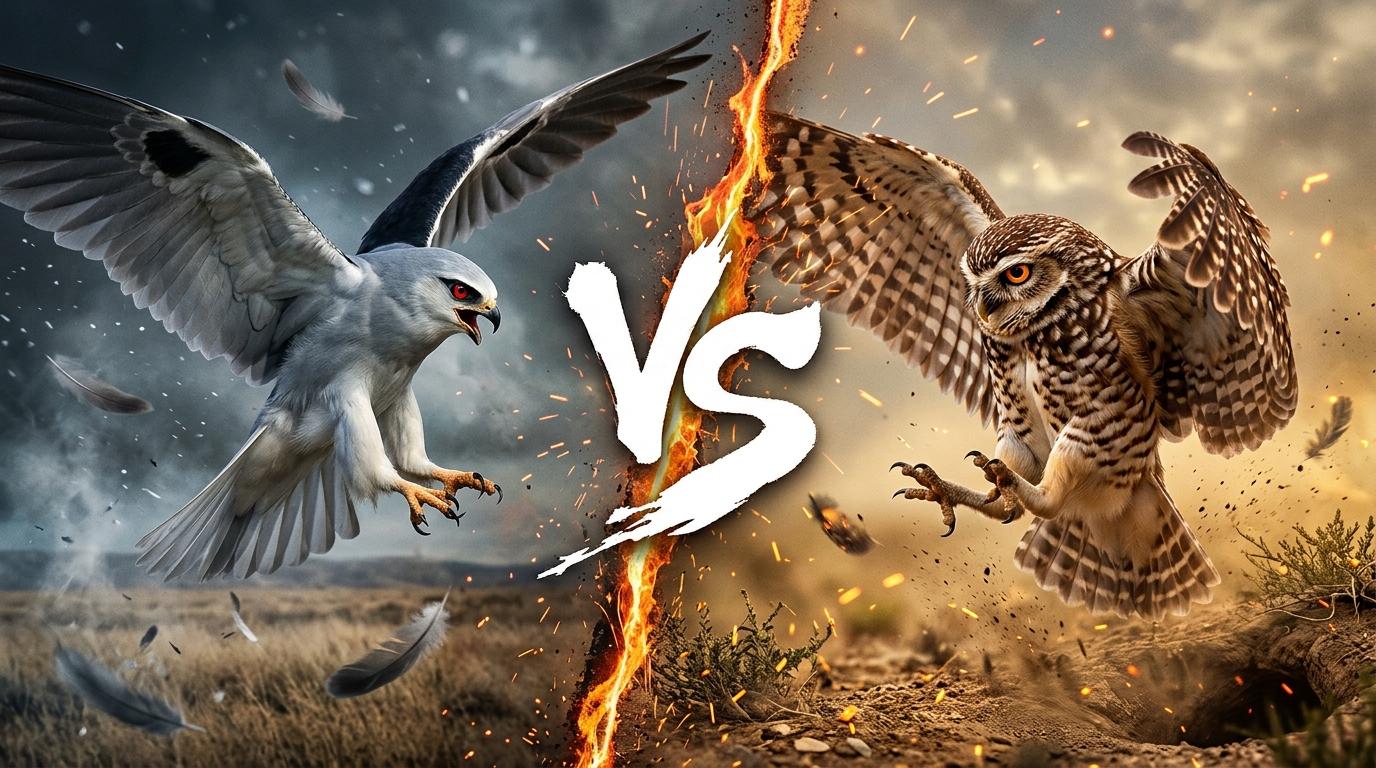
Black-shouldered Kite vs Burrowing Owl: Who Actually Wins?
Black-shouldered Kite vs Burrowing Owl: a biology-first look at size, talons, flight and burrow defense, and which small raptor wins a hypothetical confrontation.
Black-shouldered Kite vs Burrowing Owl
Matchup winner
Black-shouldered Kite
Quick verdict
Start with the direct answer, then use the structured comparison below to see what changes the outcome.
The Black-shouldered Kite wins most realistic confrontations. It is heavier, at roughly 250–300 g against the owl's typical 150–200 g, and it carries a far bigger wingspan of about 80–95 cm. It is also a true aerial hunter, built to hover, stoop and strike from above. The Burrowing Owl is no pushover. It is quick on its feet, clever around its burrow, and famous for a rattlesnake-like hiss that bluffs off bigger threats. But it is a ground-centric, leggy bird that gives up the air. In any encounter that starts in the open or in flight, the kite controls the angle of attack. The owl's best result is a stalemate at its burrow mouth, where retreat beats victory. These species never meet in the wild: the kite is Australian and the owl lives in the Americas. This is a hypothetical comparison of body plans.
Read the full explanation
Winner: Black-shouldered Kite, thanks to more mass, a much larger wingspan and full control of the air.
The Burrowing Owl's edge is ground agility, burrow access and a convincing snake-hiss bluff.
On open ground or in the air, the kite dominates. At the burrow entrance, the owl can force a draw by retreating.
They don't share a continent, so this is a body-plan comparison, not a recorded clash.
Reader vote
Who do you think wins?
Pick a side — no account needed. Results update live.
No votes yet — be the first to call it.
Editorial note
Why people disagree
'Owl' sounds fiercer than 'kite.' People picture great horned owls, but the Burrowing Owl is one of the smallest, lightest owls in its range.
Body mass & frame
Among birds this small, an extra 50–100 g is a big share of body weight. It decides who gets pinned and who gets knocked off balance.
Aerial command
The bird that owns the airspace chooses when and from where to strike. That is the kite's biggest edge.
Ground agility
If the encounter stays at ground level, the owl can dodge, reposition and counter in ways the kite can't.
Read the full explanation +
The owl's slightly higher speed and intelligence scores tempt people to favor it, but quickness on foot and burrow cunning don't cancel out a weight and reach gap in the air.
Burrow defense looks like fighting skill. In practice the owl wins by disappearing underground, not by beating an attacker.
Some argue owls' night vision and silent flight matter. The Burrowing Owl is largely active by day and at dusk, so that usual owl advantage is mostly missing here.
Comparison FAQ
Short, direct answers to the next questions readers usually ask after the headline verdict.
Would a Black-shouldered Kite beat a Burrowing Owl?+
Yes, in most scenarios. The kite is heavier, has a much larger wingspan and controls the air. The owl only reliably holds its ground at its burrow, by retreating inside.
Which is stronger, a Black-shouldered Kite or a Burrowing Owl?+
The kite. It outweighs the owl by roughly 50–100 g and strikes with diving momentum. The owl's strength is close-range footwork, not raw power.
Why is the Burrowing Owl still dangerous even though it loses?+
Its sharp talons, quick pounces and rattlesnake-like hiss can injure or deter attackers. It also always has an escape hatch underground, so it rarely gets cornered.
Do Black-shouldered Kites and Burrowing Owls ever meet?+
No. The Black-shouldered Kite is native to Australia and the Burrowing Owl to North and South America. This is a hypothetical comparison.
Is the Burrowing Owl faster than the kite?+
It scores slightly higher for quickness and is very agile on foot. In sustained flight and controlled hunting, the kite is the more capable flier.
Are Burrowing Owls nocturnal?+
Not strictly. They are often active by day and especially at dawn and dusk, unlike many owls.
Head-to-head species stats
These are the same core AnimalDex stat dimensions used on the dedicated animal pages, pulled side by side so the matchup is faster to scan.
Black-shouldered Kite
Tier CBurrowing Owl
Tier CTrait-by-trait comparison
Only the categories that matter to this matchup are included. The goal is not filler stats, but the real design differences that change the result.
~250–300 g, compact raptor build
Body mass & frame
Black-shouldered Kite
~150–200 g, small with long legs
Body mass & frame
Black-shouldered Kite
Expert hoverer, wingspan ~80–95 cm
Aerial command
Black-shouldered Kite
Capable but short flights, often low
Aerial command
Black-shouldered Kite
Awkward on the ground and rarely fights there
Ground agility
Burrowing Owl
Runs, hops and pounces on its long legs
Ground agility
Burrowing Owl
Sharp talons built for snatching mice from a hover
Talon strike
Black-shouldered Kite
Strong feet for insects, rodents and small reptiles
Talon strike
Black-shouldered Kite
Alarm calls and aggressive mobbing of intruders
Bluff & deterrence
Burrowing Owl
Rattlesnake-mimic hiss inside the burrow, bobbing threat displays
Bluff & deterrence
Burrowing Owl
Open perches and treetops
Refuge access
Burrowing Owl
Underground burrows, often taken over from mammals
Refuge access
Burrowing Owl
How the verdict forms
Verdict timeline
01 · Body mass & frame
Black-shouldered Kite
02 · Aerial command
Black-shouldered Kite
03 · Ground agility
Burrowing Owl
04 · Talon strike
Black-shouldered Kite
05 · Bluff & deterrence
Burrowing Owl
06 · Refuge access
Burrowing Owl
Change the conditions
Scenario breakdown
This is where shallow battle content usually fails. Terrain, spacing, timing, and engagement style can change the answer.
Scenario lean
Black-shouldered Kite
Verdict confidence
82%
Kite wins clearly.
In open grassland with no burrow nearby, the kite can hover and pick its moment, then stoop with gravity on its side. The owl can only hop, flare and hiss upward. Its bluff works best from inside a dark tunnel, not on bare ground. The heavier, aerially dominant bird sets every angle of contact.
AnimalDex field profiles
Explore these animals
Black-shouldered Kite
Elanus axillaris
open grassland, farmland, and woodland edge
Burrowing Owl
Athene cunicularia
grassland, prairie, desert edge, and open scrub
Systems Intelligence & Hidden Purpose
See the animals behind this comparison as engineered biological systems: what each one is built to do, where it gains leverage, and why the matchup changes by scenario.
Specialized Hardware
pale body with black shoulders, hovering rodent-hunt posture, and red eye glow give the Black-shouldered Kite a body plan tuned for its niche.
Systems Script
Black-shouldered Kites operate through open grassland, farmland, and woodland edge. Their design links movement, feeding, shelter, and timing into one workable survival system.
Strategic Insight
Dense environments reward precision, patience, and the ability to read layered cover.
Specialized Hardware
long-legged owl body, ground-dwelling burrow life, and daylight hunting in open country give the Burrowing Owl a body plan tuned for its niche.
Systems Script
Burrowing Owls operate through grassland, prairie, desert edge, and open scrub Their design links movement, shelter, and feeding into one workable survival system.
Strategic Insight
A familiar design can unlock new territory when it changes just one major habit.
Final take
The Black-shouldered Kite is the overall winner. It owns the two things that settle small-raptor conflicts: the air and a weight advantage. A bird that can hover, wait and drop with momentum dictates the encounter, and the Burrowing Owl's ground-based body plan leaves it reacting rather than controlling.
Read the full explanation
The owl's record isn't a loss so much as a different strategy. Burrows, snake-hiss mimicry and nimble legs are built to avoid fights, not win them, and they do that job extremely well. Near its tunnel, the owl is close to untouchable.
Scored across realistic contexts, the kite takes open ground, the air and contested prey. The owl takes burrow defense and tight cover. The majority, and the decisive open-sky frame, belong to the kite.
Collect both animals in AnimalDex
Track the species behind this matchup, compare their real traits, and build the rivalry into your AnimalDex collection.
Discussion
What do you think?
Share your reasoning with other readers. Be civil and stick to the animals.
Sign in to join the discussion.
Sign inNo comments yet. Start the conversation.