

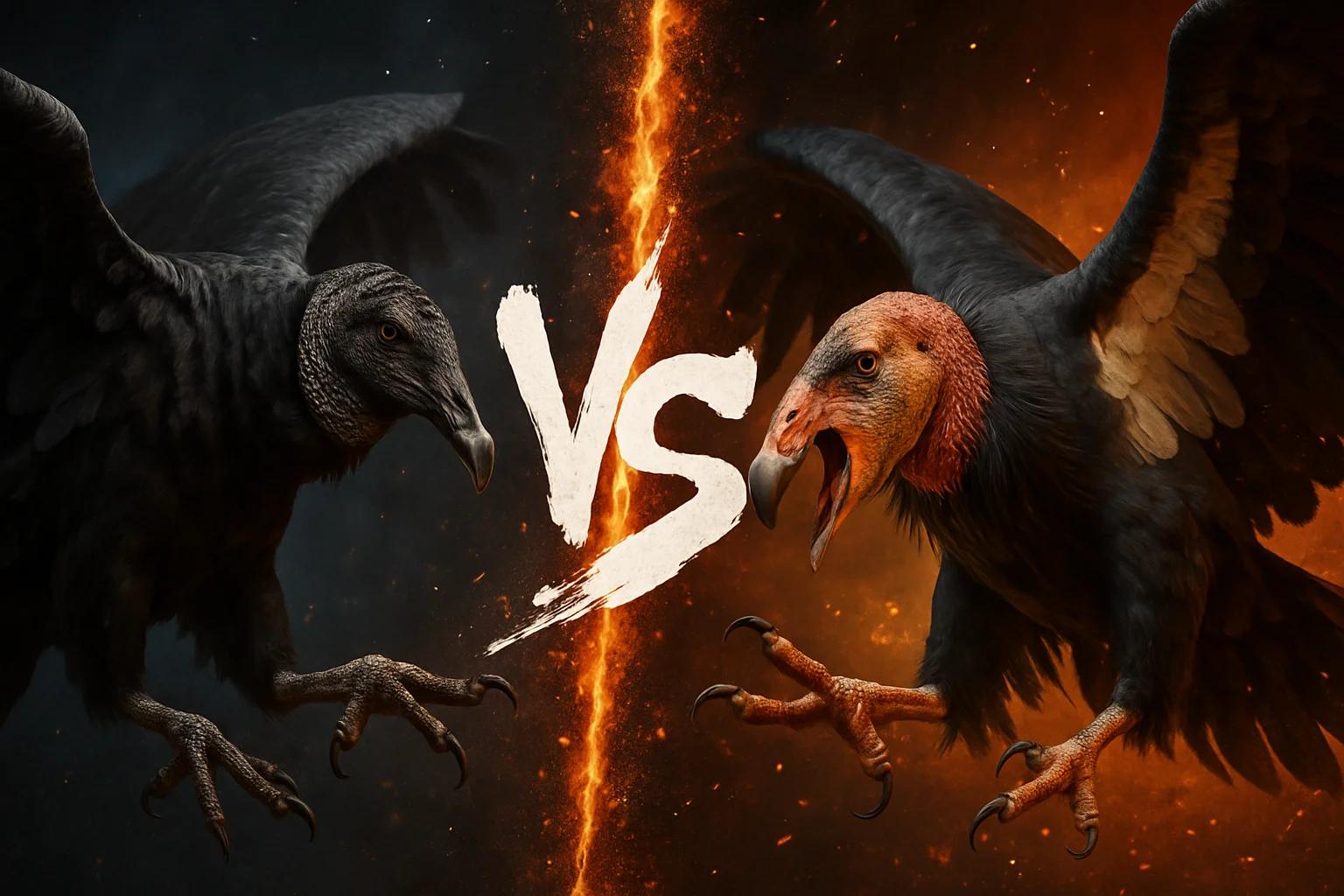
Black Vulture vs California Condor: Who Actually Wins?
Black Vulture vs California Condor: a biology-first breakdown of size, carcass dominance, group tactics, and who wins a one-on-one showdown.
Black Vulture vs California Condor
Matchup winner
California Condor
Quick verdict
Start with the direct answer, then use the structured comparison below to see what changes the outcome.
The California Condor wins. It weighs roughly 8–11 kg and has a wingspan near 2.9 m, about four times the mass of a 1.6–2.8 kg Black Vulture. At a carcass, that size gap decides almost everything. Condors sit at or near the top of the North American scavenger pecking order and routinely push smaller vultures off a kill through body mass, wing-spread displays, and lunging bites from a heavy, hooked bill. The Black Vulture is bold, quick on the ground, and famously pushy, but one-on-one it is a mid-weight bird trying to bully a heavyweight. Its real strength is numbers. A dense, cooperative mob of Black Vultures can crowd, harass, and strip a carcass faster than a lone condor can defend it. That keeps the matchup interesting, but it does not overturn the solo verdict.
Read the full explanation
California Condor wins one-on-one, mainly because it is about four times heavier.
Condors dominate carcass hierarchies and displace smaller vultures with displays and lunges.
Black Vultures are more aggressive per kilogram and much stronger as a cooperative group.
A large Black Vulture mob can win the race for the food even if it never beats the condor head-on.
Reader vote
Who do you think wins?
Pick a side — no account needed. Results update live.
No votes yet — be the first to call it.
Editorial note
Why people disagree
Black Vultures have a reputation as the bullies of the vulture world, so people overrate how they would fare against a much bigger bird.
Heavyweight presence
Scavenger disputes are mostly shoving matches, so being roughly four times heavier is close to decisive.
Intimidation spread
Wing-spread threat displays settle most carcass conflicts before contact, and the condor's display covers nearly twice the span.
Pound-for-pound nerve
Black Vultures pick fights far above their weight, which buys them bites at contested food.
Read the full explanation +
Group footage of Black Vultures overwhelming Turkey Vultures gets mistaken for proof that they win solo contests.
The condor's rarity and slow, deliberate feeding style make it look passive, which hides how decisively it controls a carcass.
Comparison FAQ
Short, direct answers to the next questions readers usually ask after the headline verdict.
Would a Black Vulture beat a California Condor?+
Not one-on-one. The condor's far greater size and dominance at carcasses win nearly every solo encounter.
Which is stronger, a Black Vulture or a California Condor?+
The California Condor. It is about four times heavier and has a much more powerful tearing bill.
How would a fight between them actually play out?+
Mostly as a display contest. The condor spreads its wings, hisses, and lunges, and the Black Vulture typically backs off without serious contact.
Why is the Black Vulture still dangerous?+
Black Vultures are aggressive, agile, and highly social. In groups they can harass a lone condor and strip a carcass faster than it can defend it, and when threatened they can defend themselves by vomiting.
Do Black Vultures and California Condors meet in the wild?+
Rarely, if at all. Their current ranges barely overlap, which makes this matchup largely theoretical.
Head-to-head species stats
These are the same core AnimalDex stat dimensions used on the dedicated animal pages, pulled side by side so the matchup is faster to scan.
Black Vulture
Tier CCalifornia Condor
Tier BTrait-by-trait comparison
Only the categories that matter to this matchup are included. The goal is not filler stats, but the real design differences that change the result.
About 1.6–2.8 kg
Heavyweight presence
California Condor
About 8–11 kg
Heavyweight presence
California Condor
About 1.5 m wingspan
Intimidation spread
California Condor
About 2.9 m wingspan
Intimidation spread
California Condor
Pushy, quick, confrontational
Pound-for-pound nerve
Black Vulture
Deliberate, confident, slower to escalate
Pound-for-pound nerve
Black Vulture
Communal roosts and kin-based feeding crowds
Mob coordination
Black Vulture
Small groups with a clear hierarchy
Mob coordination
Black Vulture
Slender bill, relies on others to open hides
Tearing hardware
California Condor
Massive hooked bill that opens tough carcasses
Tearing hardware
California Condor
Hopping, fast, quick to reposition
Ground footwork
Black Vulture
Heavier, slower to reposition
Ground footwork
Black Vulture
How the verdict forms
Verdict timeline
01 · Heavyweight presence
California Condor
02 · Intimidation spread
California Condor
03 · Pound-for-pound nerve
Black Vulture
04 · Mob coordination
Black Vulture
05 · Tearing hardware
California Condor
06 · Ground footwork
Black Vulture
Change the conditions
Scenario breakdown
This is where shallow battle content usually fails. Terrain, spacing, timing, and engagement style can change the answer.
Scenario lean
California Condor
Verdict confidence
82%
The condor takes the carcass.
With one bird each, the condor's mass and wing-spread display usually end the dispute almost immediately. If the Black Vulture presses in, a lunge from the heavy hooked bill drives it back. Scavenger hierarchies reliably follow body size, and here the gap is enormous.
AnimalDex field profiles
Explore these animals
Black Vulture
Coragyps atratus
open country, town edge, wetland margin, and warm-air soaring terrain
California Condor
Gymnogyps californianus
Mountainous open country, canyon systems, coastal ranges, and wide dry landscapes.
Systems Intelligence & Hidden Purpose
See the animals behind this comparison as engineered biological systems: what each one is built to do, where it gains leverage, and why the matchup changes by scenario.
Specialized Hardware
Huge black wings with white patches, bare pink-orange head, and very broad soaring silhouette give the California Condor a body plan tuned for its niche.
Systems Script
California Condors operate in mountainous open country, canyon systems, coastal ranges, and wide dry landscapes. Their design helps them match food access, shelter, and timing inside that environment.
Strategic Insight
Big systems sometimes survive only when many smaller systems decide they are worth saving.
Final take
The California Condor is the clear winner. Carcass contests among scavengers are decided mostly by body mass and threat displays, and the condor brings roughly four times the weight and nearly double the wingspan.
Read the full explanation
The Black Vulture's case rests entirely on teamwork. Its nerve and mob tactics make it a fierce competitor for food, but those strengths show up in groups, not in a one-on-one contest.
This is also mostly hypothetical. The two species' current ranges barely overlap, and condors are critically endangered, so any real encounter would be rare.
Collect both animals in AnimalDex
Track the species behind this matchup, compare their real traits, and build the rivalry into your AnimalDex collection.
Discussion
What do you think?
Share your reasoning with other readers. Be civil and stick to the animals.
Sign in to join the discussion.
Sign inNo comments yet. Start the conversation.