

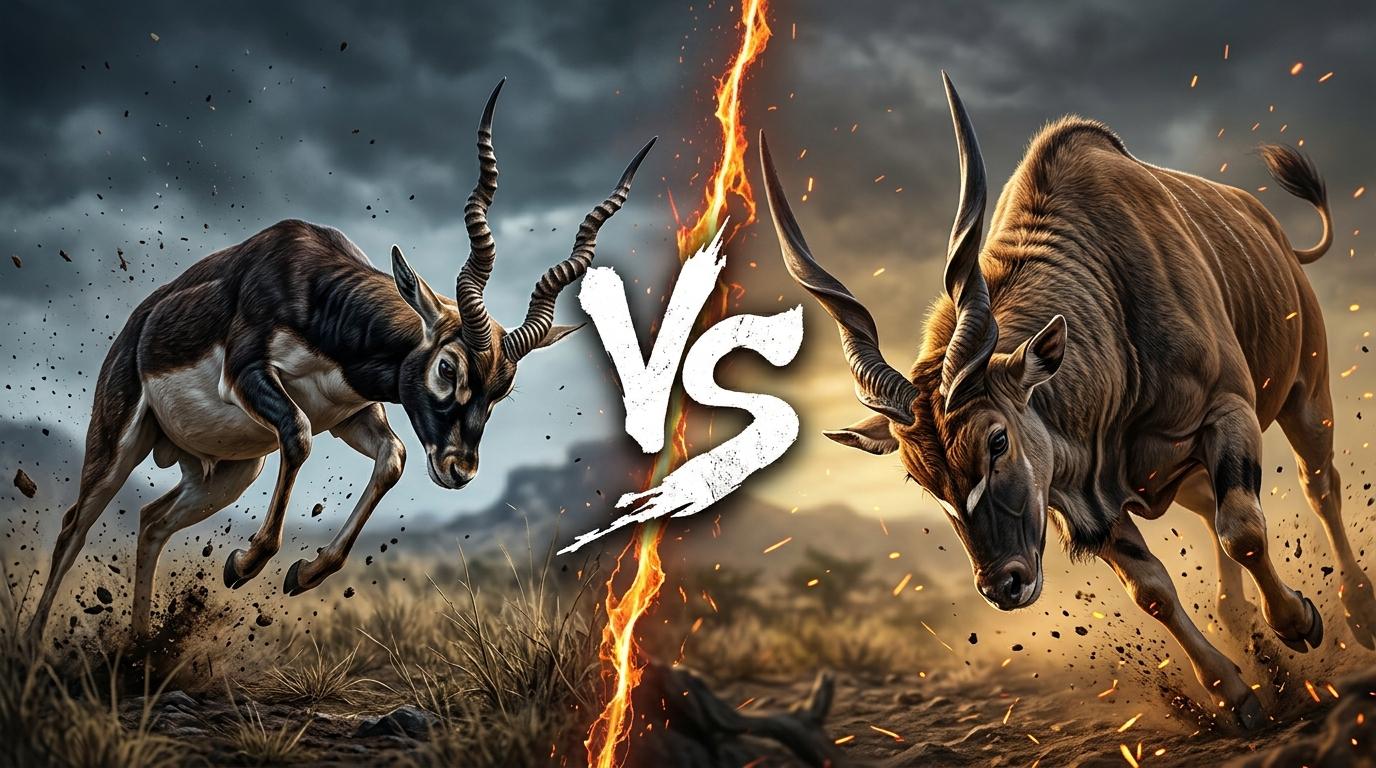
Blackbuck vs Giant Eland: Who Actually Wins?
Blackbuck vs giant eland: a sprinting Indian antelope against Africa's largest antelope. See who wins a confrontation, why, and where the blackbuck still has the edge.
Blackbuck vs Giant Eland
Matchup winner
Giant Eland
Quick verdict
Start with the direct answer, then use the structured comparison below to see what changes the outcome.
The giant eland wins, and it isn't close in a physical confrontation. Africa's largest antelope can stand around 1.5–1.8 m at the shoulder and weigh roughly 400–900 kg, with thick spiral horns up to about a metre long and a heavy, muscular neck built for shoving contests between bulls. The blackbuck is a lightweight specialist of about 25–45 kg with ringed corkscrew horns. It was built to outrun threats across open plains at speeds reported near 80 km/h, not to absorb force. If the two ever squared off, the eland's mass, reach and pushing power would decide things within seconds. The blackbuck's real winning move is to leave, and in a pure race it wins easily.
Read the full explanation
Overall winner: Giant Eland. It holds a massive edge in size, strength and horn leverage.
The eland can outweigh a blackbuck by 15–20 times, so any shoving or horn clash ends quickly.
The blackbuck is far faster and more agile. It wins any contest that comes down to escape.
Neither animal is a predator. A real clash would be a displacement or defensive encounter, not a hunt.
Reader vote
Who do you think wins?
Pick a side — no account needed. Results update live.
No votes yet — be the first to call it.
Editorial note
Why people disagree
Blackbuck horns look dramatic, so people overrate them. The spirals are display and rutting tools sized for other blackbuck, not for a half-ton bovid.
Explosive power
Power scales with mass. The eland's jumps and lunges carry many times the force a blackbuck can generate.
Escape velocity
Speed lets the blackbuck refuse the fight entirely, which is its only path to not losing.
Close-range durability
In contact the eland absorbs blows the blackbuck simply cannot deliver hard enough to matter.
Read the full explanation +
Some readers count speed as winning. Outrunning an opponent is survival, but it is not victory in a confrontation.
The eland's calm, herd-living temperament can read as weakness. Bulls still spar hard, and that docility hides enormous force.
Comparison FAQ
Short, direct answers to the next questions readers usually ask after the headline verdict.
Would a blackbuck beat a giant eland in a fight?+
No. The giant eland would win decisively thanks to its huge size, strength and horn reach. A blackbuck could only avoid defeat by running.
Which is stronger, a blackbuck or a giant eland?+
The giant eland, by a wide margin. It weighs roughly 400–900 kg against the blackbuck's 25–45 kg and carries far more muscle in its neck and shoulders.
Is a blackbuck faster than a giant eland?+
Yes. Blackbuck are among the fastest antelopes, reportedly reaching about 80 km/h, roughly double the eland's top pace.
Why is the blackbuck still dangerous even though it would lose?+
Male blackbuck have sharp, ringed spiral horns and fight fiercely during the rut. A cornered male can jab hard enough to injure people or small animals. Its speed also means it is rarely caught at all.
Do blackbuck and giant eland live in the same place?+
No. Blackbuck are native to India and Nepal. Giant eland live in the woodland savannas of central and West Africa. They would only meet in captivity or on introduced ranges.
Head-to-head species stats
These are the same core AnimalDex stat dimensions used on the dedicated animal pages, pulled side by side so the matchup is faster to scan.
Blackbuck
Tier BGiant Eland
Tier ATrait-by-trait comparison
Only the categories that matter to this matchup are included. The goal is not filler stats, but the real design differences that change the result.
Light, springy, built for bursts
Explosive power
Giant Eland
Heavy shove; can still clear about 1.5 m jumps
Explosive power
Giant Eland
Among the fastest antelopes, reported near 80 km/h
Escape velocity
Blackbuck
Steady trot, roughly 40 km/h at a push
Escape velocity
Blackbuck
Slender frame, thin neck
Close-range durability
Giant Eland
Thick hide, dewlap, massive neck and shoulders
Close-range durability
Giant Eland
Ringed corkscrew horns, about 45–70 cm
Horn leverage
Giant Eland
Thick spiral horns, often 80–120 cm
Horn leverage
Giant Eland
Stotting leaps, sharp cuts
Agility & evasion
Blackbuck
Ponderous turns
Agility & evasion
Blackbuck
Vigilance herds, alarm leaps
Herd deterrence
Giant Eland
Large herds that close ranks around calves
Herd deterrence
Giant Eland
How the verdict forms
Verdict timeline
01 · Explosive power
Giant Eland
02 · Escape velocity
Blackbuck
03 · Close-range durability
Giant Eland
04 · Horn leverage
Giant Eland
05 · Agility & evasion
Blackbuck
06 · Herd deterrence
Giant Eland
Change the conditions
Scenario breakdown
This is where shallow battle content usually fails. Terrain, spacing, timing, and engagement style can change the answer.
Scenario lean
Giant Eland
Verdict confidence
82%
Eland dominates in tight quarters
Woodland and scrub, the giant eland's native habitat, take away the blackbuck's runway. With little room to accelerate, the smaller antelope is drawn into contact range, where mass and horn reach decide everything. The eland's head-sweep alone could knock a blackbuck down.
AnimalDex field profiles
Explore these animals
Blackbuck
Antilope cervicapra
open grassland, dry plain, and lightly wooded savannah
Giant Eland
Taurotragus derbianus
savannah woodland, forest edge, and lightly wooded grassland
Systems Intelligence & Hidden Purpose
See the animals behind this comparison as engineered biological systems: what each one is built to do, where it gains leverage, and why the matchup changes by scenario.
Specialized Hardware
spiraled horns on males, fast bounding movement, and lightweight grassland body give the Blackbuck a body plan tuned for its niche.
Systems Script
Blackbucks operate through open grassland, dry plain, and lightly wooded savannah Their design links movement, shelter, and feeding into one workable survival system.
Strategic Insight
A light system can survive by turning speed into space.
Specialized Hardware
very large antelope build, spiraled horns, and deep forest and savannah movement give the Giant Eland a body plan tuned for its niche.
Systems Script
Giant Elands operate through savannah woodland, forest edge, and lightly wooded grassland. Their design links movement, feeding, shelter, and timing into one workable survival system.
Strategic Insight
Dense environments reward precision, patience, and the ability to read layered cover.
Final take
The giant eland is the clear winner. Being 15–20 times heavier, with longer and thicker horns and sparring-hardened neck muscles, makes any physical contest one-sided. This is a matchup between two very different survival strategies: mass and herd solidarity on one side, speed and vigilance on the other.
Read the full explanation
The blackbuck isn't a loser in nature's terms. It is one of the best-engineered escape artists among the antelopes, and on open ground it would never be caught. But 'who would win' means contact, and in contact the eland's size settles the question.
Collect both animals in AnimalDex
Track the species behind this matchup, compare their real traits, and build the rivalry into your AnimalDex collection.
Related comparisons
Continue with nearby matchups to compare more real-world animal traits without dropping into junky who-wins filler.
Giant Eland vs Puku: Who Actually Wins?
The giant eland wins, and it isn't close. Africa's largest antelope can stand around 1.5–1.8 m at the shoulder and weigh well over 600 kg, with bulls sometimes approaching a tonne. The puku is a compact wetland antelope of roughly 60–90 kg. The eland carries long, tightly spiraled horns on both sexes and a heavy neck and dewlap built for shoving contests. The puku's advantages are sprint acceleration, agility through floodplain grass, and an instinct to break off and flee. Those keep it alive but don't help it win a contest of force. In any confrontation where contact happens, the eland's mass and horn reach end the exchange almost immediately. The puku's real victory condition is leaving.
Read comparison
Discussion
What do you think?
Share your reasoning with other readers. Be civil and stick to the animals.
Sign in to join the discussion.
Sign inNo comments yet. Start the conversation.