

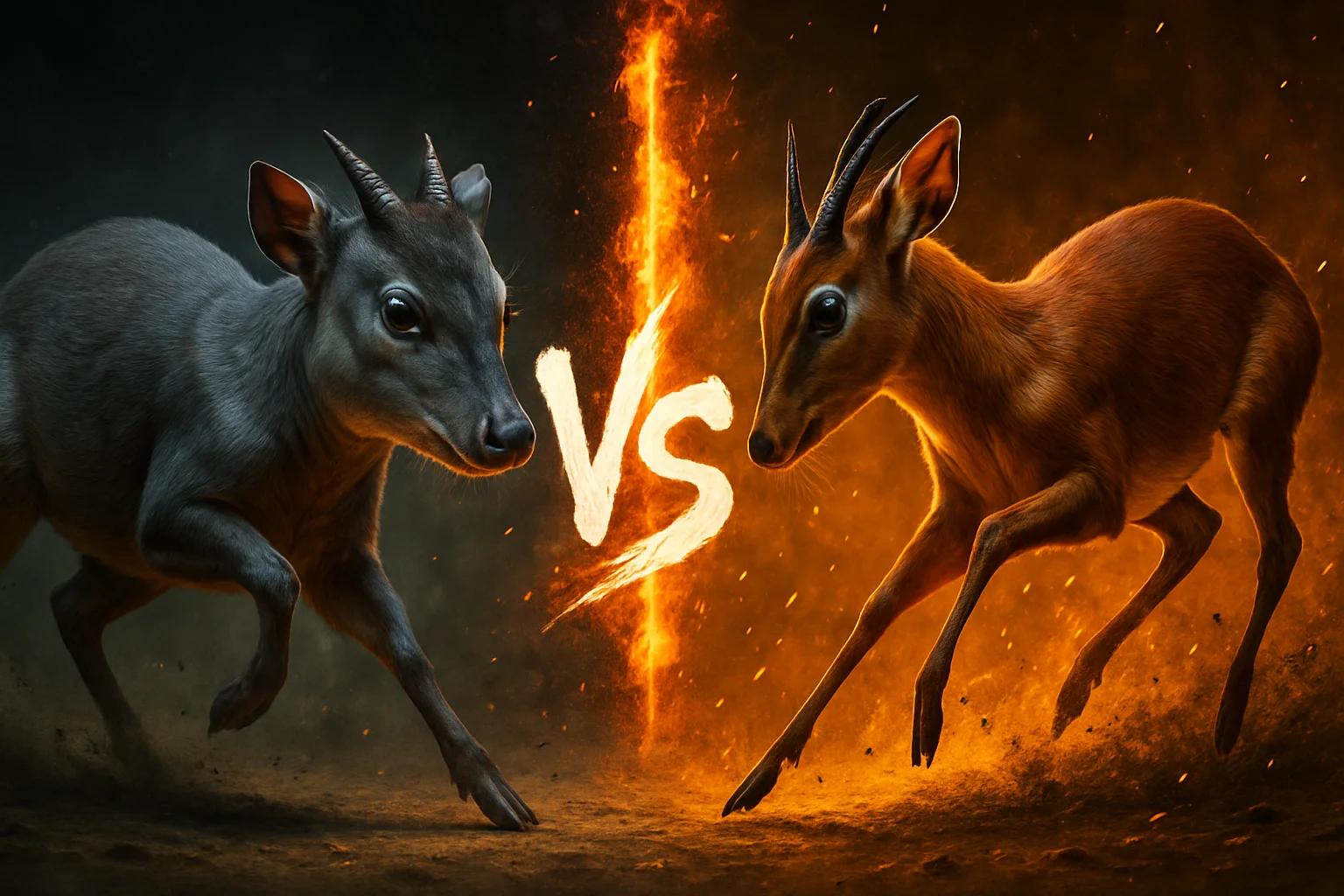
Blue Duiker vs Royal Antelope: Who Actually Wins?
Blue duiker vs royal antelope: two of Africa's smallest forest antelopes compared on size, horns, speed and territorial grit. Here is which tiny hoofed mammal comes out on top.
Blue Duiker vs Royal Antelope
Matchup winner
Blue Duiker
Quick verdict
Start with the direct answer, then use the structured comparison below to see what changes the outcome.
The blue duiker wins. At roughly 4–9 kg against the royal antelope's 1.5–3 kg, the blue duiker carries two to four times the mass. Both sexes usually have short, sharp spike horns, and the species defends small territories in pairs, driving off rivals with butts and horn jabs. The royal antelope is the world's smallest antelope. It is built for one job: vanishing. It freezes in leaf litter and then explodes away in bounds that can reportedly cover around 2.5 m. Only males have horns, and they are tiny. In any forced confrontation, such as a shared trail or a contested fruit fall, the duiker's weight, armed females and habit of defending ground decide it. The royal antelope's real victory condition is never being there when the duiker arrives.
Read the full explanation
Blue duiker wins: heavier, armed in both sexes, and used to defending territory.
The royal antelope is the smallest antelope on Earth, at roughly the size of a rabbit.
The royal antelope's edge is escape, with explosive leaps and near-invisible freezing, not fighting.
Real encounters would almost always end with the royal antelope bolting, not brawling.
Reader vote
Who do you think wins?
Pick a side — no account needed. Results update live.
No votes yet — be the first to call it.
Editorial note
Why people disagree
Both are 'tiny forest antelope,' so people assume they're evenly matched. In fact, the duiker can outweigh the royal antelope by roughly three times.
Body mass advantage
In a shoving contest between hoofed mammals, mass is the first and biggest deciding factor.
Horn armament
Armed females mean any duiker the royal antelope meets is likely carrying weapons.
Explosive escape
The royal antelope can break contact faster than almost anything its size.
Read the full explanation +
The royal antelope's leaping ability looks athletic on video, but fleeing well is not the same as winning a contest.
Neither species is famous for fighting, so some argue it's a non-event. Duikers do butt and jab rivals, which gives them real combat experience.
Comparison FAQ
Short, direct answers to the next questions readers usually ask after the headline verdict.
Would a blue duiker beat a royal antelope?+
Yes. In a direct confrontation, the blue duiker's size and horns would win decisively.
Which is stronger, the blue duiker or the royal antelope?+
The blue duiker. It can weigh roughly three times as much and has a sturdier build.
Is the royal antelope the smallest antelope?+
Yes. It is generally considered the world's smallest antelope, standing about 25 cm at the shoulder.
Why is the royal antelope still hard to beat?+
It rarely lets a contest happen. Its explosive leaps and leaf-litter camouflage let it break contact almost instantly, and a male's small horns can still jab if it is cornered.
Do these antelope actually fight each other?+
Rarely. Their ranges overlap in parts of West Africa, but encounters usually end with the smaller royal antelope retreating.
Head-to-head species stats
These are the same core AnimalDex stat dimensions used on the dedicated animal pages, pulled side by side so the matchup is faster to scan.
Blue Duiker
Tier BRoyal Antelope
Tier BTrait-by-trait comparison
Only the categories that matter to this matchup are included. The goal is not filler stats, but the real design differences that change the result.
About 4–9 kg, compact and low-slung
Body mass advantage
Blue Duiker
About 1.5–3 kg, rabbit-sized
Body mass advantage
Blue Duiker
Short spike horns, often in both sexes
Horn armament
Blue Duiker
Tiny horns, males only
Horn armament
Blue Duiker
Fast dives into undergrowth with darting runs
Explosive escape
Royal Antelope
Huge bounding leaps relative to body size
Explosive escape
Royal Antelope
Slate-blue coat that blends into forest shade
Freeze-and-vanish camouflage
Royal Antelope
Russet coat that disappears in leaf litter
Freeze-and-vanish camouflage
Royal Antelope
Bonded pairs defend ranges and mark with preorbital glands
Territorial grit
Blue Duiker
Mostly solitary, prone to fleeing, with loose spacing
Territorial grit
Blue Duiker
Sturdier frame that absorbs bumps
Close-range durability
Blue Duiker
Delicate pencil-thin legs
Close-range durability
Blue Duiker
How the verdict forms
Verdict timeline
01 · Body mass advantage
Blue Duiker
02 · Horn armament
Blue Duiker
03 · Explosive escape
Royal Antelope
04 · Freeze-and-vanish camouflage
Royal Antelope
05 · Territorial grit
Blue Duiker
06 · Close-range durability
Blue Duiker
Change the conditions
Scenario breakdown
This is where shallow battle content usually fails. Terrain, spacing, timing, and engagement style can change the answer.
Scenario lean
Blue Duiker
Verdict confidence
82%
The duiker owns the thicket.
In dense undergrowth there is little room for the royal antelope to launch its long bounds. Up close, the duiker's mass and horn jabs dominate, and the royal antelope's fragile legs become a liability.
AnimalDex field profiles
Explore these animals
Blue Duiker
Philantomba monticola
lowland rainforest, forest edge, and dense undergrowth
Royal Antelope
Neotragus pygmaeus
rainforest edge, dense thicket, and low woodland
Systems Intelligence & Hidden Purpose
See the animals behind this comparison as engineered biological systems: what each one is built to do, where it gains leverage, and why the matchup changes by scenario.
Specialized Hardware
tiny blue-gray antelope frame, short spike horns, and leaf-litter darting escape give the Blue Duiker a body plan tuned for its niche.
Systems Script
Blue Duikers operate through lowland rainforest, forest edge, and dense undergrowth. Their design links movement, feeding, shelter, and timing into one workable survival system.
Strategic Insight
Dense environments reward precision, patience, and the ability to read layered cover.
Specialized Hardware
pinhead-sized antelope frame, delicate spindle legs, and leaf-litter hiding give the Royal Antelope a body plan tuned for its niche.
Systems Script
Royal Antelopes operate through rainforest edge, dense thicket, and low woodland. Their design links movement, feeding, shelter, and timing into one workable survival system.
Strategic Insight
Dense environments reward precision, patience, and the ability to read layered cover.
Final take
The blue duiker is the clear winner. It is heavier, armed in both sexes, and wired to defend territory, and every forced-contact scenario tilts its way.
Read the full explanation
The royal antelope is still a master of its own game. It wins by not playing at all: freezing invisibly, then launching out of reach. In nature, that strategy keeps it alive against far scarier enemies than a duiker.
Collect both animals in AnimalDex
Track the species behind this matchup, compare their real traits, and build the rivalry into your AnimalDex collection.
Discussion
What do you think?
Share your reasoning with other readers. Be civil and stick to the animals.
Sign in to join the discussion.
Sign inNo comments yet. Start the conversation.