


Blue Morpho vs Glasswing Butterfly: Who Actually Wins?
Blue Morpho vs Glasswing Butterfly: a biology-first look at size, flight power, defenses and survival strategy, and which butterfly comes out on top.
Blue Morpho vs Glasswing Butterfly
Matchup winner
Blue Morpho
Quick verdict
Start with the direct answer, then use the structured comparison below to see what changes the outcome.
The Blue Morpho wins. With a wingspan of roughly 12–15 cm against the Glasswing's 5.5–6 cm, Morpho menelaus brings more than double the reach, much more wing area, and a stronger, faster flap-and-glide flight. In any physical contest, such as jostling over a fermenting fruit, a territorial chase along a forest stream, or a midair bump, the larger, more muscular morpho displaces the smaller butterfly. Male morphos are also known to patrol and chase intruders along flight paths. The Glasswing is no pushover in the bigger survival game. Its transparent wings make it nearly invisible against foliage, and the alkaloids it collects as an adult make it distasteful to many predators. Those are defenses against being eaten, though, not tools for winning a confrontation. Head to head, size and flight power decide it, and the morpho holds both.
Read the full explanation
Blue Morpho wins: it has more than twice the wingspan and far stronger flight muscles.
Morphos are faster, more aggressive patrollers and readily chase rivals off their routes.
The Glasswing's strengths are invisibility and chemical defense, which work against predators but do little in a direct contest.
In a hide-and-survive scenario, the Glasswing is the clear specialist.
Reader vote
Who do you think wins?
Pick a side — no account needed. Results update live.
No votes yet — be the first to call it.
Editorial note
Why people disagree
'Winning' is ambiguous for butterflies. Neither one fights to injure, so the real contest is about displacement, chases and access to resources.
Size and reach
In butterfly contests, the larger flier simply bodies the smaller one out of airspace and off food.
Flight power and speed
Speed and power win chases, and chases are how butterflies settle disputes.
Territorial drive
Willingness to engage turns a size edge into an actual win.
Read the full explanation +
The Glasswing's transparency and toxicity make it look like the better survivor, and against birds it often is. That is a different question from who wins head to head.
The morpho's dazzling blue flash makes it easy for predators to spot, so some readers count its flashiness as a weakness and overlook its raw physical edge.
Comparison FAQ
Short, direct answers to the next questions readers usually ask after the headline verdict.
Would a Blue Morpho beat a Glasswing Butterfly?+
Yes. In any direct contest over food or flight space, the much larger and stronger-flying morpho would displace the Glasswing.
Which butterfly is stronger?+
The Blue Morpho. It has more than twice the wingspan and considerably more flight muscle.
Do butterflies actually fight?+
Not to injure each other. They settle disputes through chases, bumping and spiraling flights, and size and speed usually decide those encounters.
Why is the Glasswing still dangerous even though it loses?+
It stores plant alkaloids that make it distasteful, and its transparent wings make it hard to detect. Predators that attack it may learn a bitter lesson.
Which one survives better in the wild?+
Against predators, often the Glasswing, because camouflage and toxicity are strong defenses. The morpho depends on flash-and-vanish flight and camouflage at rest.
Head-to-head species stats
These are the same core AnimalDex stat dimensions used on the dedicated animal pages, pulled side by side so the matchup is faster to scan.
Blue Morpho
Tier DGlasswing Butterfly
Tier DTrait-by-trait comparison
Only the categories that matter to this matchup are included. The goal is not filler stats, but the real design differences that change the result.
About 12–15 cm wingspan
Size and reach
Blue Morpho
About 5.5–6 cm wingspan
Size and reach
Blue Morpho
Strong, bounding flap-glide flight
Flight power and speed
Blue Morpho
Light, fluttering, deliberate flight
Flight power and speed
Blue Morpho
Males patrol and chase intruders
Territorial drive
Blue Morpho
Less confrontational, with group lekking
Territorial drive
Blue Morpho
Brown underside camouflage at rest
Stealth and camouflage
Glasswing Butterfly
Nearly invisible transparent wings
Stealth and camouflage
Glasswing Butterfly
Can be distasteful to some predators
Chemical defense
Glasswing Butterfly
Sequesters alkaloids, making it unpalatable
Chemical defense
Glasswing Butterfly
Flickering blue on and off confuses pursuers
Evasive flash
Blue Morpho
Relies on transparency rather than flash
Evasive flash
Blue Morpho
How the verdict forms
Verdict timeline
01 · Size and reach
Blue Morpho
02 · Flight power and speed
Blue Morpho
03 · Territorial drive
Blue Morpho
04 · Stealth and camouflage
Glasswing Butterfly
05 · Chemical defense
Glasswing Butterfly
06 · Evasive flash
Blue Morpho
Change the conditions
Scenario breakdown
This is where shallow battle content usually fails. Terrain, spacing, timing, and engagement style can change the answer.
Scenario lean
Blue Morpho
Verdict confidence
82%
The morpho takes the fruit.
Both species feed on rotting fruit and fluids. When they compete for the same spot, the morpho's bulk and wing sweep crowd the smaller Glasswing off the best feeding position. Physical displacement favors body size.
AnimalDex field profiles
Explore these animals
Blue Morpho
Morpho menelaus
rainforest edge, river trail, and humid understory
Glasswing Butterfly
Greta oto
cloud forest, rainforest edge, and humid understory
Systems Intelligence & Hidden Purpose
See the animals behind this comparison as engineered biological systems: what each one is built to do, where it gains leverage, and why the matchup changes by scenario.
Specialized Hardware
iridescent blue wings, broad slow gliding flight, and eyespot brown undersides give the Blue Morpho a body plan tuned for its niche.
Systems Script
Blue Morphos operate through rainforest edge, river trail, and humid understory. Their design links movement, feeding, shelter, and timing into one workable survival system.
Strategic Insight
Dense environments reward precision, patience, and the ability to read layered cover.
Specialized Hardware
transparent wing panels, slow floating forest flight, and thin dark wing borders give the Glasswing Butterfly a body plan tuned for its niche.
Systems Script
Glasswing Butterflys operate through cloud forest, rainforest edge, and humid understory. Their design links movement, feeding, shelter, and timing into one workable survival system.
Strategic Insight
Dense environments reward precision, patience, and the ability to read layered cover.
Final take
The Blue Morpho is the winner. In the situations where a butterfly can actually beat another butterfly, such as chases, food competition and airspace control, its larger frame and stronger flight decide the outcome.
Read the full explanation
The Glasswing deserves respect as one of the rainforest's best survivors. It wins by not being seen and by being unpleasant to eat. Those strategies keep it alive, but they do not win a head-to-head contest. On power, the morpho takes it.
Collect both animals in AnimalDex
Track the species behind this matchup, compare their real traits, and build the rivalry into your AnimalDex collection.
Related comparisons
Continue with nearby matchups to compare more real-world animal traits without dropping into junky who-wins filler.

Blue Morpho vs Hercules Beetle: Who Actually Wins?
The Hercules Beetle wins, and it is not especially close once the two actually touch. Dynastes hercules is one of the largest beetles on Earth. Males can reach about 17 cm including the horn. It carries hardened elytra, a pincer-like horn built for prying and lifting rivals, and leg strength that lets it carry loads many times its own weight. The Blue Morpho is a spectacular flier with a wingspan around 15 cm, but its body is light and soft, and its wings are fragile, scale-covered membranes. It has no weapon of any kind. The morpho's whole survival strategy is not being there: erratic, flashing flight and a dull brown underside that hides it when resting. That strategy wins escapes, not contests. In any frame where the butterfly is pinned, cornered, or competing for the same rotting fruit, the beetle's armor-and-leverage design decides it.
Read comparison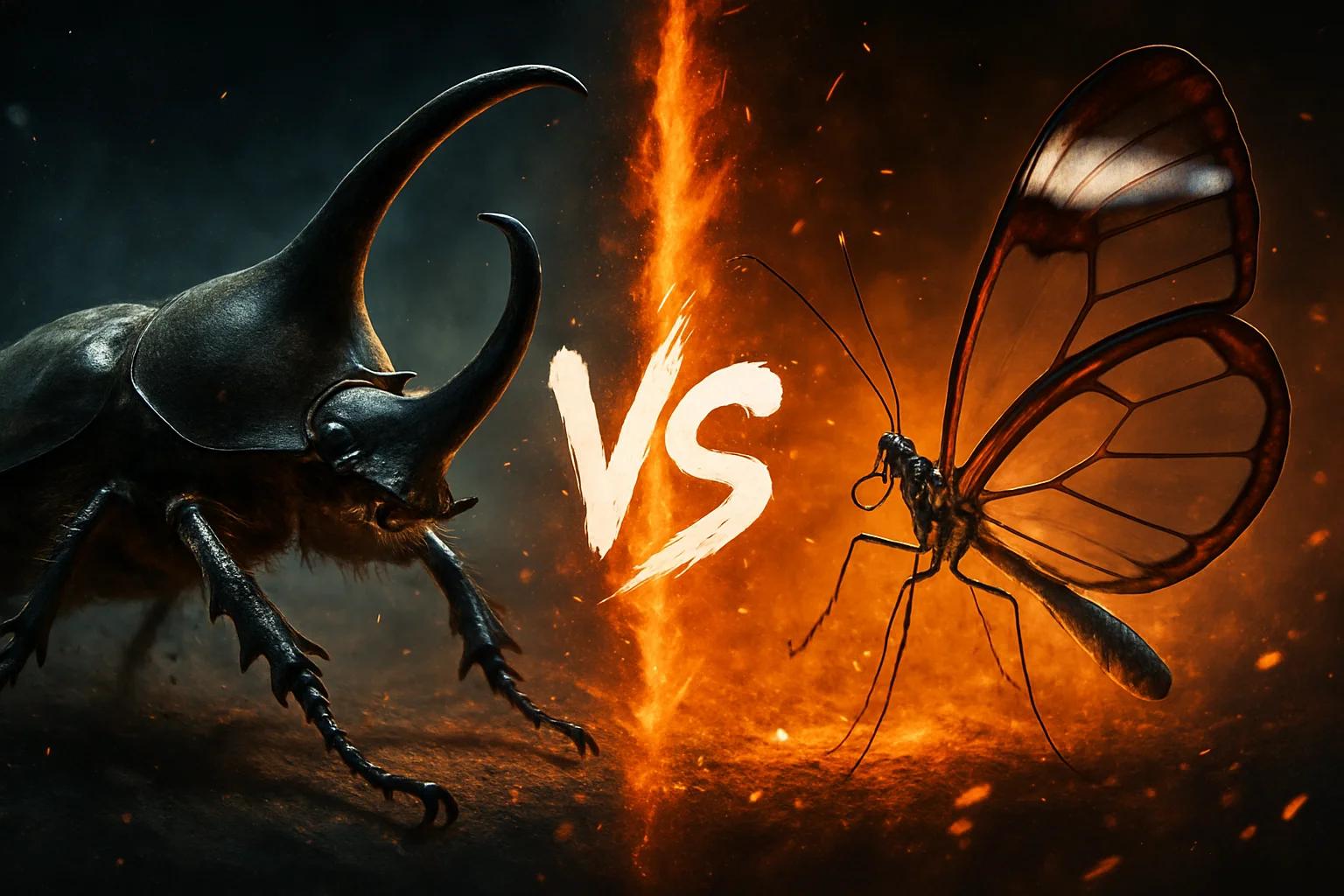
Elephant Beetle vs Glasswing Butterfly: Who Actually Wins?
The elephant beetle wins clearly. Megasoma elephas is one of the heaviest beetles in the Americas. It can reach about 12 cm and is built like a tank: a thick chitin exoskeleton, a long cephalic horn, and legs with hooked tarsi made for prying and gripping. The glasswing butterfly (Greta oto) has a wingspan of about 5–6 cm and weighs a fraction of a gram. Its whole design is about not being found and not being worth eating. It has no weapons, no armor, and no way to push back. In any forced physical contest, the beetle's mass, grip, and horn decide it almost instantly. Neither animal is a predator of the other, so 'winning' here means controlling contact and space. The butterfly's real victory condition is to never make contact at all.
Read comparison
Discussion
What do you think?
Share your reasoning with other readers. Be civil and stick to the animals.
Sign in to join the discussion.
Sign inNo comments yet. Start the conversation.