

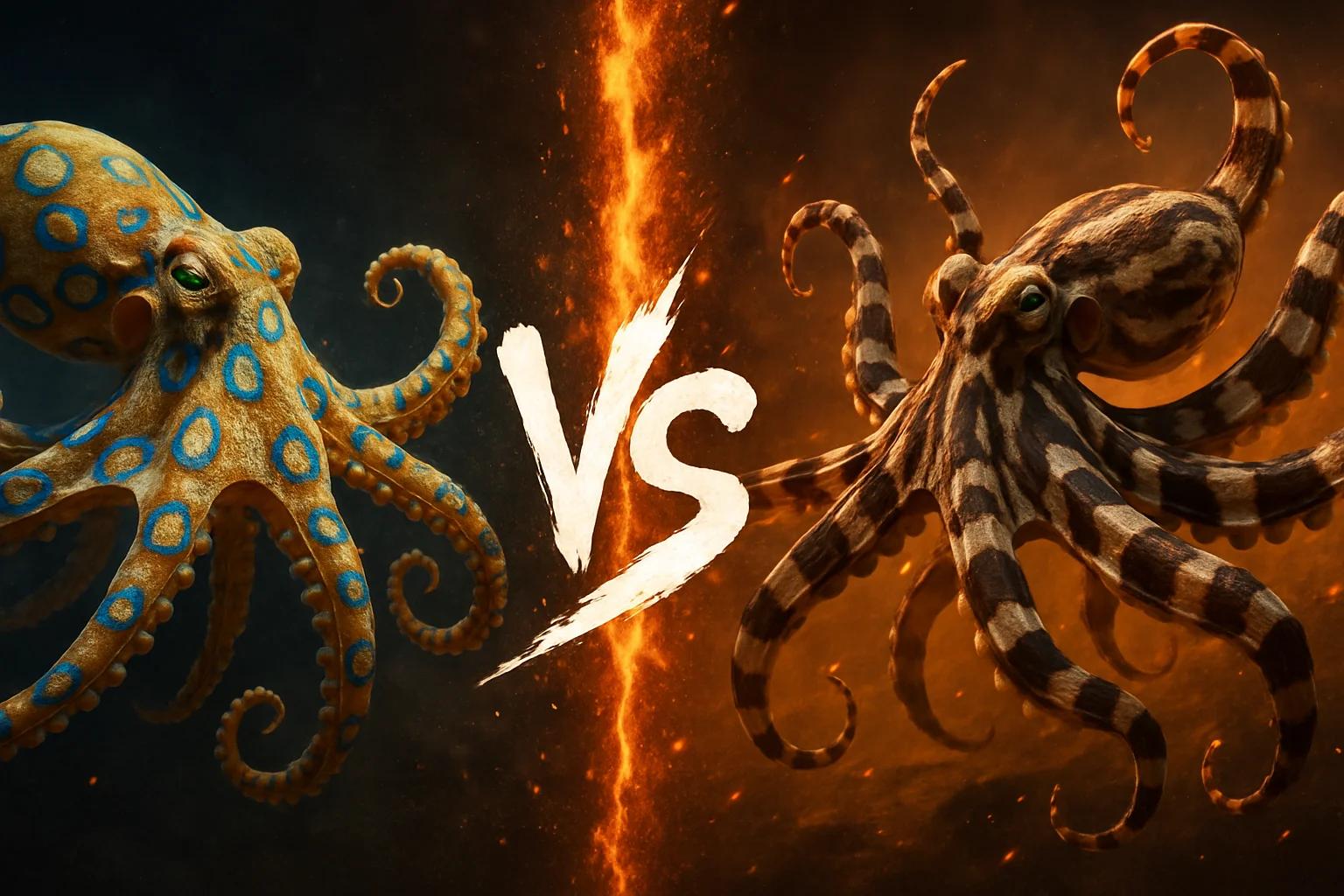
Blue-ringed Octopus vs Mimic Octopus: Who Actually Wins?
Blue-ringed octopus vs mimic octopus. The mimic is bigger, faster and the better illusionist. The blue-ringed octopus carries tetrodotoxin. Here's who wins and why.
Blue-ringed Octopus vs Mimic Octopus
Matchup winner
Blue-ringed Octopus
Quick verdict
Start with the direct answer, then use the structured comparison below to see what changes the outcome.
The blue-ringed octopus wins. The mimic octopus has every physical edge: a longer body, faster movement and one of the most sophisticated disguise repertoires in the ocean. Those edges matter for avoiding a fight, not for finishing one. Octopus-on-octopus combat is an arm-tangle that ends at the beak, and the blue-ringed octopus's bite delivers tetrodotoxin. That neurotoxin, produced by symbiotic bacteria in its salivary glands, blocks sodium channels and can paralyse animals far larger than a mimic. The mimic's tricks, such as impersonating lionfish, sea snakes and flatfish, are tuned to fool visual fish predators. They do little against a tiny, venom-armed cephalopod already in grappling range. If the mimic engages, a single bite likely decides it. The mimic's real win condition is refusing the fight on open sand.
Read the full explanation
Overall winner: Blue-ringed Octopus, decided by tetrodotoxin in close contact.
The mimic octopus is several times larger and faster, but has no comparable chemical weapon.
Mimicry is built to fool fish predators, not to win a grapple against another octopus.
The mimic's best outcome is escape, especially in open sand where it can jet away or bury itself.
Reader vote
Who do you think wins?
Pick a side — no account needed. Results update live.
No votes yet — be the first to call it.
Editorial note
Why people disagree
Size bias: the mimic can reach roughly 60 cm, while the blue-ringed often spans under 20 cm. Many people assume the bigger cephalopod simply overpowers the smaller one.
Lethal payload
In a grapple that ends at the beak, chemistry outweighs muscle. One clean bite can paralyse the mimic.
Body mass and reach
Reach lets the mimic hold an opponent at a distance, but it also gives more arm surface for a bite to land on.
Escape velocity
The mimic decides whether a fight even happens, which is its strongest card.
Read the full explanation +
Intelligence hype: the mimic's famous impersonations look like a superpower, but disguise is an avoidance tool, not a weapon.
'Win' versus 'survive': in open habitat the mimic usually just leaves, and some readers count that as beating the blue-ringed octopus.
Comparison FAQ
Short, direct answers to the next questions readers usually ask after the headline verdict.
Would a blue-ringed octopus beat a mimic octopus?+
Yes, in most real engagements. Its tetrodotoxin bite can paralyse the larger mimic, and octopus fights almost always reach biting range.
Which octopus is stronger?+
The mimic octopus is physically stronger and much larger, with longer, more muscular arms. Strength just isn't what decides this matchup. Venom is.
Can the mimic octopus's disguises protect it?+
Only partially. Impersonating a lionfish or sea snake deters visual fish predators. Another octopus already in contact is unlikely to be fooled or deterred the same way.
Why is the mimic octopus still dangerous even though it loses?+
It is fast, intelligent and large enough to pin a blue-ringed octopus. In open habitat it controls whether a fight happens at all. Its edge is the decision to engage, not lethality.
Is the blue-ringed octopus dangerous to humans?+
Yes. Its bite has caused human deaths. It is shy and rarely bites unless handled, so never touch one.
Head-to-head species stats
These are the same core AnimalDex stat dimensions used on the dedicated animal pages, pulled side by side so the matchup is faster to scan.
Blue-ringed Octopus
Tier CMimic Octopus
Tier DTrait-by-trait comparison
Only the categories that matter to this matchup are included. The goal is not filler stats, but the real design differences that change the result.
Tetrodotoxin bite, among the most potent marine venoms
Lethal payload
Blue-ringed Octopus
Typical mild octopus venom
Lethal payload
Blue-ringed Octopus
Golf-ball body, short arms
Body mass and reach
Mimic Octopus
Long slender arms, several times the reach
Body mass and reach
Mimic Octopus
Slow crawler, modest jetting
Escape velocity
Mimic Octopus
Quick jetting, rapid burying in sand
Escape velocity
Mimic Octopus
Camouflage plus flashing blue-ring warning display
Deception suite
Mimic Octopus
Multi-species impersonation (lionfish, sea snake, flatfish)
Deception suite
Mimic Octopus
A bite anywhere can be decisive
Close-range threat
Blue-ringed Octopus
Grapple and pin, limited finishing power
Close-range threat
Blue-ringed Octopus
Capable hunter, den-bound
Behavioral flexibility
Mimic Octopus
Highly flexible, context-switching disguises
Behavioral flexibility
Mimic Octopus
How the verdict forms
Verdict timeline
01 · Lethal payload
Blue-ringed Octopus
02 · Body mass and reach
Mimic Octopus
03 · Escape velocity
Mimic Octopus
04 · Deception suite
Mimic Octopus
05 · Close-range threat
Blue-ringed Octopus
06 · Behavioral flexibility
Mimic Octopus
Change the conditions
Scenario breakdown
This is where shallow battle content usually fails. Terrain, spacing, timing, and engagement style can change the answer.
Scenario lean
Blue-ringed Octopus
Verdict confidence
82%
The blue-ringed octopus wins in tight rubble.
Among rocks and shells, the mimic's reach and speed are boxed in, and its sand-burying escape is unavailable. Contact is forced at close range, which is exactly where a tetrodotoxin bite is most dangerous. The blue-ringed octopus is native to this kind of terrain and fights from it naturally.
AnimalDex field profiles
Explore these animals
Blue-ringed Octopus
Hapalochlaena lunulata
shallow reef, tide pool, and rocky coastal water
Mimic Octopus
Thaumoctopus mimicus
shallow soft-bottom sea floor and muddy reef edge
Systems Intelligence & Hidden Purpose
See the animals behind this comparison as engineered biological systems: what each one is built to do, where it gains leverage, and why the matchup changes by scenario.
Specialized Hardware
tiny body with flashing blue rings, strong venom, and reef-crevice camouflage give the Blue-ringed Octopus a body plan tuned for its niche.
Systems Script
Blue-ringed Octopuss operate through shallow reef, tide pool, and rocky coastal water Their design links movement, shelter, and feeding into one workable survival system.
Strategic Insight
A very small system can still command distance if the warning is unmistakable.
Specialized Hardware
shape-shifting arm displays, sand-flat camouflage, and copying multiple dangerous animals give the Mimic Octopus a body plan tuned for its niche.
Systems Script
Mimic Octopuss operate through shallow soft-bottom sea floor and muddy reef edge. Their design links movement, feeding, shelter, and timing into one workable survival system.
Strategic Insight
In moving water, the best systems use flow, visibility, and depth instead of fighting every current.
Final take
The blue-ringed octopus wins because octopus combat ends where its weapon lives: at the beak. The mimic octopus is larger, quicker and far more theatrical, yet none of that defeats a tetrodotoxin bite once arms are entangled.
Read the full explanation
Give the mimic credit, though. Its intelligence is mostly about not being in this fight at all. On open sand it usually never has to be.
Collect both animals in AnimalDex
Track the species behind this matchup, compare their real traits, and build the rivalry into your AnimalDex collection.
Discussion
What do you think?
Share your reasoning with other readers. Be civil and stick to the animals.
Sign in to join the discussion.
Sign inNo comments yet. Start the conversation.