

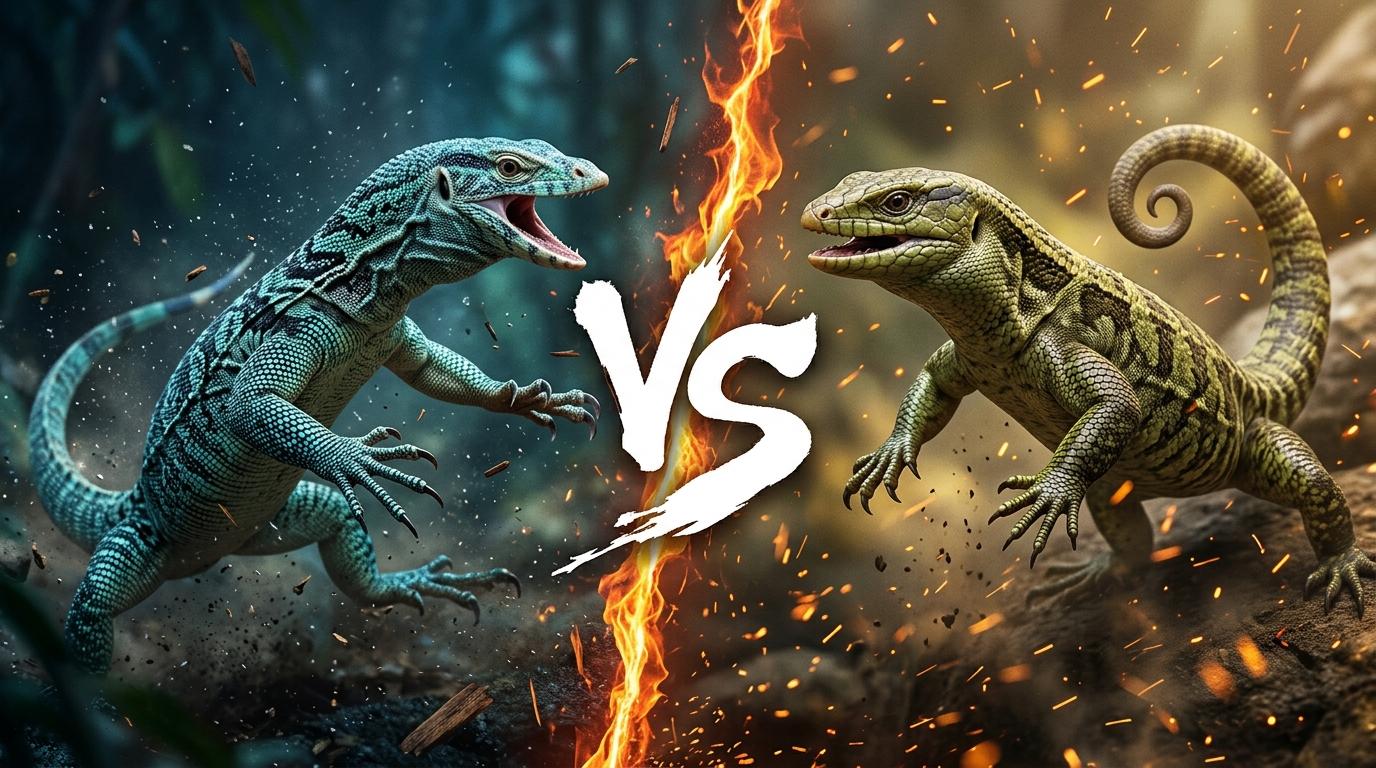
Blue Tree Monitor vs Monkey-tailed Skink: Who Actually Wins?
Blue Tree Monitor vs Monkey-tailed Skink: two rare arboreal Pacific lizards compared on speed, bite, armor and canopy skill, and why the monitor wins.
Blue Tree Monitor vs Monkey-tailed Skink
Matchup winner
Blue Tree Monitor
Quick verdict
Start with the direct answer, then use the structured comparison below to see what changes the outcome.
The Blue Tree Monitor wins this matchup. Varanus macraei is a slender, fast, actively foraging predator from Batanta Island. It has recurved serrated teeth, needle-sharp climbing claws, a prehensile tail and the high-energy metabolism typical of monitors. The Monkey-tailed Skink (Corucia zebrata) of the Solomon Islands is bulkier and can be similar in overall length. But it is a slow, almost entirely herbivorous leaf-eater, built for patience and grip rather than offense. The skink's real weapons are a hard, crushing bite, tough scales and an ability to clamp onto a branch and refuse to move. Those weapons make it costly to fight, but not hard to outmaneuver. In most realistic contexts, the monitor's speed, reach, tooth design and predatory decision-making give it control of the encounter, while the skink's best outcome is a stubborn stalemate that ends with the monitor walking away.
Read the full explanation
Winner: Blue Tree Monitor, about 78% of realistic encounters.
The monitor is a fast, alert carnivore. The skink is a slow, leaf-eating specialist.
The skink's bite is hard and its grip is strong, so it is no pushover at close range.
Neither species would seek this fight. In the wild they live on different islands and never meet.
Reader vote
Who do you think wins?
Pick a side — no account needed. Results update live.
No votes yet — be the first to call it.
Editorial note
Why people disagree
Size confusion: the Monkey-tailed Skink is among the world's largest skinks and can feel heavier in the hand. Many people assume mass decides lizard fights, but tempo and weaponry matter more here.
Explosive power
Whoever sets the pace in the canopy chooses the angle of contact, and the monitor sets the pace.
Bite design
Slicing teeth inflict damage quickly. Crushing herbivore jaws are strong but built to grip, not to wound.
Close-range durability
The skink can absorb punishment and outlast short exchanges. This is its main path to a draw.
Read the full explanation +
Bite reputation: keepers know that a defensive Corucia bite can be painful and very hard to break. That leads some to overrate how it would perform against an agile attacker.
Both are prehensile-tailed tree lizards, so they look like equals on paper. In practice, one is engineered to hunt and the other to hold on and wait.
Comparison FAQ
Short, direct answers to the next questions readers usually ask after the headline verdict.
Would a Blue Tree Monitor beat a Monkey-tailed Skink in a fight?+
Yes, in most scenarios. The monitor's speed, serrated teeth and predatory instincts outclass the slow, herbivorous skink. The skink's best result is a defensive standoff.
Which is stronger, the Blue Tree Monitor or the Monkey-tailed Skink?+
In raw static strength, the skink is impressive. Its bite and grip are very powerful for its size. In fighting ability overall, the monitor is stronger because it combines power with speed and weaponry.
Is the Monkey-tailed Skink bigger than the Blue Tree Monitor?+
They can be similar in total length, around 70–80 cm. The skink is often stockier, while the monitor is longer-tailed and more slender. Its bulk helps durability but does not decide the fight.
Why is the Monkey-tailed Skink still dangerous even though it loses?+
Its jaws can clamp hard and hold, and its armored body and anchoring grip make it very hard to dislodge from a hollow or branch. Any attacker risks a painful injury.
Do Blue Tree Monitors and Monkey-tailed Skinks meet in the wild?+
No. Blue Tree Monitors live on Batanta Island in Indonesia, while Monkey-tailed Skinks are native to the Solomon Islands. This is a hypothetical comparison.
Would a Blue Tree Monitor eat a Monkey-tailed Skink?+
An adult skink is too large to be typical prey. Blue Tree Monitors mainly eat insects and small vertebrates. A juvenile skink could be at risk, though.
Head-to-head species stats
These are the same core AnimalDex stat dimensions used on the dedicated animal pages, pulled side by side so the matchup is faster to scan.
Blue Tree Monitor
Tier BMonkey-tailed Skink
Tier CTrait-by-trait comparison
Only the categories that matter to this matchup are included. The goal is not filler stats, but the real design differences that change the result.
Quick bursts along branches, rapid strikes
Explosive power
Blue Tree Monitor
Deliberate, slow, minimal burst speed
Explosive power
Blue Tree Monitor
Serrated, recurved slicing teeth
Bite design
Blue Tree Monitor
Blunt, powerful crushing jaws for leaves
Bite design
Blue Tree Monitor
Lean, lighter frame
Close-range durability
Monkey-tailed Skink
Stocky body, tough overlapping scales
Close-range durability
Monkey-tailed Skink
Prehensile tail, sharp claws, mobile climbing
Canopy grip and anchoring
Monkey-tailed Skink
Prehensile tail, vise-like hold, superb static anchoring
Canopy grip and anchoring
Monkey-tailed Skink
Active forager, constant scanning, tongue-flicking tracking
Predatory awareness
Blue Tree Monitor
Nocturnal browser, low-alert lifestyle
Predatory awareness
Blue Tree Monitor
High monitor-style aerobic capacity
Aerobic engine
Blue Tree Monitor
Low-energy herbivore metabolism
Aerobic engine
Blue Tree Monitor
How the verdict forms
Verdict timeline
01 · Explosive power
Blue Tree Monitor
02 · Bite design
Blue Tree Monitor
03 · Close-range durability
Monkey-tailed Skink
04 · Canopy grip and anchoring
Monkey-tailed Skink
05 · Predatory awareness
Blue Tree Monitor
06 · Aerobic engine
Blue Tree Monitor
Change the conditions
Scenario breakdown
This is where shallow battle content usually fails. Terrain, spacing, timing, and engagement style can change the answer.
Scenario lean
Blue Tree Monitor
Verdict confidence
82%
Monitor wins on mobility.
In tangled branches, the monitor uses its claws and tail to reposition, approach from above or behind, and avoid the skink's jaws. The skink can anchor and bite, but it cannot chase. The monitor dictates when contact happens and can harass a static defender until it retreats into a crevice.
AnimalDex field profiles
Explore these animals
Blue Tree Monitor
Varanus macraei
island rainforest canopy and humid woodland
Monkey-tailed Skink
Corucia zebrata
rainforest canopy, mangrove edge, and island woodland
Systems Intelligence & Hidden Purpose
See the animals behind this comparison as engineered biological systems: what each one is built to do, where it gains leverage, and why the matchup changes by scenario.
Specialized Hardware
electric blue body pattern, long prehensile tail, and canopy climbing agility give the Blue Tree Monitor a body plan tuned for its niche.
Systems Script
Blue Tree Monitors operate through island rainforest canopy and humid woodland. Their design links movement, feeding, shelter, and timing into one workable survival system.
Strategic Insight
Dense environments reward precision, patience, and the ability to read layered cover.
Specialized Hardware
prehensile tail grip, heavy olive scales, and slow canopy leaf browsing give the Monkey-tailed Skink a body plan tuned for its niche.
Systems Script
Monkey-tailed Skinks operate through rainforest canopy, mangrove edge, and island woodland. Their design links movement, feeding, shelter, and timing into one workable survival system.
Strategic Insight
Dense environments reward precision, patience, and the ability to read layered cover.
Final take
The Blue Tree Monitor wins because it is a predator built around initiative. Speed, slicing teeth, high stamina and active awareness let it choose when and where contact happens. The Monkey-tailed Skink is a remarkable animal, a leaf-eating giant among skinks that lives in family groups. It is built to endure, not to attack.
Read the full explanation
The skink stays dangerous because of its crushing bite and its ability to lock onto a branch or hollow. A careless monitor could take a painful, lingering bite. But endurance only earns a stalemate. In open, mobile or contested-space scenarios, the monitor's tempo wins.
Both species face pressure from habitat loss and the pet trade. This matchup is a thought experiment, and the real story is two very different solutions to life in the canopy.
Collect both animals in AnimalDex
Track the species behind this matchup, compare their real traits, and build the rivalry into your AnimalDex collection.
Related comparisons
Continue with nearby matchups to compare more real-world animal traits without dropping into junky who-wins filler.
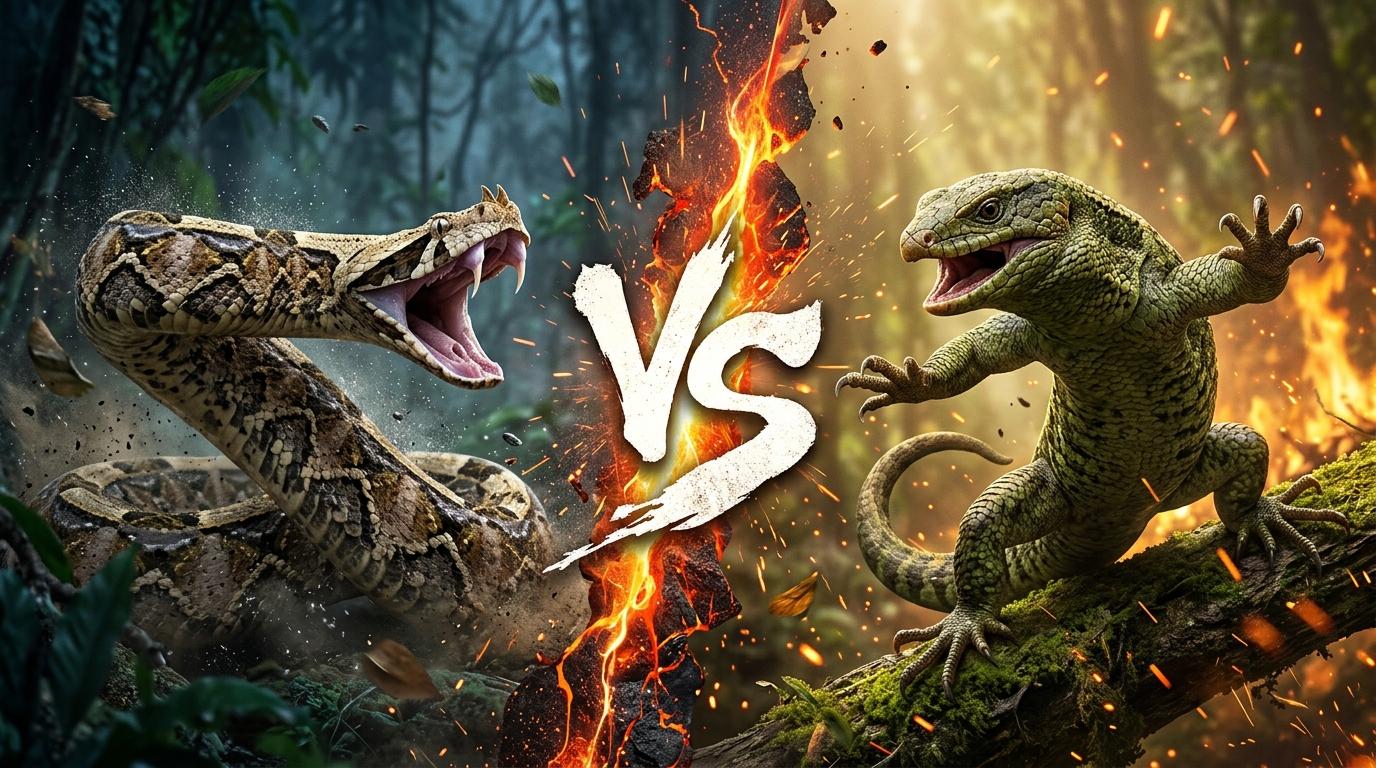
Gaboon Viper vs Monkey-tailed Skink: Who Actually Wins?
The Gaboon viper wins, and it is not especially close. The heaviest viper in Africa carries fangs up to about 5 cm long, the longest of any snake. It also has one of the largest venom yields of any snake and a strike that lands before most animals register movement. The monkey-tailed skink, or prehensile-tailed skink, is a large, slow, plant-eating lizard from the Solomon Islands. It is built for climbing and chewing leaves, not for fighting predators. It has a strong bite, tough scales and a fierce defensive temperament, but none of that answers a deep venom injection from an ambush specialist that sits still until the moment it strikes. In nearly every realistic setting, one well-placed viper bite decides the encounter.
Read comparison
Discussion
What do you think?
Share your reasoning with other readers. Be civil and stick to the animals.
Sign in to join the discussion.
Sign inNo comments yet. Start the conversation.