

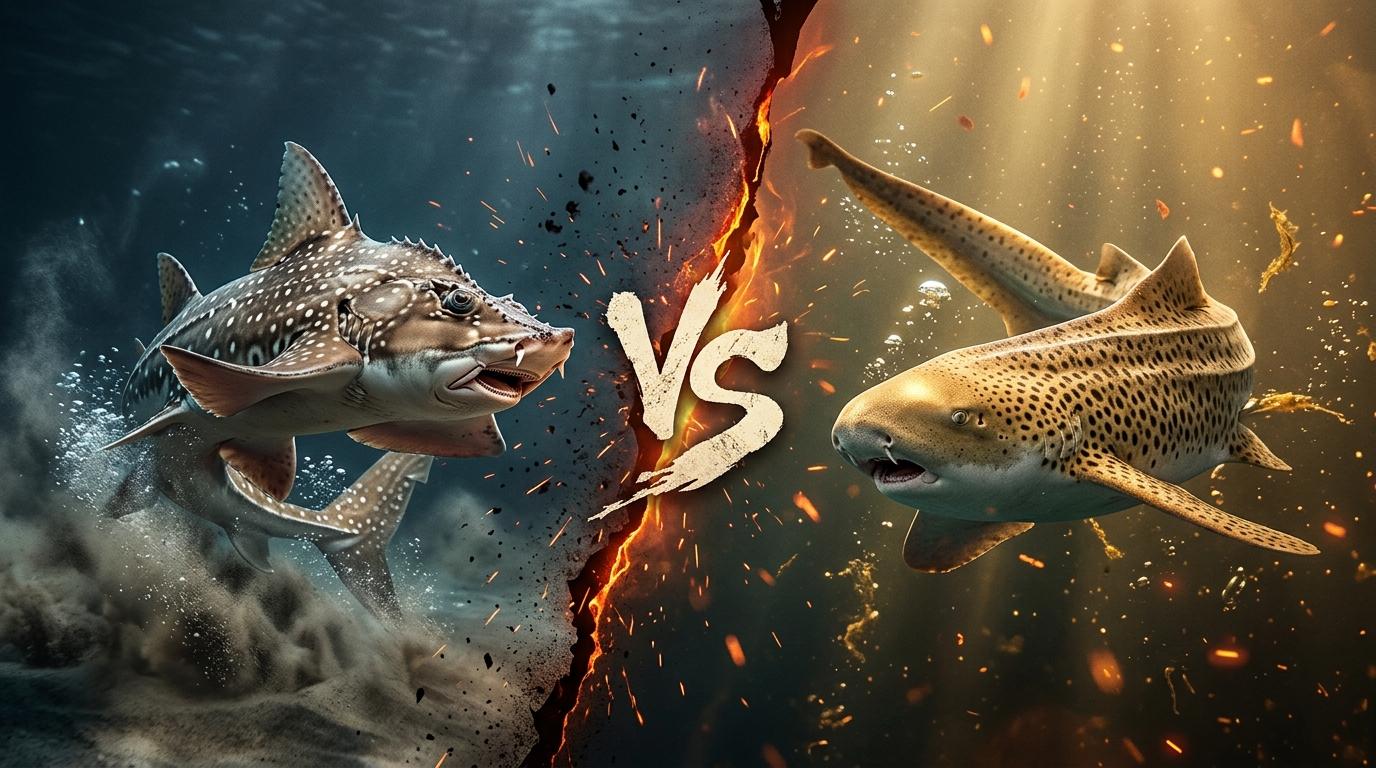
Bowmouth Guitarfish vs Zebra Shark: Who Actually Wins?
Bowmouth guitarfish vs zebra shark compared on armor, bulk, feeding gear and reef behavior, with a clear call on who comes out ahead and why.
Bowmouth Guitarfish vs Zebra Shark
Matchup winner
Bowmouth Guitarfish
Quick verdict
Start with the direct answer, then use the structured comparison below to see what changes the outcome.
The bowmouth guitarfish takes this one, narrowly but clearly. Both are slow, bottom-oriented reef fish that crush shellfish rather than tear apart large prey, so neither is built to fight. The guitarfish brings more of what matters in a short shoving contest. It has a broad, heavily muscled front end, a wide crushing mouth with ridged tooth plates, and rows of thorny ridges over the head and shoulders that make it awkward and costly to bite. The zebra shark is a little longer, mostly because of its huge whip-like tail, and it is flexible and good at wedging into crevices. But it has no real defensive armor, its small mouth is built for sucking snails and crustaceans out of holes, and its temperament is famously docile. In a forced head-on encounter, the guitarfish's armored mass and blunt-force jaws give it the edge. The zebra shark's best move is usually to slip away.
Read the full explanation
Winner: Bowmouth Guitarfish, about 66% confidence.
The guitarfish's thorny ridges and broad crushing jaws beat the zebra shark's flexible but unarmored body.
The zebra shark is slightly longer and better at threading through reef crevices, so it wins hide-and-wedge situations.
Real interactions almost always end with one animal swimming off. Neither species is a fighter.
Reader vote
Who do you think wins?
Pick a side — no account needed. Results update live.
No votes yet — be the first to call it.
Editorial note
Why people disagree
The zebra shark is a 'shark,' so people assume it wins. Biologically, it is a gentle shellfish specialist with a small mouth, not a predator built for bites on big animals.
Close-range durability
In a pushing, bumping contest, those ridges make every bite or ram more costly for the attacker.
Crushing bite
The guitarfish's mouth can actually grip and press. The zebra shark's is tuned for pulling prey out of holes.
Frontal mass
Head-on shoving rewards weight concentrated up front.
Read the full explanation +
The guitarfish looks like a ray to some and a shark to others. It is actually a ray relative with a shark-like body, plus armor most sharks lack.
Length comparisons are misleading: much of the zebra shark's length is its long tail, while the guitarfish packs its mass into a thick, broad front end.
Comparison FAQ
Short, direct answers to the next questions readers usually ask after the headline verdict.
Would a bowmouth guitarfish beat a zebra shark?+
Usually yes. In a forced close encounter, its armored ridges, broad crushing mouth and heavy front end give it the advantage.
Which is stronger, the bowmouth guitarfish or the zebra shark?+
The guitarfish is stronger in the ways that count up close: more muscle up front and a more powerful crushing bite. The zebra shark is slightly longer, but much of that length is tail.
Why is the zebra shark still dangerous?+
It is not dangerous to people, but it is a tough opponent to pin down. Its flexible body and crevice-wedging skill let it escape almost any confrontation, and its powerful tail can deliver strong slaps.
Do they meet in the wild?+
Yes. Their ranges overlap across Indo-West Pacific reefs and sandy shallows, but they generally ignore each other.
Are either of them dangerous to humans?+
Neither is considered a threat. Both are calm and are popular with divers and public aquariums.
Head-to-head species stats
These are the same core AnimalDex stat dimensions used on the dedicated animal pages, pulled side by side so the matchup is faster to scan.
Bowmouth Guitarfish
Tier BZebra Shark
Tier BTrait-by-trait comparison
Only the categories that matter to this matchup are included. The goal is not filler stats, but the real design differences that change the result.
Thorny ridges over head and shoulders
Close-range durability
Bowmouth Guitarfish
Tough skin, no dedicated armor
Close-range durability
Bowmouth Guitarfish
Wide mouth, ridged tooth plates
Crushing bite
Bowmouth Guitarfish
Small mouth, suction plus small crushing teeth
Crushing bite
Bowmouth Guitarfish
Broad, heavy head and shoulders
Frontal mass
Bowmouth Guitarfish
Long body, mass spread toward the tail
Frontal mass
Bowmouth Guitarfish
Powerful but stiff-bodied
Reef maneuvering
Zebra Shark
Eel-like flexibility, wedges into crevices
Reef maneuvering
Zebra Shark
Strong tail-driven bursts
Burst speed
Bowmouth Guitarfish
Slow cruiser, rests a lot
Burst speed
Bowmouth Guitarfish
Shy but solid
Temperament
Bowmouth Guitarfish
Exceptionally docile
Temperament
Bowmouth Guitarfish
How the verdict forms
Verdict timeline
01 · Close-range durability
Bowmouth Guitarfish
02 · Crushing bite
Bowmouth Guitarfish
03 · Frontal mass
Bowmouth Guitarfish
04 · Reef maneuvering
Zebra Shark
05 · Burst speed
Bowmouth Guitarfish
06 · Temperament
Bowmouth Guitarfish
Change the conditions
Scenario breakdown
This is where shallow battle content usually fails. Terrain, spacing, timing, and engagement style can change the answer.
Scenario lean
Bowmouth Guitarfish
Verdict confidence
82%
Guitarfish by mass and armor.
With no cover, it comes down to who can push and absorb contact. The guitarfish's thick front end and thorny ridges dominate, and its burst speed lets it decide how close things get.
AnimalDex field profiles
Explore these animals
Bowmouth Guitarfish
Rhina ancylostoma
reef flat, sandy channel, and coastal sea floor
Zebra Shark
Stegostoma tigrinum
coral reef, sandy bottom, and tropical coastal sea
Systems Intelligence & Hidden Purpose
See the animals behind this comparison as engineered biological systems: what each one is built to do, where it gains leverage, and why the matchup changes by scenario.
Specialized Hardware
broad shark-ray body, white-spotted armored back, and bottom-resting reef patrol give the Bowmouth Guitarfish a body plan tuned for its niche.
Systems Script
Bowmouth Guitarfishs operate through reef flat, sandy channel, and coastal sea floor. Their design links movement, feeding, shelter, and timing into one workable survival system.
Strategic Insight
In moving water, the best systems use flow, visibility, and depth instead of fighting every current.
Specialized Hardware
spotted adult pattern, long tail for slow reef movement, and bottom-cruising feeding style give the Zebra Shark a body plan tuned for its niche.
Systems Script
Zebra Sharks operate through coral reef, sandy bottom, and tropical coastal sea Their design links movement, shelter, and feeding into one workable survival system.
Strategic Insight
Steady coverage can beat frantic speed when the target is hidden in many small places.
Final take
The bowmouth guitarfish wins overall. It is the better-armored, heavier-fronted animal with jaws that can actually press down, and those traits decide short, close-contact encounters on open bottom or over food.
Read the full explanation
The zebra shark is not a loser by design. It is built to avoid conflict entirely, using flexibility and reef cover to stay out of trouble. Both species are endangered, and both matter far more as reef shellfish managers than as fighters.
Collect both animals in AnimalDex
Track the species behind this matchup, compare their real traits, and build the rivalry into your AnimalDex collection.
Related comparisons
Continue with nearby matchups to compare more real-world animal traits without dropping into junky who-wins filler.

Humphead Wrasse vs Zebra Shark: Who Actually Wins?
The humphead wrasse wins this matchup more often than not. A big adult male can reach about 2 m and well over 150 kg, with a thick, deep body, heavy scales, and fused beak-like jaws plus crushing pharyngeal teeth built to break shells and handle toxic, spiny prey. The zebra shark (Stegostoma tigrinum) is similar in length at roughly 2.5 m, but much of that length is a long, flexible tail. Its body is slender, its mouth is small and built for suction, and it feeds on snails, crustaceans and small fish in crevices. It is a docile bottom-dweller, not an attacker of large fish. In a reef confrontation the wrasse has more mass, more confident maneuvering around coral, and stronger territorial dominance. The zebra shark's best outcome is to disengage, and its tough skin and calm temperament make that a draw-like retreat rather than a win.
Read comparison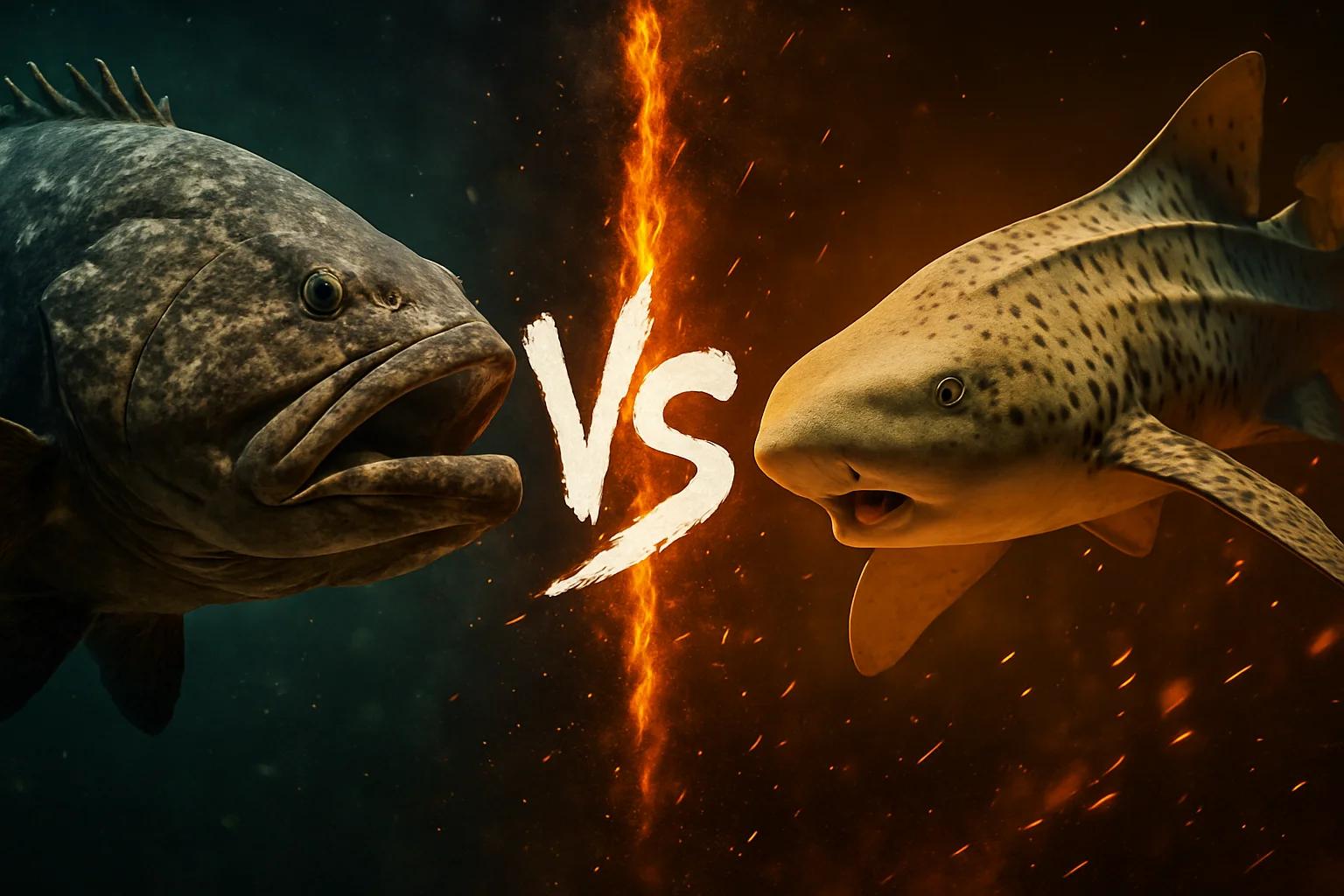
Giant Grouper vs Zebra Shark: Who Actually Wins?
The giant grouper wins, and it isn't especially close. Both animals can approach similar lengths of roughly 2.5 meters, but they are built for different jobs. The grouper is a heavy, deep-bodied reef heavyweight that can reportedly exceed 300 kg. Its cavernous mouth generates powerful suction, a feeding method that has let it swallow crustaceans, fish, and even small sharks and rays. The zebra shark is a slender, docile bottom-forager whose long tail makes up much of its length and whose small mouth is designed for crunching snails and crabs, not for fighting large animals. In any realistic reef confrontation, the grouper's mass, bite gape and ambush posture outmatch the zebra shark's flexibility and modest jaws. The shark's best outcome is escaping, not winning.
Read comparison
Discussion
What do you think?
Share your reasoning with other readers. Be civil and stick to the animals.
Sign in to join the discussion.
Sign inNo comments yet. Start the conversation.