

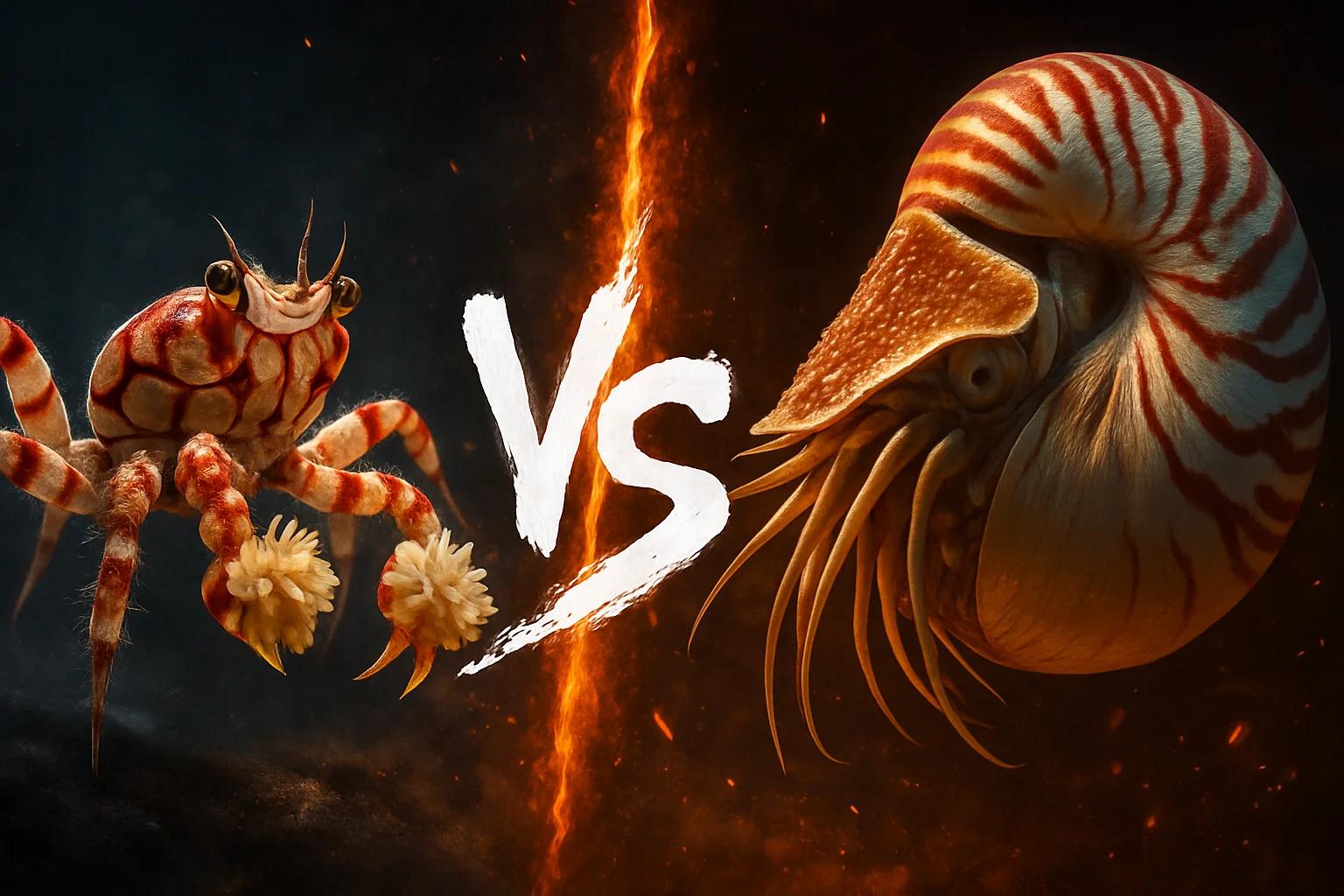
Boxer Crab vs Chambered Nautilus: Who Actually Wins?
Boxer crab vs chambered nautilus: who would win? A biology-first breakdown of size, armor, anemone weapons and beak power, with a clear verdict.
Boxer Crab vs Chambered Nautilus
Matchup winner
Chambered Nautilus
Quick verdict
Start with the direct answer, then use the structured comparison below to see what changes the outcome.
The chambered nautilus wins this matchup, and it isn't especially close. A boxer crab is a thumbnail-sized reef crab, roughly 1–2.5 cm across, that carries tiny sea anemones in its claws as stinging pom-poms. That's a clever defensive trick for deterring small fish. The nautilus brings a shell around 15–20 cm across, dozens of grasping tentacles, and a hard, parrot-like beak built for cracking crustaceans. Nautiluses are active scavengers and predators that routinely eat crabs and molted shells. The boxer crab's anemones deliver a mild sting that can sting soft tissue, but the nautilus can avoid it by closing its hood and attacking from a different angle. The crab has no way to get through ten-plus centimeters of chambered armor. The nautilus doesn't need speed or cunning to win. Its size, its armor, and a beak made for exactly this kind of prey settle the question.
Read the full explanation
Winner: Chambered Nautilus. It's roughly 8–10x longer and many times heavier.
The nautilus beak is purpose-built for crushing crustacean shells.
The boxer crab's anemone 'gloves' are a deterrent, not a kill weapon.
The crab's best outcome is escape into reef rubble, not victory.
Reader vote
Who do you think wins?
Pick a side — no account needed. Results update live.
No votes yet — be the first to call it.
Editorial note
Why people disagree
The boxer crab's viral 'pom-pom fighter' reputation makes it seem far more combative than its millimeter-scale reach allows.
Size & mass
In invertebrate encounters, a size gap this large usually decides things before tactics matter.
Crushing power
The boxer crab's claws are occupied as anemone holders, so it can't pinch back.
Borrowed weaponry
This is the crab's one real edge. It works well against small fish but poorly against an armored cephalopod.
Read the full explanation +
Nautiluses look slow and gentle, so people forget they're shelled cephalopod predators that actively hunt and scavenge crustaceans.
Some imagine anemone stings as potent venom, but the anemones (Triactis) carried by boxer crabs pack a modest, small-prey-grade sting.
Comparison FAQ
Short, direct answers to the next questions readers usually ask after the headline verdict.
Would a boxer crab beat a chambered nautilus?+
No. The nautilus is far larger, armored, and equipped with a crab-crushing beak. The crab's only realistic win is escaping into cover.
Which is stronger, a boxer crab or a nautilus?+
The nautilus by a wide margin. It outweighs the crab many times over, and its beak can break crustacean shells. The boxer crab's claws are dedicated to holding anemones.
Can boxer crab anemones hurt a nautilus?+
They can sting soft tissue mildly, but the nautilus can shield its body with its shell and hood and keep the anemones at tentacle length.
Why is the boxer crab still dangerous despite losing?+
Its borrowed anemones deter fish and small predators, and in tight reef crevices it can make an attack painful and unprofitable. The strategy is defensive, but it's effective.
Do nautiluses eat crabs?+
Yes. Nautiluses scavenge and hunt crustaceans, including crabs, hermit crabs and molted exoskeletons.
Head-to-head species stats
These are the same core AnimalDex stat dimensions used on the dedicated animal pages, pulled side by side so the matchup is faster to scan.
Boxer Crab
Tier BChambered Nautilus
Tier CTrait-by-trait comparison
Only the categories that matter to this matchup are included. The goal is not filler stats, but the real design differences that change the result.
About 1–2.5 cm, a few grams
Size & mass
Chambered Nautilus
Shell 15–20 cm, roughly 0.4–1 kg
Size & mass
Chambered Nautilus
Tiny claws dedicated to holding anemones
Crushing power
Chambered Nautilus
Hard keratinous beak that breaks crab shells
Crushing power
Chambered Nautilus
Stinging anemones waved as gloves
Borrowed weaponry
Boxer Crab
No venom, relies on armor and beak
Borrowed weaponry
Boxer Crab
Thin exoskeleton
Close-range durability
Chambered Nautilus
Thick chambered shell plus leathery hood
Close-range durability
Chambered Nautilus
Short legs, defensive posture
Grip & reach
Chambered Nautilus
Up to ~90 sticky, grooved tentacles
Grip & reach
Chambered Nautilus
Vanishes into coral rubble crevices
Escape & hiding
Boxer Crab
Jet propulsion plus buoyancy control
Escape & hiding
Boxer Crab
How the verdict forms
Verdict timeline
01 · Size & mass
Chambered Nautilus
02 · Crushing power
Chambered Nautilus
03 · Borrowed weaponry
Boxer Crab
04 · Close-range durability
Chambered Nautilus
05 · Grip & reach
Chambered Nautilus
06 · Escape & hiding
Boxer Crab
Change the conditions
Scenario breakdown
This is where shallow battle content usually fails. Terrain, spacing, timing, and engagement style can change the answer.
Scenario lean
Boxer Crab
Verdict confidence
82%
The crab survives by disappearing.
Among dense rubble with crevices only millimeters wide, the boxer crab can retreat beyond tentacle reach and present its anemones at the gap. Nautilus tentacles probe effectively, but a crab wedged deep in coral with stinging guards is a poor return on effort. Here 'winning' means surviving, and cover favors the small animal.
AnimalDex field profiles
Explore these animals
Boxer Crab
Lybia tessellata
Shallow coral reef, reef rubble, and sheltered Indo-Pacific marine substrate.
Chambered Nautilus
Nautilus pompilius
Deep reef slopes and upper continental shelf drop-offs with access to shelter and cooler water.
Systems Intelligence & Hidden Purpose
See the animals behind this comparison as engineered biological systems: what each one is built to do, where it gains leverage, and why the matchup changes by scenario.
Specialized Hardware
Tiny crab frame, delicate claws, and live sea-anemone partners turn the boxer crab into mutualist hardware with outsourced stinging defense.
Systems Script
Boxer crabs move through reef rubble as tiny examples of cooperative engineering. Their niche proves that a small system can scale its defense by partnering with another species rather than building everything itself.
Strategic Insight
When internal resources are limited, carry the right ally. A strong partnership can function like extra hardware.
Specialized Hardware
Gas-filled shell chambers, simple but effective sensory setup, and vertical migration behavior make nautiluses depth-management hardware.
Systems Script
Nautiluses occupy a slow, deliberate niche in deep reef-adjacent waters, turning buoyancy control into long-term stability. They are proof that elegant engineering does not always need novelty to remain viable.
Strategic Insight
A durable system often comes from careful calibration, not constant reinvention.
Final take
The chambered nautilus is the clear winner. It is an armored, beaked cephalopod that already treats crabs as food, and the boxer crab is among the smallest crabs on the reef. In every open or contested scenario, mass, shell, tentacles and beak overwhelm a few grams of crab.
Read the full explanation
The boxer crab still deserves respect. Its anemone-wielding strategy is a brilliant example of mutualism, and in tight rubble it can make itself too costly to extract. Its victory condition is avoidance, though, not defeat of the nautilus.
Collect both animals in AnimalDex
Track the species behind this matchup, compare their real traits, and build the rivalry into your AnimalDex collection.
Discussion
What do you think?
Share your reasoning with other readers. Be civil and stick to the animals.
Sign in to join the discussion.
Sign inNo comments yet. Start the conversation.