


Burmese Python vs Indian Rock Python: Who Actually Wins?
Burmese python vs Indian rock python. A biology-first breakdown of size, constriction power, and behavior shows which giant Asian python wins a hypothetical clash.
Burmese Python vs Indian Rock Python
Matchup winner
Burmese Python
Quick verdict
Start with the direct answer, then use the structured comparison below to see what changes the outcome.
The Burmese python wins. These are close relatives. The Indian rock python was long treated as the same species, so this matchup comes down to margins, and the margins favor the Burmese. Burmese pythons regularly reach greater length and much greater body mass, with large females carrying a thicker, heavier trunk. In a constriction contest, mass and muscle cross-section decide who controls the coils. A heavier python can pin, anchor, and outlast a lighter one, and the Burmese has the bigger engine for it. The Indian rock python is not outclassed. It is tough, alert, and quick to bite defensively. But when two constrictors lock up, the snake with more coil weight and girth usually sets the terms.
Read the full explanation
Burmese python wins most realistic matchups because of greater bulk and coil mass.
The two snakes share nearly identical hunting hardware, so size is the tiebreaker.
The Indian rock python's defensive temperament and toughness keep it competitive in tight, rocky cover.
Real fights between them are essentially nonexistent. Their natural ranges barely overlap and both avoid needless conflict.
Reader vote
Who do you think wins?
Pick a side — no account needed. Results update live.
No votes yet — be the first to call it.
Editorial note
Why people disagree
Taxonomy confusion. Many readers still think they are the same species, so they assume the matchup is a coin flip.
Coil mass and girth
Constriction is a weight-and-leverage game, and more trunk mass means more crushing control.
Length and reach
Extra length allows more wraps and better anchoring against a struggling opponent.
Strike speed
Both strike quickly. The Burmese's larger head and gape make its first bite more consequential.
Read the full explanation +
Record-size lists vary wildly. Inflated claims about old Indian rock pythons muddy the size comparison.
Some keepers report Indian rock pythons as more defensive or snappy, which reads as fighting spirit even though bulk matters more in a coil-on-coil contest.
Comparison FAQ
Short, direct answers to the next questions readers usually ask after the headline verdict.
Would a Burmese python beat an Indian rock python?+
Usually, yes. The Burmese python's greater size and body mass give it the edge in a constriction contest, especially on open ground or in water.
Which python is stronger, Burmese or Indian rock python?+
The Burmese python is generally stronger in absolute terms because adults tend to be heavier and thicker-bodied, which translates into more constricting force.
Are Burmese and Indian rock pythons the same species?+
No. They were once grouped together, but the Burmese python (Python bivittatus) is now recognized as a separate species from the Indian rock python (Python molurus).
Why is the Indian rock python still dangerous even if it loses?+
It has a fast, powerful defensive bite with backward-curving teeth, strong constriction for its size, and a reactive temperament. In rocky terrain it can brace and deny a larger snake full control.
Do these pythons fight in the wild?+
Encounters are rare because their ranges barely overlap and pythons avoid unnecessary conflict. Any interaction would usually end in size-based retreat rather than a prolonged fight.
Head-to-head species stats
These are the same core AnimalDex stat dimensions used on the dedicated animal pages, pulled side by side so the matchup is faster to scan.
Burmese Python
Tier BIndian Rock Python
Tier CTrait-by-trait comparison
Only the categories that matter to this matchup are included. The goal is not filler stats, but the real design differences that change the result.
Heavier, thicker-bodied adults
Coil mass and girth
Burmese Python
Slightly slimmer build on average
Coil mass and girth
Burmese Python
Commonly 4.5–5.5 m in large females
Length and reach
Burmese Python
Usually shorter, around 3–4.5 m
Length and reach
Burmese Python
Fast ambush strike, slow cruiser
Strike speed
Burmese Python
Comparable strike, slightly more defensive
Strike speed
Burmese Python
Often calm, deliberate
Defensive temperament
Indian Rock Python
Frequently more reactive and bite-ready
Defensive temperament
Indian Rock Python
Wetland and forest generalist
Rocky-terrain grip
Indian Rock Python
Comfortable in rocky outcrops and scrub
Rocky-terrain grip
Indian Rock Python
Large reserves from heavy body
Grappling endurance
Burmese Python
Solid but smaller reserves
Grappling endurance
Burmese Python
How the verdict forms
Verdict timeline
01 · Coil mass and girth
Burmese Python
02 · Length and reach
Burmese Python
03 · Strike speed
Burmese Python
04 · Defensive temperament
Indian Rock Python
05 · Rocky-terrain grip
Indian Rock Python
06 · Grappling endurance
Burmese Python
Change the conditions
Scenario breakdown
This is where shallow battle content usually fails. Terrain, spacing, timing, and engagement style can change the answer.
Scenario lean
Burmese Python
Verdict confidence
82%
Burmese controls the tangle.
In thick undergrowth both snakes can anchor to stems and roots, so the advantage returns to raw coil weight. The Burmese can wrap more loops and hold them longer, gradually restricting the rock python's movement.
AnimalDex field profiles
Explore these animals
Burmese Python
Python bivittatus
swamp, grassland, river edge, and tropical forest
Indian Rock Python
Python molurus
grassland, forest edge, and wetland margin
Systems Intelligence & Hidden Purpose
See the animals behind this comparison as engineered biological systems: what each one is built to do, where it gains leverage, and why the matchup changes by scenario.
Specialized Hardware
massive muscular coils, blotched camouflage pattern, and wetland-and-forest ambush life give the Burmese Python a body plan tuned for its niche.
Systems Script
Burmese Pythons operate through swamp, grassland, river edge, and tropical forest Their design links movement, shelter, and feeding into one workable survival system.
Strategic Insight
When power is stored in structure, movement can stay minimal until it matters.
Specialized Hardware
very large blotched body, heat-sensing facial pits, and quiet ambush constriction give the Indian Rock Python a body plan tuned for its niche.
Systems Script
Indian Rock Pythons operate through grassland, forest edge, and wetland margin. Their design links movement, feeding, shelter, and timing into one workable survival system.
Strategic Insight
Dense environments reward precision, patience, and the ability to read layered cover.
Final take
The Burmese python takes this matchup. The two species share the same ambush-and-constrict blueprint, so the decisive variable is size. The Burmese simply carries more of it: more length, more girth, and more coil mass to convert into control.
Read the full explanation
The Indian rock python is still a formidable animal. In rocky, crevice-rich terrain or with a well-timed defensive bite, it can neutralize a heavier rival long enough to escape. That is the realistic win condition for most wild snakes anyway.
In nature, neither seeks this fight. Pythons save energy for prey, and both species would usually choose avoidance over a costly, risky grapple.
Collect both animals in AnimalDex
Track the species behind this matchup, compare their real traits, and build the rivalry into your AnimalDex collection.
Related comparisons
Continue with nearby matchups to compare more real-world animal traits without dropping into junky who-wins filler.

Burmese Python vs King Cobra: Who Actually Wins?
A full-grown Burmese python beats an adult king cobra in most realistic encounters, because body mass decides this fight. A large Burmese python can stretch past 5 meters and weigh 50–90 kg. A king cobra of similar length usually weighs under 10 kg. The cobra is a specialist snake-eater with large venom yields, and it is faster, more alert and better at striking first. But its hunting style is built for prey it can overpower and swallow, such as rat snakes, keelbacks and young pythons. It is not built for a muscular giant several times its weight. Neurotoxic venom needs time to work through that much body, and constriction does not. Once the python gets coils around the cobra's forebody, the cobra's breathing and circulation shut down well before the venom can disable a heavyweight. The cobra wins against juvenile and subadult pythons and in open-ground skirmishes where it can strike and withdraw. In a committed fight between adults, the python's mass carries it.
Read comparison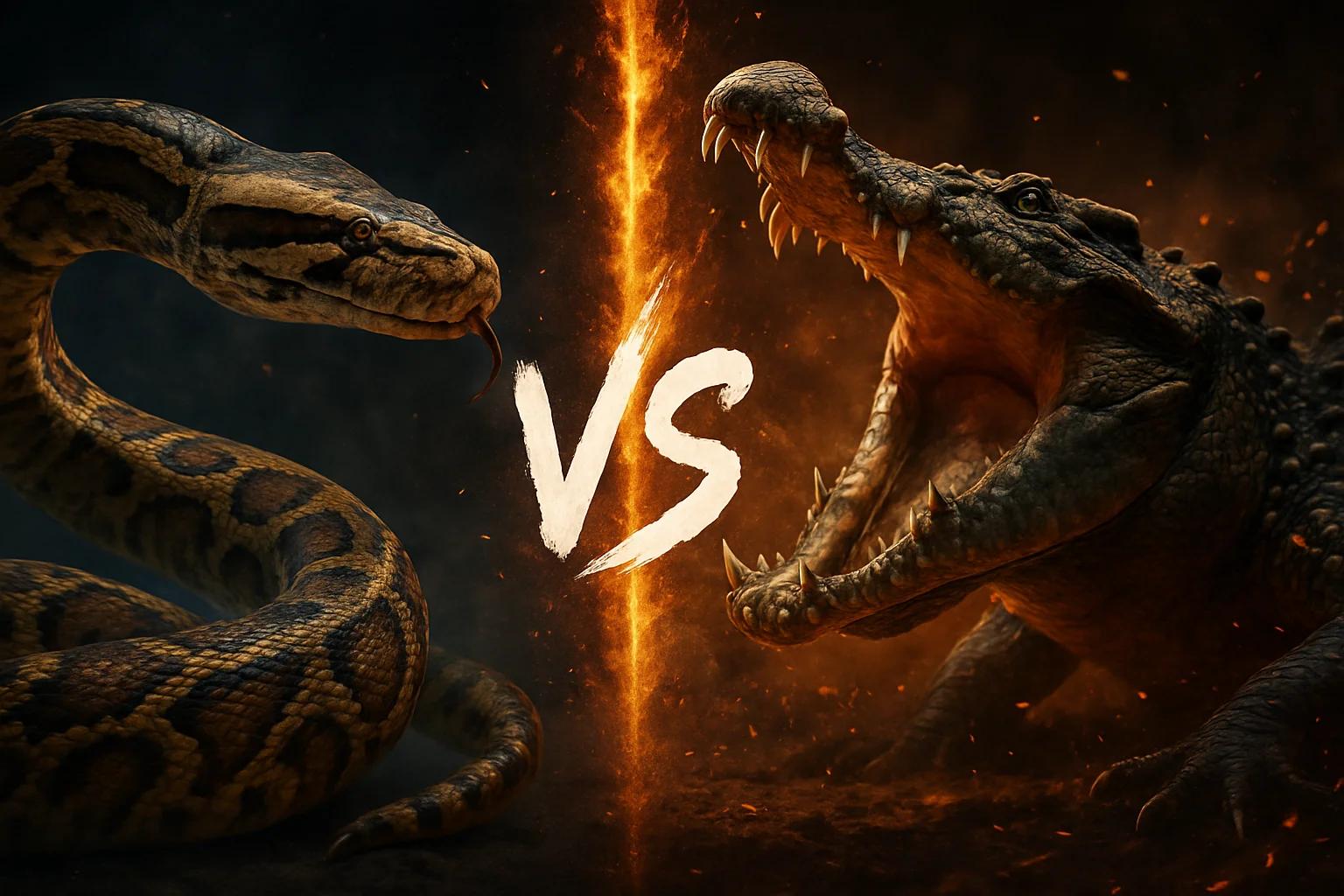
Burmese Python vs Siamese Crocodile: Who Actually Wins?
The Siamese crocodile wins most realistic encounters. A giant Burmese python can be longer and sometimes heavier, and its constriction is one of the most efficient killing systems among reptiles. But constriction needs a secure anchor bite and time to restrict breathing and blood flow. A crocodile brings osteoderm armor, a skull built for crushing, very strong neck and tail muscles, and the ability to roll and thrash, which breaks a python's coils before they lock. Crocodiles also tolerate oxygen debt well and are most dangerous in water, where the python loses its ground leverage. The python has real wins, especially as a large adult ambushing a smaller croc on land or in dense cover. Taken across size-matched adults and likely encounter sites, the crocodile's armored bite-and-roll system decides more fights than the python's squeeze.
Read comparison
Discussion
What do you think?
Share your reasoning with other readers. Be civil and stick to the animals.
Sign in to join the discussion.
Sign inNo comments yet. Start the conversation.