

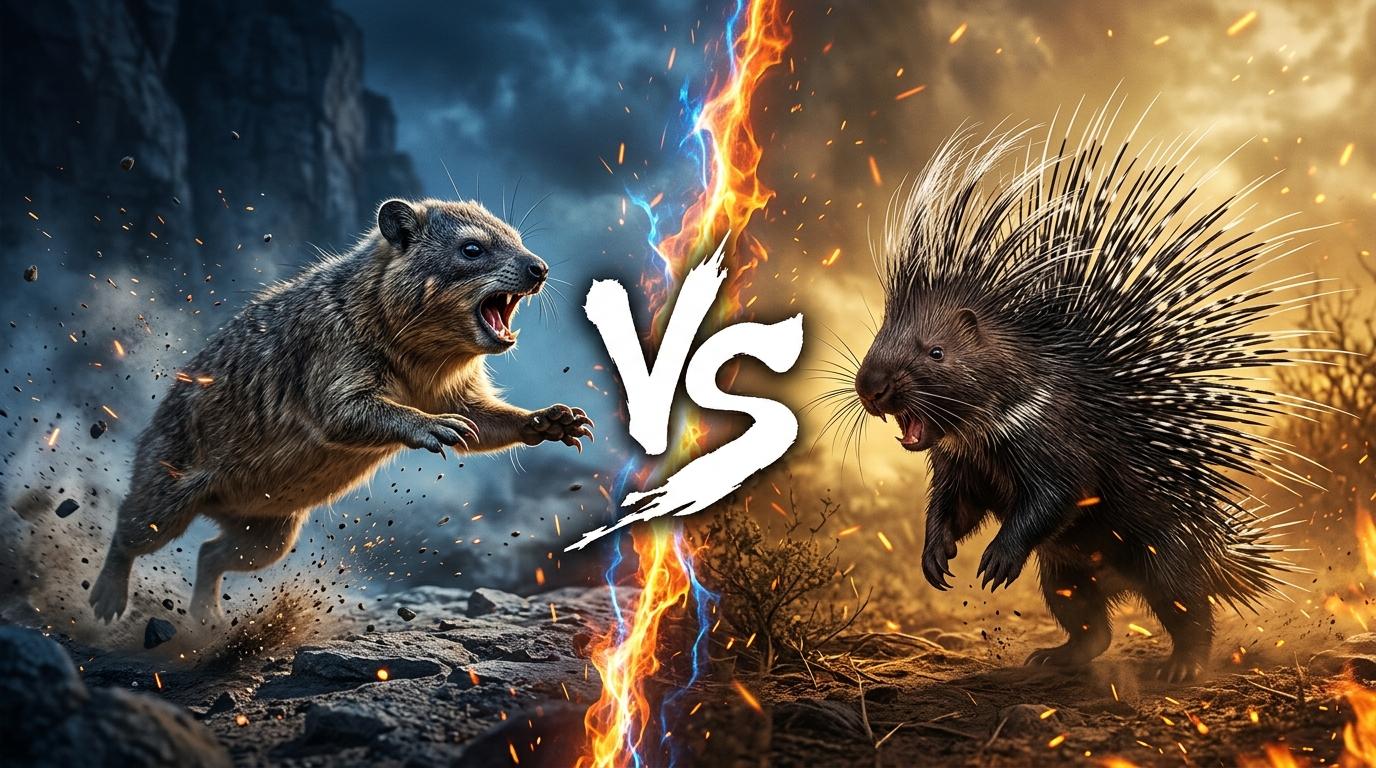
Bush Hyrax vs Crested Porcupine: Who Actually Wins?
Bush hyrax vs crested porcupine: who would win? A biology-first breakdown of size, quills, speed, and defense in a clash of African rock-dweller and spiny tank.
Bush Hyrax vs Crested Porcupine
Matchup winner
Crested Porcupine
Quick verdict
Start with the direct answer, then use the structured comparison below to see what changes the outcome.
The crested porcupine wins this matchup clearly. At roughly 10–27 kg against a bush hyrax's 1.3–4.5 kg, the porcupine outweighs its rival by about five times or more. It also carries one of the most effective passive defense systems among mammals: quills up to 30–35 cm long that detach on contact, plus a rattling, backward-charging threat display that makes even leopards and lions back off. The bush hyrax is agile, alert, and armed with sharp tusk-like incisors, but its whole survival strategy is to spot danger early and vanish into rock crevices, not to trade blows. In any frame where the two actually make contact, the hyrax's bite must get past a wall of keratin spears, and the porcupine's reverse charge can leave quills embedded in the hyrax's face and paws. The hyrax wins only by leaving.
Read the full explanation
The crested porcupine wins. It is about 5x heavier and covered in detachable defensive quills.
The bush hyrax's best weapon is escape. It is quick on rock, sharp-eyed, and a skilled climber, but it is not built to win fights.
Hyrax incisors can bite hard, but reaching flesh through a porcupine's quill shield is the core problem.
In rocky cover the hyrax survives by retreating. That is not the same as winning.
Reader vote
Who do you think wins?
Pick a side — no account needed. Results update live.
No votes yet — be the first to call it.
Editorial note
Why people disagree
Hyraxes look small and harmless, yet they have tusk-like incisors and can be surprisingly aggressive. That makes some readers overrate their fighting odds.
Mass and frame
In small-mammal clashes, a fivefold weight gap decides almost everything about pushing, pinning, and absorbing damage.
Passive armor
The porcupine does not need to attack. Any hyrax bite risks a face full of barbed keratin.
Offensive tools
The hyrax has the more fight-ready teeth, but the porcupine's reverse charge turns its whole body into a weapon.
Read the full explanation +
Porcupines are slow and rarely start fights, so people mistake low aggression for low danger.
Some people count escape as winning. On rocky outcrops the hyrax almost always gets away, which muddies the verdict.
Both are rodent-like at a glance, but hyraxes are actually relatives of elephants and manatees. That leads to confused assumptions about their 'toughness'.
Comparison FAQ
Short, direct answers to the next questions readers usually ask after the headline verdict.
Would a bush hyrax beat a crested porcupine in a fight?+
No. The crested porcupine would win. It is about five times heavier, and its detachable quills make every hyrax attack costly.
Which is stronger, a bush hyrax or a crested porcupine?+
The crested porcupine. Its larger, heavier body and powerful backward charge outclass the small hyrax in raw force.
Why is the bush hyrax still dangerous?+
Hyraxes have sharp, tusk-like incisors and bite hard when cornered. They can wound a porcupine's exposed face or underside, and their speed on rocks means they are rarely caught.
Can porcupines shoot their quills?+
No. Quills detach on contact. The porcupine drives them in by charging backward or sideways into a threat.
Is a hyrax a rodent?+
No. Hyraxes belong to the order Hyracoidea and are related to elephants and sirenians. Porcupines are true rodents.
Head-to-head species stats
These are the same core AnimalDex stat dimensions used on the dedicated animal pages, pulled side by side so the matchup is faster to scan.
Bush Hyrax
Tier CCrested Porcupine
Tier CTrait-by-trait comparison
Only the categories that matter to this matchup are included. The goal is not filler stats, but the real design differences that change the result.
1.3–4.5 kg, compact rock-dweller
Mass and frame
Crested Porcupine
10–27 kg, heavy-bodied forager
Mass and frame
Crested Porcupine
Dense fur, no specialized defense
Passive armor
Crested Porcupine
Detachable quills up to ~35 cm
Passive armor
Crested Porcupine
Sharp, tusk-like upper incisors
Offensive tools
Crested Porcupine
Powerful gnawing incisors plus a backward quill charge
Offensive tools
Crested Porcupine
Quick, nimble rock and tree climber
Agility and escape
Bush Hyrax
Slow, ground-bound waddler
Agility and escape
Bush Hyrax
Colony sentinels and alarm calls
Threat detection
Bush Hyrax
Nocturnal, solitary, relies on warning displays
Threat detection
Bush Hyrax
Teeth-baring, growls
Deterrence display
Crested Porcupine
Quill-raising, tail rattling, foot stamping
Deterrence display
Crested Porcupine
How the verdict forms
Verdict timeline
01 · Mass and frame
Crested Porcupine
02 · Passive armor
Crested Porcupine
03 · Offensive tools
Crested Porcupine
04 · Agility and escape
Bush Hyrax
05 · Threat detection
Bush Hyrax
06 · Deterrence display
Crested Porcupine
Change the conditions
Scenario breakdown
This is where shallow battle content usually fails. Terrain, spacing, timing, and engagement style can change the answer.
Scenario lean
Bush Hyrax
Verdict confidence
82%
The hyrax escapes rather than fights, but it controls the terrain.
Among boulders and narrow cracks, the hyrax's padded, grippy feet and small frame let it slip out of reach almost instantly. The porcupine cannot follow into tight crevices or up rock faces. No one is defeated, but the hyrax dictates the outcome by refusing contact. That counts as a terrain win for the smaller animal.
AnimalDex field profiles
Explore these animals
Bush Hyrax
Heterohyrax brucei
rocky kopje, cliff, and dry woodland edge
Crested Porcupine
Hystrix cristata
woodland, scrub, rocky hillside, and farmland edge
Systems Intelligence & Hidden Purpose
See the animals behind this comparison as engineered biological systems: what each one is built to do, where it gains leverage, and why the matchup changes by scenario.
Specialized Hardware
rounded ears, rubbery climbing feet, and sunning rock-perch posture give the Bush Hyrax a body plan tuned for its niche.
Systems Script
Bush Hyraxs operate through rocky kopje, cliff, and dry woodland edge. Their design links movement, feeding, shelter, and timing into one workable survival system.
Strategic Insight
Harsh places reward efficiency, timing, and bodies that waste very little.
Specialized Hardware
long black-and-white quills, powerful digging claws, and nocturnal ground foraging give the Crested Porcupine a body plan tuned for its niche.
Systems Script
Crested Porcupines operate through woodland, scrub, rocky hillside, and farmland edge Their design links movement, shelter, feeding, and survival into one workable system.
Strategic Insight
A clear defense can stop trouble before a fight even starts.
Final take
The crested porcupine is the clear winner. Size, armor, and a deterrence system proven against apex predators all point one way. The bush hyrax is a brilliant survivor, but its brilliance lies in vigilance and vanishing, not in combat.
Read the full explanation
The one context the hyrax 'wins' is the one it chooses: broken rock, where it simply leaves. In any real exchange of force, the porcupine's quills turn the hyrax's own aggression against it.
Collect both animals in AnimalDex
Track the species behind this matchup, compare their real traits, and build the rivalry into your AnimalDex collection.
Related comparisons
Continue with nearby matchups to compare more real-world animal traits without dropping into junky who-wins filler.

Bush Hyrax vs Impala: Who Actually Wins?
The impala wins this matchup clearly. An adult impala weighs roughly 40–75 kg against a bush hyrax's 1.3–4.5 kg, so it is about fifteen to thirty times heavier. It also runs at around 80 km/h, clears 3 m vertical leaps, and adult males carry lyre-shaped horns up to about 90 cm long that are built for shoving and stabbing in rut battles. The bush hyrax's real assets are sharp, tusk-like upper incisors, a fierce temper when cornered, and expert use of rock crevices. Those tools keep it alive among kopjes, but they do not let it beat an animal that can trample, gore or simply walk away. In any confrontation outside a boulder crack, the impala holds every decisive lever.
Read comparison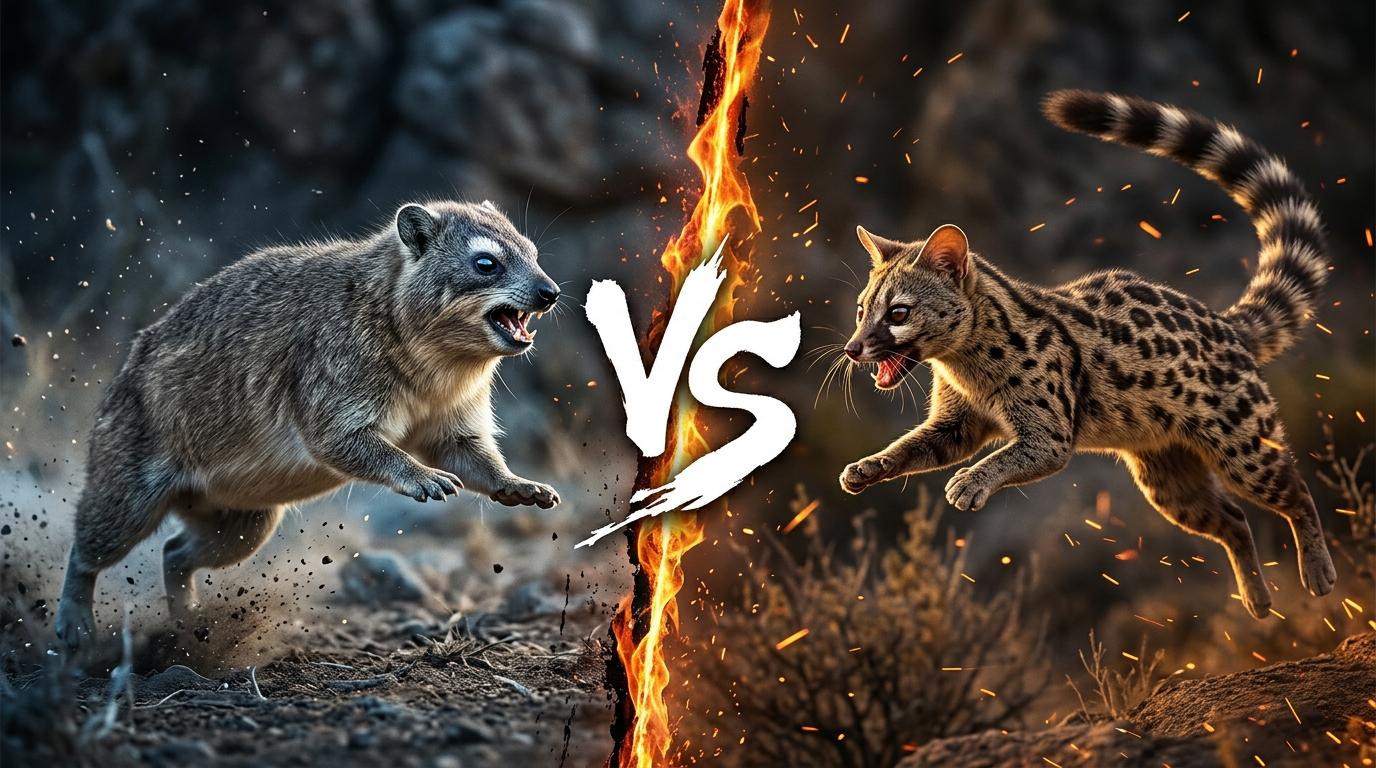
Bush Hyrax vs Common Genet: Who Actually Wins?
The common genet wins this matchup. It is a dedicated small carnivore built around a killing bite. It has sharp carnassials, retractable claws, a long flexible spine and the reflexes of a nocturnal hunter that routinely takes rodents, birds and lizards. The bush hyrax is a compact rock-dwelling herbivore weighing roughly 1.3–2.4 kg, while a genet weighs about 1.3–2.3 kg, so the two are closer in mass than people expect. But the hyrax's main weapons are long, tusk-like upper incisors and stubborn defensive biting, not predatory technique. In most encounters the genet controls distance, strikes to the head and neck, and disengages if things go badly. The hyrax's real defense is its colony. Sentinel alarm calls, fast retreats into rock crevices and a willingness to slash with those incisors make it a costly target. In a straight fight the genet takes it, but rarely cleanly.
Read comparison
Discussion
What do you think?
Share your reasoning with other readers. Be civil and stick to the animals.
Sign in to join the discussion.
Sign inNo comments yet. Start the conversation.