

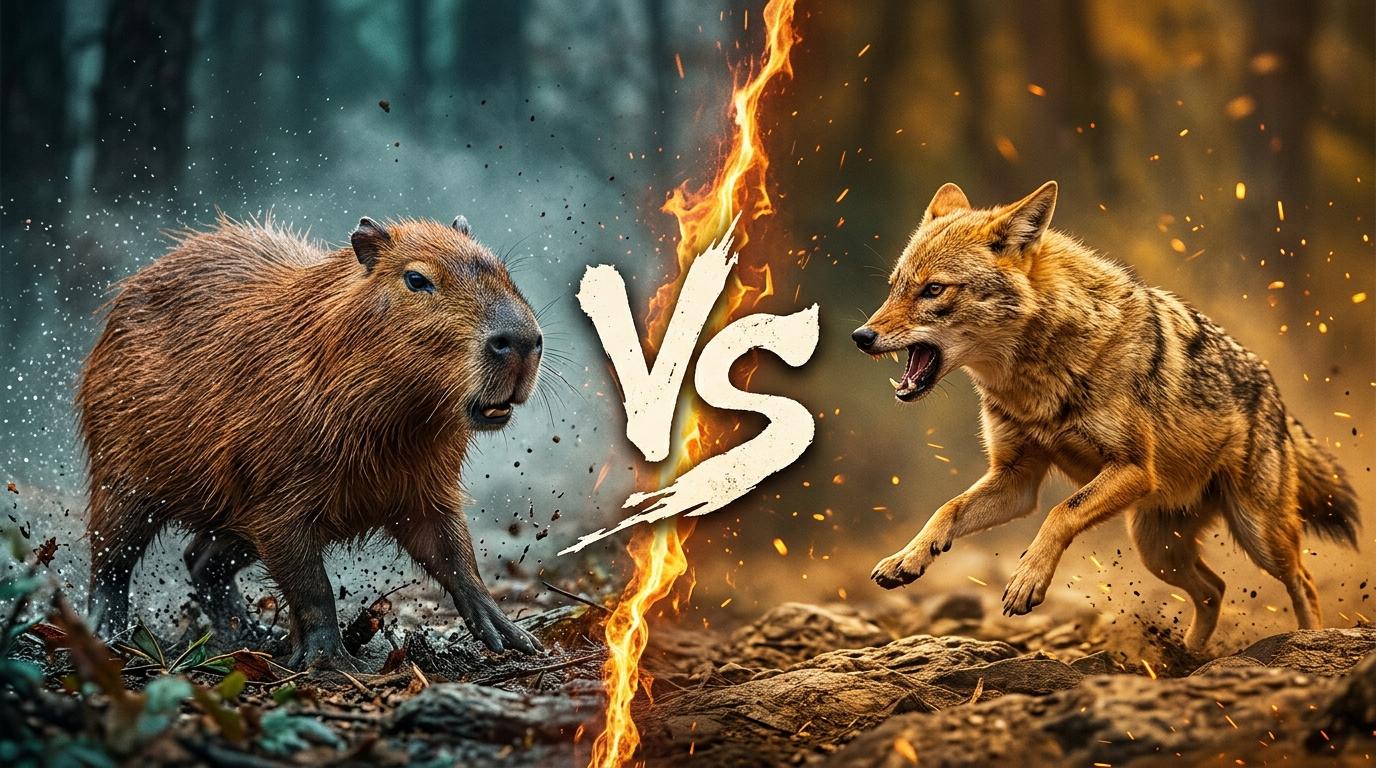
Capybara vs Golden Jackal: Who Actually Wins?
Capybara vs golden jackal: a 35–66 kg semi-aquatic rodent meets a quick 7–14 kg opportunist canid. See who wins a fight, which scenarios favor each, and why the size gap decides it.
Capybara vs Golden Jackal
Matchup winner
Capybara
Quick verdict
Start with the direct answer, then use the structured comparison below to see what changes the outcome.
The capybara wins a one-on-one fight against a golden jackal. The decisive factor is mass. An adult capybara weighs roughly 35–66 kg, while a golden jackal usually weighs 7–14 kg, so the jackal faces an opponent four to six times heavier. The capybara also has thick skin, a barrel-shaped body and ever-growing incisors that can inflict deep, tearing bites. The jackal is faster, cleverer and more tactically flexible. But its whole hunting toolkit is built for hares, rodents, birds, carrion and newborn ungulates, not for pulling down a healthy animal of that size. The jackal also lacks the jaw power and bodyweight to pin or suffocate a capybara, and it has every incentive to avoid a costly injury. In nearly every realistic frame the jackal disengages, and the capybara walks away or slips into water. The jackal's real threat is against capybara young, especially when jackals work as a pair. These animals never meet in the wild: capybaras live in South America, while golden jackals range across southeastern Europe, the Middle East and South Asia. This is a hypothetical matchup.
Read the full explanation
Winner: Capybara, mainly because it is about four to six times heavier.
The golden jackal is faster and smarter, but it is too small to subdue a healthy adult capybara.
Water is a near-total escape route for the capybara, which can stay submerged for around five minutes.
The jackal's realistic win condition is a pair targeting an unguarded capybara pup.
Reader vote
Who do you think wins?
Pick a side — no account needed. Results update live.
No votes yet — be the first to call it.
Editorial note
Why people disagree
Predator bias: people assume the carnivore wins, but jackals are mesopredators built for small prey, not 50 kg herbivores.
Mass and leverage
The jackal cannot knock down, pin or drag an animal several times its own weight.
Bite weapon
The jackal bites more often, but the capybara's bite causes worse injuries relative to the jackal's body size.
Speed and agility
Agility lets the jackal control spacing and choose when to engage, but speed alone does not finish the fight.
Read the full explanation +
The 'chill capybara' meme hides real hardware: those incisors are chisels, and adult males fight each other hard during dominance disputes.
Pack framing changes everything: one jackal is outmatched, but a coordinated pair hunting a calf flips the outcome.
Comparison FAQ
Short, direct answers to the next questions readers usually ask after the headline verdict.
Would a capybara beat a golden jackal in a fight?+
Yes. A healthy adult capybara would win or force the jackal to retreat in almost every one-on-one scenario, mainly because it is several times heavier.
Which is stronger, a capybara or a golden jackal?+
The capybara is far stronger in absolute terms. It weighs roughly 35–66 kg against the jackal's 7–14 kg, and it has a dense, powerful body.
Can a golden jackal kill a capybara?+
Not a healthy adult under realistic conditions. A jackal pair could kill a capybara pup, or possibly a sick or badly weakened adult.
Why is the golden jackal still dangerous?+
It is fast, intelligent and cooperative. Its sharp canines inflict real wounds, and its opportunistic hunting makes it a serious threat to young, injured or isolated animals.
Is the capybara dangerous?+
Yes, when provoked. Its long incisors can cause deep lacerations, and adult males fight each other forcefully during dominance disputes.
Do capybaras and golden jackals live in the same place?+
No. Capybaras are native to South America and golden jackals to Eurasia, so this matchup is hypothetical.
Head-to-head species stats
These are the same core AnimalDex stat dimensions used on the dedicated animal pages, pulled side by side so the matchup is faster to scan.
Capybara
Tier BGolden Jackal
Tier CTrait-by-trait comparison
Only the categories that matter to this matchup are included. The goal is not filler stats, but the real design differences that change the result.
35–66 kg, low and heavy
Mass and leverage
Capybara
7–14 kg, lean frame
Mass and leverage
Capybara
Long chisel incisors that tear on contact
Bite weapon
Capybara
Sharp canines and quick, slashing snaps
Bite weapon
Capybara
Short bursts up to about 35 km/h
Speed and agility
Golden Jackal
Up to about 40 km/h, tireless trotter
Speed and agility
Golden Jackal
Herd vigilance and alarm barks
Tactical flexibility
Golden Jackal
Adaptive, coordinated hunting in pairs
Tactical flexibility
Golden Jackal
Thick hide, dense body
Close-range durability
Capybara
Light build, injury-averse
Close-range durability
Capybara
Elite swimmer, can submerge about 5 minutes
Escape architecture
Capybara
Open-country endurance runner
Escape architecture
Capybara
How the verdict forms
Verdict timeline
01 · Mass and leverage
Capybara
02 · Bite weapon
Capybara
03 · Speed and agility
Golden Jackal
04 · Tactical flexibility
Golden Jackal
05 · Close-range durability
Capybara
06 · Escape architecture
Capybara
Change the conditions
Scenario breakdown
This is where shallow battle content usually fails. Terrain, spacing, timing, and engagement style can change the answer.
Scenario lean
Capybara
Verdict confidence
82%
The capybara holds its ground and the jackal backs off.
In dense grass, close range removes the jackal's spacing advantage. A cornered capybara turns and bites, and its weight lets it shove through a lunge. The jackal follows mesopredator logic and avoids injury-heavy exchanges with large prey. It probes, finds no opening and withdraws.
AnimalDex field profiles
Explore these animals
Capybara
Hydrochoerus hydrochaeris
Marshes, riversides, floodplains, lakeshores, and seasonally wet grassland.
Golden Jackal
Canis aureus
grassland, scrub, wetland edge, and farmland
Systems Intelligence & Hidden Purpose
See the animals behind this comparison as engineered biological systems: what each one is built to do, where it gains leverage, and why the matchup changes by scenario.
Specialized Hardware
Semi-aquatic body design, social vigilance, and grazing efficiency make capybaras reliable herbivore hardware for river and marsh systems.
Systems Script
Capybaras convert shoreline vegetation into mobile biomass while feeding predators and keeping wetland edges busy but readable. They help turn water access into a shared, constantly negotiated zone.
Strategic Insight
Calm is not softness when escape routes are already built in. Confidence works better when the fallback is real.
Specialized Hardware
gold-tawny canid coat, adaptable omnivorous feeding, and dusk-and-dawn calling behavior give the Golden Jackal a body plan tuned for its niche.
Systems Script
Golden Jackals operate through grassland, scrub, wetland edge, and farmland. Their design links movement, feeding, shelter, and timing into one workable survival system.
Strategic Insight
Where water controls movement, position and timing often matter more than speed.
Final take
The capybara wins. This is a case where physics beats tactics. The golden jackal is the smarter, faster and more versatile animal, but versatility does not overcome a four-to-sixfold weight gap. Its wariness about injury, which keeps it alive in the wild, also means it will almost never commit to a damaging fight with a healthy adult capybara.
Read the full explanation
Don't read that as the jackal being weak. Against small prey, carrion and young animals it is a sharp, efficient opportunist, and a pair hunting together would be a real threat to capybara pups. Against an adult, though, the capybara's mass, hide, incisors and nearby water make the matchup lopsided.
Collect both animals in AnimalDex
Track the species behind this matchup, compare their real traits, and build the rivalry into your AnimalDex collection.
Related comparisons
Continue with nearby matchups to compare more real-world animal traits without dropping into junky who-wins filler.
Capybara vs Crab-eating Fox: Who Actually Wins?
The capybara wins, and it isn't especially close. An adult capybara typically weighs around 35–66 kg, while a crab-eating fox usually weighs about 4.5–8 kg. That makes the rodent roughly six to ten times heavier. The capybara also carries thick-rooted, ever-growing incisors, a barrel-shaped body that is hard to topple, and a herd that alarm-barks and closes ranks. It also has an instant escape hatch: the water, where it can stay submerged for several minutes. The crab-eating fox is quicker, more maneuverable, and a smart opportunistic forager, but it is built to catch crabs, insects, frogs, and small vertebrates, not to subdue a large, armored-feeling grazer. In a direct confrontation the fox has no reliable way to finish the fight, while one bite or shove from the capybara can seriously injure it. The fox's real edge appears only in narrow situations, like snatching an unguarded pup or outmaneuvering for scraps at night.
Read comparison
Golden Jackal vs Rock Hyrax: Who Actually Wins?
The golden jackal wins clearly. At roughly 7–15 kg with a long canid skull, slicing carnassials, and endurance-built legs, it outweighs a 2–5 kg rock hyrax several times over and is a real predator of small mammals. The jackal controls distance, tests for weakness, and finishes with a neck or head bite. The hyrax's best hope is not fighting at all. It survives by spotting danger early, sounding alarm calls, and vanishing into rock crevices too tight for a canid to follow. Once a hyrax is cornered it fights hard with long, tusk-like incisors. In open ground, or when a hyrax is caught away from cover, the size and weapon gap decides the outcome quickly in the jackal's favor.
Read comparison
Discussion
What do you think?
Share your reasoning with other readers. Be civil and stick to the animals.
Sign in to join the discussion.
Sign inNo comments yet. Start the conversation.