

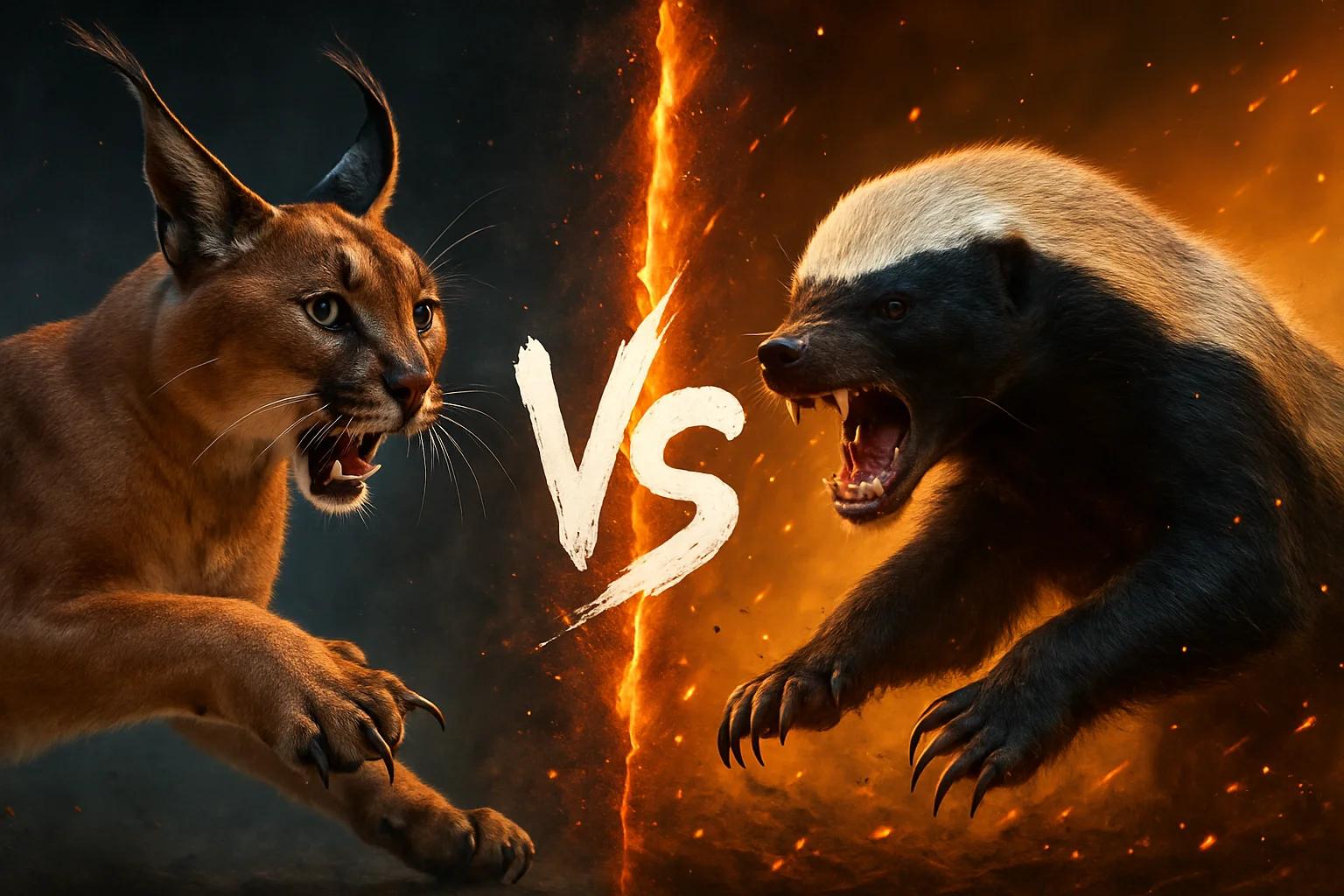
Caracal vs Honey Badger: Who Actually Wins?
Caracal vs honey badger: a biology-first breakdown of speed, armor, bite and temperament. See who wins and why the loser stays dangerous.
Caracal vs Honey Badger
Matchup winner
Honey Badger
Quick verdict
Start with the direct answer, then use the structured comparison below to see what changes the outcome.
The honey badger wins this matchup overall. A caracal is faster, longer-legged and a superb ambush killer of birds, hyraxes and small antelope. But its whole toolkit is built around a quick throat or nape bite on prey that panics and dies. The honey badger breaks that model. It has thick, loose skin that lets it twist around inside a predator's grip and bite back. It carries a powerful crushing bite, long digging claws and an anal-gland stink. It also has a documented willingness to face down lions, leopards and snakes rather than run. Caracals weigh roughly 8–19 kg and honey badgers about 6–14 kg, so the cat has a real size edge. Even so, it cannot reliably land a finishing bite on an animal it cannot pin, puncture or intimidate. In most realistic encounters the caracal decides the badger isn't worth the injury risk and leaves. That makes the badger the winner both by attrition and by retreat.
Read the full explanation
Overall winner: honey badger. Its loose, thick skin and relentless counterattack defeat the caracal's quick-kill bite strategy.
The caracal is bigger, much faster and more athletic. It wins the chase, the leap and the first strike.
Most real encounters end with the caracal backing off. Injury risk outweighs a low-calorie, high-cost meal.
A caracal ambushing a young or distracted badger could win. A head-on fight with an alert adult favors the badger.
Reader vote
Who do you think wins?
Pick a side — no account needed. Results update live.
No votes yet — be the first to call it.
Editorial note
Why people disagree
Size vs armor: the caracal is often heavier and taller, so on paper it looks like the favorite. The badger's skin and temperament don't show up in a weight chart.
Explosive power
The caracal controls when contact starts and can land the first strike almost every time.
Pursuit and escape speed
The caracal can always choose to leave, which matters because it usually does.
Close-range durability
The caracal's killing method depends on a secure bite. The badger's skin turns that bite into a liability.
Read the full explanation +
Internet reputation: the honey badger's 'fearless' myth is partly exaggerated. Badgers do get killed by big cats, so skeptics overcorrect and underrate how hard they really are to finish.
Ambush vs fight: caracal fans picture a surprise leap and nape bite. Badger fans picture a prolonged scrap. The winner depends on which first three seconds you imagine.
Comparison FAQ
Short, direct answers to the next questions readers usually ask after the headline verdict.
Would a caracal beat a honey badger in a fight?+
Usually no. A caracal can win with a clean surprise attack, especially on a young badger. In a head-on fight with an alert adult, the badger's tough skin and relentless counterattacks generally force the caracal to retreat.
Which is stronger, a caracal or a honey badger?+
The caracal is generally larger and more explosively powerful, especially in leaping and sprinting. The honey badger is stronger for its size in digging and grappling, with a crushing bite that matters more in a close-range fight.
Does a caracal ever hunt honey badgers?+
It is rarely recorded. Caracals focus on birds, rodents, hyraxes and small antelope. A honey badger offers high injury risk for little reward, so caracals typically avoid them.
Why is the caracal still dangerous to a honey badger?+
Its speed, stealth and leaping strike let it choose the moment of attack. A well-placed bite on an unaware or juvenile badger can be serious, and the cat can escape any counterattack instantly.
Is the honey badger really fearless?+
Not literally. It does flee and is sometimes killed by lions and leopards. But it is unusually willing to stand its ground, and its defenses make even large predators hesitate.
Head-to-head species stats
These are the same core AnimalDex stat dimensions used on the dedicated animal pages, pulled side by side so the matchup is faster to scan.
Caracal
Tier CHoney Badger
Tier BTrait-by-trait comparison
Only the categories that matter to this matchup are included. The goal is not filler stats, but the real design differences that change the result.
Elite leaper, can clear about 3 m to swat birds
Explosive power
Caracal
Low, ground-hugging burst
Explosive power
Caracal
Fast sprinter, around 80 km/h claimed bursts
Pursuit and escape speed
Caracal
Trotting forager, slow in open sprints
Pursuit and escape speed
Caracal
Thin-skinned athletic cat, built for short fights
Close-range durability
Honey Badger
Thick, loose rubbery hide that resists bites and lets it twist free
Close-range durability
Honey Badger
Sharp canines, hooked retractile claws for gripping
Bite and claw damage
Honey Badger
Crushing jaws and 4 cm digging claws that tear
Bite and claw damage
Honey Badger
Pragmatic hunter, disengages from costly prey
Commitment and pain tolerance
Honey Badger
Notoriously persistent, counterattacks larger predators
Commitment and pain tolerance
Honey Badger
Stealthy stalker with excellent hearing from its tufted ears
Ambush control
Caracal
Noisy, nose-down digger
Ambush control
Caracal
How the verdict forms
Verdict timeline
01 · Explosive power
Caracal
02 · Pursuit and escape speed
Caracal
03 · Close-range durability
Honey Badger
04 · Bite and claw damage
Honey Badger
05 · Commitment and pain tolerance
Honey Badger
06 · Ambush control
Caracal
Change the conditions
Scenario breakdown
This is where shallow battle content usually fails. Terrain, spacing, timing, and engagement style can change the answer.
Scenario lean
Honey Badger
Verdict confidence
82%
Close quarters favor the badger.
Dense scrub removes the caracal's leaping and sprinting advantages and forces a grappling fight. Up close, the badger can twist inside the cat's grip, rake with long claws and bite hard. A stink-gland discharge adds to the pressure. The caracal's nape bite doesn't find vital tissue through loose skin, and every second of contact costs it more than it costs the badger.
AnimalDex field profiles
Explore these animals
Caracal
Caracal caracal
Savannah, scrubland, semi-desert, and dry woodland.
Honey Badger
Mellivora capensis
Savannah, scrubland, dry forest edge, and semi-arid country.
Systems Intelligence & Hidden Purpose
See the animals behind this comparison as engineered biological systems: what each one is built to do, where it gains leverage, and why the matchup changes by scenario.
Specialized Hardware
Long black ear tufts, plain reddish coat, and athletic lean body give the Caracal a body plan tuned for its niche.
Systems Script
Caracals operate in savannah, scrubland, semi-desert, and dry woodland. Their design helps them match food access, shelter, and timing inside that environment.
Strategic Insight
Fast vertical movement can change a fight before the other side understands the angle.
Specialized Hardware
Black body with pale back stripe, low muscular body, and strong claws for digging give the Honey Badger a body plan tuned for its niche.
Systems Script
Honey Badgers operate in savannah, scrubland, dry forest edge, and semi-arid country. Their design helps them match food access, shelter, and timing inside that environment.
Strategic Insight
Confidence is strongest when your equipment can actually support it.
Final take
The caracal is the better athlete, and nobody should mistake it for a pushover. It is a hard-hitting, acrobatic cat that kills prey larger than a honey badger. Its weakness here isn't power. It is design: a cat's hunting system assumes the prey will try to escape and can be pinned with one decisive bite.
Read the full explanation
The honey badger is built to make that assumption fail. Loose armored skin, crushing jaws, digging claws, chemical defense and a temperament that escalates instead of fleeing make it one of the worst cost-to-reward targets in African and Asian scrublands. Over most realistic encounters, the badger either wins outright or wins by forcing the caracal to walk away. That is why it takes this matchup.
Collect both animals in AnimalDex
Track the species behind this matchup, compare their real traits, and build the rivalry into your AnimalDex collection.
Discussion
What do you think?
Share your reasoning with other readers. Be civil and stick to the animals.
Sign in to join the discussion.
Sign inNo comments yet. Start the conversation.