

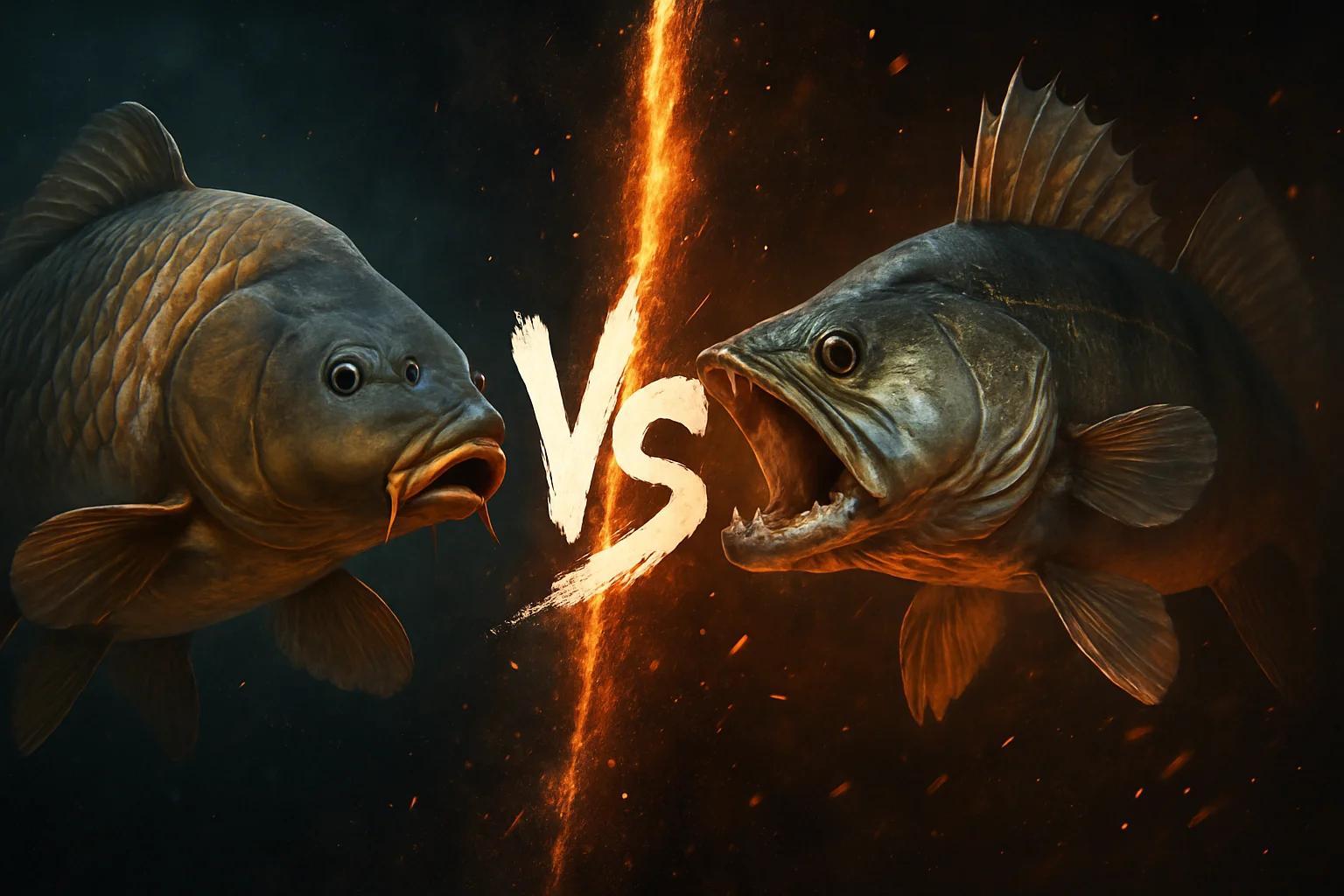
Common Carp vs Zander: Who Actually Wins?
Common carp vs zander: who would win? A biology-first breakdown of fangs, mass, scales, night vision, and how each fish wins in the wild.
Carp vs Zander
Matchup winner
Zander
Quick verdict
Start with the direct answer, then use the structured comparison below to see what changes the outcome.
The zander wins this matchup overall. It is a true piscivore. Its long canine fangs are built to seize fish, its tapetum-backed eyes let it hunt in murky and low-light water, and a fast-start pikeperch body lets it strike before prey reacts. The common carp is a bottom-sifting omnivore with no weapons beyond mass, tough scales, and stamina. That makes it extremely hard to finish, and a fully grown carp often outweighs any zander nearby. In a size-matched encounter, though, initiative belongs to the predator: the zander chooses when and how contact happens, and the carp can only absorb and flee. The carp's real edge is that big adults outgrow the zander's menu entirely.
Read the full explanation
Zander wins overall. It is an armed, low-light ambush predator facing an unarmed grazer.
Size-matched, the zander's fangs and strike speed decide the outcome.
A trophy-sized carp is too big for a zander to handle, so mass is the carp's escape hatch.
Juvenile carp are routine zander prey across European waters.
Reader vote
Who do you think wins?
Pick a side — no account needed. Results update live.
No votes yet — be the first to call it.
Editorial note
Why people disagree
Anglers picture 15 kg carp next to 4 kg zander. At those weights the carp is simply too big to be prey.
Built-in weaponry
Only one of these fish can actually grip and wound another fish.
Explosive strike speed
The first contact decides most underwater predator encounters.
Murky-water vision
Zander own dusk, night, and silty water, which are exactly the conditions where carp can't see an attack coming.
Read the full explanation +
Carp feel 'stronger' on the line because their stamina is legendary. That pulling endurance is not the same as fighting ability.
Zander rarely 'fight' anything. They ambush and swallow, so the matchup is really predator versus prey-size threshold.
Comparison FAQ
Short, direct answers to the next questions readers usually ask after the headline verdict.
Would a zander beat a common carp?+
Yes, in most realistic size-matched encounters. The zander is an armed ambush predator, while the carp has no biting weapons. Very large carp are too big for zander to attack.
Which is stronger, carp or zander?+
The carp has more raw pulling strength and endurance, and it is often much heavier. The zander is stronger as a fighter because of its teeth and strike speed.
Do zander eat carp?+
Yes. Zander regularly eat juvenile carp and other cyprinids small enough to swallow.
Why is the carp still dangerous to the zander's success?+
Its thick scales and stamina can defeat a mistimed strike. Its size growth puts adults beyond predation, and carp can outcompete zander in degraded, turbid habitats by stirring up sediment.
Head-to-head species stats
These are the same core AnimalDex stat dimensions used on the dedicated animal pages, pulled side by side so the matchup is faster to scan.
Carp
Tier CZander
Tier CTrait-by-trait comparison
Only the categories that matter to this matchup are included. The goal is not filler stats, but the real design differences that change the result.
Toothless mouth; pharyngeal teeth for crushing food
Built-in weaponry
Zander
Prominent fangs and rows of sharp teeth
Built-in weaponry
Zander
Steady cruiser, slow to accelerate
Explosive strike speed
Zander
Rapid burst from a hover
Explosive strike speed
Zander
Relies on barbels, smell, and taste
Murky-water vision
Zander
Reflective tapetum for dim, turbid water
Murky-water vision
Zander
Commonly 5–15 kg, record fish over 40 kg
Body mass ceiling
Carp
Typically 2–5 kg, rarely above 15 kg
Body mass ceiling
Carp
Deep body, thick scales, huge stamina
Close-range durability
Carp
Slender, built for strikes, not wrestling
Close-range durability
Carp
Tolerates low oxygen, warm and polluted water
Habitat toughness
Carp
Prefers cleaner, cooler, oxygenated water
Habitat toughness
Carp
How the verdict forms
Verdict timeline
01 · Built-in weaponry
Zander
02 · Explosive strike speed
Zander
03 · Murky-water vision
Zander
04 · Body mass ceiling
Carp
05 · Close-range durability
Carp
06 · Habitat toughness
Carp
Change the conditions
Scenario breakdown
This is where shallow battle content usually fails. Terrain, spacing, timing, and engagement style can change the answer.
Scenario lean
Zander
Verdict confidence
82%
Zander, decisively.
Low light is the zander's hunting window. Its tapetum gives it sight while the carp is effectively blind to an approach. A burst strike with fangs locks onto a size-appropriate carp before it can bolt.
AnimalDex field profiles
Explore these animals
Carp
Cyprinus carpio
pond, lake, reservoir, and slow river
Zander
Sander lucioperca
river, reservoir, and deep freshwater lake habitat
Systems Intelligence & Hidden Purpose
See the animals behind this comparison as engineered biological systems: what each one is built to do, where it gains leverage, and why the matchup changes by scenario.
Specialized Hardware
elongated predatory body, spiny dorsal fins, and dim-water ambush hunting give the Zander a body plan tuned for its niche.
Systems Script
Zanders operate through river, reservoir, and deep freshwater lake habitat. Their design links movement, feeding, shelter, and timing into one workable survival system.
Strategic Insight
Where water controls movement, position and timing often matter more than speed.
Final take
The zander takes this matchup because it is purpose-built to kill fish: fangs, burst speed, and eyes tuned for murk. The common carp is a grazer whose defenses are passive. It relies on bulk, scales, and stamina.
Read the full explanation
That passive defense still matters. Carp grow past the size any zander can manage, and once that happens they are effectively off the menu. Pound for pound the zander wins; heavyweight for heavyweight, the carp simply stops being prey.
Collect both animals in AnimalDex
Track the species behind this matchup, compare their real traits, and build the rivalry into your AnimalDex collection.
Related comparisons
Continue with nearby matchups to compare more real-world animal traits without dropping into junky who-wins filler.

Common Carp vs Silver Arowana: Who Actually Wins?
The silver arowana wins most realistic confrontations. It is a long, surface-cruising predator that can reach roughly 90 cm. It has an upturned, bony mouth built to snap prey, explosive bursts of speed, and the aggressive temperament that makes it notorious in shared aquariums. The common carp is often heavier and is very hard to kill. Its thick scales, deep body, and tolerance for low oxygen, cold, and murky water make it one of the most resilient freshwater fish on Earth. But it is a bottom-sifting omnivore with toothless jaws. It has no real offensive weapon, so it can only endure, displace, or flee. In any contest decided by who strikes, chases, and controls space, the arowana dictates terms. The carp's best outcome is survival, not victory.
Read comparison
Discussion
What do you think?
Share your reasoning with other readers. Be civil and stick to the animals.
Sign in to join the discussion.
Sign inNo comments yet. Start the conversation.