

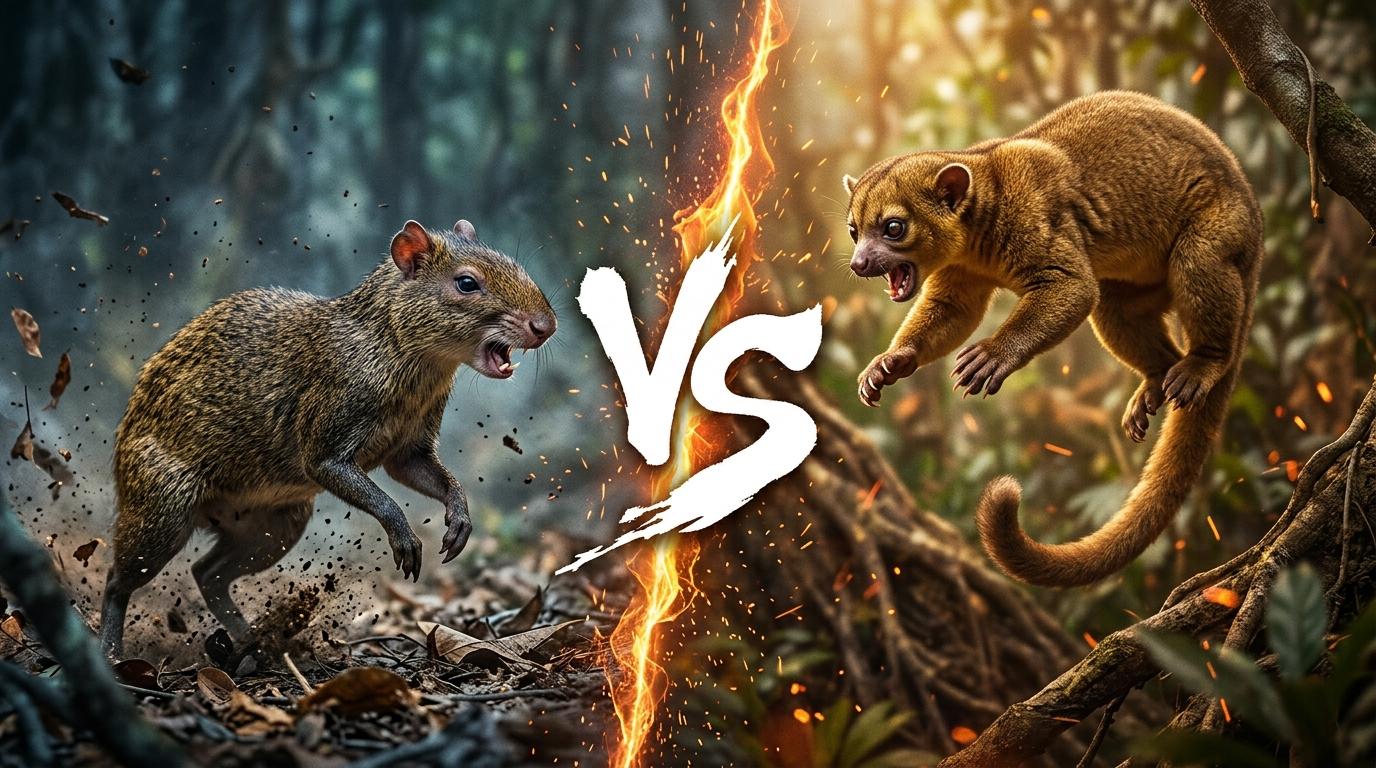
Central American Agouti vs Kinkajou: Who Actually Wins?
Agouti vs kinkajou: a biology-first breakdown of size, bite, claws, speed and behavior to decide who wins a clash between these two Neotropical forest mammals.
Central American Agouti vs Kinkajou
Matchup winner
Kinkajou
Quick verdict
Start with the direct answer, then use the structured comparison below to see what changes the outcome.
The kinkajou wins this matchup. The two weigh about the same, roughly 2–4.5 kg each, but the kinkajou is built very differently. It is a procyonid carnivoran with a dense, muscular body, a gripping prehensile tail, sharp curved claws and a carnivoran jaw with real canines. It is also known to be surprisingly fierce when cornered or handled. The agouti is a long-legged rodent built for one thing above all: escape. Its chisel incisors can deliver a painful bite, and its burst speed and leaping are excellent, but it has little grappling ability and no habit of holding its ground. In any encounter where the two actually make contact, the kinkajou's grip, claws and willingness to fight decide it. The agouti's best outcome is almost always a clean getaway rather than a win.
Read the full explanation
Kinkajou wins most real contact: denser body, claws, canines and a prehensile tail for leverage.
Agouti is faster on the ground and tends to escape rather than fight.
Size is nearly equal, so build and weaponry matter more than weight.
In the trees the agouti has no game; on open forest floor it can simply leave.
Reader vote
Who do you think wins?
Pick a side — no account needed. Results update live.
No votes yet — be the first to call it.
Editorial note
Why people disagree
The kinkajou's fruit-and-nectar diet makes people assume it is harmless, but it is a carnivoran with real fighting hardware and a famously bad temper when stressed.
Close-range durability
In a grapple, the stockier body with flexible skin absorbs bites and keeps working.
Weaponry
Canines plus hooked claws hold and puncture. Rodent incisors cut but lack grip.
Explosive power
The agouti's launch is its main survival tool and lets it break contact instantly.
Read the full explanation +
Agouti incisors are powerful enough to crack Brazil nut pods, so some readers overrate its bite as a combat weapon.
Neither animal seeks this fight. 'Winning' often means who controls the encounter, and the agouti controls it by vanishing.
Comparison FAQ
Short, direct answers to the next questions readers usually ask after the headline verdict.
Would a kinkajou beat an agouti in a fight?+
Yes, in most forced encounters. Its claws, canines, muscular build and prehensile tail give it control at close range.
Which is stronger, the agouti or the kinkajou?+
The kinkajou is stronger pound for pound in grappling and gripping. The agouti is stronger in its legs for sprinting and jumping.
Is the agouti still dangerous?+
Yes. Its incisors can split hard nuts and can inflict deep cuts, and its explosive escape makes it very hard to pin down.
Are kinkajous aggressive?+
They are usually calm, but they bite hard and defend themselves fiercely when cornered or stressed.
Do they meet in the wild?+
Their ranges overlap in Central American forests, but they use different layers: agoutis on the ground by day, kinkajous in the canopy at night.
Head-to-head species stats
These are the same core AnimalDex stat dimensions used on the dedicated animal pages, pulled side by side so the matchup is faster to scan.
Central American Agouti
Tier CKinkajou
Tier BTrait-by-trait comparison
Only the categories that matter to this matchup are included. The goal is not filler stats, but the real design differences that change the result.
Light, leggy frame
Close-range durability
Kinkajou
Dense, muscular, loose tough skin
Close-range durability
Kinkajou
Chisel incisors, blunt hooflike claws
Weaponry
Kinkajou
Sharp canines, curved climbing claws
Weaponry
Kinkajou
Sprinting bursts, vertical leaps
Explosive power
Central American Agouti
Deliberate, strong pulls
Explosive power
Central American Agouti
Minimal
Grip and leverage
Kinkajou
Prehensile tail, reversible hind feet
Grip and leverage
Kinkajou
Hyper-vigilant, alarm foot-stamps
Threat awareness
Central American Agouti
Nocturnal, relies on canopy cover
Threat awareness
Central American Agouti
Spatial memory for cached seeds
Problem solving
Kinkajou
Dexterous forager, long tongue, manipulative paws
Problem solving
Kinkajou
How the verdict forms
Verdict timeline
01 · Close-range durability
Kinkajou
02 · Weaponry
Kinkajou
03 · Explosive power
Central American Agouti
04 · Grip and leverage
Kinkajou
05 · Threat awareness
Central American Agouti
06 · Problem solving
Kinkajou
Change the conditions
Scenario breakdown
This is where shallow battle content usually fails. Terrain, spacing, timing, and engagement style can change the answer.
Scenario lean
Kinkajou
Verdict confidence
82%
Kinkajou, if contact is forced.
In tangled undergrowth with little room to sprint, the agouti loses its main advantage. The kinkajou can latch on with its claws, brace with its tail and use its canines. The agouti's incisors can still wound it, but the agouti cannot control the clinch.
AnimalDex field profiles
Explore these animals
Central American Agouti
—
Habitat details are not published on a dedicated AnimalDex species page yet.
Species guide coming soon.
Kinkajou
Potos flavus
tropical rainforest canopy, forest edge, and humid woodland
Systems Intelligence & Hidden Purpose
See the animals behind this comparison as engineered biological systems: what each one is built to do, where it gains leverage, and why the matchup changes by scenario.
Specialized Hardware
prehensile tail for canopy balance, night-active tree climbing, and fruit-focused forest diet give the Kinkajou a body plan tuned for its niche.
Systems Script
Kinkajous operate through tropical rainforest canopy, forest edge, and humid woodland Their design links movement, shelter, and feeding into one workable survival system.
Strategic Insight
A system gets lighter and safer when grip, balance, and movement work as one.
Final take
This is a fight-versus-flight matchup between two animals of almost identical weight. The kinkajou carries the tools of a fighter: claws, canines, tail leverage and a temper. The agouti carries the tools of a survivor: speed, leaping and constant vigilance.
Read the full explanation
When contact actually happens, the kinkajou wins. The agouti's real victory is never letting contact happen, which is why it remains a successful prey species. Overall winner: Kinkajou.
Collect both animals in AnimalDex
Track the species behind this matchup, compare their real traits, and build the rivalry into your AnimalDex collection.
Related comparisons
Continue with nearby matchups to compare more real-world animal traits without dropping into junky who-wins filler.

Kinkajou vs Olingo: Who Actually Wins?
The kinkajou wins. Both are nocturnal, fruit-loving members of the raccoon family, and they are so alike that people often confuse them. They also really do meet in the same fruiting trees. In those meetings the kinkajou usually holds the branch. An adult kinkajou typically weighs about 2–3+ kg, often roughly twice the mass of a northern olingo (around 1–1.5 kg). It also has a prehensile tail that works like a fifth limb. That combination lets it anchor itself, use its claws and teeth from a stable position, and refuse to give ground. The olingo is the quicker, springier climber and the more varied hunter, so it can win a chase or avoid a confrontation. Once the encounter becomes physical, though, the kinkajou's extra mass and grip settle it.
Read comparison
Discussion
What do you think?
Share your reasoning with other readers. Be civil and stick to the animals.
Sign in to join the discussion.
Sign inNo comments yet. Start the conversation.