

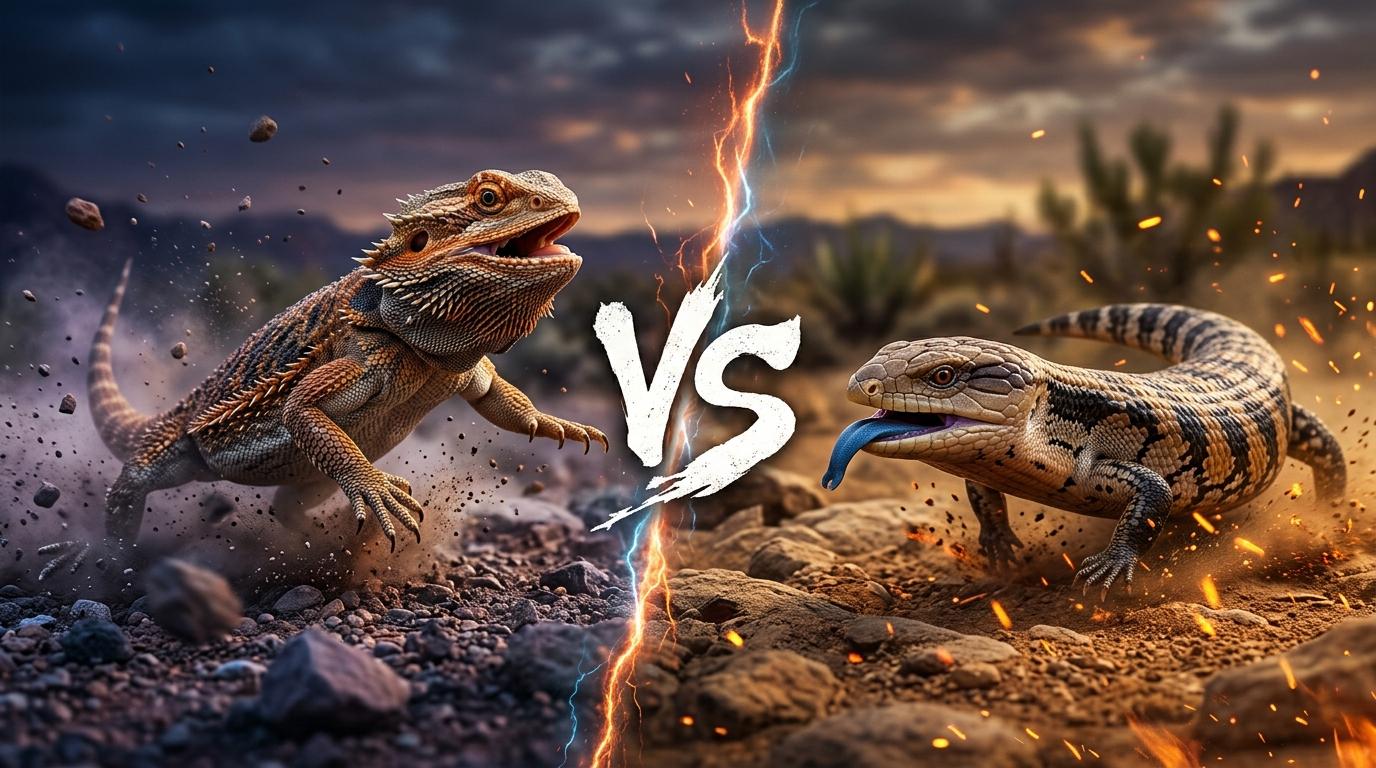
Central Bearded Dragon vs Eastern Blue-tongued Skink: Who Actually Wins?
Bearded dragon vs blue-tongued skink: a biology-first breakdown of speed, armor, bite, and bluffing, and why the bearded dragon edges this Australian lizard matchup.
Central Bearded Dragon vs Blue-tongued Skink
Matchup winner
Central Bearded Dragon
Quick verdict
Start with the direct answer, then use the structured comparison below to see what changes the outcome.
The Central Bearded Dragon (Pogona vitticeps) wins this matchup most of the time, though not by much. Both lizards top out around 50–60 cm and can weigh roughly 400–600 g, so size is close. The dragon's edge is its body plan. It has longer legs, quicker acceleration, and a raised, spiny posture, so it can choose the angle, back off, and come back at will. The Eastern Blue-tongued Skink (Tiliqua scincoides) is built like a low, armored sausage. Its overlapping scales are reinforced with bony plates called osteoderms, and its blunt jaws grip hard and crush the snails and beetles it eats. That makes it very hard to finish in a tight spot. But the skink's short legs mean it reacts rather than controls. In open terrain the dragon dictates the encounter, wears the skink down, and usually walks away the dominant animal. Give the skink a log, a burrow mouth, or leaf litter to back into, and the result gets much closer.
Read the full explanation
Overall winner: Central Bearded Dragon, mainly through speed, agility, and control of the angle.
The blue-tongued skink has the stronger crushing grip and a more armored body, which makes it a tough, durable defender.
In the open, the dragon wins clearly. In tight cover, the skink can force a stalemate or drive the dragon off.
Real encounters between these two are mostly displays, with beards, hisses, and blue tongues, not fights to the finish.
Reader vote
Who do you think wins?
Pick a side — no account needed. Results update live.
No votes yet — be the first to call it.
Editorial note
Why people disagree
Skink fans point to that grip. A blue-tongue's bite is genuinely strong for its size, and it holds on.
Explosive power
Burst speed lets the dragon start and stop exchanges on its own terms.
Bite and grip
If the skink gets a solid grip, the dragon's speed matters a lot less.
Close-range durability
The skink can absorb punishment and simply outlast a careless attacker.
Read the full explanation +
Dragon fans point to mobility. A lizard that can choose when to engage almost always beats one that can't.
Many people only know these animals as gentle pets, so they underrate how good both are at defensive theater: puffed beards, gaping mouths, flashing tongues, and loud hisses.
Comparison FAQ
Short, direct answers to the next questions readers usually ask after the headline verdict.
Would a bearded dragon beat a blue-tongued skink?+
Usually, yes, especially in open terrain. The dragon's speed and angle control outweigh the skink's grip and armor.
Which lizard is stronger?+
Pound for pound, the blue-tongued skink has the stronger crushing bite and the better armor. The bearded dragon is more athletic overall.
Why is the blue-tongued skink still dangerous to a bearded dragon?+
Its jaws are built to crush snail shells, and it holds on stubbornly. If the dragon lets it grip head-on, especially near cover, the dragon can come off badly.
Do they meet in the wild?+
Their ranges can come close in parts of inland eastern Australia. Encounters are rare, and when they happen they mostly involve displays rather than fights.
Should pet owners keep them together?+
No. Housing them together causes stress, injuries, and competition over heat. Each needs its own enclosure.
Head-to-head species stats
These are the same core AnimalDex stat dimensions used on the dedicated animal pages, pulled side by side so the matchup is faster to scan.
Central Bearded Dragon
Tier CBlue-tongued Skink
Tier DTrait-by-trait comparison
Only the categories that matter to this matchup are included. The goal is not filler stats, but the real design differences that change the result.
Quick sprints and lunges on longer legs
Explosive power
Central Bearded Dragon
Short bursts; slow, side-to-side waddle
Explosive power
Central Bearded Dragon
Sharp, quick nips
Bite and grip
Blue-tongued Skink
Broad, crushing jaws built for snail shells, with a stubborn hold
Bite and grip
Blue-tongued Skink
Spiny scales and a flattened body
Close-range durability
Blue-tongued Skink
Smooth scales reinforced with osteoderms
Close-range durability
Blue-tongued Skink
Black puffed beard, gaping mouth, flattened body
Threat display
Central Bearded Dragon
Cobalt tongue flash and a loud hiss
Threat display
Central Bearded Dragon
Agile; can climb onto perches and circle
Angle control
Central Bearded Dragon
Low to the ground; turns slowly
Angle control
Central Bearded Dragon
Alert basker that scans from elevated spots
Situational awareness
Central Bearded Dragon
Ground forager that relies heavily on scent
Situational awareness
Central Bearded Dragon
How the verdict forms
Verdict timeline
01 · Explosive power
Central Bearded Dragon
02 · Bite and grip
Blue-tongued Skink
03 · Close-range durability
Blue-tongued Skink
04 · Threat display
Central Bearded Dragon
05 · Angle control
Central Bearded Dragon
06 · Situational awareness
Central Bearded Dragon
Change the conditions
Scenario breakdown
This is where shallow battle content usually fails. Terrain, spacing, timing, and engagement style can change the answer.
Scenario lean
Central Bearded Dragon
Verdict confidence
82%
Dragon dictates the encounter
On flat, open ground, mobility decides things. The dragon can circle, feint, and dart in for a nip, then retreat before the skink can turn its broad head around. The skink's armor slows the outcome but doesn't change it. Its best move is a hissing bluff, and a confident dragon can call that bluff.
AnimalDex field profiles
Explore these animals
Central Bearded Dragon
—
Habitat details are not published on a dedicated AnimalDex species page yet.
Species guide coming soon.
Blue-tongued Skink
Tiliqua scincoides
Grassland, woodland, scrubland, gardens, and dry open habitats.
Systems Intelligence & Hidden Purpose
See the animals behind this comparison as engineered biological systems: what each one is built to do, where it gains leverage, and why the matchup changes by scenario.
Specialized Hardware
Heavy smooth-scaled body, short legs and broad head, and bright blue tongue display give the Blue-tongued Skink a body plan tuned for its niche.
Systems Script
Blue-tongued Skinks operate in grassland, woodland, scrubland, gardens, and dry open habitats. Their design helps them match food access, shelter, and timing inside that environment.
Strategic Insight
A dramatic signal can change the contest before contact even happens.
Final take
The Central Bearded Dragon is the better overall competitor. It doesn't hit harder. It controls the encounter. Speed, height, and a display built for lizard-on-lizard contests let it pick the terms.
Read the full explanation
The Eastern Blue-tongued Skink is the tougher animal to finish. Its osteoderm-reinforced armor and crushing grip make it a fortress in cover. In the right spot, it can outlast the dragon or send it away. But it can't force a fight onto its own ground.
Collect both animals in AnimalDex
Track the species behind this matchup, compare their real traits, and build the rivalry into your AnimalDex collection.
Related comparisons
Continue with nearby matchups to compare more real-world animal traits without dropping into junky who-wins filler.
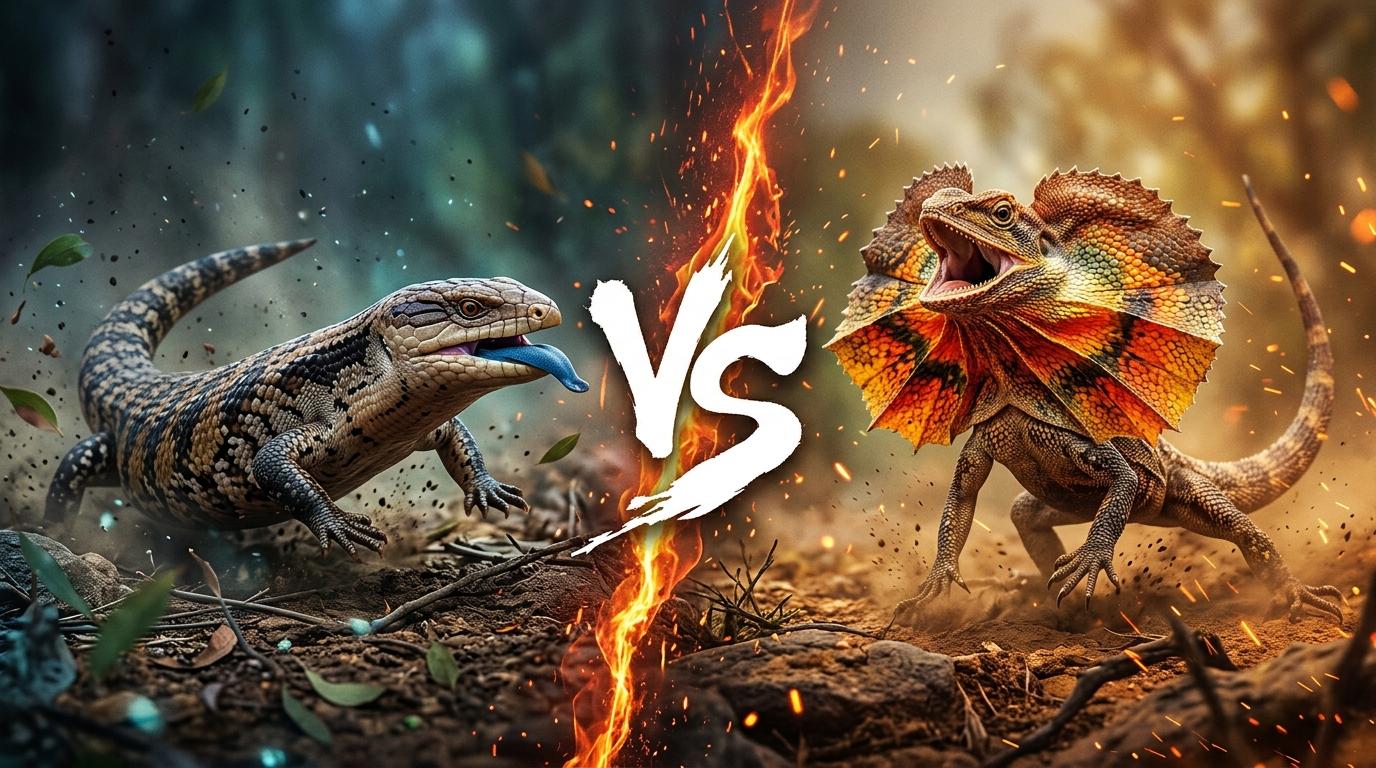
Blue-tongued Skink vs Frilled Lizard: Who Actually Wins?
The Eastern Blue-tongued Skink wins a committed fight, though not by much. The Frilled Lizard is longer, faster and far more theatrical. Its gaping mouth, hissing and umbrella frill can stop many predators in their tracks. But much of that length is tail, and its main weapons are intimidation and escape. The skink is built like a small armored log. Overlapping bony osteoderms sit under its scales, and its thick-boned skull and short, powerful jaws are made to crush snail shells and beetles. Once it bites, it tends to clamp and hold. In any frame where the frilled lizard cannot simply run or climb away, the skink's compact armor and crushing grip beat a defense built mostly on display. In open country with trees nearby, the frilled lizard usually avoids the fight entirely. That is a smart survival choice, but it is not a win.
Read comparison
Eastern Blue-tongued Skink vs Green Tree Python: Who Actually Wins?
The green tree python wins this matchup in most realistic encounters. An adult Morelia viridis is typically 1.5–2 m long and often outweighs an Eastern Blue-tongued Skink. It strikes from an anchored coil with long, recurved front teeth. Once a constrictor's coils close around a squat, short-legged lizard, the contest shifts to the python's terms. The skink has no limb leverage, no speed to break free, and no way to stop the squeeze. The skink is not a pushover, though. Its body is reinforced with bony osteoderms, its crushing bite clamps hard and holds on, and its blue-tongue threat display is a genuine deterrent. A hesitant or poorly positioned python can take a painful bite and back off. But the python controls range, angle, and the finishing mechanism, and the skink can only make the fight costly.
Read comparison
Discussion
What do you think?
Share your reasoning with other readers. Be civil and stick to the animals.
Sign in to join the discussion.
Sign inNo comments yet. Start the conversation.