

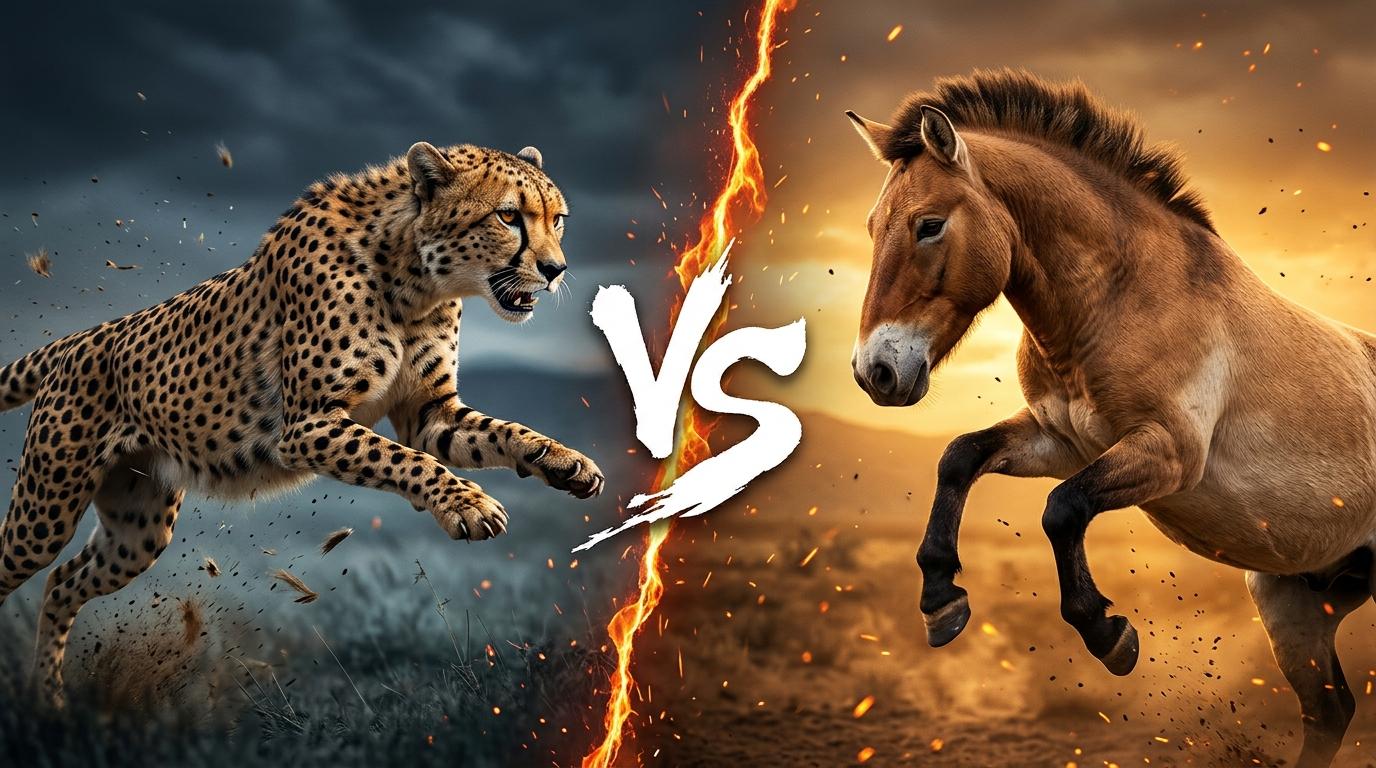
Cheetah vs Przewalski's Horse: Who Actually Wins?
Cheetah vs Przewalski's horse (takhi): the fastest land animal against a stocky wild steppe horse built to fight. Here is the biology behind who wins a confrontation and why.
Cheetah vs Takhi
Matchup winner
Takhi
Quick verdict
Start with the direct answer, then use the structured comparison below to see what changes the outcome.
Przewalski's horse wins. An adult takhi weighs roughly 250–350 kg, about five to six times as much as a 35–65 kg cheetah, and it is a compact, thick-necked fighter whose stallions settle disputes with bone-cracking kicks and crushing bites. The cheetah is a precision sprinter. It reaches around 100–110 km/h, but that speed comes from a light frame, a small jaw, and blunt, semi-retractable claws. Its killing method is a throat clamp, which works on gazelle-sized prey and does not suit a muscular, kicking horse several times its mass. In the wild, cheetahs avoid prey that can injure them, because a single broken leg or jaw means starvation. The cheetah would win the race every time. It would lose any fight where it tried to hold on.
Read the full explanation
Przewalski's horse wins a real confrontation thanks to a roughly 5–6x weight advantage and lethal kicks.
The cheetah's speed is a hunting tool. It does not let the cat subdue a large, fit adult horse.
Cheetahs avoid injury-risk prey, and an adult takhi is exactly that kind of risk.
A cheetah could only realistically succeed against a very young, isolated foal.
Reader vote
Who do you think wins?
Pick a side — no account needed. Results update live.
No votes yet — be the first to call it.
Editorial note
Why people disagree
Speed stats are vivid. 'Fastest land animal' sounds like it should mean 'dominant predator,' but the cheetah's top speed tells you how well it catches prey, not how well it controls large prey.
Explosive power
The cheetah owns acceleration, but acceleration closes distance. It does not end a fight.
Body mass and frame
Mass decides grappling. The horse can shake off, crush, or trample a cat this size.
Weaponry
The horse's weapons cause blunt trauma at range. The cheetah's methods need sustained close contact.
Read the full explanation +
People picture domestic horses as gentle. Przewalski's horse is a genuinely wild equid whose stallions fight hard, and its main natural predator was the wolf hunting in packs, not a lone mid-sized cat.
Some readers count the cheetah's 'predator' status as an automatic edge. In practice, predator success depends on the prey-size match, and this pairing sits well outside the cheetah's comfort zone.
Comparison FAQ
Short, direct answers to the next questions readers usually ask after the headline verdict.
Would a cheetah beat a Przewalski's horse in a fight?+
No. An adult Przewalski's horse is far heavier and stronger, and its kicks and bites can seriously injure a cheetah. The cheetah's throat-clamp method is not suited to prey this large.
Which is stronger, a cheetah or a Przewalski's horse?+
Przewalski's horse is much stronger in raw power and mass. The cheetah's strength is concentrated in sprinting acceleration rather than grappling force.
Is a cheetah faster than a Przewalski's horse?+
Yes, by a wide margin in a sprint. The cheetah reaches around 100–110 km/h, while the takhi tops out much lower. The horse has far better endurance, though.
Why is a cheetah still dangerous even though it loses?+
Its speed, ambush skill, and precise throat bite make it a lethal hunter of gazelles, impala, and young ungulates. A foal or a weakened, isolated horse would be genuinely vulnerable.
Do cheetahs and Przewalski's horses live together?+
Not today. Takhi live mainly on reintroduction sites in Mongolia and parts of Central Asia, while cheetahs survive mostly in Africa with a tiny Asiatic population in Iran. Historically, their ranges in Central Asia may have come close.
Head-to-head species stats
These are the same core AnimalDex stat dimensions used on the dedicated animal pages, pulled side by side so the matchup is faster to scan.
Cheetah
Tier BTakhi
Tier BTrait-by-trait comparison
Only the categories that matter to this matchup are included. The goal is not filler stats, but the real design differences that change the result.
0–95 km/h in about 3 seconds
Explosive power
Cheetah
Powerful hindquarter kick and rear-up strikes
Explosive power
Cheetah
About 35–65 kg, slender and light-boned
Body mass and frame
Takhi
About 250–350 kg, stocky and dense
Body mass and frame
Takhi
Small canines, blunt claws, suffocating throat bite
Weaponry
Takhi
Hard hooves, strong incisors, biting and kicking combinations
Weaponry
Takhi
Fragile; injuries are often fatal in the long term
Close-range durability
Takhi
Thick neck, heavy musculature, built to absorb rival blows
Close-range durability
Takhi
Elite sprint and cornering, but only for about 20–30 seconds
Pursuit control
Cheetah
Moderate speed with strong endurance across the steppe
Pursuit control
Cheetah
Mostly solitary; males sometimes form small coalitions
Group defense
Takhi
Harem bands guarded by an alert stallion
Group defense
Takhi
How the verdict forms
Verdict timeline
01 · Explosive power
Cheetah
02 · Body mass and frame
Takhi
03 · Weaponry
Takhi
04 · Close-range durability
Takhi
05 · Pursuit control
Cheetah
06 · Group defense
Takhi
Change the conditions
Scenario breakdown
This is where shallow battle content usually fails. Terrain, spacing, timing, and engagement style can change the answer.
Scenario lean
Takhi
Verdict confidence
82%
The cheetah catches up but cannot finish.
On open ground the cheetah closes the gap quickly and may land a trip attempt. Trip-and-throttle depends on unbalancing light prey, though, and a 300 kg horse with a low center of gravity is hard to topple. After about 30 seconds the overheated cheetah has to abort, while the horse keeps moving and can turn to kick.
AnimalDex field profiles
Explore these animals
Cheetah
Acinonyx jubatus
Open savannah, semi-desert, grassland, and lightly wooded hunting country.
Takhi
Equus ferus przewalskii
steppe, semi-desert, and open grassland
Systems Intelligence & Hidden Purpose
See the animals behind this comparison as engineered biological systems: what each one is built to do, where it gains leverage, and why the matchup changes by scenario.
Specialized Hardware
Lightweight frame, oversized lungs, long tail steering, and traction-focused claws make cheetahs acceleration hardware built for short high-value outcomes.
Systems Script
Cheetahs pressure mid-sized grazers in open country but pay dearly for failed commitments. Their niche rewards clean setup and punishes wasted effort.
Strategic Insight
Speed is expensive. Use it where the odds are already tilted, not where you are merely impatient.
Specialized Hardware
upright dark mane, stocky dun horse body, and wind-swept grassland herding give the Takhi a body plan tuned for its niche.
Systems Script
Takhis operate through steppe, semi-desert, and open grassland. Their design links movement, feeding, shelter, and timing into one workable survival system.
Strategic Insight
Harsh places reward efficiency, timing, and bodies that waste very little.
Final take
Przewalski's horse is the clear winner. This matchup shows that the most extreme statistic, top speed, often isn't the decisive one. The cheetah is a superbly tuned instrument for catching small, fast prey, and that same tuning leaves it light, delicate, and unwilling to gamble on injury.
Read the full explanation
The takhi is the opposite kind of design: a compact, stubborn steppe survivor whose social life is built around kicking and biting contests. Against a cat about one-sixth its weight, those habits are decisive. The cheetah would win the race and lose the fight.
Collect both animals in AnimalDex
Track the species behind this matchup, compare their real traits, and build the rivalry into your AnimalDex collection.
Related comparisons
Continue with nearby matchups to compare more real-world animal traits without dropping into junky who-wins filler.

Bactrian Camel vs Przewalski's Horse: Who Actually Wins?
The Bactrian camel wins. At roughly 450–700 kg against a Przewalski's horse's 250–350 kg, the camel brings about double the mass, a towering frame, a long neck that can pin and press, and a temperament built to stand its ground rather than flee. Rutting bulls bite, lean with their full body weight and push rivals to the ground, and that kind of pressure is hard for a compact wild horse to absorb. The takhi is faster, quicker to turn and armed with dangerous rear kicks and stallion-grade biting. In open country it can usually avoid the fight entirely. Once the two are actually engaged at close range, though, the camel's size, durability and stubbornness decide the outcome.
Read comparison
Discussion
What do you think?
Share your reasoning with other readers. Be civil and stick to the animals.
Sign in to join the discussion.
Sign inNo comments yet. Start the conversation.