

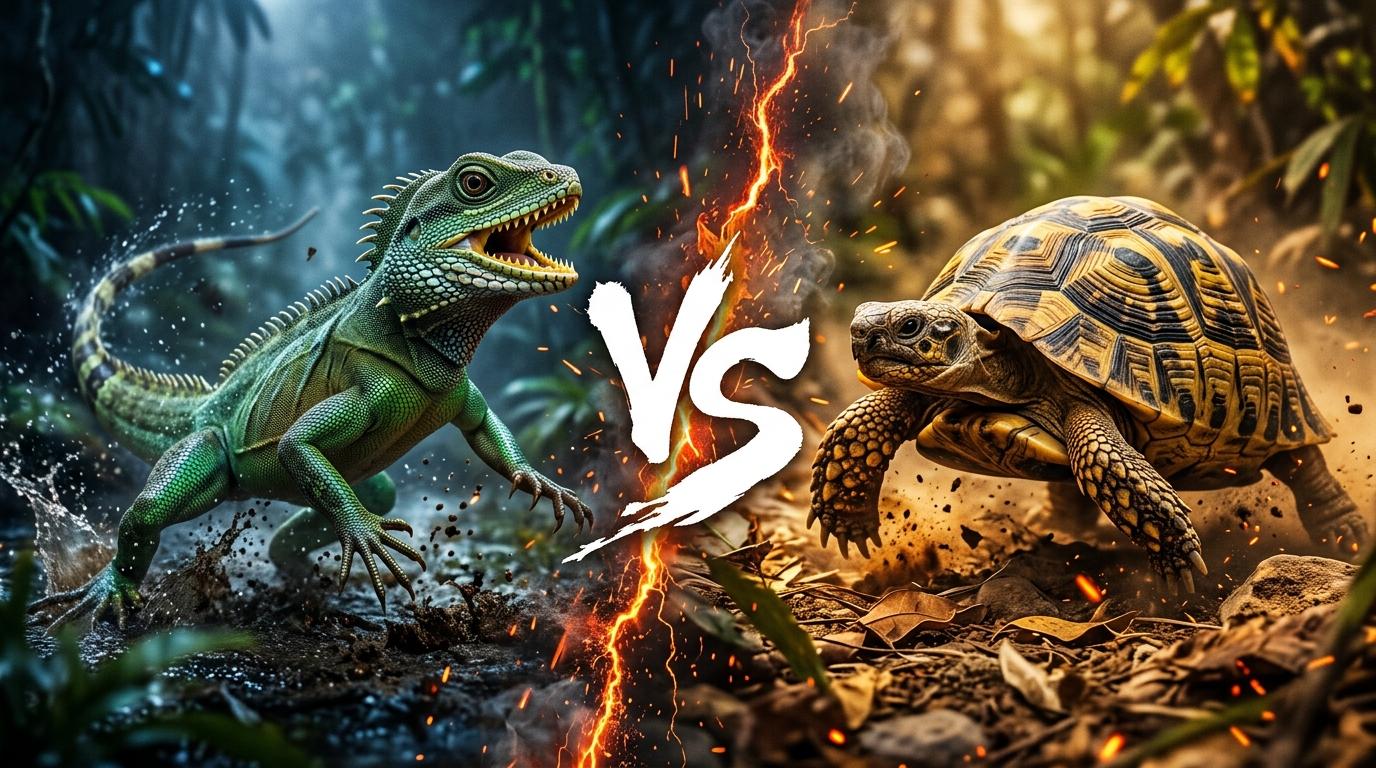
Chinese Water Dragon vs Elongated Tortoise: Who Actually Wins?
Chinese water dragon vs elongated tortoise: speed, bite, armor and behavior compared to decide who would win and why the tortoise is so hard to beat.
Chinese Water Dragon vs Elongated Tortoise
Matchup winner
Chinese Water Dragon
Quick verdict
Start with the direct answer, then use the structured comparison below to see what changes the outcome.
The Chinese water dragon wins overall, but only because it can control the encounter rather than overpower the tortoise. Physignathus cocincinus is a fast, alert agamid lizard that reaches roughly 60–90 cm with most of that length in tail. It has sharp claws, a respectable bite, quick reflexes and an escape-to-water reflex that lets it decide when contact starts and ends. The elongated tortoise (Indotestudo elongata) is a slow, armored forest-floor grazer of about 25–33 cm shell length. Its domed carapace and retractable limbs make it nearly impossible for a dragon-sized lizard to injure. Neither animal can realistically hurt the other badly, so this is a contest of control. The dragon wins on initiative, mobility and nerve. The tortoise wins only in the narrow sense that it cannot be beaten into submission.
Read the full explanation
Overall winner: the Chinese water dragon, through speed, reflexes and control of the encounter.
The tortoise's shell makes it almost immune to the dragon's bite and claws, so neither animal can score a real kill.
The dragon decides when to engage, posture or leave. The tortoise can only endure or slowly withdraw.
In a shoving contest over food, a heavy tortoise can bulldoze a dragon that commits to holding ground.
Reader vote
Who do you think wins?
Pick a side — no account needed. Results update live.
No votes yet — be the first to call it.
Editorial note
Why people disagree
Armor vs offense: some readers count 'can't be hurt' as winning, while others say the animal that controls the fight wins.
Explosive power
Burst speed lets the dragon strike first or disengage at will, which is the core of its win.
Close-range durability
The tortoise can absorb anything a lizard this size dishes out, which is why the dragon never wins by damage.
Weaponry
The dragon has real tools for deterrence. The tortoise's beak is a feeding device first.
Read the full explanation +
Size confusion: dragon length is mostly tail, and a mature tortoise often outweighs it.
Real ecology: these species rarely clash, since one is an arboreal riverbank hunter and the other a ground-dwelling forager, so any 'fight' is really posturing.
Comparison FAQ
Short, direct answers to the next questions readers usually ask after the headline verdict.
Would a Chinese water dragon beat an elongated tortoise?+
Yes, overall. The dragon controls the encounter with speed, displays and escape options. It cannot meaningfully injure an adult tortoise, though.
Which is stronger, a Chinese water dragon or an elongated tortoise?+
For raw pushing strength and mass, the tortoise is stronger. The dragon is far quicker and better armed with claws and teeth.
Can a Chinese water dragon hurt a tortoise?+
Not seriously. Its bite and claws can't penetrate the shell, and the tortoise pulls in its head and limbs when threatened.
Why is the elongated tortoise still dangerous in this matchup?+
Its jaws can deliver a firm bite to a careless toe or tail. Its weight lets it shove a lighter lizard off food, and its armor means the dragon can never 'finish' the contest.
Do these animals meet in the wild?+
Their Southeast Asian ranges overlap, but their habitats differ. Dragons favor riverbanks and trees, while tortoises forage on the forest floor. Encounters are rare and usually involve avoidance.
Head-to-head species stats
These are the same core AnimalDex stat dimensions used on the dedicated animal pages, pulled side by side so the matchup is faster to scan.
Chinese Water Dragon
Tier CElongated Tortoise
Tier CTrait-by-trait comparison
Only the categories that matter to this matchup are included. The goal is not filler stats, but the real design differences that change the result.
Fast sprints, leaps and lunges
Explosive power
Chinese Water Dragon
Slow, steady pushing force
Explosive power
Chinese Water Dragon
Scaly but soft-bodied
Close-range durability
Elongated Tortoise
Domed bony shell, retractable limbs
Close-range durability
Elongated Tortoise
Sharp claws, gripping bite, whipping tail
Weaponry
Chinese Water Dragon
Beak-like jaws, scaly forelimbs
Weaponry
Chinese Water Dragon
Keen vision, parietal eye, fast reaction
Threat awareness
Chinese Water Dragon
Moderate senses, slow response
Threat awareness
Chinese Water Dragon
Light, long-bodied
Mass and leverage
Elongated Tortoise
Dense, low center of gravity
Mass and leverage
Elongated Tortoise
Climbing, swimming, diving
Escape routes
Chinese Water Dragon
Shell withdrawal only
Escape routes
Chinese Water Dragon
How the verdict forms
Verdict timeline
01 · Explosive power
Chinese Water Dragon
02 · Close-range durability
Elongated Tortoise
03 · Weaponry
Chinese Water Dragon
04 · Threat awareness
Chinese Water Dragon
05 · Mass and leverage
Elongated Tortoise
06 · Escape routes
Chinese Water Dragon
Change the conditions
Scenario breakdown
This is where shallow battle content usually fails. Terrain, spacing, timing, and engagement style can change the answer.
Scenario lean
Chinese Water Dragon
Verdict confidence
82%
The dragon owns the vertical space and the timing.
In dense riverside vegetation the water dragon can climb, perch and approach on its own terms. The tortoise cannot follow or threaten it from below. The dragon wins by controlling engagement, though it gains little by attacking the shell.
AnimalDex field profiles
Explore these animals
Chinese Water Dragon
Physignathus cocincinus
riverbank forest, humid ravine, and subtropical woodland
Elongated Tortoise
Indotestudo elongata
forest, bamboo thicket, and monsoon woodland
Systems Intelligence & Hidden Purpose
See the animals behind this comparison as engineered biological systems: what each one is built to do, where it gains leverage, and why the matchup changes by scenario.
Specialized Hardware
bright green streamside body, long balancing tail, and water-diving escape behavior give the Chinese Water Dragon a body plan tuned for its niche.
Systems Script
Chinese Water Dragons operate through riverbank forest, humid ravine, and subtropical woodland. Their design links movement, feeding, shelter, and timing into one workable survival system.
Strategic Insight
Dense environments reward precision, patience, and the ability to read layered cover.
Specialized Hardware
stretched yellow-brown shell, strong forest-floor legs, and leaf-and-fruit browsing give the Elongated Tortoise a body plan tuned for its niche.
Systems Script
Elongated Tortoises operate through forest, bamboo thicket, and monsoon woodland. Their design links movement, feeding, shelter, and timing into one workable survival system.
Strategic Insight
Dense environments reward precision, patience, and the ability to read layered cover.
Final take
The Chinese water dragon is the overall winner, but it wins like a skilled fencer against a locked vault. It controls distance, timing and territory, and the tortoise cannot do much about it.
Read the full explanation
The elongated tortoise is not a loser in any meaningful survival sense. Its shell turns the dragon's weapons into noise, and its patience can win food contests outright. Victory here means initiative, and that belongs to the dragon.
Collect both animals in AnimalDex
Track the species behind this matchup, compare their real traits, and build the rivalry into your AnimalDex collection.
Related comparisons
Continue with nearby matchups to compare more real-world animal traits without dropping into junky who-wins filler.
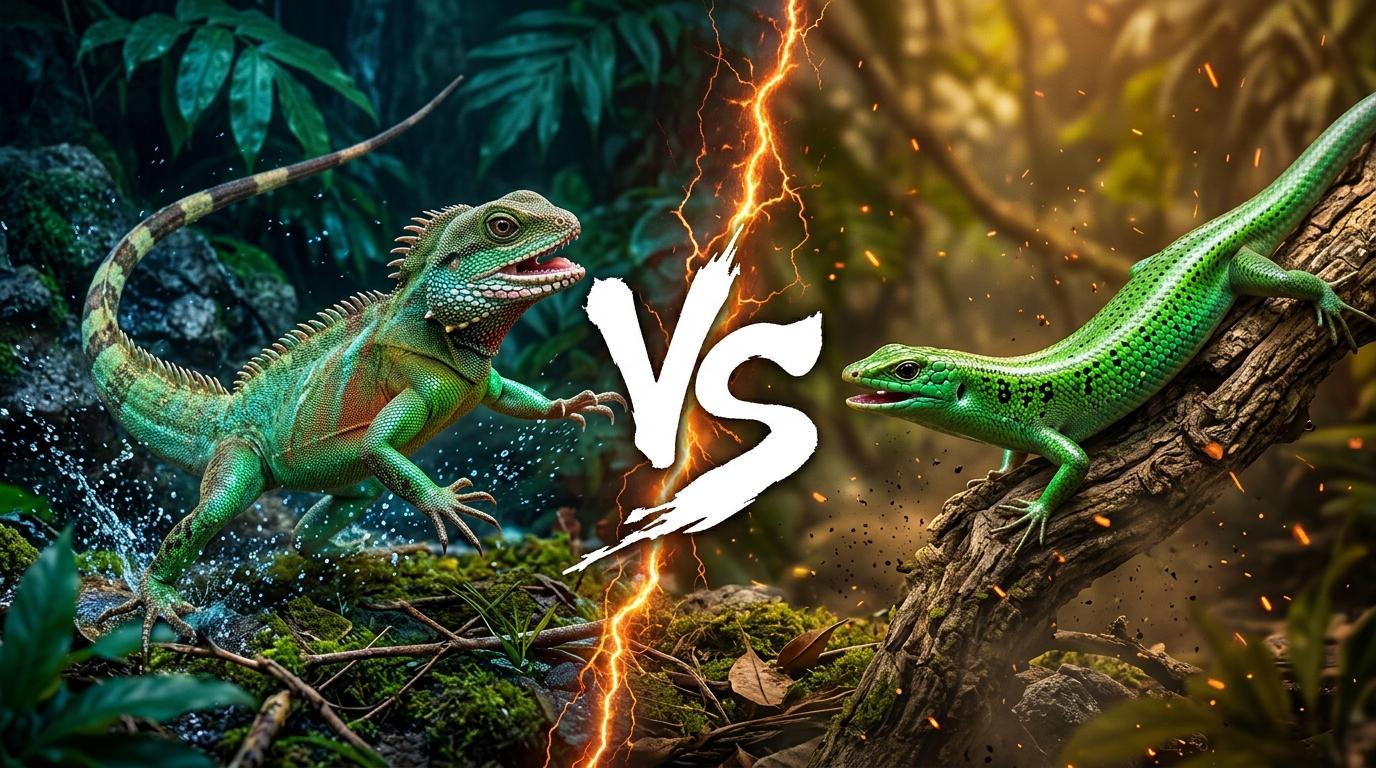
Chinese Water Dragon vs Emerald Tree Skink: Who Actually Wins?
The Chinese water dragon wins, and it isn't close in a straight confrontation. A big male dragon can reach about 90 cm long and outweighs an emerald tree skink many times over. The skink is a slim canopy lizard of roughly 20–25 cm. The dragon has a broad head, strong jaws, sturdy limbs, and a crested, muscular frame built for riverbank scrambles, swimming, and seizing live prey, including small vertebrates. The skink is a sleek, smooth-scaled insect hunter whose real strengths are agility, grip on bark, and getting away fast. Wherever the two meet on the ground, on the riverbank, or over a shared basking spot, the dragon's size and bite decide it. The skink's one dependable result is not losing: in a tangle of thin branches it can climb, dodge, and drop its tail to escape.
Read comparison
Discussion
What do you think?
Share your reasoning with other readers. Be civil and stick to the animals.
Sign in to join the discussion.
Sign inNo comments yet. Start the conversation.