

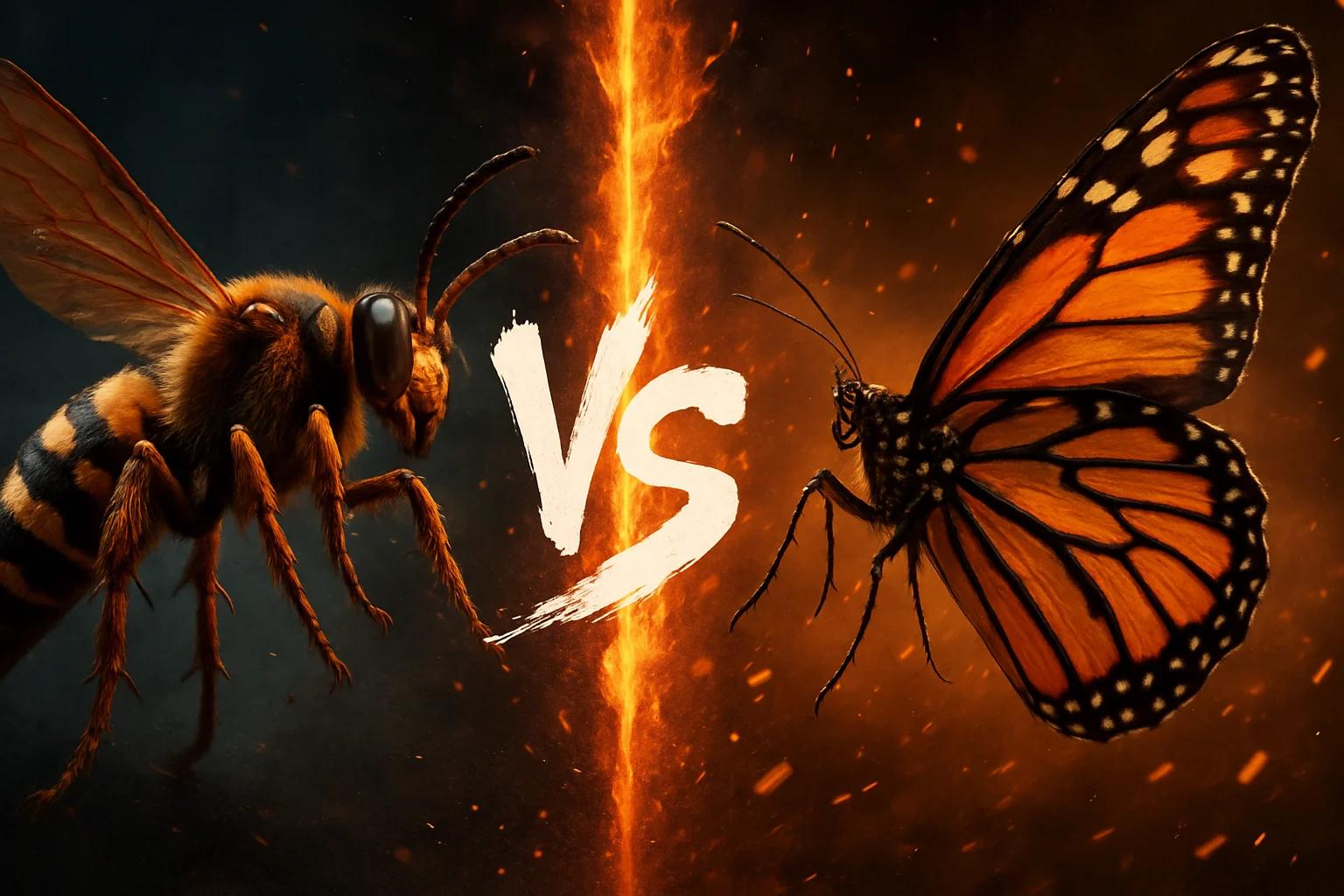
Cicada Killer Wasp vs Monarch Butterfly: Who Actually Wins?
Cicada killer wasp vs monarch butterfly: a biology-first breakdown of weapons, chemical defense, flight, and who wins a real encounter.
Cicada Killer Wasp vs Monarch Butterfly
Matchup winner
Cicada Killer Wasp
Quick verdict
Start with the direct answer, then use the structured comparison below to see what changes the outcome.
The cicada killer wasp wins clearly. It is a heavy-bodied, 3–5 cm hunting wasp with powerful flight muscles, grasping legs, strong mandibles, and, in females, a paralyzing sting built to subdue cicadas several times its own mass. The monarch has none of that hardware. It has no bite, no sting, and no grip. Its real weapon is chemistry: the cardenolide toxins it stores from milkweed. Those toxins punish vertebrate predators like birds that eat it, but they do nothing to stop a wasp that overpowers it physically. Cicada killers don't hunt butterflies, so a real encounter is rare. Forced into a contest, though, the wasp controls the outcome by a wide margin, and the monarch's best result is simply escaping.
Read the full explanation
Cicada killer wasp wins. It has a sting, mandibles, grip strength, and more muscular flight.
The monarch has no physical weapons. Its defense is milkweed toxin that works on predators that eat it.
Cicada killers hunt cicadas, not butterflies, so this is a hypothetical matchup.
The monarch's only winning outcome is to disengage and glide away.
Reader vote
Who do you think wins?
Pick a side — no account needed. Results update live.
No votes yet — be the first to call it.
Editorial note
Why people disagree
Monarchs are famously 'poisonous,' so some readers assume that makes them dangerous in a fight. Their toxins deter eating, not grappling.
Offensive weaponry
Only one side can actually injure the other.
Grapple control
A wasp that can carry a cicada in flight can easily pin a butterfly.
Flight power
In a chase over short distances, the wasp's power output dominates.
Read the full explanation +
Cicada killers look terrifying, but they are docile toward people and don't target butterflies. That makes the matchup feel unnatural.
Monarchs make one of the longest migrations of any insect, which reads as toughness. Endurance is not the same as fighting ability.
Comparison FAQ
Short, direct answers to the next questions readers usually ask after the headline verdict.
Would a cicada killer wasp beat a monarch butterfly?+
Yes, decisively. The wasp's sting, mandibles, and grasping legs give it complete control. The monarch has no physical weapons.
Which is stronger, a cicada killer or a monarch?+
The cicada killer, by far. It can fly while carrying a paralyzed cicada heavier than itself, which is a feat a monarch can't come close to.
Do cicada killers hunt monarch butterflies?+
No. Females provision their nests almost exclusively with cicadas. This matchup is hypothetical.
Why is the monarch still dangerous if it loses?+
Its body stores milkweed cardenolides that can sicken birds and other vertebrates that eat it. This teaches predators to avoid its orange-and-black pattern. The danger is to anything that eats it, not to an insect it fights.
Is the cicada killer dangerous to people?+
Rarely. Males can't sting, and females are docile unless they are handled or pressed against the skin.
Head-to-head species stats
These are the same core AnimalDex stat dimensions used on the dedicated animal pages, pulled side by side so the matchup is faster to scan.
Cicada Killer Wasp
Tier DMonarch Butterfly
Tier CTrait-by-trait comparison
Only the categories that matter to this matchup are included. The goal is not filler stats, but the real design differences that change the result.
Paralyzing sting (females), strong mandibles
Offensive weaponry
Cicada Killer Wasp
None. Proboscis only
Offensive weaponry
Cicada Killer Wasp
Spined legs built to clamp and carry large cicadas
Grapple control
Cicada Killer Wasp
Delicate legs suited to perching
Grapple control
Cicada Killer Wasp
Fast, muscular, maneuverable bursts
Flight power
Cicada Killer Wasp
Efficient soaring and gliding, slower bursts
Flight power
Cicada Killer Wasp
Short foraging trips near the burrow
Endurance flight
Monarch Butterfly
Migrates thousands of kilometers
Endurance flight
Monarch Butterfly
Venom used for offense
Chemical defense
Monarch Butterfly
Cardenolide toxins stored from milkweed
Chemical defense
Monarch Butterfly
Hard, sturdy exoskeleton
Close-range durability
Cicada Killer Wasp
Fragile wings and a soft body
Close-range durability
Cicada Killer Wasp
How the verdict forms
Verdict timeline
01 · Offensive weaponry
Cicada Killer Wasp
02 · Grapple control
Cicada Killer Wasp
03 · Flight power
Cicada Killer Wasp
04 · Endurance flight
Monarch Butterfly
05 · Chemical defense
Monarch Butterfly
06 · Close-range durability
Cicada Killer Wasp
Change the conditions
Scenario breakdown
This is where shallow battle content usually fails. Terrain, spacing, timing, and engagement style can change the answer.
Scenario lean
Cicada Killer Wasp
Verdict confidence
82%
The wasp pins and stings.
At rest, a monarch relies on stillness and its warning colors. Neither defense stops an insect that hunts by grappling. The wasp's grasping legs and sting finish the contest before the butterfly can open its wings.
AnimalDex field profiles
Explore these animals
Cicada Killer Wasp
Sphecius speciosus
sandy soil, meadow, and open woodland edge
Monarch Butterfly
Danaus plexippus
Meadow, garden, field edge, migration corridor, and overwintering woodland depending on season.
Systems Intelligence & Hidden Purpose
See the animals behind this comparison as engineered biological systems: what each one is built to do, where it gains leverage, and why the matchup changes by scenario.
Specialized Hardware
large amber-winged body, powerful cicada-hauling flight, and burrow-provisioning hunting give the Cicada Killer Wasp a body plan tuned for its niche.
Systems Script
Cicada Killer Wasps operate through sandy soil, meadow, and open woodland edge. Their design links movement, feeding, shelter, and timing into one workable survival system.
Strategic Insight
Dense environments reward precision, patience, and the ability to read layered cover.
Specialized Hardware
Long-distance flight efficiency, sun-compass orientation, and milkweed-linked chemical defense make monarchs migration hardware spread across multiple life stages.
Systems Script
Monarchs stitch continents together through pollination, herbivory, and migration timing. Their life cycle demonstrates that a system can exceed one lifespan if the rules persist across generations.
Strategic Insight
You can build long-range continuity when each stage inherits direction, not just momentum.
Final take
This is a mismatch in fighting hardware. The cicada killer wasp is a specialized hunter of large insects, with venom, grip, and power. The monarch butterfly is a specialist in surviving vertebrate predators through toxins, warning colors, and endurance.
Read the full explanation
In any direct contest, the wasp wins decisively. The monarch's strengths are real, but they are aimed at birds and at long-distance migration, not at insect-on-insect combat.
Collect both animals in AnimalDex
Track the species behind this matchup, compare their real traits, and build the rivalry into your AnimalDex collection.
Related comparisons
Continue with nearby matchups to compare more real-world animal traits without dropping into junky who-wins filler.
Monarch Butterfly vs Red Velvet Ant: Who Actually Wins?
The red velvet ant wins clearly. In any situation where the two actually make contact, the outcome favors the velvet ant. It is a female wasp in an ant's costume. Her body is wrapped in one of the hardest, most crush-resistant exoskeletons among insects, and she carries a long, maneuverable stinger. She also has strong mandibles and a temperament tuned to push through confrontations rather than flee them. The monarch is a fragile nectar-feeder with no weapons. Its defense is chemical and deferred: cardenolide toxins taken in from milkweed as a caterpillar, which punish vertebrate predators like birds after they bite, not before. Those toxins do almost nothing to deter an armored wasp that isn't trying to eat it. The monarch's one real edge is flight. That means the butterfly can avoid the fight, but it cannot win it.
Read comparison
Cicada Killer Wasp vs Zebra Swallowtail: Who Actually Wins?
The Cicada Killer Wasp wins clearly. It is one of North America's largest wasps, built around a paralytic stinger, strong grasping legs, and the flight power to carry a cicada heavier than itself. The Zebra Swallowtail has no weapon at all. Its defenses are a fast, erratic, gliding flight and a body made mildly distasteful by compounds from pawpaw leaves eaten as a caterpillar. Those traits help against birds that learn to avoid bad-tasting prey. They do not help against an armored, venom-equipped insect in direct contact. The butterfly's only real path to 'winning' is never being caught, and in fact the two rarely interact, because cicada killers hunt cicadas, not butterflies. In any forced confrontation, the wasp controls the outcome.
Read comparison
Discussion
What do you think?
Share your reasoning with other readers. Be civil and stick to the animals.
Sign in to join the discussion.
Sign inNo comments yet. Start the conversation.