

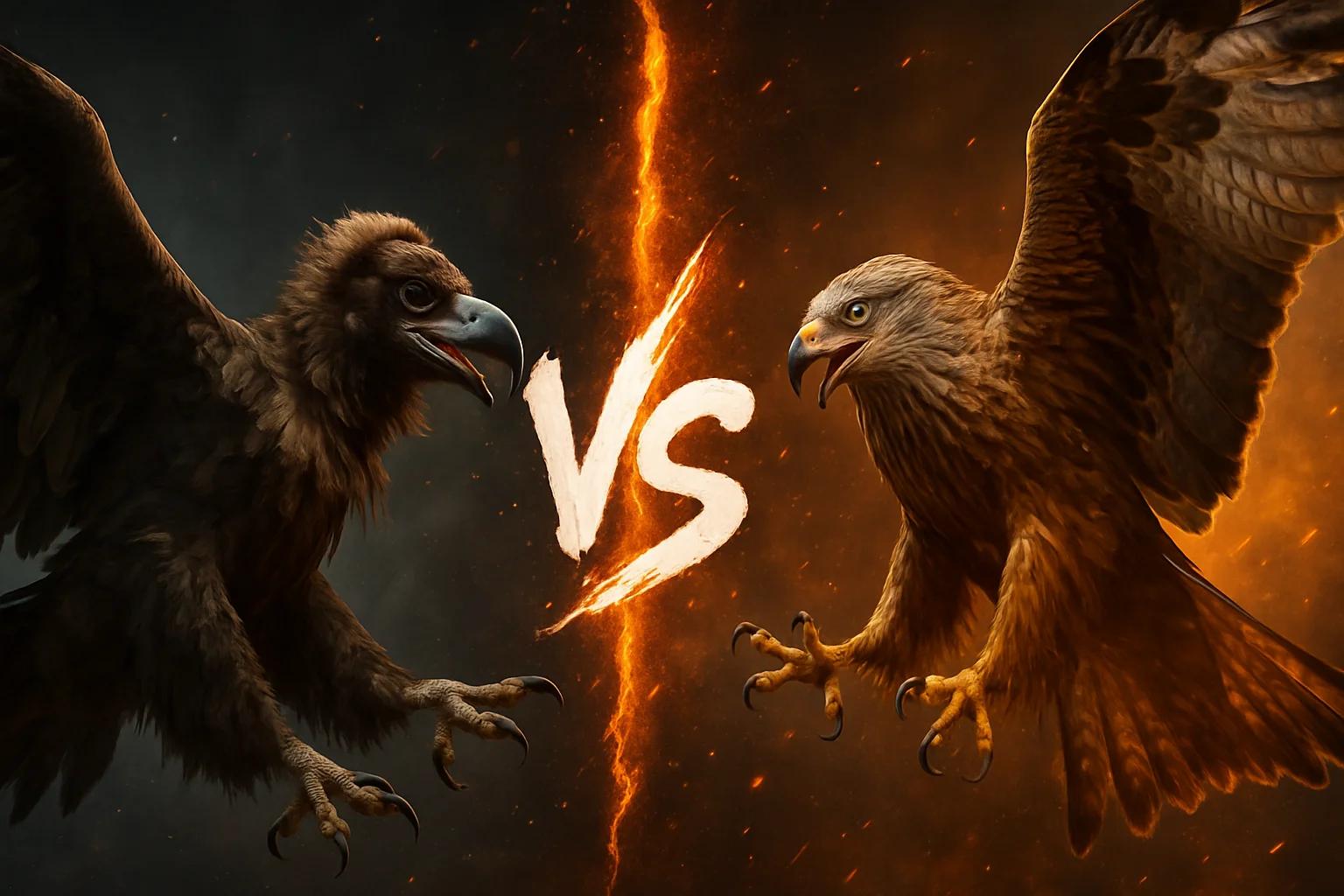
Cinereous Vulture vs Red Kite: Who Actually Wins?
Cinereous vulture vs red kite: Eurasia's heaviest raptor faces Europe's most agile scavenger-hunter. See the size, strength, and carcass-dominance facts behind the winner.
Cinereous Vulture vs Red Kite
Matchup winner
Cinereous Vulture
Quick verdict
Start with the direct answer, then use the structured comparison below to see what changes the outcome.
The cinereous vulture wins, and it is not especially close in any contest that comes down to contact. At roughly 7–12 kg with a wingspan near 2.5–3 m, Aegypius monachus outweighs the red kite (about 0.8–1.3 kg, 1.5–1.8 m span) by close to ten to one. It also carries a massive hooked bill built to tear hide and tendon. At carcasses it sits at the top of the scavenger pecking order, displacing griffons, eagles, and kites alike. The red kite's real weapons are evasion, aerial agility, and opportunism. Those skills let it snatch scraps and escape trouble, but they cannot shift a bird that heavy. In any realistic confrontation the kite yields, and if it pressed the issue it would risk serious injury.
Read the full explanation
Cinereous vulture wins: it is about 8–10x heavier, with a far more powerful bill.
Vultures routinely dominate kites at carcasses. This is observed behavior, not theory.
The red kite's edge is maneuverability. It can dodge, steal, and leave, but it cannot win contact.
Overall confidence: very high in the vulture's favor.
Reader vote
Who do you think wins?
Pick a side — no account needed. Results update live.
No votes yet — be the first to call it.
Editorial note
Why people disagree
Kites look like 'real' predators with talons and hunting dives, so people assume a hunter beats a scavenger. But the vulture's sheer mass overrides hunting style.
Raw mass and frame
In bird conflicts, body mass decides who displaces whom. A tenfold gap is decisive.
Bill and tearing power
The vulture's main weapon can injure a kite, while the kite's bill cannot meaningfully damage the vulture.
Aerial agility
This lets the kite dodge, harass, and escape, but it does not translate into a win.
Read the full explanation +
The red kite is far more agile in the air, and agility looks like dominance in video clips of mid-air harassment.
Vultures are seen as passive birds, which hides how aggressively cinereous vultures enforce rank at a carcass.
Comparison FAQ
Short, direct answers to the next questions readers usually ask after the headline verdict.
Would a cinereous vulture beat a red kite?+
Yes. The vulture's huge size and powerful bill give it a decisive advantage in any physical confrontation.
Which bird is stronger?+
The cinereous vulture, by a wide margin. It is one of the heaviest flying birds in Eurasia and roughly eight to ten times the kite's weight.
Why is the red kite still dangerous?+
Its speed, sharp talons, and aerial agility let it harass birds, steal food, and escape threats. A vulture can't easily catch it in the air.
Do they actually meet in the wild?+
Yes. They overlap in parts of Spain, where both may gather at carcasses and feeding stations. There, kites typically give way to vultures.
Head-to-head species stats
These are the same core AnimalDex stat dimensions used on the dedicated animal pages, pulled side by side so the matchup is faster to scan.
Cinereous Vulture
Tier ARed Kite
Tier BTrait-by-trait comparison
Only the categories that matter to this matchup are included. The goal is not filler stats, but the real design differences that change the result.
7–12 kg, ~2.7 m wingspan
Raw mass and frame
Cinereous Vulture
0.8–1.3 kg, ~1.7 m wingspan
Raw mass and frame
Cinereous Vulture
Massive hooked bill that rips hide and sinew
Bill and tearing power
Cinereous Vulture
Light hooked bill suited to small prey and scraps
Bill and tearing power
Cinereous Vulture
Slow, soaring glider built for efficiency
Aerial agility
Red Kite
Forked-tail acrobat with tight turns
Aerial agility
Red Kite
Top of the Eurasian scavenger hierarchy
Carcass rank enforcement
Cinereous Vulture
Peripheral scrap thief
Carcass rank enforcement
Cinereous Vulture
Specialist on large carcasses
Opportunistic flexibility
Red Kite
Generalist that hunts, scavenges, and steals
Opportunistic flexibility
Red Kite
How the verdict forms
Verdict timeline
01 · Raw mass and frame
Cinereous Vulture
02 · Bill and tearing power
Cinereous Vulture
03 · Aerial agility
Red Kite
04 · Carcass rank enforcement
Cinereous Vulture
05 · Opportunistic flexibility
Red Kite
Change the conditions
Scenario breakdown
This is where shallow battle content usually fails. Terrain, spacing, timing, and engagement style can change the answer.
Scenario lean
Cinereous Vulture
Verdict confidence
82%
The vulture owns the food.
At a carcass, mass and threat displays set the order. Cinereous vultures spread their wings, lunge, and claim the best feeding position. Kites wait at the edges and dart in for scraps. Field observations consistently show kites yielding to large vultures.
AnimalDex field profiles
Explore these animals
Cinereous Vulture
Aegypius monachus
mountain, steppe, and dry open country
Red Kite
Milvus milvus
farmland, meadow, and open woodland
Systems Intelligence & Hidden Purpose
See the animals behind this comparison as engineered biological systems: what each one is built to do, where it gains leverage, and why the matchup changes by scenario.
Specialized Hardware
massive dark soaring wings, bare blue-gray head, and high cliff nesting give the Cinereous Vulture a body plan tuned for its niche.
Systems Script
Cinereous Vultures operate through mountain, steppe, and dry open country. Their design links movement, feeding, shelter, and timing into one workable survival system.
Strategic Insight
Harsh places reward efficiency, timing, and bodies that waste very little.
Specialized Hardware
forked tail, russet body sheen, and effortless scavenging and mouse-hunting glide give the Red Kite a body plan tuned for its niche.
Systems Script
Red Kites operate through farmland, meadow, and open woodland. Their design links movement, feeding, shelter, and timing into one workable survival system.
Strategic Insight
Dense environments reward precision, patience, and the ability to read layered cover.
Final take
The cinereous vulture is the clear winner. Its mass, bill power, and established dominance at carcasses decide every contact-based scenario. Biology here is blunt: a ten-kilogram scavenger built to tear open large carcasses outranks a one-kilogram opportunist.
Read the full explanation
The red kite's genius is avoiding that contest entirely. Its agility and flexibility make it one of Europe's great survivors. It succeeds by never needing to beat the vulture, only to slip past it.
Collect both animals in AnimalDex
Track the species behind this matchup, compare their real traits, and build the rivalry into your AnimalDex collection.
Discussion
What do you think?
Share your reasoning with other readers. Be civil and stick to the animals.
Sign in to join the discussion.
Sign inNo comments yet. Start the conversation.