

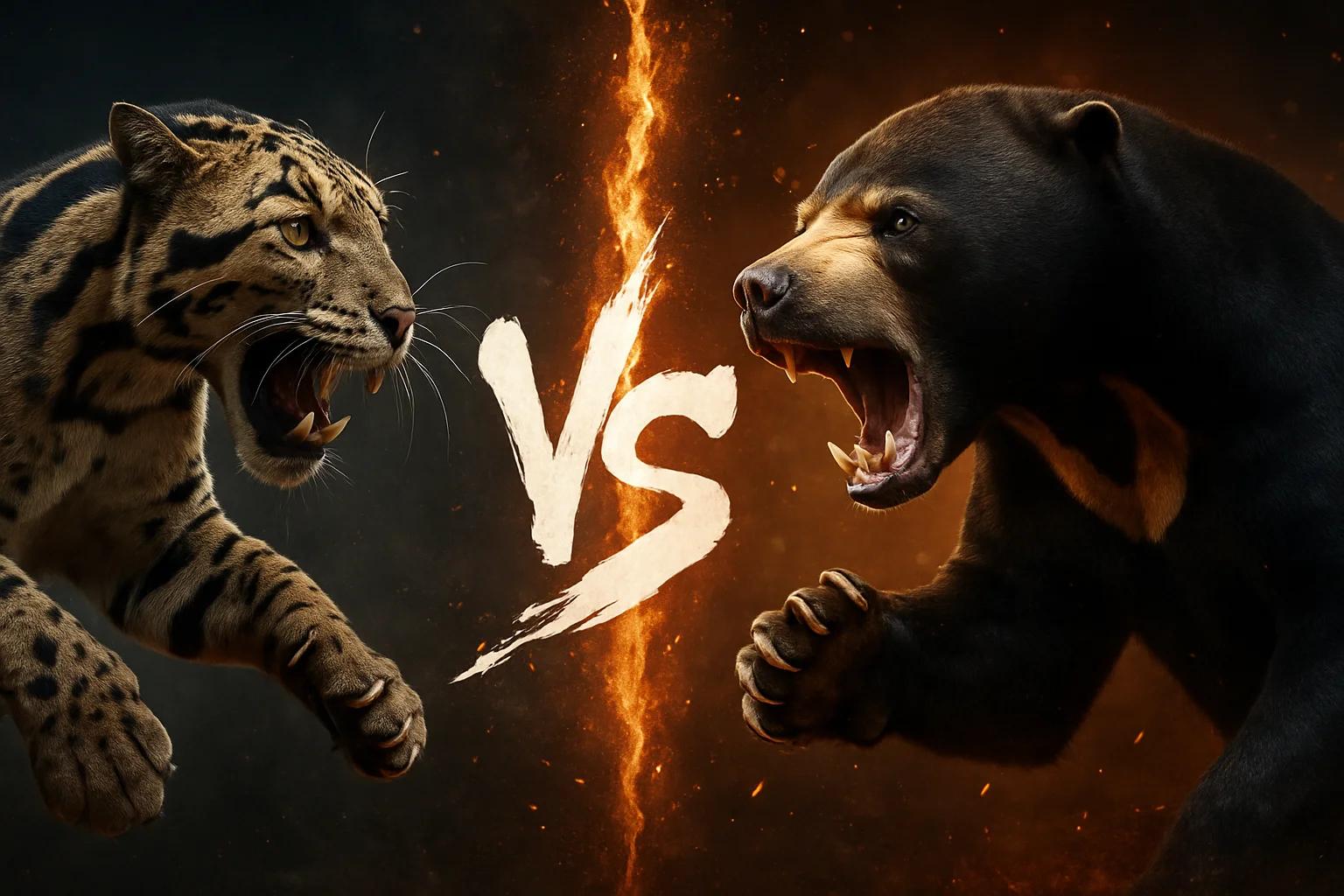
Clouded Leopard vs Sun Bear: Who Actually Wins?
Clouded leopard vs sun bear: who would win? We compare size, canines, claws, loose skin and fighting style in Southeast Asian forests to give a clear, biology-based verdict.
Clouded Leopard vs Sun Bear
Matchup winner
Sun Bear
Quick verdict
Start with the direct answer, then use the structured comparison below to see what changes the outcome.
The sun bear wins. The clouded leopard has the longest canines relative to skull size of any living cat and some of the best climbing hardware in the cat family, but the animals sit in different weight classes. A typical adult clouded leopard weighs about 11–23 kg. An adult sun bear usually weighs 27–65 kg, and big males can be heavier. The bear also brings a defensive kit built to cancel a cat's attack. Loose, thick skin lets it twist and bite back even when grabbed by the neck. Its 8–10 cm claws are built for tearing open hardwood. Its short, powerful jaws crack termite mounds and tree trunks. A clouded leopard's main weapon is the precise throat or nape bite, and that is exactly what the sun bear's anatomy is built to survive. The cat could win a surprise strike on a cub or a sick bear. In a fair encounter between healthy adults, the bear's mass, armor-like hide and refusal to back down decide the fight.
Read the full explanation
Sun bear wins most realistic adult encounters, mainly because it is 2–3 times heavier.
Clouded leopard has elite canines and unmatched tree agility, but its killing bite is aimed at prey smaller than an adult bear.
Sun bear's loose skin and long claws punish a cat that latches on.
The cat's best chance is ambush from the canopy or a young or weakened bear.
Reader vote
Who do you think wins?
Pick a side — no account needed. Results update live.
No votes yet — be the first to call it.
Editorial note
Why people disagree
Stats and size charts look close because the sun bear is the smallest bear. People forget the smallest bear still outweighs a clouded leopard by a wide margin.
Body mass & frame
Mass decides who can control the other's body. The bear can pin and shove, while the cat struggles to anchor a much heavier opponent.
Bite weaponry
The cat has the more surgical killing bite. That is its only clear weapon edge and the reason it stays dangerous.
Claw damage
Sun bear claws are meant to rip into hardwood. In close quarters they slash and hold rather than just grip.
Read the full explanation +
Clouded leopards get the 'saber-tooth' reputation. Long canines are great for killing deer and monkeys, but they do not cancel a mass and armor gap.
Both are shy, rarely seen rainforest animals with almost no documented fights, so people fill the gap with intuition instead of anatomy.
Comparison FAQ
Short, direct answers to the next questions readers usually ask after the headline verdict.
Would a clouded leopard beat a sun bear?+
Usually not. A healthy adult sun bear is two to three times heavier and is built to survive and punish the neck bite a clouded leopard relies on.
Which is stronger, a clouded leopard or a sun bear?+
The sun bear. It has more muscle mass and powerful forelimbs adapted for ripping open trees and termite mounds. The clouded leopard's strength is concentrated in precise bites and climbing.
Who wins a fight between a clouded leopard and a sun bear?+
The sun bear in most realistic scenarios. The clouded leopard can win only with a clean ambush in the trees or against a cub or weakened bear.
Why is the clouded leopard still dangerous to a sun bear?+
Its canines are the longest relative to skull size of any living cat. It can strike from above with surprise and retreat into branches where the bear struggles to follow, so a single bite can still cause serious injury.
Do clouded leopards and sun bears live in the same place?+
Yes. Both live in Southeast Asian tropical forests, though encounters are rare and poorly documented.
Why is a sun bear's loose skin important in a fight?+
When gripped by the neck, a sun bear can twist inside its skin and bite or claw its attacker. This cancels the hold-and-suffocate strategy most cats use.
Head-to-head species stats
These are the same core AnimalDex stat dimensions used on the dedicated animal pages, pulled side by side so the matchup is faster to scan.
Clouded Leopard
Tier BSun Bear
Tier BTrait-by-trait comparison
Only the categories that matter to this matchup are included. The goal is not filler stats, but the real design differences that change the result.
About 11–23 kg, long low body
Body mass & frame
Sun Bear
About 27–65+ kg, compact barrel build
Body mass & frame
Sun Bear
Record canines for its skull size, wide gape
Bite weaponry
Clouded Leopard
Short, powerful jaws built to crush wood and mounds
Bite weaponry
Clouded Leopard
Retractable hooks for grip and climbing
Claw damage
Sun Bear
8–10 cm non-retractable digging claws
Claw damage
Sun Bear
Lean frame, light protection
Close-range durability
Sun Bear
Loose, thick skin that lets it turn inside a bite
Close-range durability
Sun Bear
Rotating ankles, can hang and descend headfirst
Arboreal agility
Clouded Leopard
Strong climber, slower and heavier
Arboreal agility
Clouded Leopard
Stealthy stalker with an opening-strike style
Ambush control
Clouded Leopard
Forager that reacts with sudden aggression
Ambush control
Clouded Leopard
How the verdict forms
Verdict timeline
01 · Body mass & frame
Sun Bear
02 · Bite weaponry
Clouded Leopard
03 · Claw damage
Sun Bear
04 · Close-range durability
Sun Bear
05 · Arboreal agility
Clouded Leopard
06 · Ambush control
Clouded Leopard
Change the conditions
Scenario breakdown
This is where shallow battle content usually fails. Terrain, spacing, timing, and engagement style can change the answer.
Scenario lean
Sun Bear
Verdict confidence
82%
Bear absorbs the strike and overpowers the cat.
Even if the leopard lands a nape bite from cover, the sun bear's loose skin lets it rotate and counterattack. Then the bear's weight, claws and crushing jaws take over. A cat built to subdue 10–30 kg prey cannot hold a thrashing animal this dense.
AnimalDex field profiles
Explore these animals
Clouded Leopard
Neofelis nebulosa
tropical forest, hill forest, and humid canopy cover
Sun Bear
Helarctos malayanus
Tropical lowland forest, hill forest, swamp forest, and forest-edge mosaic.
Systems Intelligence & Hidden Purpose
See the animals behind this comparison as engineered biological systems: what each one is built to do, where it gains leverage, and why the matchup changes by scenario.
Specialized Hardware
cloud-shaped coat markings, large gripping paws, and powerful tree-climbing body give the Clouded Leopard a body plan tuned for its niche.
Systems Script
Clouded Leopards operate through tropical forest, hill forest, and humid canopy cover. Their design links movement, feeding, shelter, and timing into one workable survival system.
Strategic Insight
Dense environments reward precision, patience, and the ability to read layered cover.
Specialized Hardware
Curved claws, long tongue, climbing power, and compact bear build make sun bears excellent hardware for tearing into insect nests, fruit patches, and rotten wood.
Systems Script
Sun bears convert hidden forest resources into usable trophic movement while also dispersing seeds and opening logs. They work the hard-to-access layer of the tropical food system.
Strategic Insight
Value often sits behind a shell, log, or locked box. Build tools for extraction, not just consumption.
Final take
Overall winner: the sun bear. The clouded leopard is an elite ambush predator with world-class canines and climbing ability, but it is specialized for prey smaller than an adult sun bear.
Read the full explanation
The sun bear's hardware is close to a counter-build against cat tactics. It has extra weight, slippery loose skin, long demolition claws and a hair-trigger defensive temper. The cat wins in the canopy or with a perfect surprise strike on a vulnerable bear. Between healthy adults on equal terms, the bear walks away.
Collect both animals in AnimalDex
Track the species behind this matchup, compare their real traits, and build the rivalry into your AnimalDex collection.
Discussion
What do you think?
Share your reasoning with other readers. Be civil and stick to the animals.
Sign in to join the discussion.
Sign inNo comments yet. Start the conversation.