

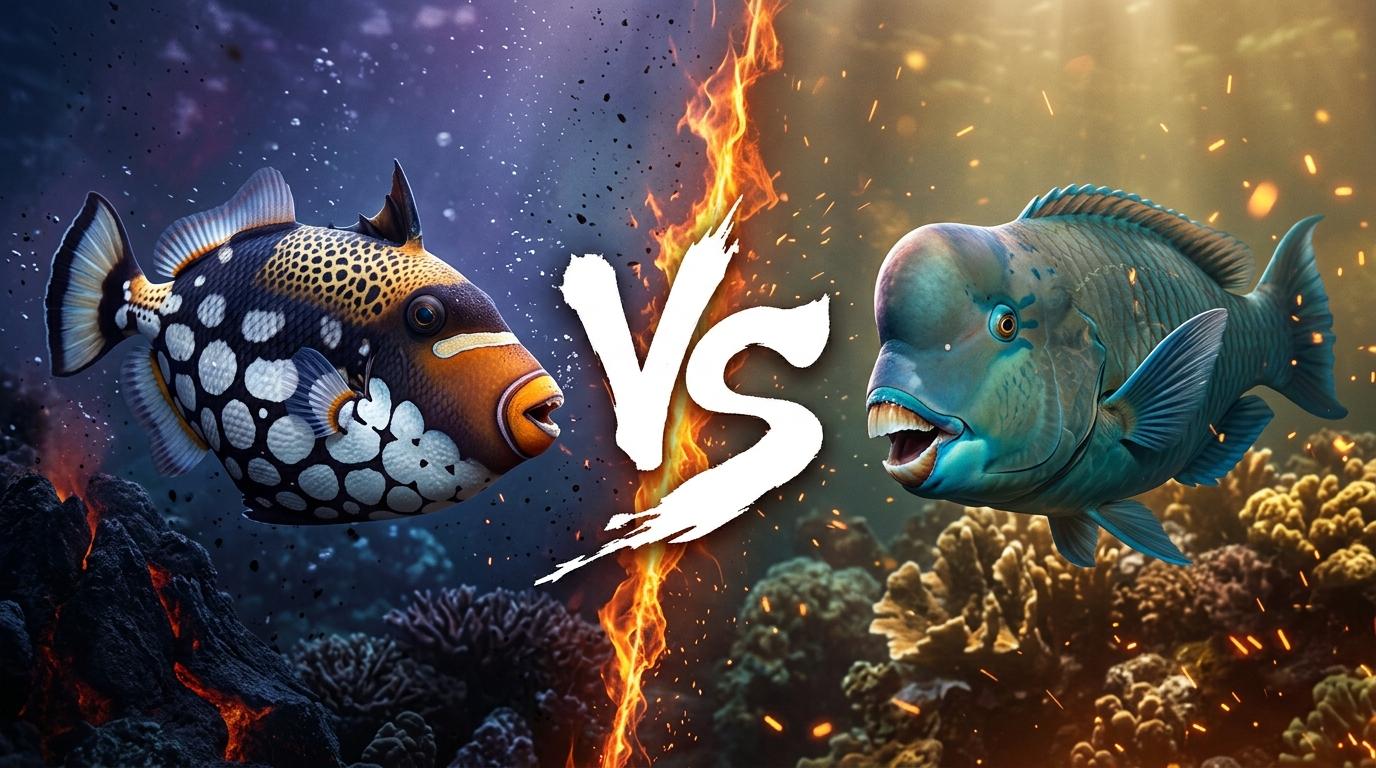
Clown Triggerfish vs Humphead Parrotfish: Who Actually Wins?
Clown triggerfish vs humphead parrotfish: who would win? A biology-first breakdown of jaw power, body mass, reef aggression, and why the bigger grazer takes the overall edge.
Clown Triggerfish vs Humphead Parrotfish
Matchup winner
Humphead Parrotfish
Quick verdict
Start with the direct answer, then use the structured comparison below to see what changes the outcome.
The humphead parrotfish wins this matchup overall. The clown triggerfish is the more aggressive fighter for its size, with crushing jaws built to crack sea urchins and a locking dorsal spine that wedges it into reef crevices. But the humphead parrotfish can exceed a meter in length and weigh over 40 kg, while the triggerfish usually stays under about 50 cm. The parrotfish also has a fused beak that bites chunks out of solid coral and a bony forehead that males use in documented head-ramming contests. A triggerfish can nip fins and defend a hole, but it cannot meaningfully injure a body that large. When the parrotfish commits to a shove or a ram, the size gap decides the contest.
Read the full explanation
Overall winner: Humphead Parrotfish, mostly because it is roughly five to ten times heavier.
The clown triggerfish is the more aggressive and territorial animal, with excellent bite force for its size.
Inside a crevice, the triggerfish's locking spine makes it almost impossible to dislodge.
In open water or a shoving contest, the parrotfish's mass and ramming forehead dominate.
Reader vote
Who do you think wins?
Pick a side — no account needed. Results update live.
No votes yet — be the first to call it.
Editorial note
Why people disagree
Clown triggerfish have a notorious reputation for aggression in aquariums and among divers, so people overrate how much damage they can do to a much larger fish.
Body mass and frame
Between fish this mismatched in size, mass decides most shoving and ramming exchanges.
Crushing bite
Both bites are formidable. The parrotfish's beak works on rock-hard coral at a much larger scale.
Territorial aggression
The triggerfish starts more fights and presses them harder, but willingness to fight cannot replace size.
Read the full explanation +
The humphead parrotfish is a peaceful grazer, and its lack of predatory behavior hides how much physical force it can produce.
Most real reef encounters end with the triggerfish holding its territory and the parrotfish simply moving on, which looks like a triggerfish win but is really avoidance.
Comparison FAQ
Short, direct answers to the next questions readers usually ask after the headline verdict.
Would a clown triggerfish beat a humphead parrotfish?+
Usually not. It can hold a crevice and nip fins, but the parrotfish's much larger size wins in open fights and direct clashes.
Which is stronger, a clown triggerfish or a humphead parrotfish?+
The humphead parrotfish is far stronger in absolute terms. It is much heavier and its beak can bite through solid coral.
Why is the clown triggerfish still dangerous?+
It is very aggressive, its jaws can crack shells and urchins, and its locking dorsal spine makes it almost impossible to dislodge from cover.
Do these fish actually fight in the wild?+
Serious fights between them are rare. Triggerfish defend their territory, and parrotfish generally move on rather than escalate.
Head-to-head species stats
These are the same core AnimalDex stat dimensions used on the dedicated animal pages, pulled side by side so the matchup is faster to scan.
Clown Triggerfish
Tier CHumphead Parrotfish
Tier CTrait-by-trait comparison
Only the categories that matter to this matchup are included. The goal is not filler stats, but the real design differences that change the result.
Up to ~50 cm, compact and armored
Body mass and frame
Humphead Parrotfish
Over 1 m, 40+ kg, bulky
Body mass and frame
Humphead Parrotfish
Strong jaws that crack urchins and shells
Crushing bite
Humphead Parrotfish
Fused beak that bites chunks out of coral
Crushing bite
Humphead Parrotfish
Bold, persistent, quick to charge
Territorial aggression
Clown Triggerfish
Mostly calm, aggressive mainly between rival males
Territorial aggression
Clown Triggerfish
Tough scaled skin plate
Close-range durability
Humphead Parrotfish
Thick body, bony forehead hump
Close-range durability
Humphead Parrotfish
Dorsal spine locks it into holes
Crevice anchoring
Clown Triggerfish
Too large for most reef crevices
Crevice anchoring
Clown Triggerfish
Agile over short bursts
Reef cruising
Humphead Parrotfish
Steady, powerful long-range swimmer
Reef cruising
Humphead Parrotfish
How the verdict forms
Verdict timeline
01 · Body mass and frame
Humphead Parrotfish
02 · Crushing bite
Humphead Parrotfish
03 · Territorial aggression
Clown Triggerfish
04 · Close-range durability
Humphead Parrotfish
05 · Crevice anchoring
Clown Triggerfish
06 · Reef cruising
Humphead Parrotfish
Change the conditions
Scenario breakdown
This is where shallow battle content usually fails. Terrain, spacing, timing, and engagement style can change the answer.
Scenario lean
Clown Triggerfish
Verdict confidence
82%
The triggerfish holds its hole.
With a crevice at its back, the clown triggerfish raises and locks its dorsal spine and wedges itself in place. The parrotfish cannot reach it or pull it out, and the triggerfish can nip at anything that comes close. The triggerfish cannot win outright here, but it cannot be beaten either.
AnimalDex field profiles
Explore these animals
Clown Triggerfish
Balistoides conspicillum
coral reef, lagoon, and tropical drop-off
Humphead Parrotfish
Bolbometopon muricatum
coral reef slope and lagoon habitat
Systems Intelligence & Hidden Purpose
See the animals behind this comparison as engineered biological systems: what each one is built to do, where it gains leverage, and why the matchup changes by scenario.
Specialized Hardware
bold black body with white spots, yellow snout pattern, and trigger-spine reef defense give the Clown Triggerfish a body plan tuned for its niche.
Systems Script
Clown Triggerfishs operate through coral reef, lagoon, and tropical drop-off. Their design links movement, feeding, shelter, and timing into one workable survival system.
Strategic Insight
In moving water, the best systems use flow, visibility, and depth instead of fighting every current.
Specialized Hardware
bulging forehead, beaklike coral-crushing mouth, and schooling reef grazing give the Humphead Parrotfish a body plan tuned for its niche.
Systems Script
Humphead Parrotfishs operate through coral reef slope and lagoon habitat. Their design links movement, feeding, shelter, and timing into one workable survival system.
Strategic Insight
In moving water, the best systems use flow, visibility, and depth instead of fighting every current.
Final take
The humphead parrotfish wins because reef fights between fish this mismatched are decided by mass, and it has a large advantage in body size, beak strength, and a forehead built for impact.
Read the full explanation
The clown triggerfish is still the more dangerous fighter pound for pound. If it has a crevice to anchor in, it cannot be removed, and its bite punishes anything that gets careless. It loses the overall matchup but would never be an easy opponent.
Collect both animals in AnimalDex
Track the species behind this matchup, compare their real traits, and build the rivalry into your AnimalDex collection.
Related comparisons
Continue with nearby matchups to compare more real-world animal traits without dropping into junky who-wins filler.
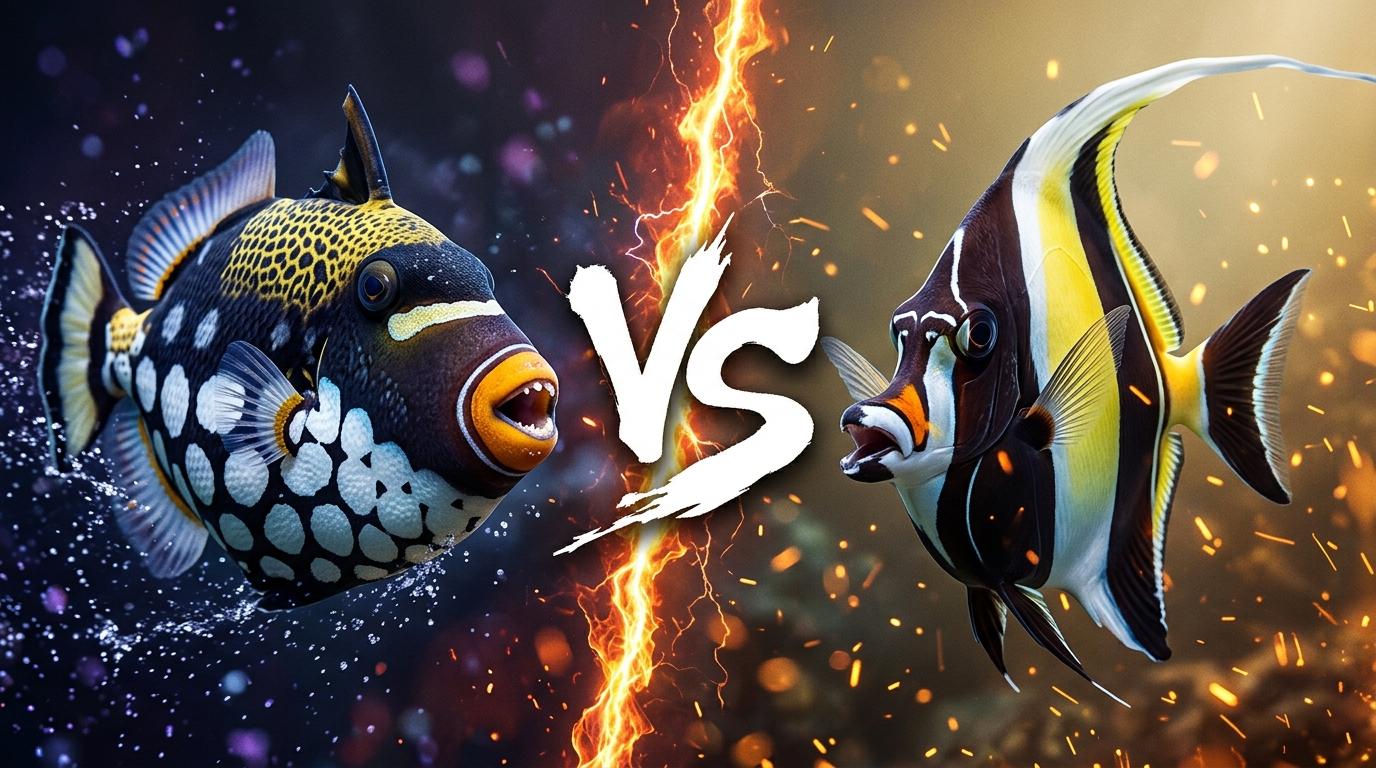
Clown Triggerfish vs Moorish Idol: Who Actually Wins?
The clown triggerfish wins clearly. It reaches roughly 50 cm, about double the Moorish idol's typical 20 cm or so. It is built around a crushing beak of fused, chisel-like teeth made for cracking crabs, urchins, and mollusks. Its thick, plate-like scales work as body armor, and a lockable first dorsal spine lets it wedge itself into crevices where it can't be pulled out. Triggerfish are famously territorial and will charge intruders far larger than themselves. The Moorish idol is a slender, disc-shaped grazer with a long tube-like snout built for picking sponges and small invertebrates. It has no real weapon and no armor, and its main defense is staying out of trouble. In a direct contest the triggerfish has the size, the bite, and the temperament. The idol's best result is a clean escape.
Read comparison
Humphead Wrasse vs Humphead Parrotfish: Who Actually Wins?
The humphead wrasse wins. At up to about 2 m and 190 kg, it outclasses the humphead parrotfish, which tops out around 1.3 m and 75 kg. The wrasse is also a true predator. Its thick lips, protrusible jaws and crushing pharyngeal teeth are built to seize and process armored prey such as crabs, mollusks, sea urchins and even toxic boxfish and crown-of-thorns starfish. The parrotfish has a formidable beak of fused teeth, and it uses its bony forehead to ram coral. But that hardware is tuned for grinding reef rock, not for controlling a mobile, heavier opponent. In any real contest over space or a feeding spot, the wrasse's mass, bite versatility and dominant solitary temperament carry the day. Neither species seeks out the other, and serious injury between them is rarely documented.
Read comparison
Clown Triggerfish vs Warty Frogfish: Who Actually Wins?
The clown triggerfish wins clearly. It reaches roughly 40–50 cm against the warty frogfish's 10–15 cm. It swims faster and has fused, chisel-like teeth built to crush urchins and crabs. It can also lock its first dorsal spine upright to wedge itself into crevices. The frogfish's weapon is real. Its gape-and-suck strike ranks among the fastest feeding events among fishes and can engulf prey up to about its own length. But that weapon works only on animals that drift unsuspecting into range, and an adult clown triggerfish is far too big to swallow. Once the triggerfish identifies the lump on the reef as food or as an intruder, the frogfish has no armor, no speed and no escape plan that beats a bigger, aggressive, crushing-jawed predator.
Read comparison
Clown Triggerfish vs Ribbon Eel: Who Actually Wins?
The clown triggerfish wins this reef matchup clearly. It is a heavily built, aggressive grazer-predator with fused, chisel-like teeth strong enough to crack sea urchins, crabs, and mollusk shells. Its tough plated skin and locking dorsal spine make it hard to bite and hard to extract from a crevice. The ribbon eel is long, slender, and spectacular, but it is built as a patient sit-and-wait ambusher of small fish and shrimp. It spends most of its life with only its head out of a sand or rubble burrow. The ribbon eel can snap fast at close range and retreat instantly. But its small mouth and thin body give it little answer to a fish that bites through armor for a living. Outside the burrow, the triggerfish's maneuverability and bite dominate.
Read comparison
Discussion
What do you think?
Share your reasoning with other readers. Be civil and stick to the animals.
Sign in to join the discussion.
Sign inNo comments yet. Start the conversation.