

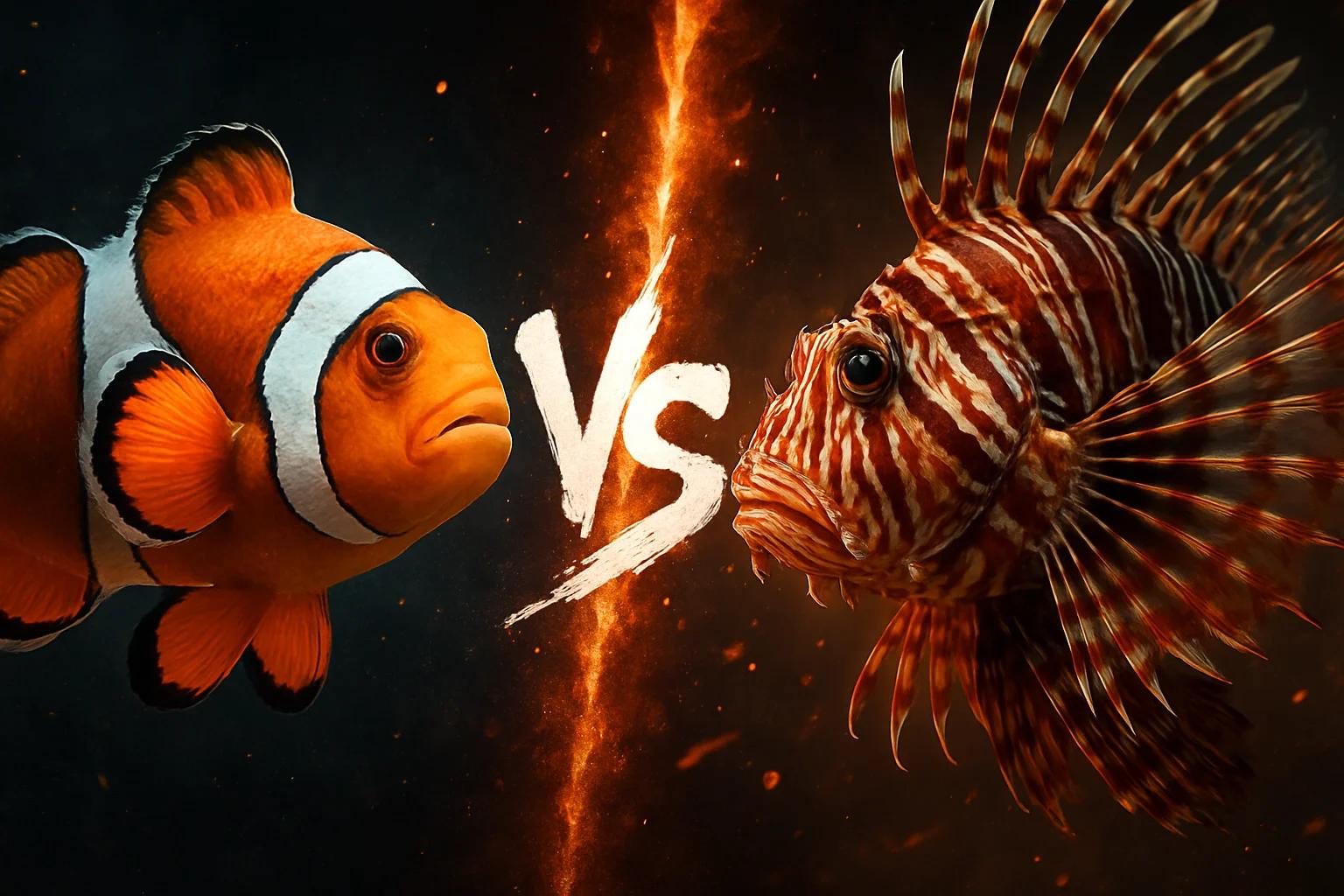
Clownfish vs Lionfish: Who Actually Wins?
Ocellaris clownfish vs red lionfish: size, venom, speed and reef tactics compared. See who wins in open water, in an anemone and over territory.
Clownfish vs Lionfish
Matchup winner
Lionfish
Quick verdict
Start with the direct answer, then use the structured comparison below to see what changes the outcome.
The red lionfish wins this matchup clearly. At roughly 30–38 cm against a clownfish's 8–11 cm, it carries several times the body length and many times the mass. It also has venomous dorsal, pelvic and anal spines that make it nearly untouchable, and it is a specialist ambush predator. It corners small fish with its fanned pectoral fins and swallows them whole with a fast suction strike. A clownfish is exactly the size of prey lionfish evolved to eat. The clownfish's only serious counter is its host anemone. Its protective mucus lets it shelter among stinging tentacles that a lionfish will avoid. That refuge can save the clownfish, but it is a way to survive, not a way to win.
Read the full explanation
The lionfish wins: it is several times longer and armed with venomous spines.
Clownfish sit squarely in the lionfish's prey size range and can be swallowed whole.
The clownfish's best move is retreating into its stinging anemone, which lionfish avoid.
Clownfish are bold territorial nippers, but their bites can't meaningfully hurt a lionfish.
Reader vote
Who do you think wins?
Pick a side — no account needed. Results update live.
No votes yet — be the first to call it.
Editorial note
Why people disagree
Clownfish are famously feisty and will charge divers, so people overrate their fight value against a true predator.
Size and mass
The size gap puts the clownfish inside the lionfish's swallow range, so the fight ends before it starts.
Defensive weaponry
Venomous spines deter almost every reef fish from attacking a lionfish, and a clownfish has no way around them.
Ambush control
Lionfish trap small fish against reef structure, which is exactly where clownfish live.
Read the full explanation +
The anemone refuge is real. Many argue a clownfish at home is effectively unbeatable, which is true for survival but not for dominance.
Lionfish look slow and showy, which hides how fast and precise their strike is at close range.
Comparison FAQ
Short, direct answers to the next questions readers usually ask after the headline verdict.
Would a clownfish beat a lionfish?+
No. The lionfish is several times larger, venomous and a fish-eating predator. A clownfish can only escape by hiding in its anemone.
Which is stronger, a clownfish or a lionfish?+
The lionfish. It outclasses the clownfish in mass, strike power and weaponry by a wide margin.
Do lionfish eat clownfish?+
Yes, they can. Small reef fish like clownfish are typical lionfish prey, especially when caught away from shelter.
Why is a clownfish still dangerous to approach?+
Its anemone stings intruders, and clownfish aggressively nip anything near their home. Divers even report being bitten. The risk comes from the anemone fortress more than from the fish itself.
Is a lionfish sting dangerous to people?+
Yes. It is very painful and can cause swelling and nausea, though it is rarely fatal. Hot water treatment and medical care are recommended.
Head-to-head species stats
These are the same core AnimalDex stat dimensions used on the dedicated animal pages, pulled side by side so the matchup is faster to scan.
Clownfish
Tier CLionfish
Tier CTrait-by-trait comparison
Only the categories that matter to this matchup are included. The goal is not filler stats, but the real design differences that change the result.
8–11 cm, a few grams
Size and mass
Lionfish
30–38 cm, up to ~1 kg
Size and mass
Lionfish
Small teeth, nipping bites
Defensive weaponry
Lionfish
13 venomous dorsal spines plus pelvic and anal spines
Defensive weaponry
Lionfish
Not a predator of fish
Ambush control
Lionfish
Fin-herding plus a fast suction gulp
Ambush control
Lionfish
Mucus-protected life inside a stinging anemone
Refuge security
Clownfish
Relies on venom, has no shelter partner
Refuge security
Clownfish
Bold, persistent nipper
Territorial aggression
Clownfish
Calm, confident, rarely retreats
Territorial aggression
Clownfish
Quick darting over short distances
Burst speed
Lionfish
Slow cruise, explosive strike
Burst speed
Lionfish
How the verdict forms
Verdict timeline
01 · Size and mass
Lionfish
02 · Defensive weaponry
Lionfish
03 · Ambush control
Lionfish
04 · Refuge security
Clownfish
05 · Territorial aggression
Clownfish
06 · Burst speed
Lionfish
Change the conditions
Scenario breakdown
This is where shallow battle content usually fails. Terrain, spacing, timing, and engagement style can change the answer.
Scenario lean
Lionfish
Verdict confidence
82%
Lionfish, decisively.
Away from its host, the clownfish is just a small fish with weak defenses. A lionfish can herd it against coral with its pectoral fins and finish it with one suction strike. Nothing in the clownfish's toolkit counters a predator that is both larger and venom-armored.
AnimalDex field profiles
Explore these animals
Clownfish
Amphiprion ocellaris
Warm shallow coral reefs and lagoon systems with host anemones.
Lionfish
Pterois volitans
Coral reefs, rocky bottoms, mangroves, and artificial structures in warm marine water.
Systems Intelligence & Hidden Purpose
See the animals behind this comparison as engineered biological systems: what each one is built to do, where it gains leverage, and why the matchup changes by scenario.
Specialized Hardware
Protective mucus coating, maneuverable reef swimming, and social hierarchy make clownfish reef hardware built for living inside another species' defenses.
Systems Script
Clownfish turn sea anemones into fortified homes while providing cleaning and nutrient benefits in return. Their niche works because partnership is the architecture, not an optional extra.
Strategic Insight
A strong alliance is not decorative. It should change what each side can survive.
Specialized Hardware
Venomous fin spines, ambush feeding style, and broad habitat tolerance make lionfish predatory hardware that scales too well in the wrong system.
Systems Script
In native ranges they are one predator among many; in invaded reefs they become a stress test for ecological defenses. Lionfish show how dangerous efficient hardware becomes when checks are missing.
Strategic Insight
Performance without constraints is not excellence. It is often a system failure in disguise.
Final take
This is a predator-versus-prey matchup with a lopsided result: the red lionfish wins. It has the size, the venom and the hunting technique built for eating fish exactly the size of a clownfish.
Read the full explanation
The clownfish still deserves respect for its defensive strategy. Its partnership with an anemone turns a stinging animal into a fortress, and that is why clownfish thrive on reefs full of predators. It cannot win the fight, but it can avoid ever having one.
Collect both animals in AnimalDex
Track the species behind this matchup, compare their real traits, and build the rivalry into your AnimalDex collection.
Discussion
What do you think?
Share your reasoning with other readers. Be civil and stick to the animals.
Sign in to join the discussion.
Sign inNo comments yet. Start the conversation.