

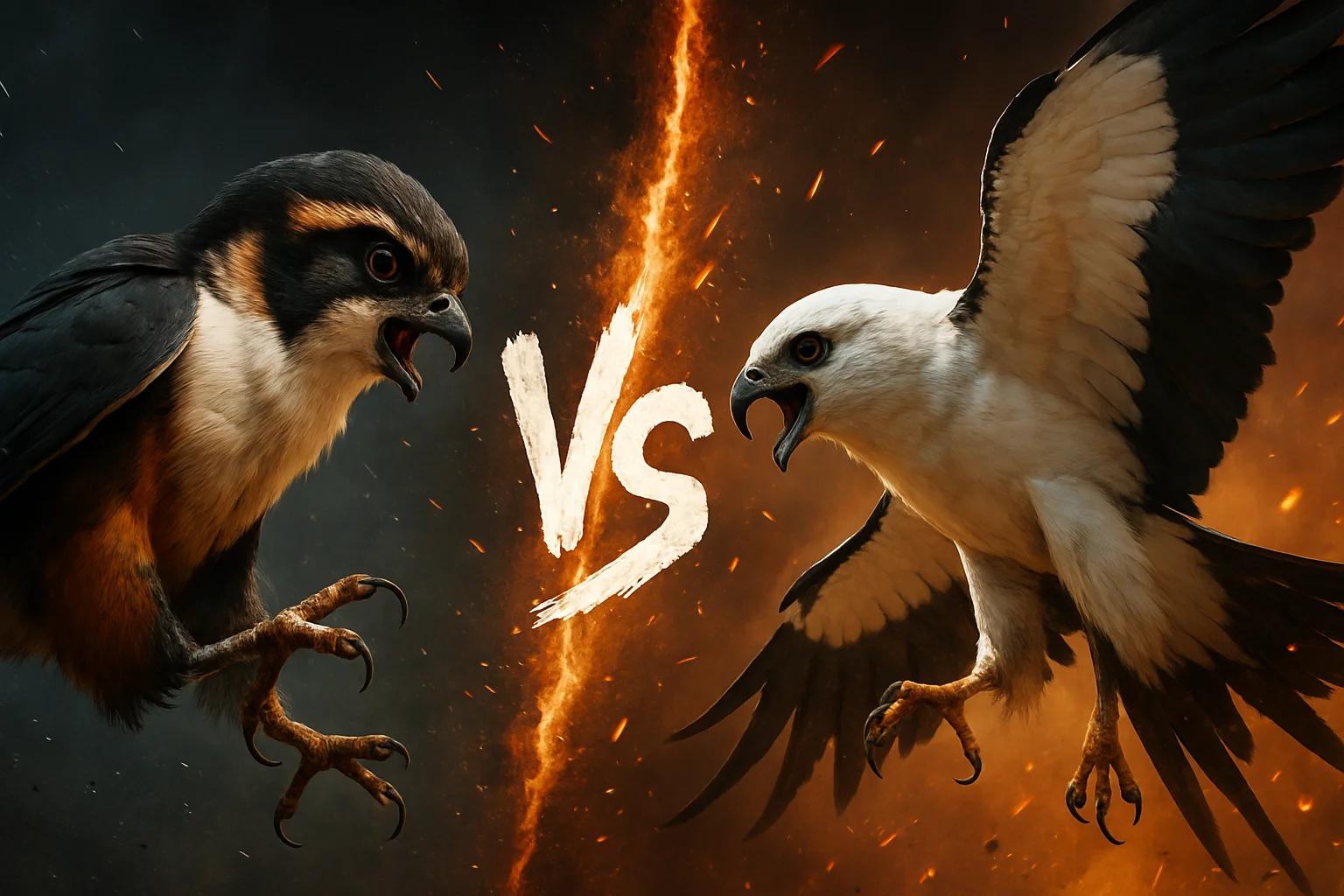
Collared Falconet vs Swallow-tailed Kite: Who Actually Wins?
Collared Falconet vs Swallow-tailed Kite: a biology-first breakdown of size, weapons, flight style, and fighting instincts to show which raptor would really win.
Collared Falconet vs Swallow-tailed Kite
Matchup winner
Swallow-tailed Kite
Quick verdict
Start with the direct answer, then use the structured comparison below to see what changes the outcome.
The Swallow-tailed Kite wins this matchup, mainly because of size. A Collared Falconet is one of the smallest raptors on Earth, about 15–18 cm long and roughly 30–55 g. A Swallow-tailed Kite stretches 50–65 cm with a wingspan near 1.2–1.3 m and weighs around 350–600 g, close to ten times heavier. The falconet is the more aggressive bird. It is a true falcon with a notched, tomial-toothed bill and a habit of pouncing on dragonflies and small birds, so it has real weapons and real intent. The kite, though, is not a pushover. Its long wings and deeply forked tail give it great control at speed, and its sheer mass means the falconet's bites and grabs can't reach anything vital. The falconet can sting, harass, and escape, but it cannot pin, kill, or drive off a bird that large. In any frame where both commit, the kite's weight and reach settle it.
Read the full explanation
Winner: Swallow-tailed Kite, roughly 10x the falconet's body mass.
The falconet is the fiercer, better-armed hunter for its size, but its weapons are built for insects and sparrow-sized birds.
The kite's buoyant, agile flight lets it shrug off harassment and use its reach.
In real life they never meet. The falconet lives in South and Southeast Asia, the kite in the Americas.
Reader vote
Who do you think wins?
Pick a side — no account needed. Results update live.
No votes yet — be the first to call it.
Editorial note
Why people disagree
Falcon prestige: people assume a true falcon with a killing bill beats any kite. That holds at equal size, not at a 10x weight gap.
Size and mass
Raptor fights are decided by whether one bird can physically control the other. The falconet simply cannot restrain something ten times its weight.
Killing toolkit
The falconet carries the better kill system per gram. That is why it stays dangerous, though it can't scale its weapons up to a kite-sized target.
Predatory intent
The falconet is more likely to start trouble. Starting a fight is not the same as finishing it.
Read the full explanation +
Kites look gentle: Swallow-tailed Kites snatch insects and lizards on the wing and rarely fight, so some readers underrate how much their size alone protects them.
Pound-for-pound vs absolute: the falconet wins easily on aggression per gram, but this question is about who wins the encounter, not who is tougher per ounce.
Comparison FAQ
Short, direct answers to the next questions readers usually ask after the headline verdict.
Would a Collared Falconet beat a Swallow-tailed Kite in a fight?+
No. The kite is about ten times heavier with far greater reach. The falconet might land a quick strike, but it can't overpower or seriously injure a bird that size.
Which is stronger, a Collared Falconet or a Swallow-tailed Kite?+
In absolute strength, the Swallow-tailed Kite. Pound for pound, the falconet is the more powerful predator, with a true falcon bill and a habit of killing birds near its own weight.
Why is the Collared Falconet still dangerous even though it loses?+
It is a genuine falcon with a notched killing bill, sharp talons, explosive perch launches, and bold aggression. It can rake a larger bird, win races for prey, and escape quickly. For anything its own size, it is lethal.
Do Collared Falconets and Swallow-tailed Kites ever meet in the wild?+
No. Collared Falconets live in the Indian subcontinent and Southeast Asia, while Swallow-tailed Kites breed in the southeastern US and Central and South America.
What do they eat?+
Falconets take large insects like dragonflies and cicadas, plus small birds and lizards. Swallow-tailed Kites feed on flying insects, lizards, frogs, and nestlings, often eating in flight.
Head-to-head species stats
These are the same core AnimalDex stat dimensions used on the dedicated animal pages, pulled side by side so the matchup is faster to scan.
Collared Falconet
Tier BSwallow-tailed Kite
Tier BTrait-by-trait comparison
Only the categories that matter to this matchup are included. The goal is not filler stats, but the real design differences that change the result.
~30–55 g, sparrow-sized
Size and mass
Swallow-tailed Kite
~350–600 g, 1.2 m+ wingspan
Size and mass
Swallow-tailed Kite
Notched falcon bill, sharp grasping talons
Killing toolkit
Collared Falconet
Small hooked bill, relatively weak feet tuned for snatching
Killing toolkit
Collared Falconet
Bold perch-pouncer that hits small birds
Predatory intent
Collared Falconet
Mostly peaceful aerial forager
Predatory intent
Collared Falconet
Quick, darting sallies from a perch
Aerial maneuvering
Swallow-tailed Kite
Elite gliding control, forked-tail steering
Aerial maneuvering
Swallow-tailed Kite
Fast, shrike-like acceleration
Burst speed
Collared Falconet
Fast but more glide-oriented
Burst speed
Collared Falconet
Tiny frame, easily buffeted
Close-range durability
Swallow-tailed Kite
Larger body absorbs glancing strikes
Close-range durability
Swallow-tailed Kite
How the verdict forms
Verdict timeline
01 · Size and mass
Swallow-tailed Kite
02 · Killing toolkit
Collared Falconet
03 · Predatory intent
Collared Falconet
04 · Aerial maneuvering
Swallow-tailed Kite
05 · Burst speed
Collared Falconet
06 · Close-range durability
Swallow-tailed Kite
Change the conditions
Scenario breakdown
This is where shallow battle content usually fails. Terrain, spacing, timing, and engagement style can change the answer.
Scenario lean
Swallow-tailed Kite
Verdict confidence
82%
Falconet lands the first sting; kite still prevails.
This is the falconet's best setting. It hunts from exposed snags near cover and can ambush from a perch. It might strike first and rake the kite. But the kite's long wings and mass mean one strike can't disable it, and in a clinch the falconet gets crushed or shaken off. The falconet's best outcome here is a hit-and-hide, not a win.
AnimalDex field profiles
Explore these animals
Collared Falconet
Microhierax caerulescens
forest edge, open woodland, and village tree lines
Swallow-tailed Kite
Elanoides forficatus
river forest, swamp edge, and warm open sky over woodland
Systems Intelligence & Hidden Purpose
See the animals behind this comparison as engineered biological systems: what each one is built to do, where it gains leverage, and why the matchup changes by scenario.
Specialized Hardware
tiny falcon body, short hooked bill, and fast perch-and-dart attacks give the Collared Falconet a body plan tuned for its niche.
Systems Script
Collared Falconets operate through forest edge, open woodland, and village tree lines. Their design links movement, feeding, shelter, and timing into one workable survival system.
Strategic Insight
Dense environments reward precision, patience, and the ability to read layered cover.
Specialized Hardware
deeply forked tail, graceful aerial insect and reptile hunting, and light effortless gliding give the Swallow-tailed Kite a body plan tuned for its niche.
Systems Script
Swallow-tailed Kites operate through river forest, swamp edge, and warm open sky over woodland Their design links movement, shelter, and feeding into one workable survival system.
Strategic Insight
Beautiful movement is often just efficiency seen from the outside.
Final take
The Swallow-tailed Kite wins because physics outranks attitude. The Collared Falconet is a real falcon in miniature, with the right bill, the right talons, and the nerve to attack birds its own size. Its whole design is calibrated for prey under about 50 grams.
Read the full explanation
The kite isn't a fighter by temperament, but it doesn't need to be. Ten times the mass, a meter-plus wingspan, and some of the finest flight control among raptors make it effectively untouchable for a bird the size of a sparrow. The falconet can score a hit or win a race to food. It cannot end the encounter in its favor, so the overall edge goes clearly to the kite.
Collect both animals in AnimalDex
Track the species behind this matchup, compare their real traits, and build the rivalry into your AnimalDex collection.
Related comparisons
Continue with nearby matchups to compare more real-world animal traits without dropping into junky who-wins filler.
Red-tailed Hawk vs Swallow-tailed Kite: Who Actually Wins?
The Red-tailed Hawk wins clearly. The two birds have similar wingspans, but the hawk is a heavier, thicker-bodied raptor, often more than twice the kite's mass. It is built to seize and crush mammals with powerful feet and talons. The Swallow-tailed Kite is one of the most graceful fliers in North America, but it is engineered for snatching insects, lizards and nestlings mid-air while eating on the wing. Its feet are relatively small and its build is light. In any contact-heavy confrontation, the hawk's grip, mass and bone-deep killing toolkit decide the outcome. The kite's real weapon is evasion, not combat.
Read comparison
Mississippi Kite vs Swallow-tailed Kite: Who Actually Wins?
The Swallow-tailed Kite wins this matchup. Both are lightweight aerial insect hunters, not brawlers, so a real clash between them would be a short aerial dispute rather than a grappling fight. In that kind of dispute, the Swallow-tailed Kite brings the decisive edge. It typically weighs around 370–600 g against the Mississippi Kite's roughly 240–370 g, and its wingspan of about 1.2–1.35 m dwarfs the Mississippi's roughly 0.9 m. It also has more practice handling vertebrate prey, plucking lizards, tree frogs, small snakes, and nestlings from the canopy while in flight. The Mississippi Kite is quicker to commit, more agile in tight turns, and famously aggressive around its nest colony. That makes it dangerous in a defensive scramble. But mass, reach, and gliding control usually decide who holds the airspace, and those favor the Swallow-tailed Kite in most realistic contexts.
Read comparison
Discussion
What do you think?
Share your reasoning with other readers. Be civil and stick to the animals.
Sign in to join the discussion.
Sign inNo comments yet. Start the conversation.