


Comet Moth vs Giraffe Weevil: Who Actually Wins?
Comet moth vs giraffe weevil: Madagascar's giant mouthless moth meets its armored long-necked weevil. Who wins, why the size gap misleads, and how each one actually lives.
Comet Moth vs Giraffe Weevil
Matchup winner
Giraffe Weevil
Quick verdict
Start with the direct answer, then use the structured comparison below to see what changes the outcome.
The giraffe weevil wins. This looks backward at first, because the comet moth has a wingspan of up to about 20 cm and towers over a weevil roughly 2.5 cm long. Size is not the same as fighting ability, though. Adult comet moths have no functional mouthparts. They do not eat, live only a few days on fat stored as caterpillars, and carry a huge, thin, scale-covered wing surface that tears easily. The giraffe weevil is built the other way around: it is small and compact, with a hard exoskeleton, chewing mandibles, a grip made for clinging to leaves, and, in males, an extended neck that is actually used in shoving contests with rival males. In any frame where 'winning' means holding ground on a branch or leaf, the weevil has the only real tools. The moth's honest victory condition is leaving.
Read the full explanation
Giraffe weevil wins: it has armor, mandibles, a firm grip, and males really do fight.
Comet moth is about 8× longer in wingspan but cannot bite. Adults have no working mouth at all.
The moth's best move is flight. It wins escape scenarios, not control scenarios.
In real life they never fight. Both are harmless Madagascar endemics on different host plants.
Reader vote
Who do you think wins?
Pick a side — no account needed. Results update live.
No votes yet — be the first to call it.
Editorial note
Why people disagree
Size bias: a 20 cm moth 'looks' like it should flatten a thumbnail-sized beetle, but its bulk is mostly fragile wing area.
Offensive weaponry
A fighter with zero ways to inflict damage cannot win a contest decided by contact.
Close-range durability
Weevils are built to take bumps. Moth wings fray and tear with little force.
Raw size and reach
Size lets the moth buffet and displace the weevil, but it cannot turn that size into lasting control.
Read the full explanation +
People confuse not losing with winning. The moth can almost always fly off, but escaping is not the same as beating its opponent.
The weevil's neck seems like a weakness. In fact it is a male combat and courtship tool, used in neck-to-neck shoving contests over females.
Comparison FAQ
Short, direct answers to the next questions readers usually ask after the headline verdict.
Would a comet moth beat a giraffe weevil?+
No. The giraffe weevil wins any contest about holding ground. The moth's only advantage is that it can fly away.
Which is stronger, the comet moth or the giraffe weevil?+
Pound for pound, the giraffe weevil. It is armored, grips leaves tightly, and has mandibles. The moth is larger but lightly built, and it has no mouth for biting.
Do comet moths eat?+
Adult comet moths do not eat. They lack functional mouthparts and live off energy stored during the caterpillar stage, which is why adults survive only a few days.
What is the giraffe weevil's neck for?+
Males use their elongated necks in contests with other males over females. The female uses her shorter neck to help roll a leaf into a nest for a single egg.
Why does the comet moth stay dangerous in this matchup?+
Its sheer size and wing force can knock a weevil off a branch, and it can never really be caught. It cannot win control, but it is very hard to beat outright.
Do they live in the same place?+
Both are endemic to Madagascar's forests, but they rely on different host plants and would not normally interact.
Head-to-head species stats
These are the same core AnimalDex stat dimensions used on the dedicated animal pages, pulled side by side so the matchup is faster to scan.
Comet Moth
Tier DGiraffe Weevil
Tier DTrait-by-trait comparison
Only the categories that matter to this matchup are included. The goal is not filler stats, but the real design differences that change the result.
None. Adults lack functional mouthparts
Offensive weaponry
Giraffe Weevil
Chewing mandibles at the tip of the snout
Offensive weaponry
Giraffe Weevil
Thin scaled wings, soft body
Close-range durability
Giraffe Weevil
Hardened beetle exoskeleton and wing cases
Close-range durability
Giraffe Weevil
Wingspan up to ~20 cm, long tail streamers
Raw size and reach
Comet Moth
About 2.5 cm, males longer because of the neck
Raw size and reach
Comet Moth
Strong flier with tails that may deflect bat sonar
Escape mobility
Comet Moth
Can fly, but mostly clings and crawls
Escape mobility
Comet Moth
No fighting behavior. Spends its short life mate-seeking
Combat experience
Giraffe Weevil
Males shove rivals with their necks
Combat experience
Giraffe Weevil
Light perching, awkward when grounded
Grip and footing
Giraffe Weevil
Tenacious leaf-clinging grip
Grip and footing
Giraffe Weevil
How the verdict forms
Verdict timeline
01 · Offensive weaponry
Giraffe Weevil
02 · Close-range durability
Giraffe Weevil
03 · Raw size and reach
Comet Moth
04 · Escape mobility
Comet Moth
05 · Combat experience
Giraffe Weevil
06 · Grip and footing
Giraffe Weevil
Change the conditions
Scenario breakdown
This is where shallow battle content usually fails. Terrain, spacing, timing, and engagement style can change the answer.
Scenario lean
Giraffe Weevil
Verdict confidence
82%
The weevil holds the leaf.
In tight foliage the moth's wingspan becomes a liability, because its wings catch on twigs and lose scales. The weevil clings, braces, and can nip with its mandibles. The moth has no way to dislodge an opponent that grips well and does not mind being bumped.
AnimalDex field profiles
Explore these animals
Comet Moth
Argema mittrei
rainforest and humid woodland edge
Giraffe Weevil
Trachelophorus giraffa
forest, shrubland, and leaf-rich woodland edge
Systems Intelligence & Hidden Purpose
See the animals behind this comparison as engineered biological systems: what each one is built to do, where it gains leverage, and why the matchup changes by scenario.
Specialized Hardware
golden yellow silk-moth wings, very long ribbon tails, and brief breeding-focused adult life give the Comet Moth a body plan tuned for its niche.
Systems Script
Comet Moths operate through rainforest and humid woodland edge. Their design links movement, feeding, shelter, and timing into one workable survival system.
Strategic Insight
Dense environments reward precision, patience, and the ability to read layered cover.
Specialized Hardware
extra-long neck in males, red wing covers, and rolled-leaf nesting behavior give the Giraffe Weevil a body plan tuned for its niche.
Systems Script
Giraffe Weevils operate through forest, shrubland, and leaf-rich woodland edge. Their design links movement, feeding, shelter, and timing into one workable survival system.
Strategic Insight
Dense environments reward precision, patience, and the ability to read layered cover.
Final take
The giraffe weevil wins because it is the only one of the two built for contact. Armor, mandibles, a firm grip, and real male-versus-male fighting behavior outweigh a giant body that is mostly delicate wing.
Read the full explanation
The comet moth's design goal is reproduction, not confrontation. It emerges, searches for a mate, breeds, and dies within days, running on stored fuel. Its strategy is to stay out of trouble through flight, camouflage among leaves, and tails that may misdirect bats. Against the weevil, that strategy means it survives but does not win.
Confidence stays moderate because 'winning' between two harmless insects depends heavily on how you frame it. In any frame based on holding ground, however, the small armored specialist comes out ahead.
Collect both animals in AnimalDex
Track the species behind this matchup, compare their real traits, and build the rivalry into your AnimalDex collection.
Related comparisons
Continue with nearby matchups to compare more real-world animal traits without dropping into junky who-wins filler.
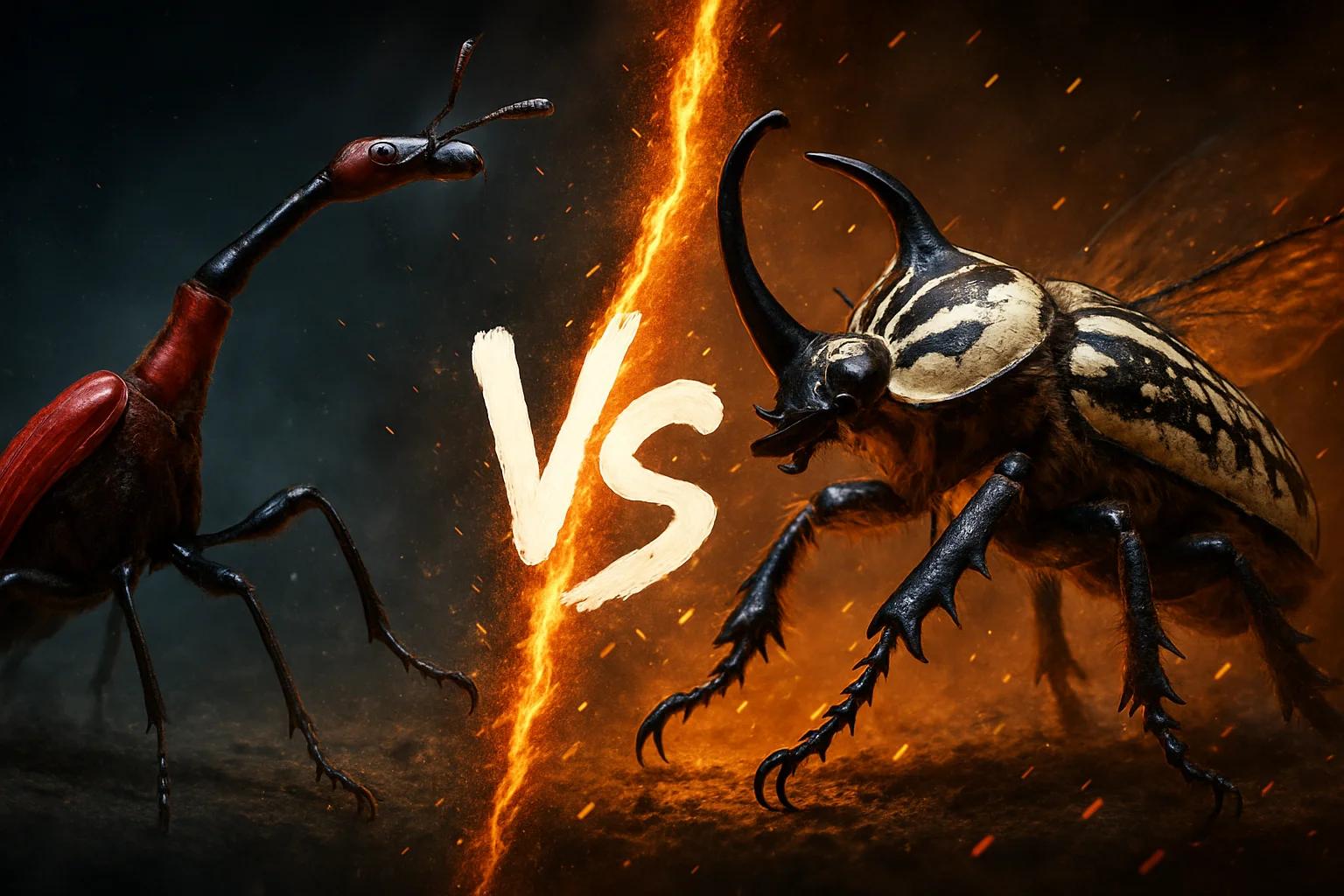
Giraffe Weevil vs Goliath Beetle: Who Actually Wins?
The Goliath beetle wins, and it is not close. Goliathus goliatus is one of the heaviest insects on Earth. Adults reach roughly 6–11 cm and can weigh tens of grams in the larval stage. Madagascar's giraffe weevil is a slender 2–2.5 cm specialist built around an elongated neck for leaf-rolling and male sparring. The Goliath's thick, domed elytra and powerful tarsal claws give it a massive mass and armor edge. Males also carry a Y-shaped head horn used to shove rivals off feeding sites. The weevil's neck is a display-and-leverage tool, not a weapon that can pry open beetle armor. In any contact scenario the Goliath simply outweighs, out-grips and out-shoves it. The weevil's real 'wins' come from not being there: it can fly off, drop from the plant, or avoid the confrontation entirely.
Read comparison
Comet Moth vs Sunset Moth: Who Actually Wins?
The Sunset Moth wins overall. The Comet Moth is far larger, with a wingspan around 20 cm and spectacular tails up to about 15 cm long. The Sunset Moth (Chrysiridia rhipheus) brings the better toolkit for any real contest. It is faster and more agile in the air, has a working proboscis for refueling on nectar, and lives weeks as an adult rather than days. It also carries chemical defenses sequestered from its toxic Omphalea host plants, and its iridescent wings advertise them. The adult Comet Moth (Argema mittrei) has no functional mouthparts, so it cannot feed and burns through its larval energy reserves in roughly a week. These two would not trade blows, because moths do not fight like predators. Measured by who controls airspace, outlasts the other, and stays untouchable, the Sunset Moth comes out ahead.
Read comparison
Giraffe Weevil vs Sunset Moth: Who Actually Wins?
The giraffe weevil wins. In any confrontation that involves actual contact, it is the only one of these two Madagascan insects built to inflict or absorb force. It has a hardened beetle exoskeleton and chewing mandibles at the tip of its rostrum, and males routinely wrestle rivals with their long necks. The sunset moth is larger, faster and far more spectacular. But its adult mouthparts are a nectar-sipping proboscis, and its delicate scaled wings tear easily. Its real weapons are flight and chemical defense, toxins it carries from its larval host plants, and neither one damages a weevil. The moth's best move is to leave. Leaving can win it a scenario, but it does not win the fight.
Read comparison
Discussion
What do you think?
Share your reasoning with other readers. Be civil and stick to the animals.
Sign in to join the discussion.
Sign inNo comments yet. Start the conversation.