


Common Genet vs Red Deer: Who Actually Wins?
Common genet vs red deer: a 2 kg nocturnal climber against a 100–200 kg antlered grazer. See who wins, why size decides it, and where the genet still holds its own.
Common Genet vs Red Deer
Matchup winner
Red Deer
Quick verdict
Start with the direct answer, then use the structured comparison below to see what changes the outcome.
The red deer wins, and it isn't close in a direct confrontation. A common genet weighs roughly 1.5–2.5 kg. A red deer weighs anywhere from about 90 kg for a hind to over 200 kg for a rutting stag, which makes it something like 50 to 100 times heavier. The deer brings sharp hooves that can strike with enough force to injure wolves, and in autumn the stags carry branching antlers built for shoving matches with rivals of equal mass. The genet's tools are needle-sharp teeth, semi-retractile claws, and superb agility, but they evolved for rodents, birds, lizards, and insects, not for anything with a skull and neck built to absorb antler clashes. The genet has no realistic way to deliver a disabling bite to an adult deer, while a single well-placed hoof strike could end the encounter. The genet's real victory condition is simply leaving: up a tree, into a rock crevice, or into thick scrub where a deer has no reason or ability to follow.
Read the full explanation
Red deer wins decisively in any direct physical contest.
Mass gap of roughly 50–100x makes the genet's bite nearly irrelevant against an adult deer.
Hooves (year-round) and antlers (stags, seasonally) give the deer lethal close-range weapons.
The genet 'wins' only by escaping, which it does extremely well thanks to climbing and cover use.
Reader vote
Who do you think wins?
Pick a side — no account needed. Results update live.
No votes yet — be the first to call it.
Editorial note
Why people disagree
Carnivore bias: some readers assume any predator beats any herbivore, but predator status only matters when the prey is within the predator's size class, and an adult red deer is far outside the genet's.
Raw mass
Mass sets the ceiling on force. The genet cannot move, pin, or meaningfully wound something this large.
Strike weapons
The deer's weapons scale with its body and can kill small predators outright. The genet's are precision tools for small prey.
Agility & climbing
This is the genet's escape hatch. Vertical space and tight cover are places the deer simply cannot follow.
Read the full explanation +
Antler season confusion: stags drop their antlers each spring, but hinds and antlerless stags still kick hard, so the deer is never truly unarmed.
'Win' vs 'survive': the genet almost never loses its life to a deer because it avoids contact, which some people mistake for the genet holding its own in a fight.
Comparison FAQ
Short, direct answers to the next questions readers usually ask after the headline verdict.
Would a common genet beat a red deer in a fight?+
No. The red deer wins. It is roughly 50–100 times heavier and armed with hooves and, in stags, antlers. The genet cannot inflict disabling damage on an adult deer.
Which is stronger, a genet or a red deer?+
The red deer, by an enormous margin. Its neck and leg muscles are built for antler combat and long gallops, while the genet's strength is scaled for catching rodents and birds.
Do genets hunt deer?+
No. Genets eat small mammals, birds, reptiles, insects, and fruit. Adult red deer, and even healthy calves, are far beyond their prey size range.
Why is the genet still dangerous even though it loses?+
Its sharp teeth and claws can cause painful puncture wounds, and its speed and climbing let it escape almost any pursuer. To the animals it actually hunts, it is a highly effective nocturnal predator.
Can a red deer kill small predators?+
Yes. Red deer, especially protective hinds and rutting stags, can strike hard enough with their hooves to seriously injure or kill small predators that get too close.
Where do common genets and red deer live together?+
Mainly in the Iberian Peninsula and southern France, where introduced genet populations overlap red deer woodland range. Both species also occur in parts of North Africa.
Head-to-head species stats
These are the same core AnimalDex stat dimensions used on the dedicated animal pages, pulled side by side so the matchup is faster to scan.
Common Genet
Tier CRed Deer
Tier CTrait-by-trait comparison
Only the categories that matter to this matchup are included. The goal is not filler stats, but the real design differences that change the result.
About 1.5–2.5 kg, house-cat slim
Raw mass
Red Deer
About 90–240 kg depending on sex and region
Raw mass
Red Deer
Small sharp teeth, curved semi-retractile claws
Strike weapons
Red Deer
Cutting forehooves, rear kicks, antlers on stags
Strike weapons
Red Deer
Elite climber, slips through narrow gaps
Agility & climbing
Common Genet
Powerful runner and jumper, cannot climb
Agility & climbing
Common Genet
Light frame, vulnerable to blunt trauma
Close-range durability
Red Deer
Thick neck, dense hide, built to absorb antler clashes
Close-range durability
Red Deer
Quick bursts over short distances
Open-ground speed
Red Deer
Sustained gallops of roughly 50+ km/h
Open-ground speed
Red Deer
Nocturnal specialist with tapetum-boosted vision and silent movement
Night sensing & stealth
Common Genet
Keen smell and hearing, wary crepuscular grazer
Night sensing & stealth
Common Genet
How the verdict forms
Verdict timeline
01 · Raw mass
Red Deer
02 · Strike weapons
Red Deer
03 · Agility & climbing
Common Genet
04 · Close-range durability
Red Deer
05 · Open-ground speed
Red Deer
06 · Night sensing & stealth
Common Genet
Change the conditions
Scenario breakdown
This is where shallow battle content usually fails. Terrain, spacing, timing, and engagement style can change the answer.
Scenario lean
Red Deer
Verdict confidence
82%
Deer dominates with no contest.
With no trees or cover nearby, the genet loses its only real advantage. A deer that feels threatened, especially a hind protecting a calf, can charge and stamp. The genet's bite cannot stop a 100+ kg animal, so its best outcome is to sprint for distant cover before a hoof lands.
AnimalDex field profiles
Explore these animals
Common Genet
Genetta genetta
woodland, rocky scrub, forest edge, and river corridor
Red Deer
Cervus elaphus
forest edge, meadow, upland grazing country, and mixed woodland
Systems Intelligence & Hidden Purpose
See the animals behind this comparison as engineered biological systems: what each one is built to do, where it gains leverage, and why the matchup changes by scenario.
Specialized Hardware
spotted cat-like body, long ringed tail, and agile night climbing give the Common Genet a body plan tuned for its niche.
Systems Script
Common Genets operate through woodland, rocky scrub, forest edge, and river corridor Their design links movement, shelter, and feeding into one workable survival system.
Strategic Insight
A narrow, balanced system can go where heavier systems cannot.
Specialized Hardware
large branching antlers on males, powerful woodland-and-meadow body, and seasonal roaring display behavior give the Red Deer a body plan tuned for its niche.
Systems Script
Red Deers operate through forest edge, meadow, upland grazing country, and mixed woodland Their design links movement, shelter, and feeding into one workable survival system.
Strategic Insight
Timing can make an already strong signal feel much larger than the body sending it.
Final take
The red deer is the clear winner. This matchup is decided almost entirely by body-size physics: one of Europe's largest wild herbivores against a cat-sized viverrid hunter. Hooves, antlers, and sheer mass mean the deer can end a confrontation instantly, while the genet has no realistic way to disable an adult deer.
Read the full explanation
That doesn't make the genet a pushover in its own world. It is a precise, night-adapted hunter whose survival strategy is to avoid fights it can't win. In real ecosystems these two animals coexist peacefully, sharing woodlands while occupying completely different niches. The deer grazes and browses, and the genet hunts small prey in the dark and in the branches overhead.
Collect both animals in AnimalDex
Track the species behind this matchup, compare their real traits, and build the rivalry into your AnimalDex collection.
Related comparisons
Continue with nearby matchups to compare more real-world animal traits without dropping into junky who-wins filler.
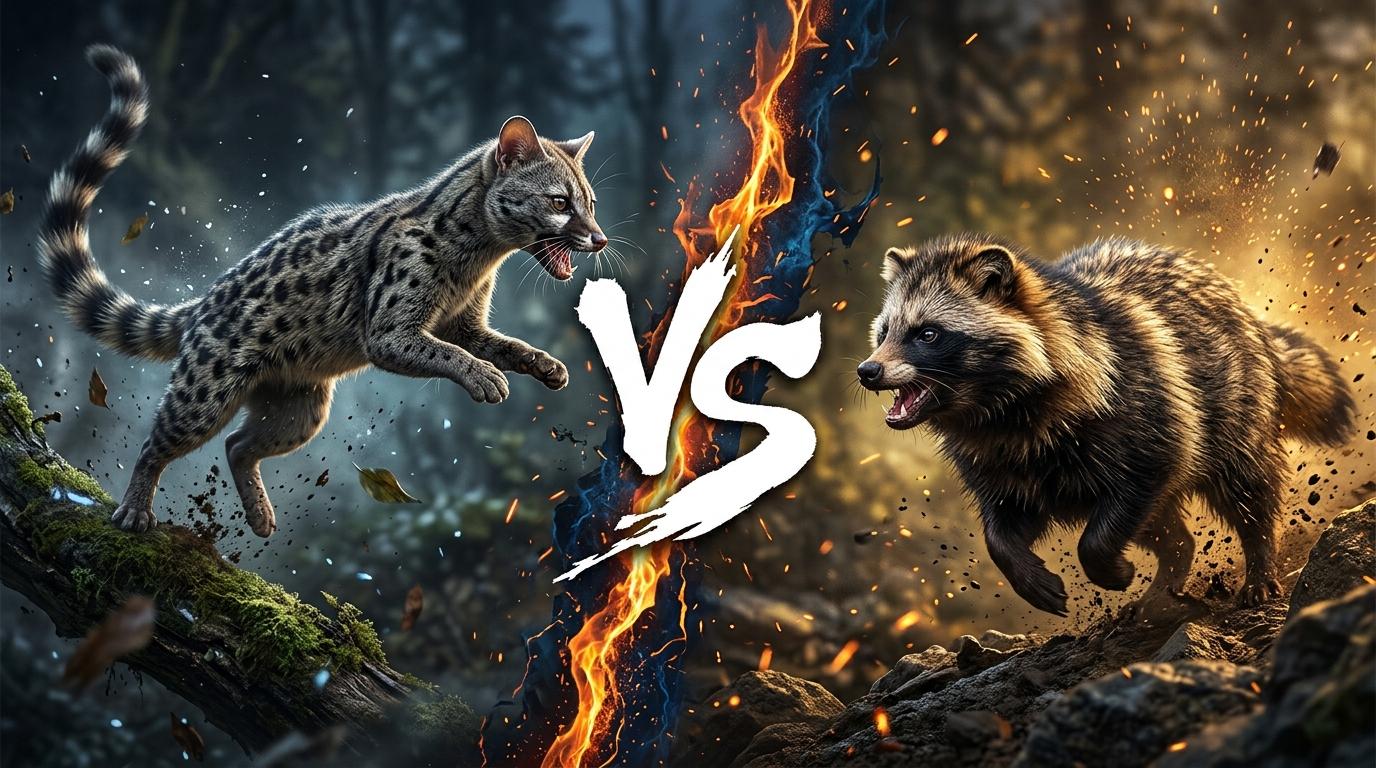
Common Genet vs Raccoon Dog: Who Actually Wins?
The common genet wins this matchup, but narrowly. The raccoon dog is the heavier animal, often 4–8 kg against the genet's 1.5–2.5 kg, and its thick winter coat soaks up bites well. What decides the encounter is purpose-built hardware. The genet is a near-obligate predator, a lithe viverrid with sharp carnassial teeth, semi-retractable claws, and the fast reflexes of an animal that kills rodents, birds, and reptiles for a living. The raccoon dog is a generalist omnivore that eats frogs, berries, carrion, and grain. Its main defense is to endure rather than attack, and it is famous for playing dead. In a real encounter, the genet controls the timing, lands precise bites, and can escape into trees at will. The raccoon dog wins only if it can turn the fight into a slow ground brawl where its weight and fur matter more than speed. Because the genet dictates the terms, it takes the overall edge.
Read comparison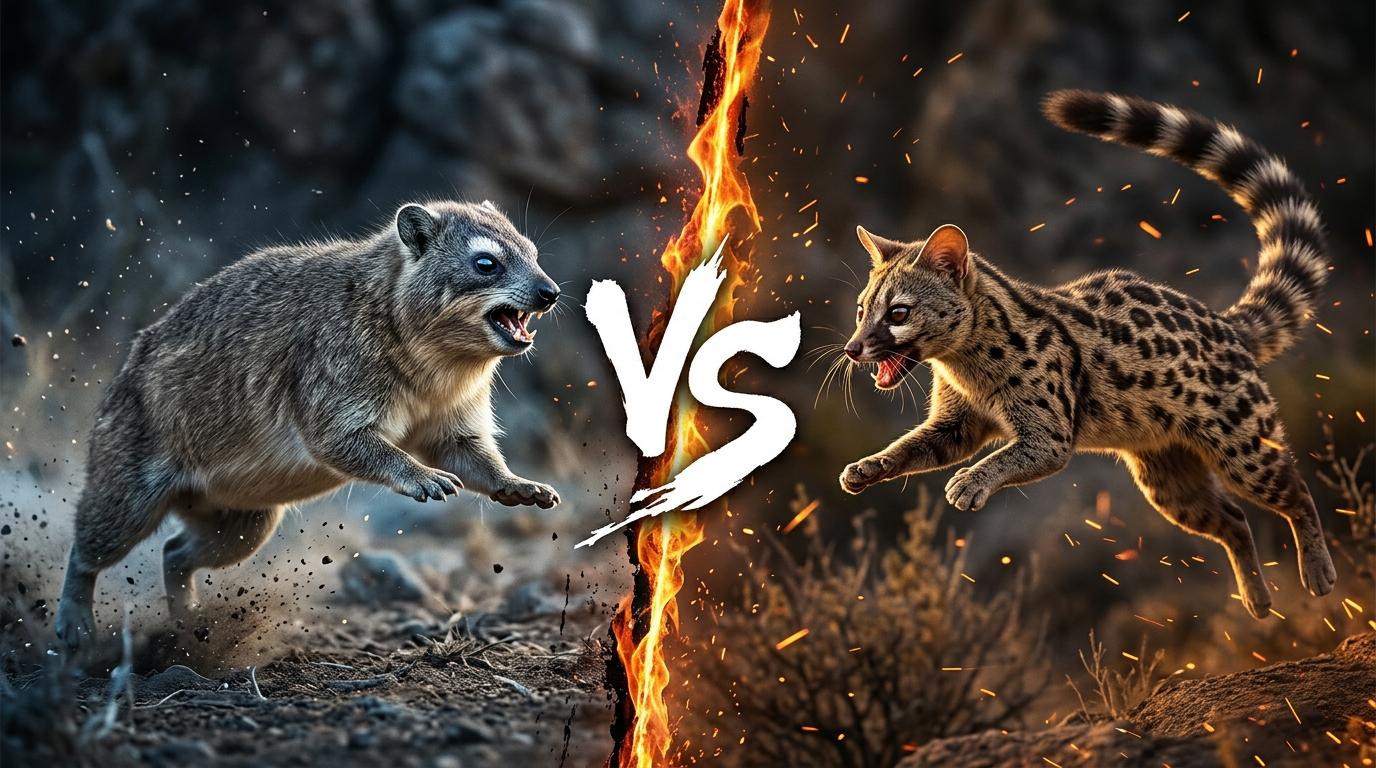
Bush Hyrax vs Common Genet: Who Actually Wins?
The common genet wins this matchup. It is a dedicated small carnivore built around a killing bite. It has sharp carnassials, retractable claws, a long flexible spine and the reflexes of a nocturnal hunter that routinely takes rodents, birds and lizards. The bush hyrax is a compact rock-dwelling herbivore weighing roughly 1.3–2.4 kg, while a genet weighs about 1.3–2.3 kg, so the two are closer in mass than people expect. But the hyrax's main weapons are long, tusk-like upper incisors and stubborn defensive biting, not predatory technique. In most encounters the genet controls distance, strikes to the head and neck, and disengages if things go badly. The hyrax's real defense is its colony. Sentinel alarm calls, fast retreats into rock crevices and a willingness to slash with those incisors make it a costly target. In a straight fight the genet takes it, but rarely cleanly.
Read comparison
Common Genet vs Otter: Who Actually Wins?
The otter wins, and the main reason is size. A typical Eurasian otter, the species whose range overlaps the common genet's in Iberia and North Africa, weighs roughly 7 to 12 kg. A common genet is a slender 1.3 to 2.3 kg climber, so the otter carries about four to six times its mass. That weight supports a thick neck, a broad skull and a crushing bite built for crayfish shells and slippery fish. Dense, oily fur and a muscular, tubular body also absorb the kind of slashing bites a genet relies on. The genet is the better athlete in three dimensions. It has retractable claws, an excellent sense of balance and a long counterweight tail, so in trees or rock clefts it can simply leave. But if the two are forced into contact on the ground or near water, the otter's mass, grip and tenacity decide it quickly. The genet's best result is escaping, not beating the otter.
Read comparison
Discussion
What do you think?
Share your reasoning with other readers. Be civil and stick to the animals.
Sign in to join the discussion.
Sign inNo comments yet. Start the conversation.