

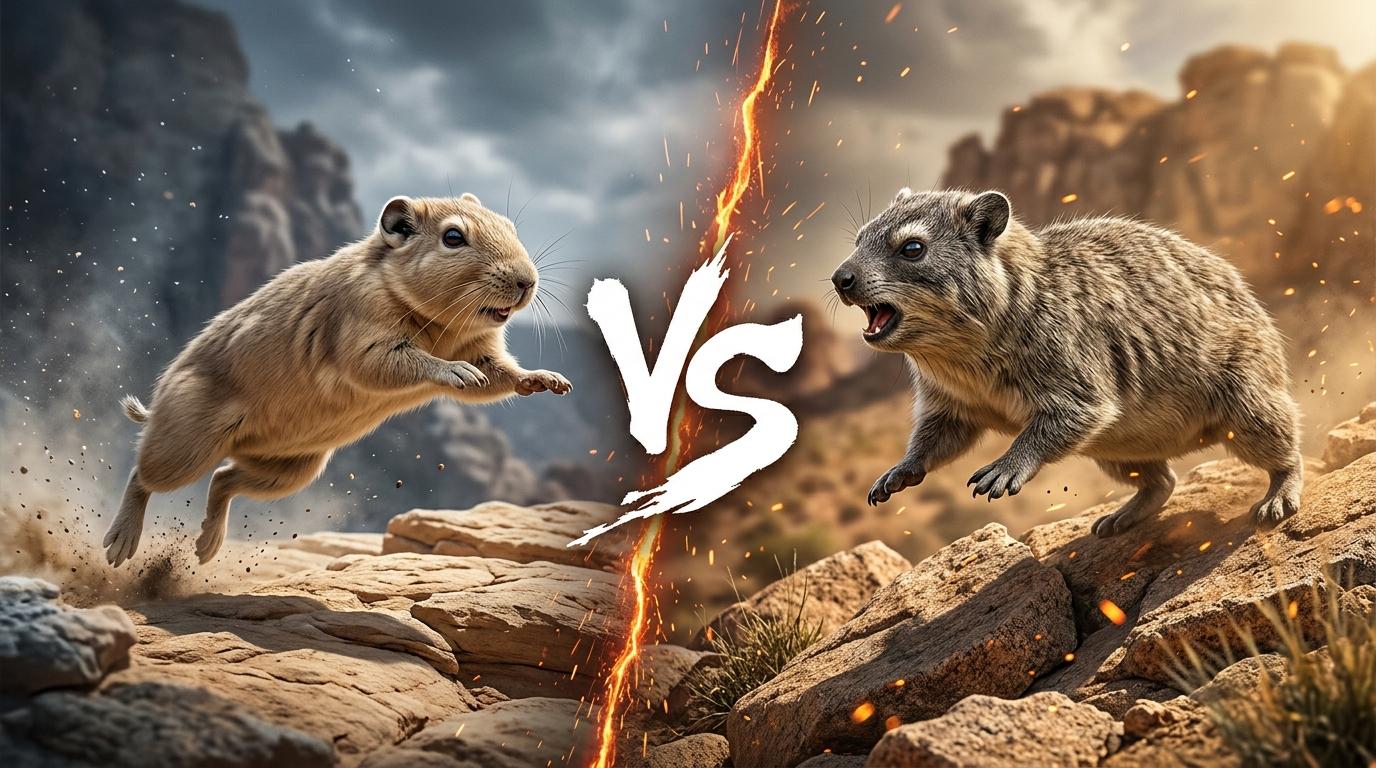
Common Gundi vs Rock Hyrax: Who Actually Wins?
Common gundi vs rock hyrax: who would win? A biology-first breakdown of size, teeth, defense and rocky-terrain tactics between two North African and Afro-Arabian rock specialists.
Common Gundi vs Rock Hyrax
Matchup winner
Rock Hyrax
Quick verdict
Start with the direct answer, then use the structured comparison below to see what changes the outcome.
The rock hyrax wins this matchup clearly. At roughly 2.5 to 4.5 kg against the common gundi's 170 to 300 g, the hyrax carries about ten times the body mass. It also has a weapon the gundi simply lacks: long, tusk-like upper incisors that dominant males use in real territorial fights, backed by a thick-skinned, stocky frame built for shoving matches on rock ledges. The gundi is a superb escape artist. It has comb-toed feet, near-vertical climbing ability and a habit of freezing flat into crevices. Its biology is designed to avoid confrontation, not win it. In any frame where the two actually make contact, the hyrax's mass, incisors and colony-level aggression decide it.
Read the full explanation
Rock hyrax wins: about 10x heavier, with tusk-like incisors used in real fights.
The common gundi is a flight-and-freeze specialist, not a fighter.
The gundi's best outcome is vanishing into a crack too narrow for the hyrax.
Neither species preys on the other; this is a hypothetical territorial clash.
Reader vote
Who do you think wins?
Pick a side — no account needed. Results update live.
No votes yet — be the first to call it.
Editorial note
Why people disagree
Both look like 'small furry rock animals,' so people underestimate how much bigger and better-armed the hyrax is.
Body mass and frame
A roughly tenfold mass gap is decisive in shoving and pinning contests on narrow ledges.
Bite and weaponry
Only one of these animals evolved teeth for fighting rivals; that changes everything at contact.
Vertical rock mobility
The gundi can reach and use tighter, steeper escape routes than the heavier hyrax.
Read the full explanation +
Gundis are astonishingly agile on rock faces, which makes them look like they could outmaneuver anything their size, but the hyrax isn't their size.
Hyraxes seem sleepy because they spend hours sunbathing, which hides how combative territorial males get.
Comparison FAQ
Short, direct answers to the next questions readers usually ask after the headline verdict.
Would a common gundi beat a rock hyrax?+
No. The rock hyrax would win almost any physical confrontation thanks to roughly ten times the body mass and tusk-like fighting incisors.
Which is stronger, a gundi or a hyrax?+
The rock hyrax by far. It weighs about 2.5–4.5 kg versus the gundi's 170–300 g and has a dense, muscular frame.
Is the rock hyrax related to the gundi?+
No. The gundi is a rodent. The hyrax belongs to its own order, Hyracoidea, and its closest living relatives are elephants and sea cows.
Why is the gundi still hard to beat?+
Its escape game is elite. Bristled, comb-toed feet and a tiny body let it climb near-vertical rock and hide in cracks a hyrax cannot reach, so catching it is the real problem.
Do gundis and hyraxes fight in the wild?+
Not in any documented, meaningful way. Their ranges barely overlap and neither hunts the other. This matchup is a hypothetical based on their anatomy and behavior.
Head-to-head species stats
These are the same core AnimalDex stat dimensions used on the dedicated animal pages, pulled side by side so the matchup is faster to scan.
Common Gundi
Tier CRock Hyrax
Tier CTrait-by-trait comparison
Only the categories that matter to this matchup are included. The goal is not filler stats, but the real design differences that change the result.
170–300 g, guinea-pig build
Body mass and frame
Rock Hyrax
2.5–4.5 kg, stocky barrel body
Body mass and frame
Rock Hyrax
Small rodent incisors, rarely used offensively
Bite and weaponry
Rock Hyrax
Tusk-like upper incisors, used in male fights
Bite and weaponry
Rock Hyrax
Comb-toed, bristled feet; near-vertical scrambling
Vertical rock mobility
Common Gundi
Sweat-moistened suction pads; excellent grip
Vertical rock mobility
Common Gundi
Flattens into crevices, freezes for long periods
Freeze-and-hide defense
Common Gundi
Retreats to communal shelters on sentinel alarm
Freeze-and-hide defense
Common Gundi
Mild; relies on thumping alarms and flight
Territorial aggression
Rock Hyrax
Dominant males guard colonies and fight rivals
Territorial aggression
Rock Hyrax
Fragile, soft-furred, thin-skinned
Close-range durability
Rock Hyrax
Dense, tough hide and heavy musculature
Close-range durability
Rock Hyrax
How the verdict forms
Verdict timeline
01 · Body mass and frame
Rock Hyrax
02 · Bite and weaponry
Rock Hyrax
03 · Vertical rock mobility
Common Gundi
04 · Freeze-and-hide defense
Common Gundi
05 · Territorial aggression
Rock Hyrax
06 · Close-range durability
Rock Hyrax
Change the conditions
Scenario breakdown
This is where shallow battle content usually fails. Terrain, spacing, timing, and engagement style can change the answer.
Scenario lean
Common Gundi
Verdict confidence
82%
Gundi survives by vanishing, not by winning.
In a boulder field full of narrow cracks, the gundi's small body and grippy, comb-toed feet let it slip into gaps the hyrax physically cannot enter. Whoever avoids harm 'wins' here, and the gundi simply leaves the fight. This is an escape victory, not dominance, but it is the gundi's best frame.
AnimalDex field profiles
Explore these animals
Common Gundi
Ctenodactylus gundi
desert cliff, rocky outcrop, and dry wadi slope
Rock Hyrax
Procavia capensis
rocky outcrop, cliff, and dry scrub slope
Systems Intelligence & Hidden Purpose
See the animals behind this comparison as engineered biological systems: what each one is built to do, where it gains leverage, and why the matchup changes by scenario.
Specialized Hardware
flattened rock-hugging body, comb-like grooming claws, and communal sun-basking give the Common Gundi a body plan tuned for its niche.
Systems Script
Common Gundis operate through desert cliff, rocky outcrop, and dry wadi slope. Their design links movement, feeding, shelter, and timing into one workable survival system.
Strategic Insight
Harsh places reward efficiency, timing, and bodies that waste very little.
Specialized Hardware
rubbery gripping foot pads, stout rock-loving body, and sun-basking colony life give the Rock Hyrax a body plan tuned for its niche.
Systems Script
Rock Hyraxs operate through rocky outcrop, cliff, and dry scrub slope. Their design links movement, feeding, shelter, and timing into one workable survival system.
Strategic Insight
Harsh places reward efficiency, timing, and bodies that waste very little.
Final take
The rock hyrax is the clear winner. This isn't because the gundi is weak. The two animals were simply optimized for different problems. The hyrax is a heavy, tusked colonial animal that settles disputes physically. The gundi is a featherweight rock acrobat that survives by never being where trouble lands.
Read the full explanation
Give the gundi a crevice and it walks away unharmed. Force contact on open rock and the hyrax's tenfold mass and fighting incisors end it quickly. Most realistic frames involve contact over space or basking spots, and that is why the hyrax takes the overall verdict.
Collect both animals in AnimalDex
Track the species behind this matchup, compare their real traits, and build the rivalry into your AnimalDex collection.
Related comparisons
Continue with nearby matchups to compare more real-world animal traits without dropping into junky who-wins filler.

Rock Hyrax vs Striped Hyena: Who Actually Wins?
The striped hyena wins, and it isn't close in a direct confrontation. An adult striped hyena weighs roughly 25–45 kg against a rock hyrax's 2–5 kg, so it has about ten times the mass. Its bone-cracking jaws and premolars are built to shear through cartilage and crush skeletons, and its neck and shoulders are built to drag and hold. The hyrax is a tough, sharp-tusked little rock specialist with excellent vigilance and padded, grippy feet, but none of that offsets a carnivore whose bite can end the encounter in one hold. The hyrax's real win condition is to avoid the fight entirely by staying near a crevice the hyena can't fit into. On open ground or anywhere it can't retreat, the hyena wins decisively.
Read comparison
Golden Jackal vs Rock Hyrax: Who Actually Wins?
The golden jackal wins clearly. At roughly 7–15 kg with a long canid skull, slicing carnassials, and endurance-built legs, it outweighs a 2–5 kg rock hyrax several times over and is a real predator of small mammals. The jackal controls distance, tests for weakness, and finishes with a neck or head bite. The hyrax's best hope is not fighting at all. It survives by spotting danger early, sounding alarm calls, and vanishing into rock crevices too tight for a canid to follow. Once a hyrax is cornered it fights hard with long, tusk-like incisors. In open ground, or when a hyrax is caught away from cover, the size and weapon gap decides the outcome quickly in the jackal's favor.
Read comparison
Discussion
What do you think?
Share your reasoning with other readers. Be civil and stick to the animals.
Sign in to join the discussion.
Sign inNo comments yet. Start the conversation.