

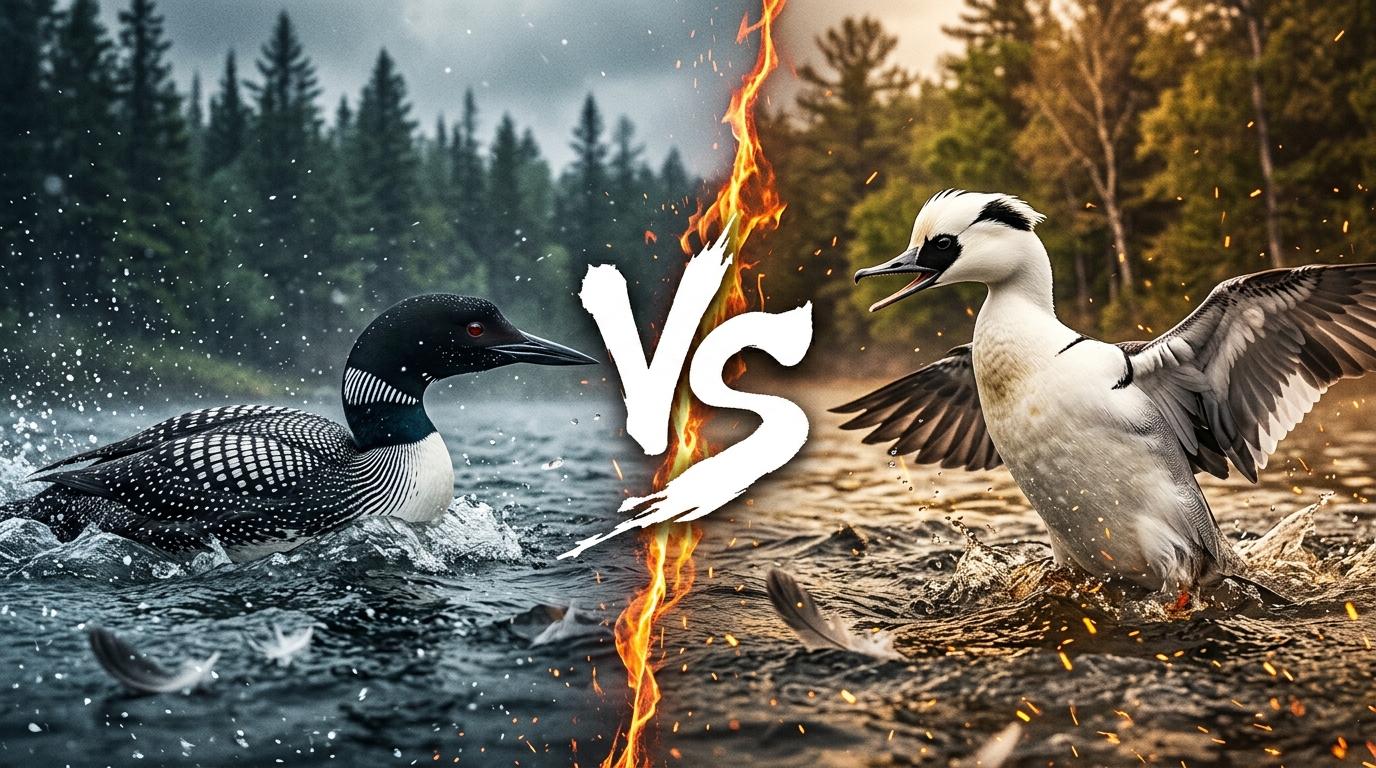
Common Loon vs Smew: Who Actually Wins?
Common Loon vs Smew compared on size, diving power, bill weaponry and agility. Find out which diving bird wins a confrontation and why the smaller smew still holds its own.
Common Loon vs Smew
Matchup winner
Common Loon
Quick verdict
Start with the direct answer, then use the structured comparison below to see what changes the outcome.
The Common Loon wins clearly. An adult loon weighs roughly 2.7 to 6 kg, which is about four to eight times the mass of a smew at around 0.5 to 0.9 kg. It also carries a dagger-like bill built for stabbing, and it belongs to one of the most territorially aggressive waterbird groups in North America. Loons routinely drive off ducks, geese and even other loons by charging and stabbing at them from underwater. The smew is a quick, agile little sawbill with serrated mandibles made for gripping slippery fish, not for fighting. It cannot absorb a loon's attack or answer it. The smew's best result in any realistic meeting is escape, because it is lighter, takes flight far more easily, and can slip into tight cover. That makes it hard to catch, but it never makes it the winner.
Read the full explanation
Common Loon wins: it is several times heavier and has a true stabbing bill.
Loons are notoriously territorial and attack intruders from below the water.
The smew's serrated bill grips fish; it is not a weapon against a bird this size.
The smew's real edge is evasion. It takes off fast and hides well, so it usually escapes rather than loses.
Reader vote
Who do you think wins?
Pick a side — no account needed. Results update live.
No votes yet — be the first to call it.
Editorial note
Why people disagree
Smews look sharp and fierce in photos, with their 'sawbill' reputation and bold black-and-white pattern, which makes them seem more combative than they are.
Body mass & frame
Among waterbirds, weight decides most shoving and pinning contests. The loon simply outclasses the smew.
Bill weaponry
The loon's bill is used aggressively in territorial disputes and can do real damage. The smew's bill is built for holding prey.
Underwater assault
Loons famously surface beneath intruders. That ambush tactic gives the smew almost no warning.
Read the full explanation +
Both are skilled divers, so people assume they are evenly matched underwater. Loons are bigger and dive deeper, and their dense bones and rear-set legs are built for underwater pursuit.
Their ranges barely overlap in the wild. The smew is Eurasian and the Common Loon is mainly North American, though loons do reach Iceland and Western Europe. With so few real-world encounters to point to, the debate stays theoretical.
Comparison FAQ
Short, direct answers to the next questions readers usually ask after the headline verdict.
Would a Common Loon beat a Smew in a fight?+
Yes. The loon is several times heavier, uses its dagger bill aggressively, and attacks from underwater. The smew would flee rather than fight.
Which bird is stronger, the loon or the smew?+
The Common Loon, by a wide margin. Its dense, heavy body and powerful leg-driven diving give it far more force than the small smew.
Is the smew still dangerous or hard to beat?+
It is hard to catch rather than dangerous. Its fast takeoff, agility in wooded waters and serrated bill make it a slippery opponent, and in cover it usually escapes untouched.
Do loons and smews ever meet in the wild?+
Rarely. Smews are Eurasian, and Common Loons are mostly North American, though loons breed in Iceland and winter along Western European coasts, so occasional overlap is possible.
Which bird dives better?+
The loon dives deeper and longer, reaching depths of over 60 m in some records. The smew is an agile but shallower diver.
Head-to-head species stats
These are the same core AnimalDex stat dimensions used on the dedicated animal pages, pulled side by side so the matchup is faster to scan.
Common Loon
Tier CSmew
Tier CTrait-by-trait comparison
Only the categories that matter to this matchup are included. The goal is not filler stats, but the real design differences that change the result.
2.7–6 kg, goose-sized torpedo
Body mass & frame
Common Loon
0.5–0.9 kg, compact duck
Body mass & frame
Common Loon
Long, dagger-straight stabbing bill
Bill weaponry
Common Loon
Short serrated fish-gripping bill
Bill weaponry
Common Loon
Deep diver; attacks rivals from below
Underwater assault
Common Loon
Agile shallow-to-mid diver
Underwater assault
Common Loon
Needs a long running takeoff
Takeoff & escape
Smew
Springs airborne quickly
Takeoff & escape
Smew
Powerful but broad-turning
Tight-water agility
Smew
Nimble in narrow, wooded waters
Tight-water agility
Smew
Fiercely defends breeding lakes
Aggression & territorial drive
Common Loon
Shy, wary, flees disturbance
Aggression & territorial drive
Common Loon
How the verdict forms
Verdict timeline
01 · Body mass & frame
Common Loon
02 · Bill weaponry
Common Loon
03 · Underwater assault
Common Loon
04 · Takeoff & escape
Smew
05 · Tight-water agility
Smew
06 · Aggression & territorial drive
Common Loon
Change the conditions
Scenario breakdown
This is where shallow battle content usually fails. Terrain, spacing, timing, and engagement style can change the answer.
Scenario lean
Common Loon
Verdict confidence
82%
Loon dominates open water.
Open water offers no cover, so the loon's size, diving range and underwater approach work fully in its favor. The smew's only option is to take flight, which ends the contest as a retreat.
AnimalDex field profiles
Explore these animals
Common Loon
Gavia immer
Clear northern lakes during breeding and coastal marine waters in winter.
Smew
Mergellus albellus
taiga lake, river, and winter coastal inlet
Systems Intelligence & Hidden Purpose
See the animals behind this comparison as engineered biological systems: what each one is built to do, where it gains leverage, and why the matchup changes by scenario.
Specialized Hardware
Spear-like bill, checkered black-and-white breeding plumage, and sits low in the water give the Common Loon a body plan tuned for its niche.
Systems Script
Common Loons operate in clear northern lakes during breeding and coastal marine waters in winter. Their design helps them match food access, shelter, and timing inside that environment.
Strategic Insight
Quiet environments reveal more when the system is built to slip below the surface.
Specialized Hardware
crisp black-and-white winter plumage, fine serrated fish-catching bill, and cold-water diving give the Smew a body plan tuned for its niche.
Systems Script
Smews operate through taiga lake, river, and winter coastal inlet. Their design links movement, feeding, shelter, and timing into one workable survival system.
Strategic Insight
Where water controls movement, position and timing often matter more than speed.
Final take
The Common Loon is the clear winner. Mass, a purpose-built stabbing bill, deep-diving ambush tactics and an aggressive territorial temperament all point the same way, and in open water or over a contested food source the smew has no real counter.
Read the full explanation
The smew is not helpless, though. It is a specialist in evasion: a quick takeoff, agility in tight spaces and wary habits keep it alive. Against a predator or rival it cannot outfight, its strategy is to never let the fight happen, and that is a legitimate survival approach even if it doesn't count as winning.
Collect both animals in AnimalDex
Track the species behind this matchup, compare their real traits, and build the rivalry into your AnimalDex collection.
Related comparisons
Continue with nearby matchups to compare more real-world animal traits without dropping into junky who-wins filler.

Horned Grebe vs Smew: Who Actually Wins?
The Smew wins this matchup. It is the heavier bird, roughly 500–900 g against the Horned Grebe's 300–570 g. It also carries the better weapon: a serrated, hook-tipped sawbill built to seize slippery fish. Male Smew contest space and mates on winter water, so the species is used to physical shoving. The Horned Grebe is no pushover. It is a superb underwater maneuverer with a sharp, dagger-like bill and lobed feet that give it fine control below the surface. But grebes mostly answer threats by diving and slipping away, not by holding ground. When the two meet face-to-face on the water, mass and a gripping bill usually decide it, and the Smew has both.
Read comparison
Discussion
What do you think?
Share your reasoning with other readers. Be civil and stick to the animals.
Sign in to join the discussion.
Sign inNo comments yet. Start the conversation.