

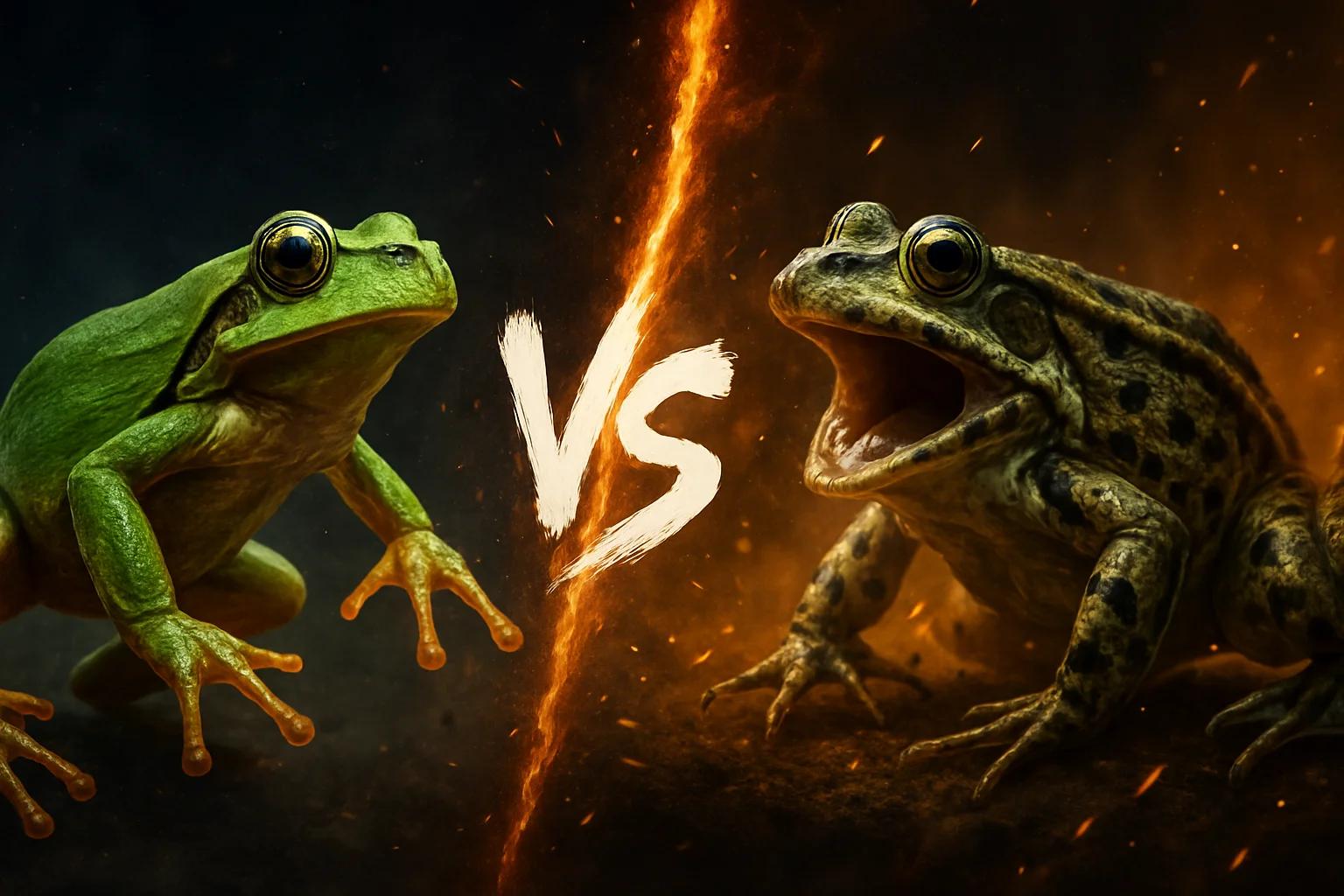
Common Tree Frog vs Marsh Frog: Who Actually Wins?
Common Tree Frog vs Marsh Frog: who would win? Compare size, gape, bite-and-gulp power, climbing escape and habitat edges. The Marsh Frog wins on mass and predatory reach.
Common Tree Frog vs Marsh Frog
Matchup winner
Marsh Frog
Quick verdict
Start with the direct answer, then use the structured comparison below to see what changes the outcome.
The Marsh Frog wins, and it is not close. Pelophylax ridibundus is Europe's largest native water frog. Big females reach about 15 cm and can weigh well over 100 g. The Common Tree Frog (Hyla arborea) is a 4–5 cm, single-digit-gram climber. That is roughly a 10–20x mass gap. Marsh Frogs are gape-limited opportunists that swallow insects, small fish, tadpoles and smaller frogs whole. A tree frog fits inside that prey window. Any contact on the water's edge, in open ground or around a shared pond ends with the tree frog being treated as food. The tree frog's real answer is not fighting. It escapes upward with adhesive toe pads into reeds and shrubs where the heavy, ground-and-water-bound Marsh Frog cannot follow. That makes the tree frog a survivor, never a winner.
Read the full explanation
Winner: Marsh Frog, by a huge size and gape advantage.
Marsh Frogs can and do eat smaller frogs. A Common Tree Frog is within swallowing range.
The tree frog's best move is vertical escape on sticky toe pads, not confrontation.
Up in the vegetation, the tree frog is effectively untouchable.
Reader vote
Who do you think wins?
Pick a side — no account needed. Results update live.
No votes yet — be the first to call it.
Editorial note
Why people disagree
Both are 'just frogs,' so people underestimate how big a mature Marsh Frog gets compared with a palm-sized tree frog.
Body mass & frame
Among frogs, mass sets who can swallow whom. The Marsh Frog sits in a completely different weight class.
Lunge-and-gulp reach
A frog's weapon is its mouth. Only one of these two can fit the other inside it.
Vertical escape
The tree frog's whole survival plan is leaving the plane where the Marsh Frog hunts.
Read the full explanation +
Tree frogs look agile and alert. Readers confuse escape skill with fighting ability.
Some imagine a stand-up brawl, but frog 'fights' are really lunge-and-swallow events where gape size decides everything.
Comparison FAQ
Short, direct answers to the next questions readers usually ask after the headline verdict.
Would a Common Tree Frog beat a Marsh Frog?+
No. The Marsh Frog is many times heavier and can swallow a tree frog whole. The tree frog's only good outcome is escaping into vegetation.
Which frog is stronger?+
The Marsh Frog, by far. It is Europe's largest native water frog, with powerful hind legs and a wide gape. The tree frog is a lightweight climber.
Do Marsh Frogs eat other frogs?+
Yes. Large Marsh Frogs are opportunistic predators that take smaller frogs, tadpoles, small fish and even small vertebrates when they can swallow them.
Why is the Common Tree Frog still hard to catch?+
Adhesive toe pads let it climb reeds and shrubs that a Marsh Frog cannot. Its green camouflage keeps it hidden. It also has mildly irritating skin secretions, so for a tree frog, escape is the winning strategy.
Where would a tree frog have the advantage?+
In dense reeds, shrubs or trees, where it can climb out of reach and stay concealed.
Head-to-head species stats
These are the same core AnimalDex stat dimensions used on the dedicated animal pages, pulled side by side so the matchup is faster to scan.
Common Tree Frog
Tier DMarsh Frog
Tier DTrait-by-trait comparison
Only the categories that matter to this matchup are included. The goal is not filler stats, but the real design differences that change the result.
4–5 cm, a few grams
Body mass & frame
Marsh Frog
Up to ~15 cm, 100+ g in large adults
Body mass & frame
Marsh Frog
Small mouth tuned for flies and spiders
Lunge-and-gulp reach
Marsh Frog
Wide gape, fast tongue-and-jaw lunge for large prey
Lunge-and-gulp reach
Marsh Frog
Adhesive toe pads, climbs reeds, shrubs and trees
Vertical escape
Common Tree Frog
Ground and water bound, poor climber
Vertical escape
Common Tree Frog
Enters water mainly to breed
Water-edge control
Marsh Frog
Highly aquatic, powerful swimmer and diver
Water-edge control
Marsh Frog
Quick, light hops onto perches
Burst leap
Marsh Frog
Powerful long leaps from muscular hind legs
Burst leap
Marsh Frog
Bright green, can shift tone, blends into leaves
Camouflage & stealth
Common Tree Frog
Mottled olive-brown, blends into mud and pond margins
Camouflage & stealth
Common Tree Frog
How the verdict forms
Verdict timeline
01 · Body mass & frame
Marsh Frog
02 · Lunge-and-gulp reach
Marsh Frog
03 · Vertical escape
Common Tree Frog
04 · Water-edge control
Marsh Frog
05 · Burst leap
Marsh Frog
06 · Camouflage & stealth
Common Tree Frog
Change the conditions
Scenario breakdown
This is where shallow battle content usually fails. Terrain, spacing, timing, and engagement style can change the answer.
Scenario lean
Marsh Frog
Verdict confidence
82%
Marsh Frog eats the tree frog.
At the water margin the Marsh Frog is in its element. It sits low and waits, then lunges at anything that moves and fits its gape. A tree frog crossing the shallows to breed is exactly the size of prey large water frogs take.
AnimalDex field profiles
Explore these animals
Common Tree Frog
Hyla arborea
pond edge, wet meadow, and shrubby wetland
Marsh Frog
Pelophylax ridibundus
marsh, pond, and slow river edge
Systems Intelligence & Hidden Purpose
See the animals behind this comparison as engineered biological systems: what each one is built to do, where it gains leverage, and why the matchup changes by scenario.
Specialized Hardware
adhesive toe pads, bright green skin, and reed-climbing night calling give the Common Tree Frog a body plan tuned for its niche.
Systems Script
Common Tree Frogs operate through pond edge, wet meadow, and shrubby wetland. Their design links movement, feeding, shelter, and timing into one workable survival system.
Strategic Insight
Where water controls movement, position and timing often matter more than speed.
Specialized Hardware
large green water-frog body, strong jumping hind legs, and loud reedside croaking give the Marsh Frog a body plan tuned for its niche.
Systems Script
Marsh Frogs operate through marsh, pond, and slow river edge. Their design links movement, feeding, shelter, and timing into one workable survival system.
Strategic Insight
Where water controls movement, position and timing often matter more than speed.
Final take
The Marsh Frog is the clear winner. In frog-on-frog encounters, the mouth is the weapon and gape size decides the outcome. A big Marsh Frog can swallow a Common Tree Frog. The reverse is impossible.
Read the full explanation
The Common Tree Frog's genius is avoidance. Sticky toe pads, green camouflage and a life spent above the waterline let it share wetlands with a predator many times its size. It survives encounters. It does not win them.
Collect both animals in AnimalDex
Track the species behind this matchup, compare their real traits, and build the rivalry into your AnimalDex collection.
Related comparisons
Continue with nearby matchups to compare more real-world animal traits without dropping into junky who-wins filler.
Alpine Newt vs Marsh Frog: Who Actually Wins?
The Marsh Frog wins this matchup clearly. Pelophylax ridibundus is Europe's largest native water frog. Big females can approach 15 cm and well over 100 g. It is a sit-and-lunge generalist predator with a wide gape, a fast sticky tongue and a documented habit of swallowing smaller amphibians whole. The Alpine Newt (Ichthyosaura alpestris) is roughly 8–12 cm from snout to tail tip, and much of that length is tail, so it carries a fraction of the frog's body mass. Its real defense is chemistry: skin secretions that make it unpleasant to eat, plus a bright orange belly that warns predators. That defense can make a frog spit a newt out or hesitate. It does nothing to stop the initial strike. In most realistic encounters the frog sets the terms.
Read comparison
Marsh Frog vs Smooth Newt: Who Actually Wins?
The Marsh Frog wins, and it is not especially close. As one of Europe's largest native frogs, Pelophylax ridibundus can reach about 15 cm and weigh several times more than a Smooth Newt, which usually measures 7–11 cm including its tail. That size gap matters most because of gape. A marsh frog is a sit-and-lunge predator with a wide mouth and a fast tongue-and-jaw strike, and it is documented eating small amphibians, including newts and tadpoles. The Smooth Newt has no bite worth fearing at this scale, and its main defenses are its slippery, mildly distasteful skin secretions, quick tail-driven swimming, and dense weed cover. Those tools can make a frog spit it out or lose track of it, but they cannot turn the newt into the aggressor. In any direct encounter, the frog controls the outcome, and the newt's realistic best result is escape.
Read comparison
Discussion
What do you think?
Share your reasoning with other readers. Be civil and stick to the animals.
Sign in to join the discussion.
Sign inNo comments yet. Start the conversation.