


Common Warthog vs Zorilla: Who Actually Wins?
Common warthog vs zorilla: a biology-first breakdown of size, tusks, chemical defense and behavior to answer who would win in a fight.
Common Warthog vs Zorilla
Matchup winner
Common Warthog
Quick verdict
Start with the direct answer, then use the structured comparison below to see what changes the outcome.
The common warthog wins, and it isn't close on physical terms. An adult warthog weighs roughly 50–100 kg and carries curved tusks, thick facial warts that shield its head, and a low, charging build. The zorilla, Africa's striped polecat, weighs well under 1.5 kg. The zorilla's real weapon is not its bite. It is one of the most potent anal-gland sprays of any African mammal, a foul, eye-stinging chemical deterrent backed by bold black-and-white warning stripes. That spray can make a warthog break off contact and abandon a burrow, but it cannot injure the bigger animal or overpower it. In any frame where 'winning' means physical control of space, the warthog's mass, tusks and confidence carry the day. The zorilla's best outcome is a stink-soaked stalemate, not a victory.
Read the full explanation
Warthog wins: roughly 50–100x the zorilla's body mass, plus tusks and armored facial warts.
The zorilla's spray is a deterrent, not a weapon that disables a pig-sized ungulate.
The zorilla's best result is making the warthog leave, which is survival rather than winning.
Warthogs routinely face lions and leopards. A polecat is not a serious threat.
Reader vote
Who do you think wins?
Pick a side — no account needed. Results update live.
No votes yet — be the first to call it.
Editorial note
Why people disagree
Skunk-style spray feels like an instant win button, but deterring an animal is not the same as beating it.
Body mass and frame
A gap this large means the zorilla cannot pin, wound or hold ground physically.
Close-range weaponry
Warthog tusks can open wounds on leopards. Zorilla teeth are built for insects and mice.
Chemical deterrence
This is the zorilla's whole strategy: make contact so unpleasant that attackers quit.
Read the full explanation +
Zorillas are famously fearless and will stand their ground, which people misread as fighting power.
Warthogs are herbivores and often flee predators, so some assume they lack fight. Cornered warthogs are genuinely dangerous.
Comparison FAQ
Short, direct answers to the next questions readers usually ask after the headline verdict.
Would a warthog beat a zorilla in a fight?+
Yes. The warthog's size, tusks and durability overwhelm the zorilla physically. The zorilla can only drive it off with spray.
Which is stronger, a warthog or a zorilla?+
The warthog, by an enormous margin. It is dozens of times heavier and can shove, dig and charge with real force.
Why is the zorilla still dangerous to a warthog?+
Its spray is among the most noxious of African mammals. It burns the eyes and lingers, so even big predators learn to avoid zorillas.
Is the zorilla a skunk?+
No. It is an African mustelid, a polecat, that converged on skunk-like warning stripes and chemical defense.
Do warthogs and zorillas actually meet?+
Their ranges overlap across African savannas. Both use burrows, so den encounters are the most realistic point of contact.
Head-to-head species stats
These are the same core AnimalDex stat dimensions used on the dedicated animal pages, pulled side by side so the matchup is faster to scan.
Common Warthog
Tier CZorilla
Tier CTrait-by-trait comparison
Only the categories that matter to this matchup are included. The goal is not filler stats, but the real design differences that change the result.
50–100 kg, stocky and barrel-chested
Body mass and frame
Common Warthog
0.6–1.4 kg, slender mustelid build
Body mass and frame
Common Warthog
Curved upper tusks and razor-edged lower tusks
Close-range weaponry
Common Warthog
Small sharp teeth and digging claws
Close-range weaponry
Common Warthog
None to speak of
Chemical deterrence
Zorilla
Powerful anal-gland spray with warning coloration
Chemical deterrence
Zorilla
Thick hide, protective facial warts
Close-range durability
Common Warthog
Fragile body that relies on not being bitten
Close-range durability
Common Warthog
Charges and sprints near 48 km/h
Explosive burst
Common Warthog
Quick, but short-legged
Explosive burst
Common Warthog
Tail-up alarm flight or a committed charge
Bluff and nerve
Zorilla
Bristles, raises its tail and stands firm
Bluff and nerve
Zorilla
How the verdict forms
Verdict timeline
01 · Body mass and frame
Common Warthog
02 · Close-range weaponry
Common Warthog
03 · Chemical deterrence
Zorilla
04 · Close-range durability
Common Warthog
05 · Explosive burst
Common Warthog
06 · Bluff and nerve
Zorilla
Change the conditions
Scenario breakdown
This is where shallow battle content usually fails. Terrain, spacing, timing, and engagement style can change the answer.
Scenario lean
Zorilla
Verdict confidence
82%
Zorilla can hold or clear a tight den with spray
Inside a confined aardvark hole, the zorilla's spray concentrates and the warthog's size becomes a liability. Warthogs often back into burrows, so a resident zorilla spraying the entrance can win the space through sheer chemical misery.
AnimalDex field profiles
Explore these animals
Common Warthog
Phacochoerus africanus
savannah, open scrub, and dry grassland
Zorilla
Ictonyx striatus
grassland, rocky scrub, and open savannah
Systems Intelligence & Hidden Purpose
See the animals behind this comparison as engineered biological systems: what each one is built to do, where it gains leverage, and why the matchup changes by scenario.
Specialized Hardware
upcurved facial tusks, kneeling grazing posture, and burrow-backward defense give the Common Warthog a body plan tuned for its niche.
Systems Script
Common Warthogs operate through savannah, open scrub, and dry grassland. Their design links movement, feeding, shelter, and timing into one workable survival system.
Strategic Insight
Harsh places reward efficiency, timing, and bodies that waste very little.
Specialized Hardware
bold black-and-white stripes, pungent defensive spray, and night-active rodent hunting give the Zorilla a body plan tuned for its niche.
Systems Script
Zorillas operate through grassland, rocky scrub, and open savannah. Their design links movement, feeding, shelter, and timing into one workable survival system.
Strategic Insight
Open landscapes reward early detection, clean movement, and fast decisions once the space opens up.
Final take
The common warthog is the clear winner. It is a tusked, armored ungulate built to survive confrontations with big cats, facing an animal that weighs less than a bag of sugar.
Read the full explanation
The zorilla deserves respect anyway. Its whole biology is a bet that no animal wants a face full of its spray, and that bet often pays off. Many encounters end with the larger animal retreating. In the narrow case of a tight burrow, the zorilla can genuinely win the space.
Judged as a fight, though, mass and weaponry beat deterrence. The zorilla survives encounters with warthogs. It does not defeat them.
Collect both animals in AnimalDex
Track the species behind this matchup, compare their real traits, and build the rivalry into your AnimalDex collection.
Related comparisons
Continue with nearby matchups to compare more real-world animal traits without dropping into junky who-wins filler.
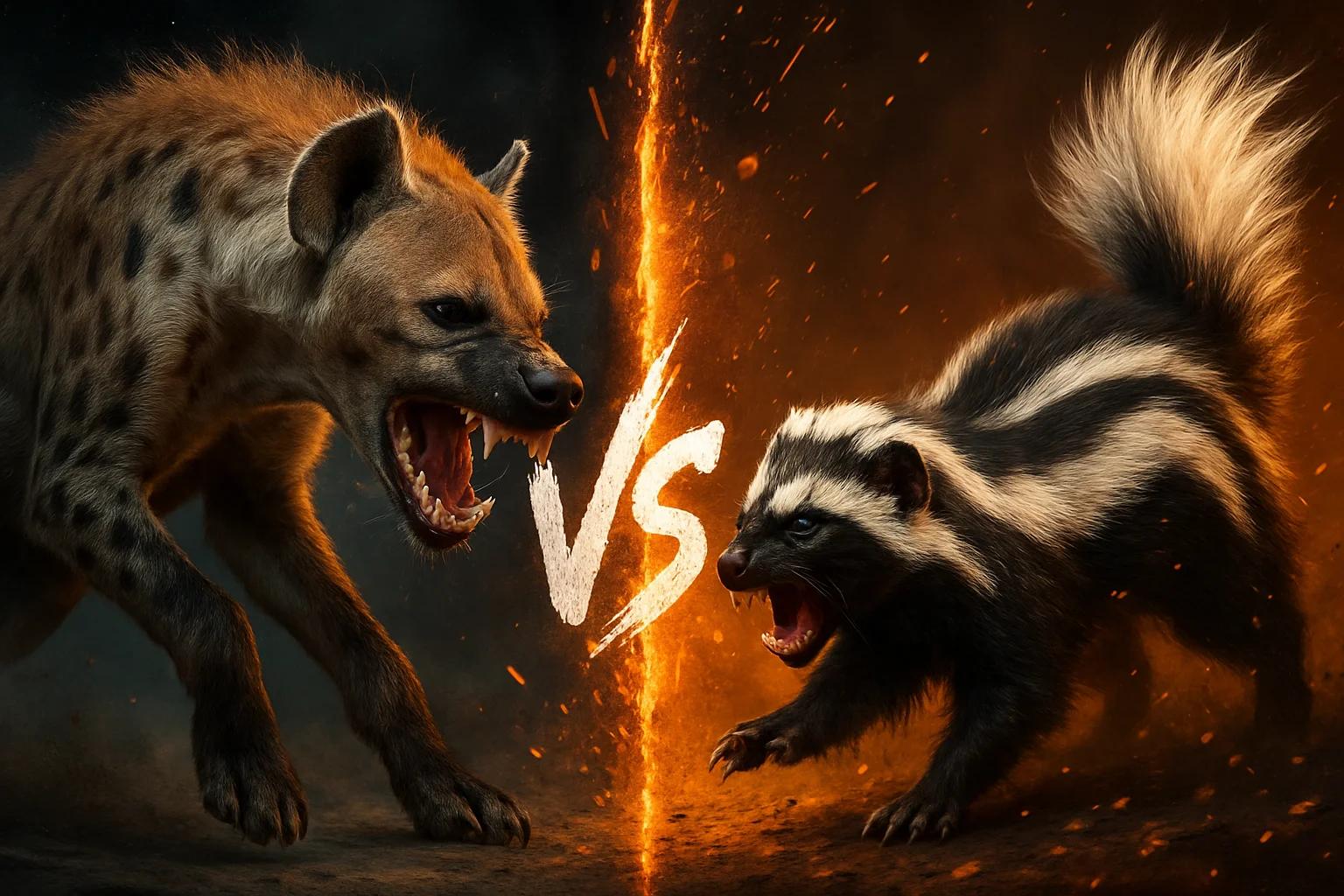
Spotted Hyena vs Zorilla: Who Actually Wins?
The spotted hyena wins decisively. At roughly 45–70 kg against a zorilla of about 0.6–1.4 kg, the hyena outweighs its opponent by around 50 to 1. It brings a bite built to crack giraffe bones, a thick neck and shoulders, and stamina tuned for long chases. The zorilla's real weapon is chemical. Its anal glands spray a sulfurous secretion that can blind, choke, and nauseate, and it backs that up with bold black-and-white warning stripes and a habit of playing dead. That defense makes many predators think twice, and a sprayed hyena may break off, rub its face in the dirt, and lose its appetite. But a determined adult hyena only needs one committed bite to end the encounter, and its tolerance for foul-smelling carrion is unusually high. The zorilla can make the win miserable and occasionally avoid being eaten. It cannot physically beat the hyena.
Read comparison
Discussion
What do you think?
Share your reasoning with other readers. Be civil and stick to the animals.
Sign in to join the discussion.
Sign inNo comments yet. Start the conversation.