

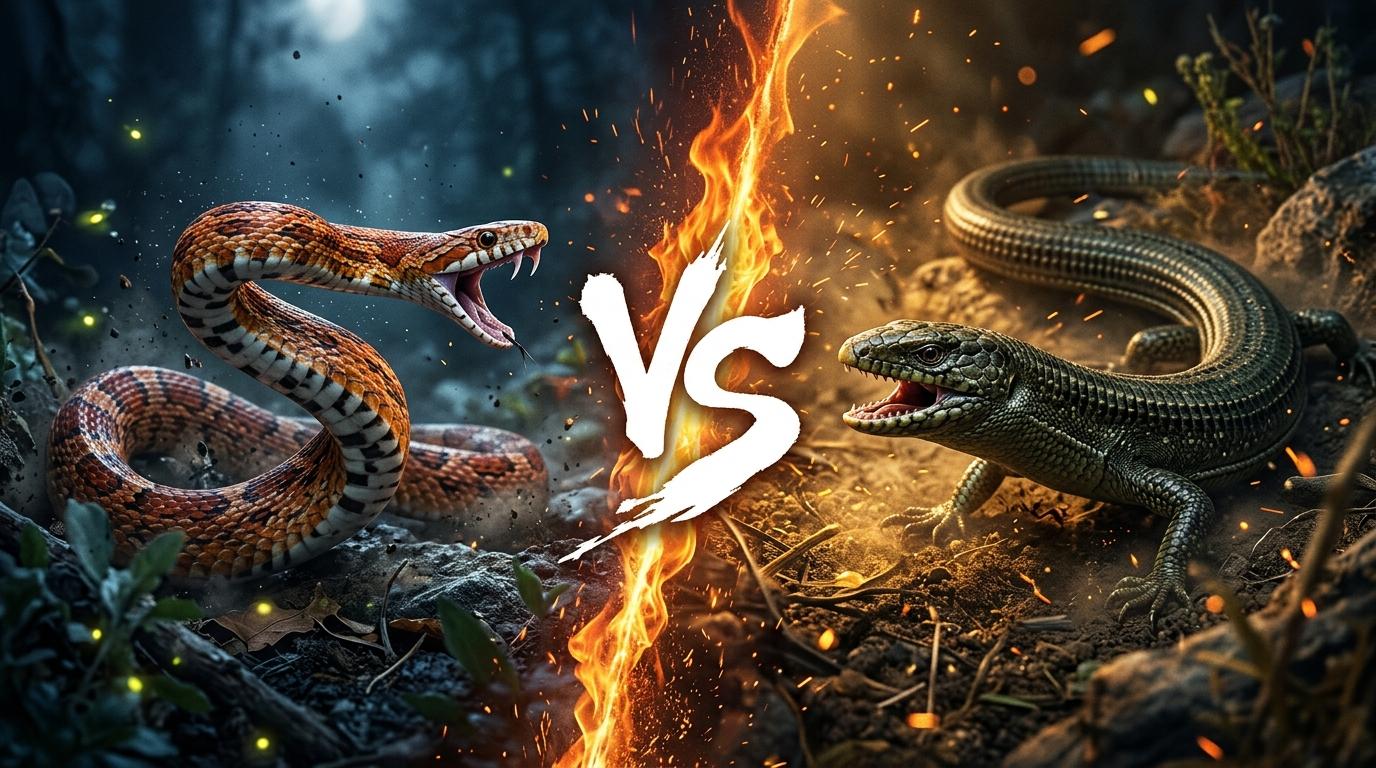
Corn Snake vs Eastern Glass Lizard: Who Actually Wins?
Corn snake vs eastern glass lizard: a biology-first look at constriction, armored scales, tail autotomy, and which legless-looking reptile wins a real confrontation.
Corn Snake vs Eastern Glass Lizard
Matchup winner
Corn Snake
Quick verdict
Start with the direct answer, then use the structured comparison below to see what changes the outcome.
The corn snake wins this matchup. Both animals look like snakes, but only one is built to subdue other vertebrates. Pantherophis guttatus is a dedicated constrictor. It strikes, anchors with backward-curving teeth, and throws coils that steadily shut down circulation, and lizards are already part of its natural diet. The eastern glass lizard has a longer total length, but roughly two-thirds of that is a breakaway tail. Its body is stiffened by bony osteoderms, and its toolkit is built for eating insects, snails, spiders, and the occasional small vertebrate, plus a dramatic escape trick. That armor makes constriction slower and its bite can sting, but the lizard has no way to control a snake of similar mass. The likely outcome is that the snake wins the grapple, or the lizard leaves part of itself behind and survives by fleeing rather than by winning.
Read the full explanation
Corn snake wins. Constriction is a true subduing weapon, and the glass lizard has no equivalent.
The glass lizard's measured length is misleading because most of it is detachable tail, so its head-and-body mass is modest.
Osteoderm armor and a firm bite make the lizard a tougher meal than a mouse.
The lizard's best result is escape through tail autotomy, not victory.
Reader vote
Who do you think wins?
Pick a side — no account needed. Results update live.
No votes yet — be the first to call it.
Editorial note
Why people disagree
People see 'glass snake' and assume two snakes are fighting. The lizard has eyelids, ear openings, and a lizard's jaw, and it fights like one.
Subduing weapon
Constriction can end a fight. A shaking bite can only discourage the attacker.
Effective fighting mass
Usable mass decides grapples, and the lizard's length is mostly tail it can lose.
Close-range durability
Bony plates resist coils and teeth, which buys the lizard time.
Read the full explanation +
Total length makes the glass lizard look bigger, but its compact, armored trunk is the part that actually matters in a grapple.
Some count a tail-drop escape as a win. Escaping is survival, and it is not the same as defeating the snake.
Comparison FAQ
Short, direct answers to the next questions readers usually ask after the headline verdict.
Would a corn snake beat an eastern glass lizard?+
Usually yes. A comparably sized corn snake can strike, coil, and subdue the lizard, and wild corn snakes do eat lizards.
Which is stronger, the corn snake or the glass lizard?+
The corn snake is functionally stronger in a fight because its muscle runs its whole length and powers constriction. The glass lizard is stiffer and armored but cannot exert comparable controlling force.
Why is the eastern glass lizard still dangerous to a corn snake?+
Its firm, clamping bite can wound the snake, and its osteoderm armor makes constriction slow. Its shattering tail can also leave a predator with nothing but a decoy.
Is the eastern glass lizard a snake?+
No. It is a legless lizard with movable eyelids, external ear openings, and a rigid body, which makes it very different from a snake in both anatomy and fighting style.
Is either animal dangerous to humans?+
No. Neither is venomous. Either may bite in defense, and the glass lizard may drop its tail when handled.
Head-to-head species stats
These are the same core AnimalDex stat dimensions used on the dedicated animal pages, pulled side by side so the matchup is faster to scan.
Corn Snake
Tier CEastern Glass Lizard
Tier CTrait-by-trait comparison
Only the categories that matter to this matchup are included. The goal is not filler stats, but the real design differences that change the result.
Full-body constriction
Subduing weapon
Corn Snake
Grab-and-shake bite
Subduing weapon
Corn Snake
Muscle along the whole length
Effective fighting mass
Corn Snake
Short trunk, long fragile tail
Effective fighting mass
Corn Snake
Flexible scales, no armor
Close-range durability
Eastern Glass Lizard
Osteoderm-reinforced body
Close-range durability
Eastern Glass Lizard
Speed and climbing
Escape insurance
Eastern Glass Lizard
Shattering tail autotomy
Escape insurance
Eastern Glass Lizard
Nocturnal, cover-savvy striker
Ambush control
Corn Snake
Grassland forager
Ambush control
Corn Snake
Quick, but prefers cover
Open-ground mobility
Eastern Glass Lizard
Fast, wriggling sprints
Open-ground mobility
Eastern Glass Lizard
How the verdict forms
Verdict timeline
01 · Subduing weapon
Corn Snake
02 · Effective fighting mass
Corn Snake
03 · Close-range durability
Eastern Glass Lizard
04 · Escape insurance
Eastern Glass Lizard
05 · Ambush control
Corn Snake
06 · Open-ground mobility
Eastern Glass Lizard
Change the conditions
Scenario breakdown
This is where shallow battle content usually fails. Terrain, spacing, timing, and engagement style can change the answer.
Scenario lean
Corn Snake
Verdict confidence
82%
The snake strikes first and coils.
In leaf litter or under debris, the corn snake's ambush instincts let it land a strike and wrap the lizard's trunk. The osteoderms slow the squeeze, but the lizard has no leverage to pry coils off. Tail-drop does not help when the snake already has the front half.
AnimalDex field profiles
Explore these animals
Corn Snake
Pantherophis guttatus
woodland edge, farmland, grassland, and rocky scrub
Eastern Glass Lizard
Ophisaurus ventralis
sandhill, grassland, and pine scrub
Systems Intelligence & Hidden Purpose
See the animals behind this comparison as engineered biological systems: what each one is built to do, where it gains leverage, and why the matchup changes by scenario.
Specialized Hardware
orange-and-red blotched pattern, slender climbing-and-crawling body, and rodent-hunting agility give the Corn Snake a body plan tuned for its niche.
Systems Script
Corn Snakes operate through woodland edge, farmland, grassland, and rocky scrub Their design links movement, shelter, and feeding into one workable survival system.
Strategic Insight
Adaptability scales when the body can fit many pathways.
Specialized Hardware
legless lizard body, movable eyelids, and brittle autotomizing tail give the Eastern Glass Lizard a body plan tuned for its niche.
Systems Script
Eastern Glass Lizards operate through sandhill, grassland, and pine scrub. Their design links movement, feeding, shelter, and timing into one workable survival system.
Strategic Insight
Open landscapes reward early detection, clean movement, and fast decisions once the space opens up.
Final take
The corn snake is the overall winner because its core skill, restraining and subduing vertebrate prey, is exactly what this confrontation requires. The eastern glass lizard is a superb survivor, but its adaptations are built around getting away.
Read the full explanation
That difference explains the result. The lizard wins when it can flee, and the snake wins whenever the encounter becomes a real struggle at close range.
Collect both animals in AnimalDex
Track the species behind this matchup, compare their real traits, and build the rivalry into your AnimalDex collection.
Related comparisons
Continue with nearby matchups to compare more real-world animal traits without dropping into junky who-wins filler.

Corn Snake vs Gila Monster: Who Actually Wins?
The Gila monster wins this matchup clearly. A corn snake is a fast, agile, nonvenomous constrictor built to squeeze warm-blooded rodents and birds, and its main weapon struggles against a stocky, low-slung lizard covered in bony osteoderms and carrying a crushing, venom-laced bite. The Gila monster does not need speed. It needs one solid grip, and once its jaws lock and it begins chewing, venom flows from glands in the lower jaw into the wound. A corn snake can rarely coil tightly enough around that thick, short body to cause the circulatory collapse constriction depends on. The snake's real edge is escape, not victory: it is faster, climbs well, and can disengage before contact. In a committed close-range encounter, armor, grip and venom beat coils and agility.
Read comparison
Corn Snake vs Eastern Indigo Snake: Who Actually Wins?
The Eastern Indigo Snake wins, and it isn't especially close. North America's longest native snake regularly tops 2 m and can exceed 2.5 m, against a corn snake's typical 1.0–1.5 m. More important than size, the indigo is an ophiophage: snakes are a normal part of its diet, including venomous rattlesnakes. Its method doesn't depend on constriction. It grips with its jaws, pins the prey with its heavy body, and overpowers it. The corn snake is a skilled constrictor of rodents and birds, but it has no defensive answer to a larger, faster-acting predator that treats it as food. Corn snakes escape through climbing, camouflage, and burrow use, and those are the corn snake's only real routes to survival.
Read comparison
Discussion
What do you think?
Share your reasoning with other readers. Be civil and stick to the animals.
Sign in to join the discussion.
Sign inNo comments yet. Start the conversation.