

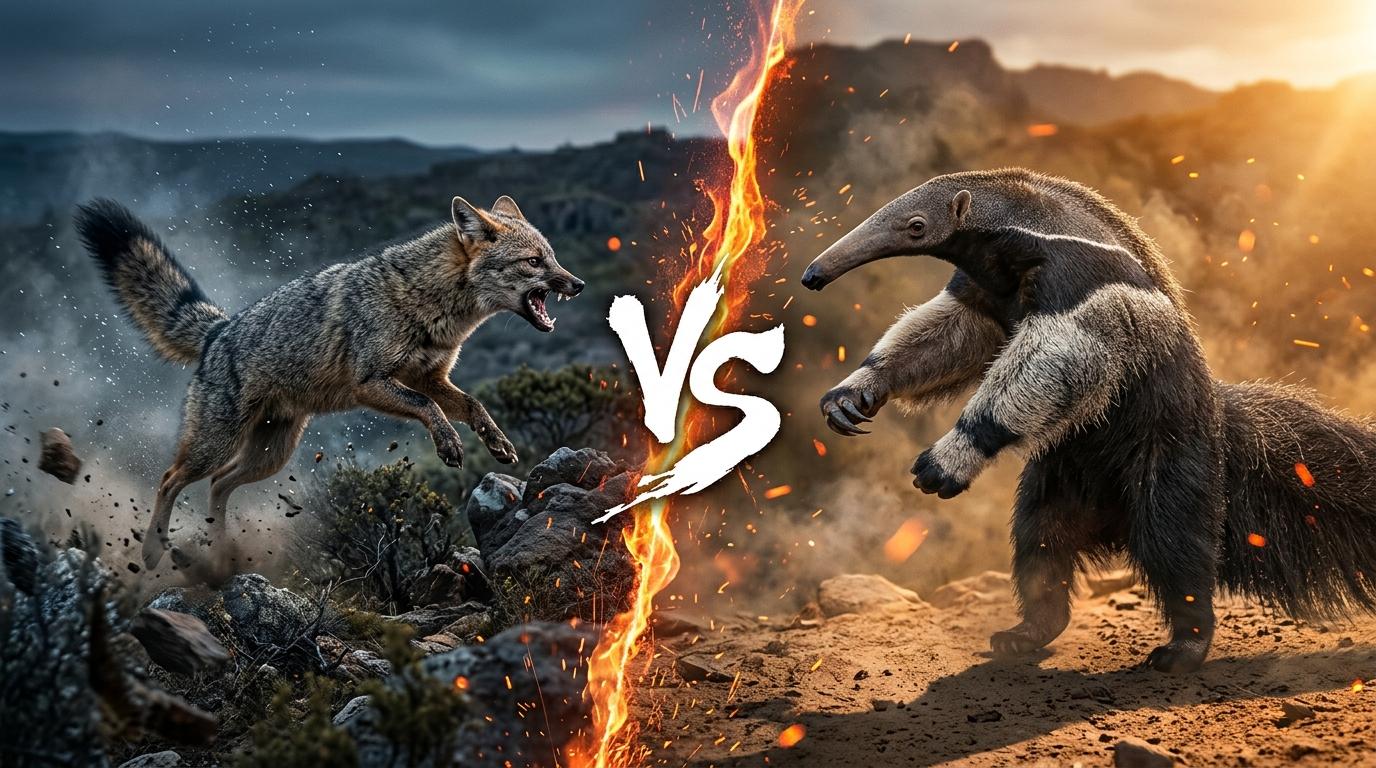
Crab-eating Fox vs Giant Anteater: Who Actually Wins?
Crab-eating fox vs giant anteater: a biology-first breakdown of size, claws, speed and defense to settle who would win in a fight.
Crab-eating Fox vs Giant Anteater
Matchup winner
Giant Anteater
Quick verdict
Start with the direct answer, then use the structured comparison below to see what changes the outcome.
The giant anteater wins, and it isn't especially close. A crab-eating fox weighs roughly 5–8 kg. A giant anteater runs about 25–40 kg and carries forelimb claws up to 10 cm long, built to rip open termite mounds as hard as sun-baked clay. The anteater has no teeth, but it doesn't need them. When threatened, it rears onto its hind legs, braces on its tail, and swipes or hugs with those claws. The same defense has killed dogs, wounded jaguars and injured people. The fox's real assets are agility, quick reflexes and smart opportunism. Those help it avoid danger, not win against a heavily armed animal five times its mass. In nearly every realistic encounter the fox either retreats or loses.
Read the full explanation
Giant anteater wins: about 5x heavier with claws that tear open termite mounds.
The fox is faster and nimbler, but its bite can't get past thick, coarse fur at a safe angle.
The anteater's tail-braced standing defense punishes any close approach.
The fox's best outcome is simply leaving, which it usually does.
Reader vote
Who do you think wins?
Pick a side — no account needed. Results update live.
No votes yet — be the first to call it.
Editorial note
Why people disagree
Toothless and slow-looking: people assume the anteater is harmless and underestimate its claws.
Mass advantage
A fivefold weight gap means the fox can't pin, drag or wear down its opponent.
Weapon hardware
The anteater's claws can slash deep wounds. The fox's bite is made for small prey and fruit.
Footwork and agility
Agility lets the fox dodge and disengage, which protects it but doesn't defeat the anteater.
Read the full explanation +
Canid bias: foxes read as predators, but the crab-eating fox is an omnivorous generalist, not a large-prey hunter.
Speed vs armament: some argue agility lets the fox harass indefinitely, ignoring that harassment isn't a kill path.
Comparison FAQ
Short, direct answers to the next questions readers usually ask after the headline verdict.
Would a crab-eating fox beat a giant anteater?+
No. The giant anteater is about five times heavier and armed with long claws. A fox has no realistic way to overpower it.
Which is stronger, a crab-eating fox or a giant anteater?+
The giant anteater, by a wide margin. Its forelimbs are built to tear through hard termite mounds, which gives it far more raw strength than a small fox.
Can a giant anteater kill a predator?+
Yes. There are documented cases of anteaters fatally wounding dogs and injuring jaguars and pumas with their claws when cornered.
Why is the crab-eating fox still dangerous even though it loses?+
Its agility, quick bites and smart opportunism make it effective against small prey, and it can deliver painful bites if cornered. It simply lacks the size to threaten an anteater.
Would they actually fight in the wild?+
Rarely. They share South American habitats but compete little. The fox almost always avoids a large, armed anteater.
Head-to-head species stats
These are the same core AnimalDex stat dimensions used on the dedicated animal pages, pulled side by side so the matchup is faster to scan.
Crab-eating Fox
Tier CGiant Anteater
Tier BTrait-by-trait comparison
Only the categories that matter to this matchup are included. The goal is not filler stats, but the real design differences that change the result.
~5–8 kg, slender build
Mass advantage
Giant Anteater
~25–40 kg, long heavy body
Mass advantage
Giant Anteater
Small canid bite
Weapon hardware
Giant Anteater
Up to 10 cm digging claws
Weapon hardware
Giant Anteater
Quick, light, darting
Footwork and agility
Crab-eating Fox
Lumbering gait, decent bursts
Footwork and agility
Crab-eating Fox
Thin coat, little protection
Close-range durability
Giant Anteater
Coarse, thick hair and rearing tail-braced stance
Close-range durability
Giant Anteater
Adaptable, opportunistic forager
Situational smarts
Crab-eating Fox
Specialized, routine-driven
Situational smarts
Crab-eating Fox
Low; often yields to larger animals
Threat deterrence
Giant Anteater
High; even big cats approach warily
Threat deterrence
Giant Anteater
How the verdict forms
Verdict timeline
01 · Mass advantage
Giant Anteater
02 · Weapon hardware
Giant Anteater
03 · Footwork and agility
Crab-eating Fox
04 · Close-range durability
Giant Anteater
05 · Situational smarts
Crab-eating Fox
06 · Threat deterrence
Giant Anteater
Change the conditions
Scenario breakdown
This is where shallow battle content usually fails. Terrain, spacing, timing, and engagement style can change the answer.
Scenario lean
Giant Anteater
Verdict confidence
82%
Anteater holds ground; the fox gains nothing.
Dense brush limits the fox's room to circle. Up close, the anteater rears and strikes downward, and its reach covers the short distances that cover creates. Cover helps the fox hide, not attack.
AnimalDex field profiles
Explore these animals
Crab-eating Fox
Cerdocyon thous
savannah, marsh edge, and seasonally flooded grassland
Giant Anteater
Myrmecophaga tridactyla
Grassland, savannah, wetland edge, and open woodland with insect colony access.
Systems Intelligence & Hidden Purpose
See the animals behind this comparison as engineered biological systems: what each one is built to do, where it gains leverage, and why the matchup changes by scenario.
Specialized Hardware
gray-and-russet fox body, wetland-edge scavenging, and night-active open-country movement give the Crab-eating Fox a body plan tuned for its niche.
Systems Script
Crab-eating Foxs operate through savannah, marsh edge, and seasonally flooded grassland. Their design links movement, feeding, shelter, and timing into one workable survival system.
Strategic Insight
Where water controls movement, position and timing often matter more than speed.
Specialized Hardware
Very long narrow snout, huge bushy tail, and strong curved foreclaws give the Giant Anteater a body plan tuned for its niche.
Systems Script
Giant Anteaters operate in grassland, savannah, wetland edge, and open woodland with insect colony access. Their design helps them match food access, shelter, and timing inside that environment.
Strategic Insight
A narrow toolset is powerful when it is built for exactly the right job.
Final take
The giant anteater is the clear winner. It turns ant-mound engineering into self-defense: massive claws, heavy mass, and a rearing stance that makes any attacker pay at close range.
Read the full explanation
The crab-eating fox is a superb generalist, and its intelligence shows in how rarely it would take this fight. Its winning move is to leave. In a forced confrontation, size and weaponry decide it, and both favor the anteater.
Collect both animals in AnimalDex
Track the species behind this matchup, compare their real traits, and build the rivalry into your AnimalDex collection.
Discussion
What do you think?
Share your reasoning with other readers. Be civil and stick to the animals.
Sign in to join the discussion.
Sign inNo comments yet. Start the conversation.